Trade agreements often look deceptively simple on paper. A tariff goes from 5% to zero, a market opens, and the expectation is that exports will follow. The real story is usually somewhere in between.
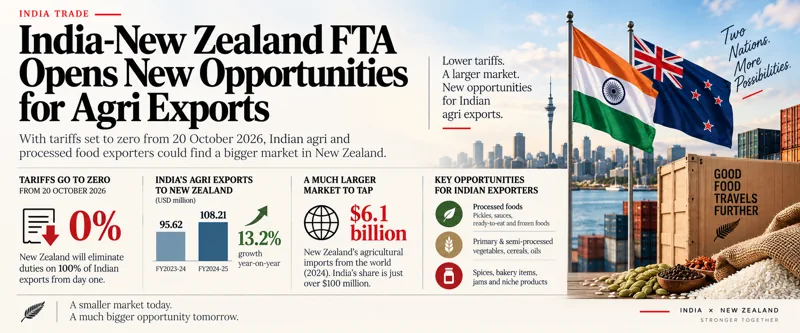
For Indian agriculture, the India-New Zealand Free Trade Agreement , which will enter into force on 20 October 2026 , could create a particularly interesting opening. New Zealand will eliminate duties on 100% of Indian exports from day one, and agriculture is among the sectors that will gain from the agreement. Nearly one-third of India's agricultural exports to New Zealand currently face tariffs of up to 5%, according to the Ministry of Commerce. Those duties will disappear once the agreement takes effect.
That may not sound dramatic when compared with FTAs where tariffs of 20% or 30% are being removed. But India is entering a market where its agricultural presence is still relatively small. India's agricultural exports to New Zealand increased from $95.62 million in FY2023-24 to $108.21 million in FY2024-25 , while New Zealand imports roughly $6.1 billion of agricultural products from the world.
There is a sizable gap between those two numbers, and that is exactly where the opportunity becomes more interesting. India is entering a market that already imports billions of dollars of agricultural products every year, while India's own agricultural exports to New Zealand are still measured in just over $100 million. The question is therefore less about whether a market exists and more about how much of that existing demand Indian exporters can realistically capture.
The FTA changes the price equation for Indian exporters
The most immediate benefit is fairly straightforward. Until now, some Indian agricultural products entering New Zealand faced tariffs of up to 5%. From October 20, those duties will be eliminated under the FTA.
For an exporter working with tight margins, that difference can matter. A 5% tariff is not necessarily enough to prevent a product from entering a market, but it does affect the landed cost, particularly when an Indian supplier is competing against exporters from countries that already have preferential trade arrangements with New Zealand.
New Zealand's agricultural import market is heavily supplied by countries such as Australia, the European Union, the United States, China and other established trading partners. APEDA's market research shows that Australia alone accounted for 44% of New Zealand's consumer-oriented agricultural imports in 2024, followed by the EU at 26% and the US at 16% in 2024.
India is therefore entering a market where competition is already well established. The difference now is that Indian exporters will no longer carry the same tariff disadvantage on the covered agricultural products, giving them a more level starting point.

The opportunity is bigger because India's current share is small
This is perhaps the most important number in the entire agreement. India exported $108.21 million of agricultural products to New Zealand in FY2024-25 , while New Zealand imported approximately $6.1 billion of agricultural products from the world.
India's existing business with New Zealand is therefore not insignificant, but it is nowhere near the scale of the market itself. That leaves considerable room for products that have not traditionally had a strong presence there.
The Ministry of Commerce specifically identifies opportunities across primary and semi-processed vegetables, cereals, processed foods, oils and niche agricultural products. The agreement also improves the competitive position of Indian food products such as pickles, preserved vegetables, frozen foods, jams, sauces, ready-to-eat products, biscuits, bakery items, cereal snacks, spices, juices and coffee extracts.
For Indian exporters, this is an important distinction. The FTA is not simply about sending more of the commodities India already exports. It gives manufacturers and processors a chance to test a market with products that can carry more value.
Processed food may be one of the quiet winners
There is a natural tendency to think about agricultural FTAs in terms of rice, pulses, spices or fresh produce. But processed food could become one of the more interesting beneficiaries of the India-New Zealand agreement.
A shipment of dried spices is one business. A packaged spice blend is another. A container of vegetables is one thing; frozen or preserved vegetables are another. A food manufacturer exporting sauces, pickles, bakery products or ready-to-eat meals is participating in a considerably broader value chain.
The FTA specifically identifies processed foods as an opportunity, with products such as pickles, preserved vegetables, frozen foods, jams, sauces and ready-to-eat items moving from tariffs of up to 5% to zero under the relevant tariff lines.
That is important for India because the country is increasingly trying to move from exporting agricultural raw materials towards exporting more processed food. New Zealand gives Indian companies another market in which to make that transition.
Spices and cereals have a natural opening
India already has a strong global reputation in spices, and the FTA gives products such as chilli, cumin, turmeric, pepper and spice mixes improved access to New Zealand. Cereal-based products, including flour, starch products, biscuits and cereal snacks, are also among the categories identified by the government.
These are not entirely new products for Indian exporters, and that is precisely why they are interesting. A company already producing spices, cereal products or processed foods for the Middle East, Europe or Southeast Asia may already have much of the production and compliance infrastructure required for another export market.
The FTA changes the commercial calculation. The question becomes whether the product can be positioned correctly, whether the exporter can meet New Zealand's regulatory requirements and whether the landed price now works well enough to compete.
Organic food adds another layer to the opportunity
There is also a smaller but interesting opportunity in organic food. India exported 2,401.53 tonnes of organic products worth $3.18 million to New Zealand in FY2024-25 , according to APEDA's NPOP data. That is still a modest trade flow.
But it is worth looking at in the context of India's overall organic sector. India exported 368,155 tonnes of organic products worth $665.97 million in 2024-25 , with cereals and millets, processed food, oilseeds, spices, tea, coffee and other categories forming part of the export basket.
The FTA's cooperation on organic standards and agriculture could make this segment easier to develop over time. More importantly, organic products fit naturally into the broader value-added food opportunity. Indian exporters are not limited to selling a commodity; they can sell a certified product with a defined production system, packaging and consumer proposition.
That is a different conversation from simply competing on price.

The agreement also protects India's sensitive agricultural interests
The opening is significant, but it is not unrestricted. India has kept several sensitive agricultural sectors outside tariff concessions, including dairy, most animal meat, key agricultural commodities, sugar and edible oils.
For products such as apples, kiwifruit and Manuka honey, the agreement provides calibrated access through mechanisms including tariff-rate quotas, minimum import price provisions and seasonal import windows.
This matters because an FTA does not have to mean that every agricultural product is suddenly exposed to a competition that is completely unrestricted. The agreement attempts to open export opportunities for Indian businesses while retaining safeguards around areas that India considers sensitive.
At the same time, the two countries are establishing an Agriculture Productivity Partnership , with cooperation proposed around kiwifruit, apples and honey, including orchard management, post-harvest practices, supply chains, food safety and sustainable beekeeping.
So there is a second layer to the agricultural relationship. It is not only about tariffs; it is also about productivity and technology.
The bigger opportunity may be building a New Zealand market from scratch
This is where the FTA becomes more interesting from an exporter's perspective.
New Zealand is not a huge consumer market by population, so an Indian exporter looking only at population size might overlook it. But that would miss the point. New Zealand is a high-income market with an established food-import sector, sophisticated retail channels and strong connections with the wider Pacific and Asia-Pacific trading system.
The opportunity for India is not necessarily to dominate the market. It is to increase its presence in categories where Indian products already have a reason to compete.
Spices, processed foods, cereal products, pickles, frozen foods, beverages, coffee and organic products all offer potential entry points, particularly where Indian suppliers can combine competitive pricing with processing capability and product differentiation.
The tariff reduction simply makes that proposition easier to test.
An FTA cannot create exports by itself
There is an important reality that exporters should keep in mind. Zero duty does not automatically create demand.
A New Zealand importer will still look at quality, consistency, food safety, packaging, certification, shelf life, freight costs and the reliability of the supplier. New Zealand also has strict biosecurity requirements for plant and animal products, and its food import regulations can be detailed and frequently updated.
So the tariff advantage is an opening, not a guarantee. Indian exporters that benefit most will likely be those that use the lower landed cost alongside the things buyers actually care about: consistent specifications, dependable shipments, compliant packaging and the ability to supply repeatedly.
That is particularly important for processed food. Getting a product onto a shelf once is one achievement; getting the importer to reorder it is the real test.
The FTA arrives at an interesting point in India's agricultural export story
India's agricultural exports were worth $51.91 billion in 2024-25 , according to APEDA. The country already exports agricultural, horticultural and processed food products across a wide range of international markets.
The New Zealand agreement therefore does not create India's agricultural export capability. It gives that capability another market to work with.
And because India's existing agricultural exports to New Zealand are only around $108 million, there is a relatively small base from which to build. The opportunity is particularly interesting for exporters that have traditionally concentrated on larger markets. New Zealand may not replace the Gulf, Europe or North America in terms of absolute volume, but it can become another reliable destination in a diversified export portfolio.
That diversification has value in itself. A business that depends too heavily on one market is exposed whenever regulations, freight costs, currency movements or demand conditions change. A wider export map gives manufacturers more options.
October 20 is the starting point, not the finish line
The India-New Zealand FTA will formally enter into force on 20 October 2026, following the completion of domestic processes in both countries. The agreement was signed in April, and New Zealand's Parliament passed the implementing legislation on September 16.
The agreement also goes well beyond agriculture. New Zealand has committed to facilitating $20 billion of investment into India , while the pact provides Indian businesses access across 118 services sectors and includes mobility provisions for skilled professionals and students. The two countries have also set an ambition to double bilateral trade in goods and services to NZ$7 billion by 2030.
Agriculture is only one part of that larger relationship, but it is a part with considerable room to grow.
For Indian exporters, the most important change on October 20 will be simple: some products that previously carried a tariff will enter New Zealand at zero duty. What happens after that will depend on the exporters.
If Indian companies use the tariff advantage to offer competitive prices, build distributor relationships, meet New Zealand's demanding food standards and establish products beyond the traditional commodity basket, the agreement could gradually turn a relatively small trade flow into something much more substantial.
The opportunity is already visible in the numbers. New Zealand imports around $6.1 billion of agricultural products from the world. India currently supplies only about $108 million. The FTA does not guarantee that India will capture the difference — but it gives Indian exporters a considerably better commercial runway from which to try.




.webp "The Government Plans to Bring in a New Agriculture Export Policy")