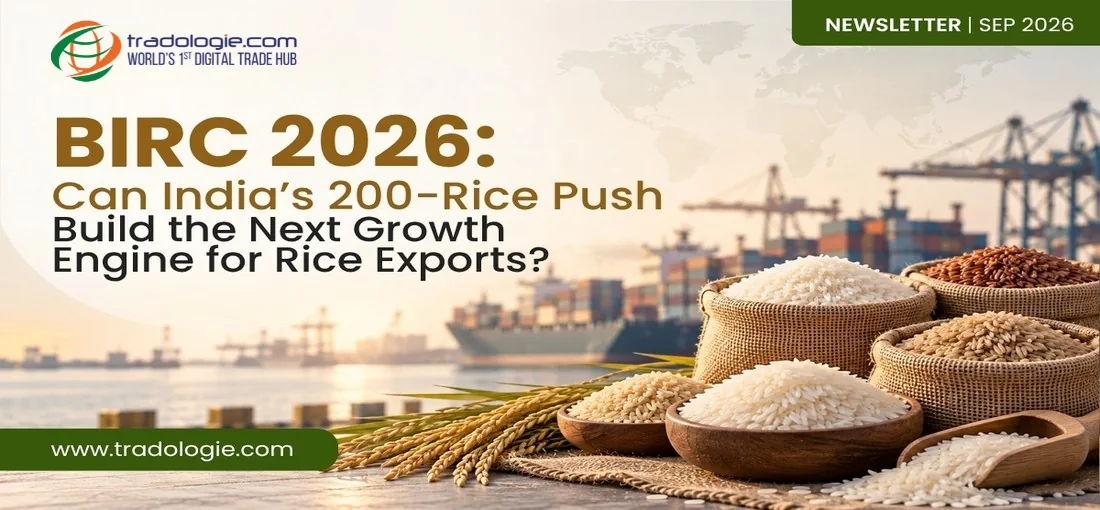
India's rice export industry is about to put something unusual on display: not another large shipment, not another production figure, but the sheer breadth of rice that India can sell.
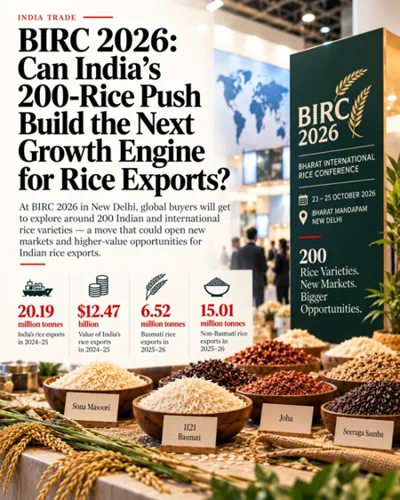
At the Bharat International Rice Conference (BIRC) 2026 in New Delhi, the Indian Rice Exporters' Federation plans to unveil a Global Rice Archive featuring around 200 commercially relevant Indian and international rice varieties. The conference is scheduled for October 23-25 at Bharat Mandapam, with buyers able to examine varieties by grain appearance, characteristics, processing format and origin before moving into direct business discussions with exporters and producers.
It is an interesting move because India's rice industry does not have a volume problem.
It has a value-discovery problem.
India exported 20.19 million tonnes of rice worth $12.47 billion in 2024-25 and has remained the world's largest rice exporter since 2012, accounting for roughly 30-35% of global rice exports in recent years. The next leg of growth, therefore, may not come simply from putting more tonnes onto ships. It could come from getting international bulk rise buyers to recognise that Indian rice is a much broader proposition than the familiar Basmati-versus-Non-basmati divide.
The Rice Export Basket Is Much Wider Than Most Buyers See
For an international buyer who has traditionally sourced Indian rice, the familiar names tend to dominate the conversation.
Basmati rice, of course, occupies the premium end. Then there is the enormous non-Basmati trade, where varieties such as IR 64, Sona Masoori and other commercially established grains move in substantial volumes.
But somewhere between those two broad categories sits a much more intriguing collection of rice.
The archive will put varieties such as 1121, 1718, 1509 and 1401 Basmati, Pusa Basmati, Sugandha, Sharbati, PR-11, PR-14, Parmal and Sona Masoori alongside regional varieties including Joha, Kalanamak, Chinnor, Seeraga Samba, Mappillai Samba, Karuppu Kavuni, Ambemohar and Mushbudji. International varieties such as Italy's Arborio and Thailand's Jasmine will also be present.
That assortment is commercially important because rice is rarely purchased merely as “rice”.
A buyer supplying restaurants may want one grain for biryani and another for everyday consumption. A food processor could be looking for a particular cooking behaviour. A retailer serving a regional diaspora may need an aromatic variety that consumers already recognise.
Grain length, aroma, starch behaviour, texture and cooking performance all have a market attached to them.

Basmati Has Already Proved That Rice Can Sell on Attributes
India's Basmati business offers perhaps the clearest evidence of what happens when a rice variety acquires a strong identity in international markets.
In 2025-26, India exported 6.52 million tonnes of Basmati rice worth $5.67 billion according to APEDA. Non-Basmati rice exports were considerably larger at 15.01 million tonnes, but generated $5.82 billion.
The arithmetic is revealing.
Basmati averaged roughly $869 per tonne, against about $388 per tonne for non-Basmati . Those are broad export averages rather than like-for-like quotations, but the gap is difficult to ignore.
It illustrates what differentiation can do to an agricultural commodity.
A container of standardised rice can become heavily price-led because several origins may be able to offer broadly substitutable products. A distinctive aromatic grain, a regional variety or a rice associated with a particular cuisine has a little more room to escape that commodity trap.
That is the economic proposition behind putting 200 varieties in front of global buyers.
The Real Opportunity Is Product-Market Matching
The Global Rice Archive is interesting less because it contains 200 names and more because it could reduce the distance between a variety and the buyer who needs it.
A buyer who has never encountered Mushbudji is unlikely to ask an Indian exporter for Mushbudji.
The same applies to Joha, Kalanamak or Chinnor.
This sounds obvious, but it is one of the quiet frictions in international trade. Buyers tend to purchase what they know. Exporters tend to promote what already sells. The result is a familiar loop in which established products attract more enquiries while less-known varieties remain commercially invisible.
Put the products together, however, and that loop can be broken.
A buyer can see a grain, understand its origin, examine its characteristics and then ask the exporter a very different question: Can you supply this regularly?
That is where product discovery begins turning into trade.

From Commodity Rice to a Rice Portfolio
This could eventually create a more sophisticated price ladder for Indian rice.
At one end is commodity-oriented non-Basmati rice, where competitive pricing and reliable supply remain central. At the other is premium Basmati. Between them is a potentially substantial territory of aromatic, regional, specialty, GI and culinary-specific varieties.
That middle ground is commercially attractive.
Sugandha Basmati Rice , for example, belongs to a different commercial conversation from IR 64. Parboiled rice serves markets with very different consumption patterns from premium aromatic rice. Even within Basmati, the processing format changes the product: raw, steam, creamy sella rice and golden sella rice can appeal to different bulk rice importers and applications.
The archive itself is expected to display Indian offerings across raw, steam, sella and golden-sella formats.
This is more than a catalogue of varieties. It hints at a broader way of selling rice—by combining variety, processing and end use rather than treating the grain as a single undifferentiated commodity.
There Is a Supply-Side Question Too
Demand creation is only half the equation.
Suppose an overseas buyer discovers a regional rice at BIRC and likes it. The next question will not be particularly romantic: Can you supply 500 tonnes of it next quarter?
That is where things become more difficult which Tradologie has always been affirming in its write-ups.
As a leading B2B trade facilitation platform we have closely observed that specialty varieties require dependable sourcing, segregation and quality control. Mills may need to preserve varietal identity rather than blending material across procurement channels. Bulk rice exporters may need stronger traceability.
This is where a successful specialty-rice export market could have a deeper effect on the supply chain.
If bulk rice importers repeatedly pay more for a particular variety, that premium can begin travelling backwards—from exporter to mill, from mill to procurement network and eventually towards the producer.
But it only happens when the premium is attached to something the market can consistently verify.
Diversification Also Has a Risk Dimension
There is another reason this strategy deserves attention.
India's Basmati trade has a pronounced geographical concentration. In 2025-26, Saudi Arabia accounted for 16.6% of Basmati exports, Iran 13.9%, Iraq 11.2%, the UAE 8.2%, Yemen 5.7% and the US 5% according to APEDA.
That concentration is not necessarily a problem by itself. These are established markets with deep demand for Indian aromatic rice.
But diversification has value when a commodity becomes exposed to particular geopolitical, regulatory or demand cycles. Expanding the number of Indian varieties being sold—and the number of markets buying them—could gradually spread that exposure across a wider commercial base.
Non-Basmati already has a more geographically dispersed export profile, with Benin, Bangladesh, Guinea, Togo and Côte d'Ivoire among its leading destinations in 2025–26.
The opportunity, then, is not simply to find more countries.
It is to find the right rice for each market.
The Test Will Come After the Conference
A beautifully presented archive can create interest. It cannot create a market on its own.
The real measure will come later.
If a buyer sees a regional Indian variety at BIRC, requests samples, tests it with consumers, places an initial order and eventually starts importing it regularly, then the archive has done something economically meaningful. It has reduced the distance between an obscure variety and a commercial market.
That is a much bigger achievement than generating enquiries at an exhibition.
India already knows how to export rice in bulk . It has the ports, mills, exporters, procurement networks and international relationships to move millions of tonnes every year. What it is now attempting is more nuanced: to make the world look beyond the few Indian rice varieties it already knows.
And that may be where the next increment of value lies.
Conclusion
The Global Rice Archive is ultimately an experiment in turning India's extraordinary rice diversity into commercial diversity. The opportunity is not to replace Basmati or commodity Non-Basmati rice, but to add more rungs to the export ladder. If regional, aromatic and specialty Indian rice varieties can find repeat buyers abroad, India could gradually move from being simply the world's largest rice supplier to being a much more differentiated rice portfolio provider—with different varieties commanding different markets, margins and demand cycles.




.webp "How Assam’s Joha Rice Is Carving Out a Premium Niche in Global Markets")
.webp "India’s Rice Export Surge in 2025: What Really Changed After the Curbs Were Lifted")