.webp "How Assam’s Joha Rice Is Carving Out a Premium Niche in Global Markets")
The global rice market hasn't exactly been unpredictable over the last few decades; it usually follows a very specific script. On one end of the spectrum, you have premium Basmati rice—the long-grain, aromatic powerhouse that dominates high-end consumer markets from London to Riyadh. On the other end, there is the massive, high-volume engine of non-Basmati white and parboiled varieties. This bulk trade essentially serves as a critical food security lifeline for dozens of nations across Asia and Africa.
But this two-sided setup often leaves little room for India’s massive variety of unique, hyper-local grains to get any real international spotlight for bulk rice exports.

That script changed a bit when a 25-metric-tonne container of GI-tagged Joha rice quietly started its journey from Guwahati, heading toward the United Kingdom and Italy. The shipment was put together by the Agricultural and Processed Food Products Export Development Authority (APEDA) alongside Assam’s agriculture department. Now, on paper, this looks like just another routine trade transaction. In reality, it marks a pretty significant shift in how India is trying to position its agricultural heritage on the global stage.
Understanding the Hype Around Joha Rice
To see why this specific rice export is making waves, you have to understand what Joha rice actually means to the local communities in Assam. This isn't a commercial crop bred in a lab just to chase high yields per acre. Instead, Joha is an ancient, short-grain paddy that locals value for its intense, sweet fragrance—the kind that can easily fill a whole house while it's cooking—along with a fine texture and distinct taste profile.
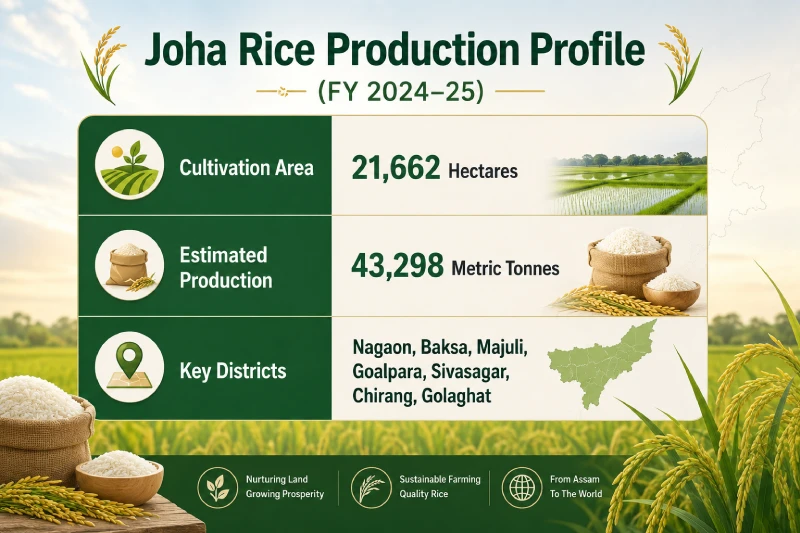
For generations, families in Assam didn't just eat Joha as an everyday staple; they saved it for milestone events like weddings, community feasts, and harvest festivals like Bihu. It was always more of an identity crop. It currently takes up around 21,662 hectares of land, yielding roughly 43,298 metric tonnes for the 2024–25 financial year. Because it yields a lot less per hectare than modern hybrid seeds, growing it has historically been an act of keeping a tradition alive rather than running a high-profit business.
Securing the Geographical Indication (GI) tag back in 2017 was a massive win for legally protecting the grain's identity. But as anyone in agribusiness will tell you, a certificate doesn't automatically mean better income for the farmers on the ground. You still need to build a pipeline to affluent international consumers who care about the story behind their food and don't mind paying a premium for it. This 25-tonne shipment to Europe is essentially the first major proof that this pipeline can work.
The Bigger Picture: Balancing Scale with Niche Choices
If we step back and look at the sheer scale of India’s footprint in the international rice trade, the strategy behind pushing a niche grain like Joha becomes a lot clearer.
When you dig into the official data tracked by APEDA, India pretty much dictates the terms of the global rice market, handling roughly 40% of all global rice exports. If you look at the numbers for the 2024–25 financial year, Indian exporters shipped a staggering 20.1 million metric tonnes of rice to over 172 countries. That massive volume brought in around USD 12.95 billion in export revenue.
How the Revenue Breaks Down: While high-margin Basmati exports bring in about USD 6.61 billion, the rest of that multi-billion-dollar revenue comes from moving massive quantities of low-margin, non-Basmati parboiled and broken grains.
While moving those massive volumes is great for headline statistics, it brings along some tricky environmental and economic realities. Growing millions of tonnes of ordinary white rice year after year drains an incredible amount of groundwater. On top of that, it leaves Indian farmers vulnerable to sudden shifts in global commodity prices. It also puts the government in a tough spot when domestic inflation ticks up, forcing them to hit the brakes on exports to protect local food supplies.
This is exactly why the push for Joha rice is so interesting. By focusing more on unique, GI-tagged varieties, India can start tapping into high-value boutique markets without needing to clear out millions of hectares for water-heavy, bulk crop cultivation.
Instead of playing the volume game, APEDA is pivoting toward a value game. Buyers in Western markets are increasingly looking for unique culinary experiences, heirloom grains, and items with verifiable origins. Joha fits into that exact consumer trend.

Connecting the Dots from the Field to the Shipping Container
Moving a traditional grain from a small, fragmented farm in districts like Baksa or Majuli all the way to a specialty grocery store shelf in London or Rome takes a lot of coordination. It requires a lot of moving parts to sync up perfectly between government bodies and private logistics teams.
The official launch of this 25-metric-tonne batch saw Assam’s Agriculture Minister, Atul Bora, flagging off the cargo alongside several key administrative figures, including:
- Agriculture Production Commissioner Aruna Rajoria
- ARIAS Society State Project Director Virendra Mittal
- Director of Agriculture Uday Praveen
- APEDA Representative Saurabh Srivastava
Beyond the official photo-ops, the actual supply chain behind this run is worth noting. The trade itself is being managed by Safe Agritrade Pvt. Ltd., an APEDA-registered exporter out of Kolkata, while the critical cleaning, processing, and final retail packaging happened right at Pratik Agro Food Processing in Guwahati.
Having that processing capacity directly in the region is a massive deal. In the past, raw crops from the North Eastern Region usually had to travel to major maritime shipping hubs like Kolkata or Mumbai just to get packed properly. That extra step didn't just add to the logistics bill; it also stripped local communities of the profits that come with value-added processing. Keeping that work in Guwahati means more of the economic benefits stay right where the crop is grown.
What Comes Next for the North East?
While breaking into the UK and Italy is a great milestone, it isn't just a one-off stroke of luck. It's actually the result of a slow, deliberate market-testing plan that APEDA has been running for a while now.
Before making this larger jump into Europe, the authority ran a few quiet, small-scale test runs—sending 1 metric tonne over to Vietnam and a combined total of 2 metric tonnes across five Middle Eastern markets, specifically Kuwait, Bahrain, Qatar, Oman, and Saudi Arabia.
These tiny shipments were essentially stress tests for the supply chain. They allowed exporters to check how the grain handled long transit times, see how custom ports reacted to phytosanitary paperwork, and get real feedback from overseas buyers.
Now that the groundwork has cleared, the real task is figuring out how to scale up production without losing the premium quality that makes the grain special in the first place.
For farming communities across Nagaon, Goalpara, Sivasagar, and Golaghat, the long-term impact here could be huge. If Joha rice can secure a steady, permanent foothold in European specialty markets, it gives local farmers a fantastic safety net. It protects them from the usual local price crashes that happen whenever a harvest season sees a temporary oversupply in the domestic market.
A Few Realities to Keep in Mind
That said, celebrating this win shouldn't mean ignoring the very real hurdles that are still on the horizon. If the goal is to truly transform the North East into an export hub for premium agricultural goods, a few specific issues need attention:
- Meeting Strict International Standards: European ports have some of the toughest rules in the world when it comes to Maximum Residue Levels (MRL) for chemical pesticides. Joha has a natural edge here because it’s traditionally grown using low-input, nearly organic methods by default. But as demand grows and production scales up, keeping that chemical-free streak intact will require strict oversight and reliable testing.
- The Geography Problem: Being landlocked means Assam’s export lines are always vulnerable to heavy monsoon rains, infrastructure bottlenecks, and unexpected transit delays. Making sure there are smooth, multimodal transport links—connecting local hubs via rail and inland waterways directly to major ocean ports—is going to be vital to keep freight costs reasonable.
- Telling the Right Story: Look at why Thailand’s Jasmine rice or Japan's Koshihikari sell at such incredibly high prices; it's because those countries spent decades building a distinct cultural narrative around them. India needs to adopt that exact playbook. Joha shouldn't just be labeled as "fragrant rice" on a shelf. It needs to be marketed as a centuries-old heirloom grain grown along the fertile floodplains of the Brahmaputra River.
Seeing those 25 tonnes of Joha rice head out to European buyers shows that India's rice export strategy is getting a lot better at balancing sheer volume with high-end, boutique items. It proves that a small farmer in Assam can stick to an ancient crop, protect local biodiversity, and still find a direct path to global trade. If this momentum is handled correctly, the distinct aroma of Joha rice might just be the opening chapter for a whole range of unique regional flavors finding a home in the global market.