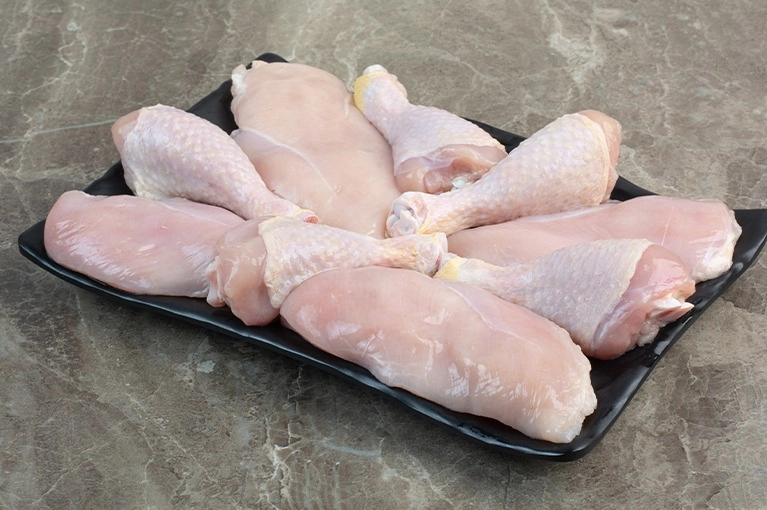
Chicken meat is one of the most traded animal proteins worldwide. Global chicken exporters and poultry meat suppliers supply frozen chicken, whole chicken, chicken breast, wings, and processed poultry meat to importers, distributors, and food manufacturers. Bulk buyers source poultry meat from leading exporting countries such as Brazil, the USA, Thailand, and India due to competitive prices, large production capacity, and reliable cold chain logistics.
Technical Overview for Trade and Bulk Procurement
Known scientifically as Gallus gallus domesticus, "chicken meat" is commonly referred to in the trade as broiler chicken. Commercially, it is a cornerstone of the global animal protein, Quick Service Restaurant (QSR), and industrial food manufacturing sectors. Poultry meat's naturally occurring high-quality proteins, essential amino acids, and low lipid content are highly susceptible to rapid bacterial proliferation and degradation upon slaughter; therefore, its highly nutritious and versatile profile requires rigorous, uninterrupted cold-chain logistics in order to fully maximize product safety and shelf life. Because of its unmatched feed conversion ratio and widespread cultural acceptance, this product is the industry standard for affordable staple proteins in the Middle East, Asia, Africa, and a significant chunk of the Americas and the EU. As a result, there is a thriving frozen chicken trade among global buyers.
The microbiological integrity and physical consistency of Poultry Meat are critical for food service distributors and Industrial Meat processors who buy in bulk. The live harvested broilers are stunned, bled, defeathered, and eviscerated before being subjected to advanced chilling processes (such as air or water chilling), causing them to be reduced to uniform, temperature-controlled batches without retaining biological impurities. Its retained nutritional profile and neutral flavor make it the preferred raw material for value-added processing, where the structural integrity of the meat must be authentic and verifiable—a distinct advantage over plant-based alternatives that lack similar natural fibrous textures.
While commonly found in retail as fresh whole birds or tray-packed cuts, export-grade material is engineered for specific "Yield Profiles" and physical formats (defined by Cut Specifications and Grade A limits). The process involves chilling and freezing the meat under strictly controlled conditions to prevent the natural fats from oxidizing and the muscle tissues from spoiling due to excess microbial loads.
Due to its robust market demand, it works differently depending on the purity, cut, and grade specified by the buyer. It can be portioned directly into food service retail packs, processed into industrial sausage formulations via Mechanically Deboned Meat (MDM), or exported as highly specific offal (like paws) to Asian markets. Buyers who opt to purchase premium Grade A poultry in bulk guarantee superior presentation and processing efficiency, even though the cold chain is prone to rapid failure once the cargo is exposed to temperature fluctuations. This necessitates superior thermal packaging and reefer containers to preserve freshness and prevent spoilage.
PRODUCT SPECIFICATIONS
Parameter
Standard / Limit
Core Temperature
Max -18°C at bone (Crucial to prevent bacterial growth)
Moisture / Water Content
Max 4.0% - 6.0% (Crucial to prevent plumping fraud)
Appearance & Skin
Clean, no yellow skin, no feathers, no bad smell
Physical Damage
No broken bones, no severe bruising, no black pads (on paws)
Blood Spots / Coagulation
Strictly Controlled / Absent in Grade A
Microbiology (Salmonella / Campylobacter)
Absent in 25g (Crucial for EU/US/Japan human consumption)
Antibiotic Residues (MRL)
Strictly Controlled (Crucial for high-value export compliance)
Shelf Life
12 to 24 Months (when maintained continuously at -18°C)
Halal Certification
Mandatory (Crucial for Middle East and Muslim-majority markets)
Critical Note: "Core Temperature," "Microbiology," and "Antibiotic Limits" are the major specifications for Poultry Meat. Premium buyers require "Grade A Fully Intact Birds," where the product offers a clean, uniform appearance and a safe sanitary profile with minimal water retention. A rigorous health certification check for "Avian Influenza (HPAI) Free Status" (ensuring safe regional sourcing) and "Veterinary Health Certificates" (ensuring fit for human consumption) is mandatory to ensure the product remains sound and fit for high-value export.
TYPES, GRADES & VARIANTS
In the highly competitive landscape of the Poultry Meat B2B marketplace, segmentation is rigorous. It is strictly driven by the slaughter quality, the anatomical cut, and the intended use:
Premium Grade A (Whole Chicken & Chicken Breast): This globally traded grade is thought to be the best in the industry for culinary applications and aesthetic appeal. The raw material is sourced from top integrators in Brazil, the USA, and the EU, where top suppliers utilize automated vision-grading machines during the sorting process. It has a strikingly uniform, blemish-free appearance and perfectly intact skin because bruised and damaged birds are eliminated. This variety is often considered the premium standard for rotisserie applications and high-end retail by bulk meat suppliers due to its visual perfection.
Commodity Cuts (Chicken Legs, Quarters & Chicken Wings): A staple of the global bulk protein market, this is the standard for mass catering and affordable consumer retail. It is generally processed from heavier broilers, yielding a highly cost-effective nutritional percentage. It is processed using automated cutting lines, offering high value for general commercial applications but a lower overall price point per metric ton due to the higher dark meat and bone content.
Processed Chicken Grade & Offal (MDM, Paws, Feet): This is the specialized volume variety and dominates the bulk export market to East Asia (particularly China) and industrial processors globally. In order to meet the demands of sausage, nugget, and ethnic delicacy manufacturers, the by-products are subjected to specific cleaning and freezing protocols. While it must still meet strict temperature and sanitary limits, it provides immense aggregate value to poultry integrators by utilizing parts of the bird not favored in Western retail markets.
POULTRY MEAT: APPLICATIONS & END-USE
Food Service & Retail (HoReCa)
Restaurant & Catering Supply: A lean, affordable substitute for red meat, poultry is a major, adaptable protein source in international food service, used in everything from premium fillets to bulk-grilled dishes. A key "volume anchor" for commercial profitability is grade A poultry, highlighting the necessity of regular procurement. For jobs requiring exact portion control and little thawing, premium IQF boneless chicken breasts are frequently selected.
QSR (Quick Service Restaurants): The meat is essential to the fast-food industry. It is a typical component of international fried chicken chains, sandwich shops, and casual dining venues. It is also widely used in the rapidly expanding market for chicken wings. Excellent marinating and breading adhesion are made possible by the bird's ideal processing. Its structural integrity is guaranteed to be preserved during commercial deep-frying thanks to this uniformity. As a result, each batch has a consistent bite and flavour profile.
Industrial Processing (Human Consumption)
Value-Added Meat Processing: The ability of proteins to extract and bind creates a demand for bulk Mechanically Deboned Meat (MDM) and trimmings in this particular market. As a result, strict microbial limits, particular emulsion capacities, and fat-to-lean ratios are given top priority by sausage and nugget manufacturers. They specifically look for MDM blocks that are pure and free of bone fragments. Before being formed into patties or extruded into hot dogs, the meat is rigorously blended at a precise temperature. For this particular use, a committed bulk supplier will usually need low-cost, high-volume grades.
Non-Retail & Pet Nutrition (Industrial)
Pet Food Manufacturing & Rendering: Large amounts of poultry by-products (offal, frames) are needed by the pet food industry due to restrictions on protein and ash. For premium kibble, commercial pet food extruders need reliable, high-yield poultry meal and chicken fat, with a focus on particular fat yields, natural amino acids, and stringent hygienic rendering. Abattoir clearances must be frequent and high volume for bulk suppliers. High-lipid poultry fats are also necessary for the synthesis of biofuels and oleochemicals.
SUPPLY & DEMAND COUNTRIES
Top Producing Countries & Export Hubs
Production Leaders: By sheer volume, the USA and Brazil stand as the absolute dominant forces in the industry. Bulk poultry suppliers in these nations hold a distinct structural advantage. They capitalize heavily on their massive domestic cultivation of feed crops, primarily soybeans and corn. Meanwhile, poultry exports from Brazil have experienced a notable global surge. This growth is largely driven by the country's historically disease-free status. While Brazil and the USA dominate volume, bulk chicken suppliers in India are increasingly expanding their footprint, with chicken export from India seeing targeted growth in regional markets like Oman, the Maldives, and Indonesia.
Important Export Hubs: Several critical maritime locations act as historical centers of concentration for this global trade. In Brazil, the Ports of Paranaguá and Santos play a pivotal role. Similarly, New Orleans and Savannah serve as vital export gateways in the USA. At these locations, agricultural suppliers systematically freeze and pack this specific product for international transit. Furthermore, major cold-storage logistics parks are strategically situated near these port facilities. These specialized complexes are equipped to handle the vast bulk of containerized reefer shipments.
Top Importing Regions
China & East Asia: This region boasts massive consumer demand for highly specific cuts of meat. Consequently, it serves as a major importer of standard commercial-grade wings. It also drives the global market for premium poultry paws, commonly known as feet. Buyers here have strict culinary and quality requirements. They demand perfectly cleaned, black-pad-free paws tailored for traditional applications. Additionally, the region consistently requires heavy inbound volumes of mid-joint wings.
Middle East: Within this region, the Gulf Cooperation Council (GCC) operates as a strict regulatory market. Importers require absolute and documented compliance with Halal slaughter practices, prompting them to source directly from certified Halal chicken exporters. Consumer demand heavily focuses on clean, Grade A halal chicken. These are commonly referred to in the trade as grillers. These specific birds typically range in weight from 800g to 1200g. They are primarily destined for direct retail sale and rotisserie applications. This specific market dynamic is heavily driven by Saudi Arabia and the UAE. Both of these nations boast notably high per-capita consumption rates for poultry.
Africa: Sub-Saharan Africa represents a truly massive market for affordable dark meat. This regional preference leads to a consistent, year-round surge in demand. Consequently, bulk frozen leg quarters are imported in massive, continuous quantities. This sustained demand serves a vital socioeconomic purpose for the region. It specifically addresses the ongoing need for cost-effective animal protein. Ultimately, these bulk imports deliver high-quality nutrition to rapidly developing economies.
GLOBAL MARKET OVERVIEW
Current Market Value: The global poultry meat market is currently valued at an impressive $350 billion, enjoying robust worldwide prosperity. Driven by an expanding global middle class, demand is high from both food manufacturers and retail consumers. The sector currently holds the dominant share of all global meat consumption.
Future Outlook: The industry is expected to grow steadily thanks to a number of important trends. Exporters observe that, particularly in Western markets, consumer demand for "Antibiotic-Free" (ABF) and animal welfare-certified products is growing. In order to reduce the regulatory risks associated with import bans on raw meat, the market for fully cooked, ready-to-eat poultry is also growing dramatically.
Trends: Global trade is evolving structurally, shifting from general commodity models to highly audited, biosecure purchasing protocols. The use of "Compartmentalized Disease-Free Zones" is becoming standard. Procurement is increasingly utilizing specialized online B2B platforms for bulk frozen meat. Simultaneously, the broader market strongly prefers working within highly guaranteed, vertically integrated operational systems.
KEY DEMAND DRIVERS
Protein Affordability & Feed Conversion: Global dietary trends depend heavily on inexpensive, nutrient-dense proteins. Poultry is actually the most popular meat in the world due to its extraordinarily high feed conversion ratio (FCR). As a result, developing nations frequently see an increase in import volumes. In order to satisfy the dietary need for complete amino acids without requiring the large land and water footprints associated with ruminant livestock, this surge takes place.
Halal Market Expansion: Whole frozen poultry is heavily marketed within the Islamic world. It is promoted specifically for providing compliant, safe protein. This religious and cultural requirement actively propels the demand for specific types of certified slaughter. Importers require products that have been strictly supervised by recognized Islamic bodies, ensuring entirely hand-slaughtered or compliant machine-slaughtered birds.
PRODUCTION & SUPPLY DYNAMICS
The global poultry meat market operates on a continuous, year-round production schedule. This immense operation relies heavily on the fluctuating prices of global grain commodities. Specifically, the costs of corn and soy heavily dictate overall market stability. Furthermore, stringent biosecurity regulations universally define and constrain this complex global trade.
Supply-Side Realities:
Brazil & USA (The Volume Leaders): Leading chicken exporters and domestic chicken suppliers within these two nations completely dominate the bulk frozen export market. These global players represent an absolutely enormous scale of agricultural output. To maintain this dominance, they strategically utilize their remarkably low-cost domestic feed bases. This inherent structural advantage allows them to keep their FOB (Free on Board) prices extremely competitive on the world stage.
Seasonality: The actual processes of rearing and slaughtering take place year-round. This constant production is facilitated by advanced, climate-controlled agricultural facilities. However, consumer demand still varies wildly on a seasonal basis. For instance, the demand for chicken wings in the US increases significantly during major athletic events. This localized surge in consumption consistently raises wholesale prices worldwide. Conversely, the regional demand for whole birds in the Middle East peaks sharply just before the observance of Ramadan.
Processing Note: Trading export-grade poultry differs vastly from the simpler logistics of trading dry grains. This specific meat product requires highly specialized, energy-intensive infrastructure to process safely. To "Blast Freeze" the meat and precisely "Calibrate" it by sorting it by precise weight, facilities must be completely furnished. They also have to strictly uphold a continuous cold chain from processing to delivery. In the end, the final quality of the meat is directly determined by the particular freezing technique. Large ice crystals will form inside the product if it is only slow-frozen instead of properly blast-frozen. The fragile meat cells are physically ruptured by these large crystals. Upon thawing, this cellular damage causes massive moisture loss, commonly referred to as "purge." Consequently, this heavy industrial cold-storage cost serves as a major component of the final FOB price.
Risks:
Cold Chain Failure: International trade often involves moving this product over very long ocean transits. During these extended voyages, the frozen meat remains highly susceptible to rapid spoilage. This catastrophic failure typically occurs if the mechanical reefer container malfunctions. If the meat thaws and subsequently refreezes, it quickly develops a very bad odor. More alarmingly, it begins to harbor incredibly dangerous bacterial loads. Because of these severe risks, bulk international trade heavily depends on robust mitigation strategies. This includes a strict reliance on comprehensive maritime insurance policies. It also necessitates the constant use of data-logging temperature monitors to verify transit conditions.
EXPORT & IMPORT TREND ANALYSIS
Volume Trend: Growing. Demand is rising due to population growth, rising incomes in developing nations, and the massive expansion of the commercial fast-food sector.
Value Trend: Highly Volatile. Prices fluctuate directly based on the raw feed crop data (soy and corn indices), which is highly sensitive to weather, combined with the sudden, unpredictable impacts of Avian Influenza bans. Finished frozen meat prices can typically swing by 20-30% in a quarter based on these macro factors.
Key Insight: When making a frozen poultry bulk purchase, buyers are increasingly specifying exact weight calibrations and strict limits on water injection (plumping). Precisely calibrated, air-chilled birds command a significant premium over standard water-chilled commercial bags because they reduce cooking shrinkage and ensure exact portion control for the end-user.
PRICE & BULK COST INDICATORS
Commodity Cuts (Leg Quarters): The chicken price generally ranges from $900 to $1,300 per metric ton, which sets the entry-level chicken wholesale benchmark. This range sets the entry-level cost for affordable consumer protein and heavy food service blends. Buyers must analyze the wholesale price carefully to account for ocean reefer freight. First, check the export price, which is the chicken meat FOB price. Second, review the import price per MT, also known as the landed CIF cost.
Premium Cuts (Grade A Breasts / Paws): This variety typically costs between $2,500 and $4,000+ per MT. The frozen chicken export price is significantly higher for this grade. This increase is due to the intense labor requirement for deboning (breasts) or strict cosmetic sorting and cleaning (paws). Facilities must handle the meat carefully to retain integrity.
Market Volatility: Volatility is directly linked to the feed grain harvests in the Americas. It is also tied closely to reefer container availability and cold-storage operational costs. Therefore, buyers must track global soybean meal and corn commodity boards. This monitoring is crucial for accurately calculating the future pricing trends of the frozen product.
HSN / HS CODE & TAX CLASSIFICATION
HS Code (Global): 0207.12 (Meat of fowls of the species Gallus domesticus, not cut in pieces, frozen) or 0207.14 (Cuts and offal, frozen) – proper HS code classification is crucial as it dictates agricultural tariffs and sanitary import quotas.
Note: Customs and port health authorities will strictly scrutinize the agricultural product for proper veterinary compliance and specifically for cold-chain temperature logs and microbiological standard checks.
BUYER EXPECTATIONS & TRADE REQUIREMENTS
Cold Chain Integrity (Consistency): This is the most important requirement for international buyers. Customers anticipate a very particular physical outcome without signs of thawing, freezer burn, or blood seepage. This usually translates to guaranteed unbroken -18°C transit data. Keeping this thermal coherence is a significant value driver for big purchases.
Veterinary Safety & SPS Measures: There must be no dangerous trace of pathogens such as Salmonella or banned antibiotic residues. Strict origin tracing to ensure the birds come from disease-free zones is becoming the standard in the industry. This additional degree of biosecurity is becoming more and more expected.
Calibration & Yield: The meat must meet exact weight brackets to ensure it fits food service specifications. Exact sizing ensures higher cooking yields and predictable profit margins for restaurants.
LOGISTICS, PACKAGING & TRADE TERMS
Packaging: Frozen poultry requires robust bulk packaging choices. These consist of thick food-grade inner polybags packed inside heavy-duty, moisture-resistant corrugated cardboard cartons weighing 10 kg to 20 kg. For premium retail, IQF bags are sometimes requested. Significant freezer burn, cross-contamination, and transit damage are avoided with strong, blast-freezer-safe cartons.
Storage & Shelf Life: Commercial cold storage warehouses must keep the bulk product at or below -18°C. Additionally, during loading and unloading, it requires environments that are totally shielded from temperature changes. Proper storage in a deep-freeze environment preserves the meat's nutritional profile and culinary viability. Under these ideal conditions, the frozen product consistently has a shelf life of 12 to 24 months.
Incoterms & MOQ: CIF (Cost, Insurance, and Freight) trade terms are heavily used in international frozen transactions to manage shipping liabilities. In order to negotiate direct export rates, buyers typically need to meet a wholesale Minimum Order Quantity (MOQ). Usually, this MOQ requires a full reefer container load. Twenty-six to twenty-eight metric tonnes can be transported in a heavy-duty 40-foot High Cube Reefer (FCL).
Required Documentation: International trade requires specific documentation. Customs requires the submission of a Veterinary Health Certificate. This document confirms fitness for human consumption and absence of specific avian diseases. Along with a Halal Certificate (if applicable), shipments also need a standard Certificate of Origin and a Commercial Invoice.
FUTURE OUTLOOK & OPPORTUNITIES
Traceability & Tech Integration: Buyers are becoming highly educated on meat supply chains. They wish to confirm if the poultry is tracked via blockchain or advanced ERP systems. Complex recall management is practically revolutionized with this data processing method.
Welfare-Smart Cultivation:
Transparent supply chains, including the rising demand for organic chicken, are becoming more and more sought after by sustainability-focused buyers. They wish to confirm the stocking densities and antibiotic-free (ABF) practices used in the rearing of the live birds before they were processed.
Ready-to-Eat (RTE) Expansion: The convenience food manufacturing sector globally is changing as a result of shifting trade barriers. To bypass strict raw-meat import bans related to Avian Influenza, massive volumes of trade are shifting toward fully cooked, heat-treated poultry products.
TRANSPARENCY & DISCLAIMER
Disclaimer: Market data, price indications, and trade regulations may change because of feed commodity conditions, geopolitical policies, disease outbreaks (HPAI), and currency fluctuations. The technical details are for general guidance only; buyers must verify the details (Temperature logs, Microbiological Limits, Antibiotic MRLs, and Halal authenticity) with suppliers through a Veterinary Health Certificate and Bill of Lading before making a purchase. No specific trade result can be guaranteed.
IQF (Individually Quick Frozen) means each piece of chicken (e.g., a breast or wing) is frozen separately, allowing the buyer to remove only what they need without thawing the whole box. Block frozen means the cuts are packed tightly into a carton and frozen into a single solid block, which is highly cost-effective for bulk transport but requires thawing the entire block for use.
Poultry meat naturally contains moisture. When the packaging is torn or poorly sealed, the cold, dry air of the freezer sublimates the moisture directly out of the meat tissue, causing severe dehydration and oxidation. This leaves tough, discolored patches on the meat, which is why heavy-duty poly-liners inside export cartons are predominantly used globally.
Because poultry is reared in dense agricultural conditions, it is highly susceptible to contagious respiratory viruses carried by wild migrating birds. If HPAI infects a commercial flock, the mortality rate is devastating. Importing nations will immediately reject shipments or ban entire regions to protect their own domestic flocks, making veterinary health certificates a massive priority for bulk buyers.
While considered low-value by-products in Western retail, paws are a massive culinary delicacy in Asian markets (particularly China). However, they must be perfectly clean. Specialized processing is required to remove the outer skin while ensuring there are no black pads (ammonia burns from poor farm litter conditions). This strict cosmetic grading adds significant cost.
Yes. Because it is highly perishable and susceptible to rapid microbial growth, the temperature must be strictly controlled at -18°C or colder. If exposed to broken cold chains or port delays without power to the reefer container, the meat will spoil and become toxic very quickly. Uninterrupted deep-freeze storage and proper data-logging are strictly required to maintain industrial viability.
Need more help?
Need Help Expanding Your Business Globally?
Connect with our trade experts to understand buyer access, international trade opportunities, and membership benefits.
1M+
Verified Global
₹1.25+
Lakh Crore Trade Facilitated
70+
Countries Connected
Experience on Mobile App
Connect with Us
Fill in your details and our team will get in touch with you.
Unlock Global Trade Opportunities
Join a growing international trade ecosystem connecting buyers, exporters, and aspiring businesses across 70+ countries.
1M+
Verified Global
₹1.25+
Lakh Crore Trade Facilitated
70+
Countries Connected
Experience on Mobile App
Connect with Us
Fill in your details and our team will get in touch with you.
We use cookies
We use cookies to enhance site functionality, improve user experience, analyze website performance, and deliver relevant content in accordance with our Cookie Policy.
We use cookies
Essential Cookies
Essential cookies are strictly necessary for Tradologie.com to operate properly. They enable core functionalities such as security, session management, network stability, and cookie consent preferences. These cookies do not collect personal data and cannot be disabled.
Name
Vendor / Service
Purpose
Expiry
Privacy Policy
ASP.NET_SessionId
Tradologie.com / ASP.NET
Maintains secure user session across pages.
Session
https://privacy.microsoft.com/
__RequestVerificationToken
Tradologie.com
CSRF protection for forms.
Session
https://www.tradologie.com/privacy-policy/
cookie_consent
Tradologie.com
Stores consent preferences so the banner does not reappear.
We use analytics cookies to gather anonymous, aggregated information about how visitors interact with Tradologie.com. This helps us improve the site, measure the success of content and services, and prioritize performance fixes.
Functional cookies allow the website to provide enhanced usability and personalization. They store preferences such as language, region, chat settings, and login details for a smoother browsing experience. Disabling these cookies may limit certain features.
Name
Vendor / Service
Purpose
Expiry
Privacy Policy
user_lang / lang
Tradologie.com
Remembers chosen language.
1 year
https://www.tradologie.com/privacy-policy/
timezone_pref
Tradologie.com
Stores timezone preference for display.
6 months
https://www.tradologie.com/privacy-policy/
remember_user
Tradologie.com
Keeps logged-in state when chosen.
30 days
https://www.tradologie.com/privacy-policy/
livechat_session
Tawk.to
Maintains chat session state.
Session
https://www.tawk.to/privacy-policy/
Marketing
Marketing cookies are used to deliver advertising that is relevant to you and to measure the effectiveness of our marketing campaigns across platforms such as Google, LinkedIn, Meta and Microsoft. These cookies are set only with your consent.