Tradologie
  • cumin seeds

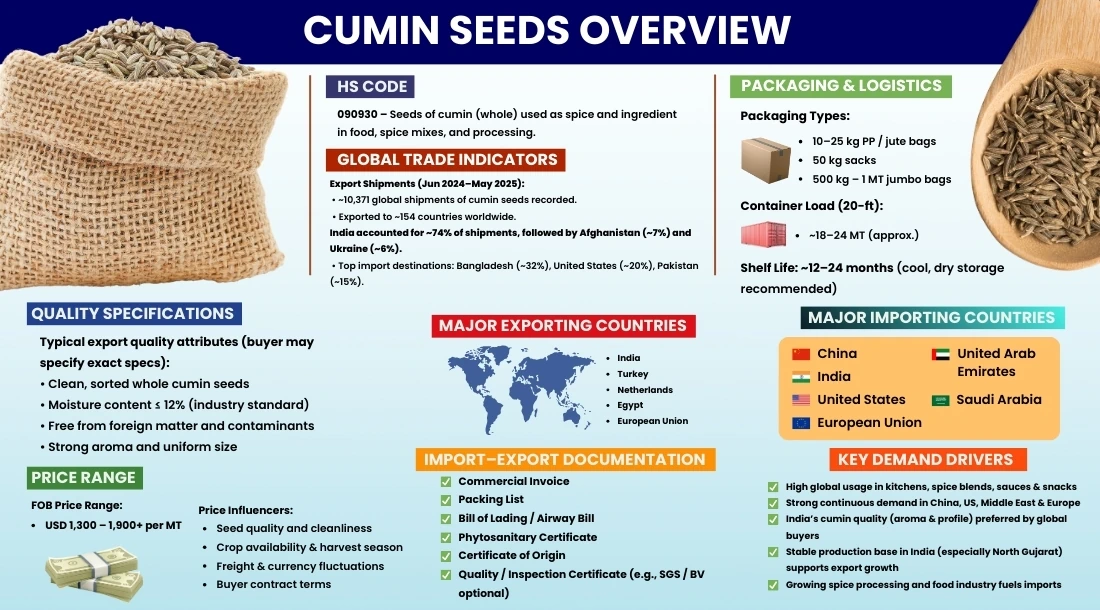
Cumin Seeds


Minimum Order Quantity : 5-10 MT

Packaging Types : 10 kg, 25 kg, 50 kg PP / jute bags bulk packaging

Forms Available: Whole Seeds, Organic Cumin Seeds

Shelf Life : 12–18 Months

Moisture Content : ≤12% (Export Standard)

Essential Oil Content : 2–4% (depending on variety)

HS Code : 09093100 (Cumin / Jeera seeds)

Origin : India (Rajasthan, Gujarat, Madhya Pradesh)

Certifications : ISO, HACCP, FSSAI, APEDA, Organic


Facilitated by Tradologie.com

Offered By : Verified Spice Sellers

veg icon

This is a Vegetarian product.


Cumin Seeds: A Guide to Varieties, Grades, and Global Trade

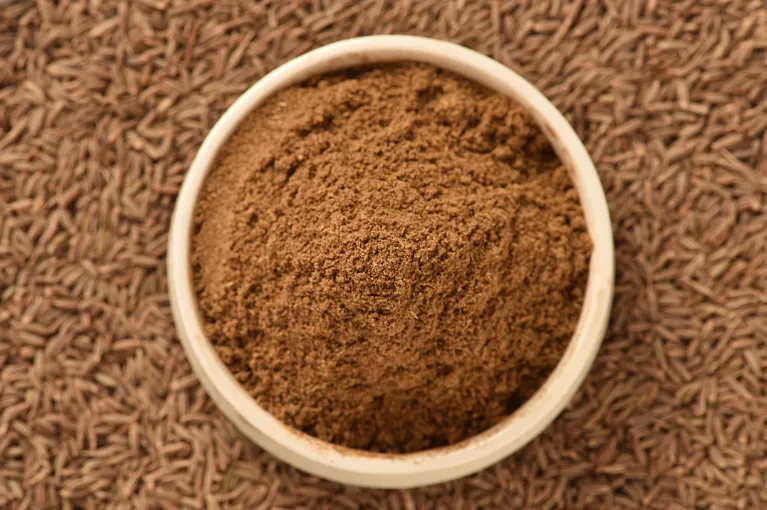
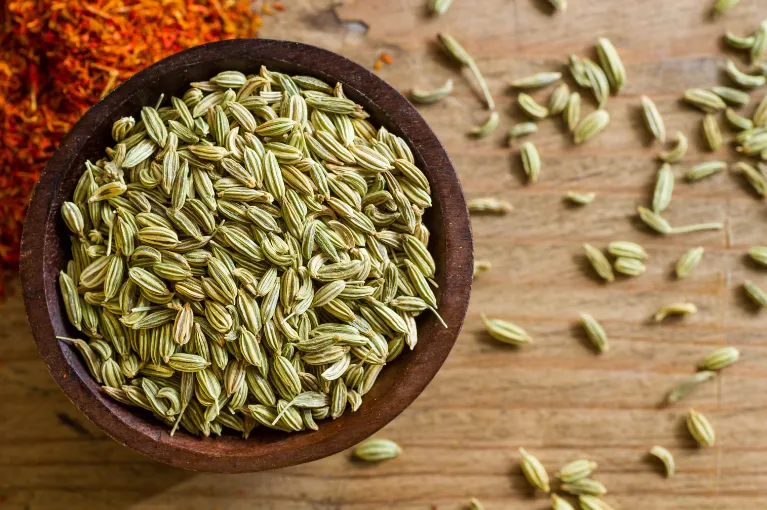
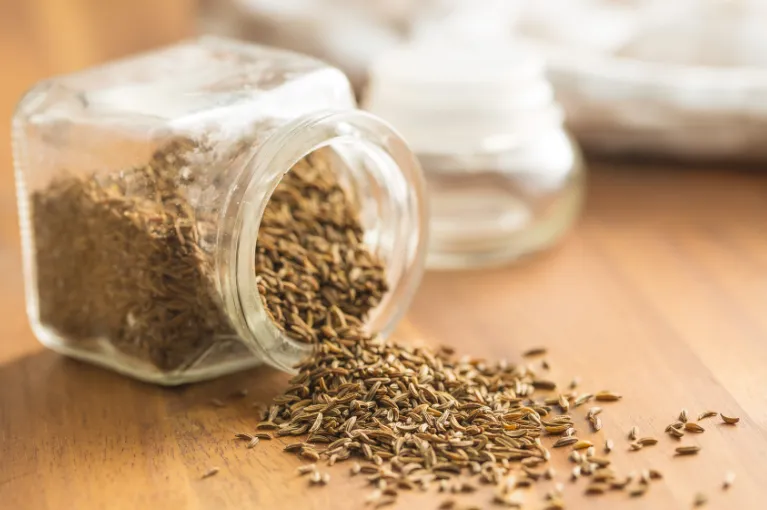
Cumin Seeds, known domestically as jeera seeds or zeera, are a robust, aromatic spice product harvested and sun-dried to concentrate their potent essential oils. Unlike jeera powder, this product retains the seed's integrity, consisting of small, boat-shaped ridges that encapsulate the volatile compounds. This product is prized by the Spice Blending, Distillation (Flavor & Fragrance), and Food industries for its penetrating, earthy flavour, high concentration of essential oils (Cuminaldehyde), and distinctive warm aroma. For food manufacturers and extractors who are planning to buy cumin seeds in bulk, it is important to understand these subtleties of structure to determine which processing grade to purchase.

While commonly recognised as a pantry staple or a tempering spice in retail, high-grade whole cumin seeds are engineered for precise "purity" and visual uniformity (Bold vs. Medium). The process involves harvesting the crop when the seeds turn yellow-brown and drying them to a specific moisture level to prevent fermentation.

It functions differently from jeera powder because of its whole format. It can be used as a visual garnish in bakery products or for steam distillation. Because the volatile oil is protected within the hard outer shell of the seed, providing a sustained, intense release of earthy notes as opposed to the rapid oxidation of flavour in powder, their physical wholeness is essential.

seller registration

PRODUCT SPECIFICATIONS

Parameter Standard / Limit
Purity 98% - 99.5% (Machine Cleaned / Sortex)
Moisture Content Max 8% - 9%
Volatile Oil (VO) Min 2.5% - 4.0% (Origin Dependent)
Total Ash Max 8.0% - 9.5% (dry basis)
Acid Insoluble Ash Max 1.5%
Broken / Split Max 3% - 5% (Whole Grades)
Damaged / Discoloured Max 2% - 3%
Foreign Matter Max 0.5% - 2.0% (Grade Dependent)
Salmonella Absent in 25g
Size Varies (e.g., 3mm - 6mm)

Critical Note: "Purity" and "Volatile Oil" are the major specifications for cumin. Premium buyers require "European Quality" (99.5% Purity), where the product has not been adulterated with grass seeds or foreign matter. A visual check for "Spent Seeds" (lightweight seeds used for oil extraction and mixed back in) is mandatory to ensure the product remains sound and fit for consumption.

TYPES, GRADES & VARIANTS

In the highly competitive landscape of the cumin seeds B2B marketplace, segmentation is rigorous. It is strictly driven by four specific metrics:

Europe Quality (Premium / 99.5%): This globally traded grade, known as IPM or Pesticide-Free stock, is the benchmark for Western retail. It consists of pristine, bold, greyish-brown seeds, primarily from Gujarat and Rajasthan. Machine-cleaned and Sortexed to remove stems and stones, it boasts impurities below 1%. This makes it favored by European buyers and gourmet packers worldwide.

Singapore Quality (99% / 98%): This grade is the industrial workhorse for export. It offers a reliable mix of standard seeds with 98%-99% purity. It has a slightly higher tolerance for foreign matter, including a moderate percentage of stalks and thinner seeds, compared to Premium grades. While the visual uniformity is lower, the flavour profile remains consistent. Therefore, it is preferred for grinding into jeera masala and curry powders.

Grinding Quality (General): These are value-oriented seeds distinguished by their smaller size or darker colour. They are often the screenings from the grading process. While they lack the visual appeal of bold cumin, they are chemically sound. Buyers prefer them specifically for high-volume industrial processing where the physical seed is pulverized.

Syrian / Turkish (High Oil): This often sweeter, slightly larger variety typically ranges from light to dark brown. They are used in traditional dishes and for the extraction of oleoresins, and their high volatile oil content makes them a desirable option for niche Middle Eastern buyers despite supply problems.

CUMIN SEEDS: APPLICATIONS & END-USE

Food Processing (Industrial)

  • Spice Blends & Masalas: Cumin takes a front-and-centre role in global spice mixes, often constituting a significant volume of Taco Seasoning and Curry Powder. It acts as a base note and a digestive aid. Its inclusion adds a layer of deep, musky warmth. This is due to its high cuminaldehyde content. In industrial applications, they function as the "anchor" of the blend, balancing bright spices like coriander and turmeric.
  • Processed Meats & Bakery: This spice is essential for the savory baking sector. It is typically used whole or coarsely cracked. You will find it in Rye Bread, Crackers, and Sausages. They often require sterilised cumin to ensure low bacterial counts. This step prevents spoilage in shelf-stable products.

Non-Food Industrial

  • Fragrance & Essential Oils: This sector is a niche but high-value volume driver. It is specifically dominant in France and the USA. The technical requirements here are distinct. Distillers prioritise high volatile oil content. The seeds are steam-distilled to extract Cumin Oil. This liquid is used to create men's perfumes and colognes.
  • Oleoresins & Extracts: Cumin serves as a structural base for the flavour industry. They are vital for creating "Natural Flavourings." The demand here is for Chemical Yield. Specifically, high aldehyde content is required. This compound is isolated for use in digestive syrups and pharmaceutical preparations.

SUPPLY & DEMAND COUNTRIES

Top Producing Countries & Export Hubs

  • Production Leaders: Cumin seeds exporters in India stand as the dominant force in the sector. It is responsible for producing approximately 70% of the world's supply, particularly the "Gujarat" varieties. Nonetheless, domestic consumption accounts for a massive portion of this volume. But when political stability permits, Syria and Turkey are important exporters. Known for their sweeter, high-oil crops, these countries cater to the Middle Eastern palate. A particular type produced in Iran is also highly valued in regional markets.
  • Key Export Hubs: The consolidation zone located in Unjha (Gujarat, India) functions as the world's cumin capital. It is in this hub that cumin undergoes critical steps. They are cleaned, graded (via gravity separators and Sortex), and subsequently re-packed. Dubai also acts as a major hub for re-export. It aggregates spices from Iran and India. From there, it manages shipments to African and Western markets.

Top Importing Regions

  • Americas: The USA and Mexico represent key markets in this region. The demand here is massive and volume-driven. It stems from the need for base ingredients in Tex-Mex cuisine and Chili powders. They typically import Singapore Quality or IPM grades.
  • Middle East: Saudi Arabia and the UAE constitute a premium market. The demand here is specific and visual. It focuses on the "Bold" and "Clean" seeds for direct retail sale.
  • Europe: In this region, cumin is used primarily for industrial applications and in the bakery. This feeds the Cheese and Bread industries. Additionally, they are crucial for the spice blending industry. The demand profile here is strict regarding pesticide residues. Whole seeds are sought for retail jars.

buyer registration

GLOBAL MARKET OVERVIEW

  • Current market value: As of 2024, the global Cumin market holds one of the top spots in the spice trade by volume and value. It serves as a dominant segment within the broader global spices and seasonings market, which is projected to reach approximately $30.98 billion by 2026 (Source: The Business Research Company).
  • Future outlook: The market is expected to demonstrate robust growth, driven by the increasing popularity of spicy foods and clean-label natural flavorings.
  • Growth rate: The market is expected to grow at a CAGR of 5.5% - 6.5%.
  • Trends: The market is moving from general "FAQ" trading to specific lab-certified purchasing (e.g., "IPM Grade" vs "Standard"). The market is also moving towards ETO-treated or steam-sterilised varieties, for customers looking to buy cumin seeds that meet strict US and EU safety standards.

KEY DEMAND DRIVERS

The "Global Heat" Palate

Modern food culture is undergoing a shift. It is moving steadily toward bolder, spicier flavor profiles. Cumin is the foundational spice for Tex-Mex, Indian, and Middle Eastern dishes. Consequently, the snack and seasoning industries are looking into reliable supply chains more and more. They use cumin to provide the savory depth that supports chili heat. This trend is directly driving industrial demand for consistent, machine-cleaned seeds.

Natural Digestive Health

Global awareness of gut health is rising. This shift has maintained a consistent market for functional beverages. Companies are now actively seeking specific qualities. They require cumin that allows for the marketing of "Jeera Water" and digestive teas.

The Clean Label Movement

Traditional preservative usage is declining. In these sectors, the spice is treated differently. It is viewed as a natural antioxidant. This drives demand for organic cumin seeds and pesticide-free grades that can be listed simply as "Natural Spice" on labels without E-numbers.

PRODUCTION & SUPPLY DYNAMICS

The global cumin market is characterized by a "hub-and-spoke" supply reality where India acts as the central stabilizer, while secondary origins fluctuate wildly due to conflict and climate stress.

Supply-Side Realities

  • India (The Anchor): Controls ~70-75% of global production. It defines the global baseline price. Indian cumin is prized for "Processability"—consistent size, colour, and cleanliness (ASTA grade) making it the preferred choice for large-scale grinders and extractors.
  • Syria & Turkey (The Flavor Specialists): Together, they account for a total of 10-15% of the total supply. Their cumin also contains a higher oil content, i.e., between 3.5% and 4%, while that of India contains only between 2.5% and 3.5%. This gives their cumin a pungent aroma, which is highly prized for its perfume value.
  • China (The Wildcard): As a minor player at first, China has grown into a swing producer. Price fluctuations result from their importation of cumin from India during periods of low crop yields and their massive exportation of cumin during periods of high crop yields.

Processing Note

Unlike simple harvesting, cumin requires precise "Winnowing" to separate the light seeds and stalks from the heavy seeds. Mechanical gravity separators are common, but airflow must be controlled to avoid losing the "Bold" seeds. Sun-drying is the standard, but it carries the risk of contamination if not done in concrete yards.

Risks:

  • Moisture Sensitivity: Cumin is moderately hygroscopic. If the moisture content exceeds 9%, it is prone to fungal growth and flavour loss.
  • Adulteration (Look-alikes): A major trade risk involves "Grass Seeds" and "Spent Seeds." Buyers must inspect for seeds that look like cumin but have no aroma.
  • Pesticide Residue: A regulatory risk involves exceeding MRLs (Maximum Residue Limits). Buyers must test for residues before shipping to the EU.

EXPORT & IMPORT TREND ANALYSIS

  • Volume Trend: Seasonal. The cumin crop relies heavily on the Rabi season (winter sowing) in India. Harvest peaks in March-April, causing massive fluctuations in global volume during Q2.
  • Value Trend: Highly Volatile. Prices can fluctuate wildly based on the carry-over stock from the previous year and the immediate demand from China and Bangladesh.
  • Key Insight: Buyers are increasingly specifying the "Purity %". Cheaper grades have more stems (Singapore 98%), while premium grades are strictly 99.5% pure.

PRICE & BULK COST INDICATORS

  • Singapore Quality (99%): Generally ranges from $3,000 to $4,500 per metric ton, setting the benchmark jeera price per kg and wholesale rates.
  • Europe Quality (99.5%): This variety will cost between $3,800 and $5,000+ per MT. The cumin seeds export price rises because of the Sortex cleaning required to ensure zero foreign matter and low pesticide residue.
  • Market Volatility: This is directly linked to the weather in Unjha and Rajasthan. When the farmers face unseasonal rains during harvest, the price of cumin is sure to follow vertical trajectories due to crop damage. Therefore, tracking weather reports in India is crucial for buyers calculating the landed import cumin seeds price.

HSN / HS CODE & TAX CLASSIFICATION

  • HS Code (Global): 0909.31 (Cumin seeds, neither crushed nor ground).
  • Note: 0909.32 refers to Crushed or Ground cumin.
  • Indian HSN Code:
    • 0909 31 11: Grey.
    • 0909 31 29: Other (Preferred for General Bulk Trade).

BUYER EXPECTATIONS & TRADE REQUIREMENTS

  • Oil Content (Cuminaldehyde): The #1 Requirement for Extractors. A standard seed must yield nearly 2.5% to 3.0% volatile oil. Seeds for powder may yield lower but must have good colour.
  • Visual Appearance: The product must be free from "Whitish" or "Dead" seeds. Buyers expect a uniform greyish-brown colour. Verified bulk cumin seed suppliers mitigate rejection risks by using camera-sorting machines (Sortex).
  • Purity Percentage: Strict limits. Buyers paying for 99.5% purity do not want to pay for dust and stems.
  • Microbiological Standards: Salmonella absent. Aflatoxin limits are strictly enforced for spices entering the EU and the US.

LOGISTICS, PACKAGING & TRADE TERMS: Cumin Seeds

Packaging Standards

Due to the nature of cumin, which is free-flowing, it has to be packed tightly to avoid leakage. Cumin is packed in 25kg/50kg polypropylene bags or jute bags for bulk orders. For Sortex varieties, 25kg paper bags can be used, which can be vacuum sealed to preserve the aroma.

Storage & Shelf Life

Cumin has a strong aroma, which is retained longer than leafy spices, but it still loses quality if not stored properly. Cumin has to be kept cool, dry, and away from direct sunlight. Heat evaporates the essential oil in cumin. The shelf life of whole cumin seeds is 18-24 months.

Incoterms & Documentation

FOB/CIF is the standard practice for cumin trading. The documentation required is similar to that for other spices: Certificate of Analysis, Phytosanitary Certificate, Bill of Lading, Health Certificate, and Non-GMO Certificate.

Regulatory Compliance & Certifications

Mandatory steps for a new market entrant: First and foremost, food safety is a must for any spice, even for cumin, which is used at the last stage of cooking.

  • Fumigation: This is essential for all shipments of cumin as it controls storage pests. Phosphine is commonly used. The Fumigation Certificate is vitally important when clearing customs.
  • Traceability: Buyers also require information about the cleaning facility to ensure that the cumin is processed in a hygiene-controlled environment.

FUTURE OUTLOOK & OPPORTUNITIES

  • Steam Sterilised Seeds (The "Safety" Wave)
    There is an aggressive global shift toward food safety. This has created a dedicated market for Steam Sterilised Cumin, where low bacterial load is more important than raw pricing. The segment is led by major industrial spice grinders in the USA. For Western manufacturing, these seeds offer a safe, ready-to-use ingredient for dips and seasonings.
  • Essential Oil Distillation (The "Flavor" Factor)
    Driven by the global interest in natural flavoring, Western markets are actively seeking the intense profile of Cumin Oil. The star of this category is the High-Oil Seed. These are processed to maximise Cuminaldehyde retention.
  • Sustainable Sourcing (Ethical Focus)
    Whether sourcing cumin seeds online or via traditional contracts, the European supply chain is forcing a rapid check on pesticide usage. In the Bulk Trade, this has spurred a shift towards IPM (Integrated Pest Management) farming in Gujarat. The "holy grail" of ethical sourcing is ensuring that the crop is free from banned chemicals, allowing brands to use the term "Sustainably Sourced" on their labels.

TRANSPARENCY & DISCLAIMER

Disclaimer: Market data, price indications, and trade regulations may change because of harvest conditions, geopolitical policies, and currency fluctuations. The technical details are for general guidance only; buyers must verify the details (Oil Content, Purity %, Moisture) with suppliers through a Certificate of Analysis (CoA) before making a purchase. No specific trade result can be guaranteed by Tradologie.

Get in Touch

Frequently Asked Questions

Singapore Quality typically refers to 99% or 98% purity, allowing for a small amount of stems and foreign matter, suitable for general grinding. "Europe Quality" usually refers to 99.5% purity or higher, often machine-cleaned and Sortexed, with strict limits on pesticide residues.

Adulteration often involves grass seeds that look similar but crush easily into dust, or spent seeds (seeds used for oil extraction) which are lighter and have no smell. A simple water test or visual inspection for weight and aroma can reveal this.

This depends on the origin and age. Fresh Indian cumin is typically greyish-brown. Turkish or Syrian cumin can be darker. Old cumin turns very dark brown or blackish and loses its fresh aroma.

Like most spices, they don't spoil in a way that makes them unsafe immediately, but they lose potency. Best used within 18-24 months. The essential oils responsible for the flavour will fade over time. Always verify the harvest year before you Buy Cumin in bulk.

Cumin is an extremely weather-sensitive crop. It is prone to diseases like blight if it rains during the harvest season (Feb-March). Since India produces the majority of the world's supply, a single bad weather event in Gujarat can double global prices in weeks.

Need more help?