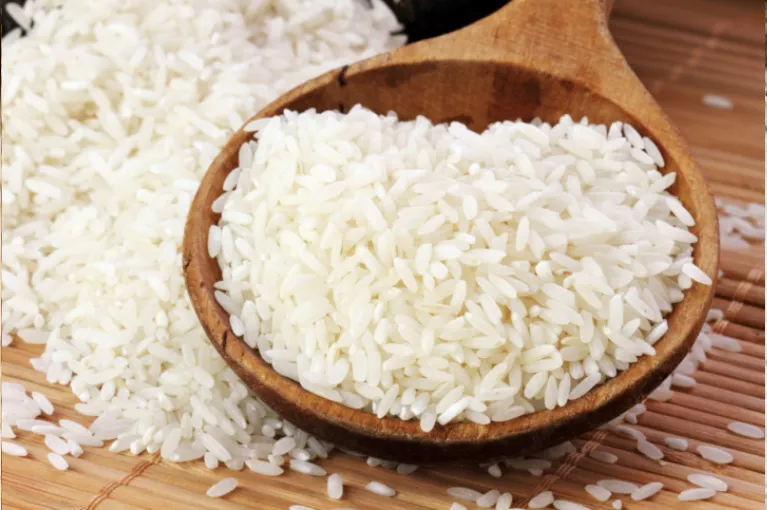
EMATA rice is a category of parboiled long-grain non-basmati rice traded in bulk, mainly for West African markets.
In trade, EMATA stands for rice that moves in bulk and volume. It's not bought for branding or origin stories. It's bought because it cooks consistently, handles storage well, and fits into large food distribution systems.
That's why EMATA rice keeps moving. It works at scale, stays affordable, and does exactly what buyers in mass-consumption markets need it to do.
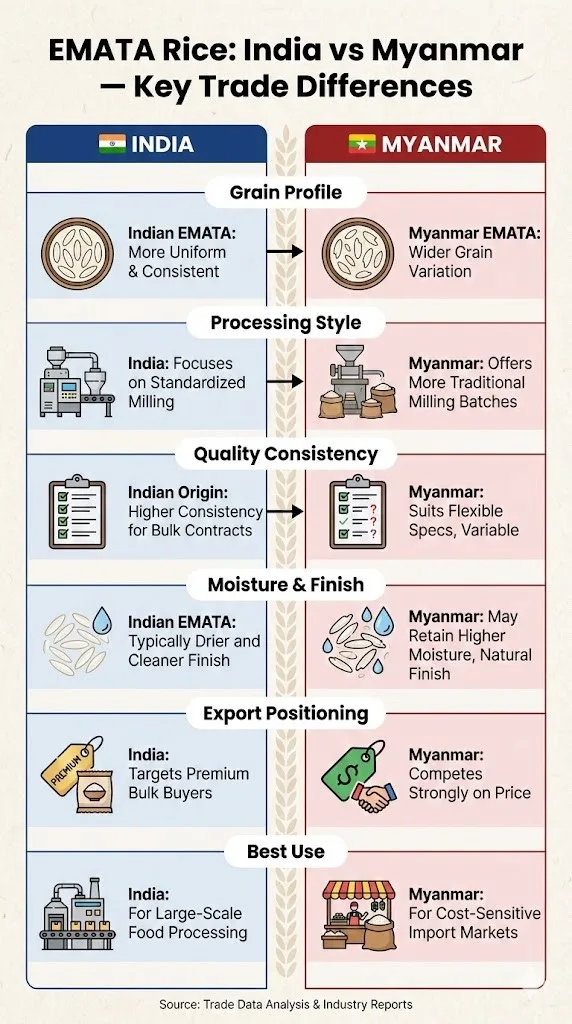
How is Indian EMATA Rice Different from Myanmar EMATA Rice?
Supply scale is the first separator.
Indian EMATA rice is available in much larger volumes. India's parboiling capacity and export infrastructure allow suppliers to handle big, repeat shipments more easily.
Consistency across shipments.
Indian EMATA is generally preferred when buyers want the same broken %, parboiling depth, and grain behaviour across multiple lots. Myanmar EMATA can vary more from shipment to shipment.
Price positioning differs.
Myanmar EMATA often comes in at a lower price point, especially in spot trades. Indian EMATA tends to trade slightly higher, backed by consistency and reliability.
Parboiling and handling.
Indian EMATA usually shows more uniform parboiling and better grain strength, which helps during long storage and transit. Myanmar EMATA may be softer, depending on processing.
Buyer preference depends on use
Buyers focused purely on cost often look at Myanmar. Buyers running large programs or long contracts usually lean toward Indian EMATA.
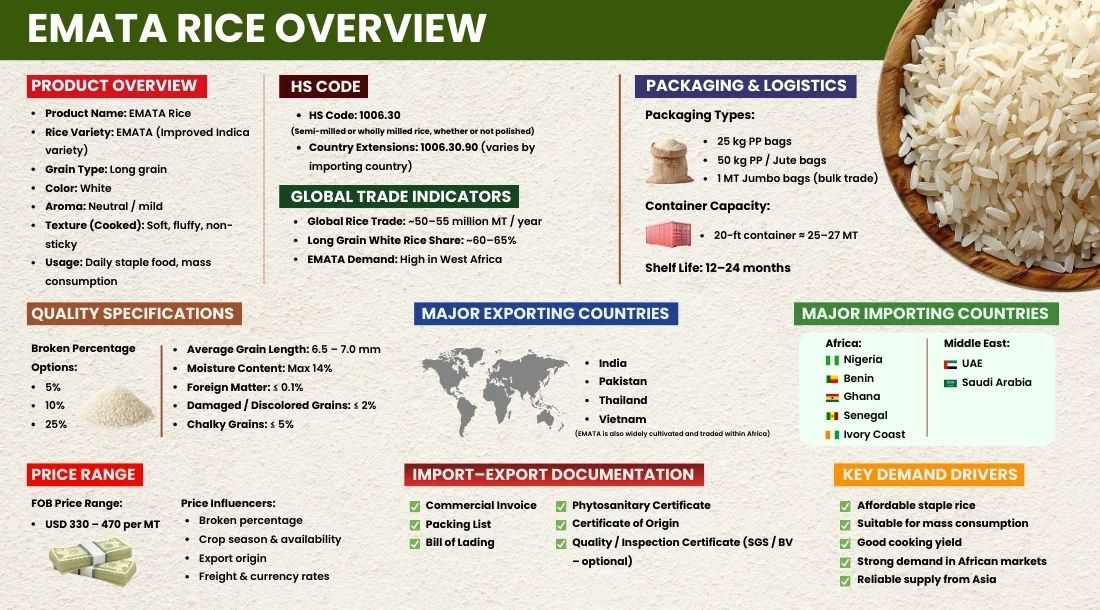
Emata Rice Specifications
Moisture
14% Max
Broken
25% Max
Size Of Broken
0.75 mm
Paddy
4 Grains Max
Damage
2% Max
Foreign Matter
1% Max
Red And Red Streaked Kernel
3% Max
Chalky Kernel
8% Max
Milling Standard
Reasonably Well Milled
Types, Grades & Variants - Emata Rice
Emata rice variety is a commercial trade designation, not a botanical variety. It is widely used in West African import markets to describe parboiled, long-grain, non-basmati rice positioned for everyday consumption. Trade specifications are driven primarily by broken percentage, grain profile, and parboiling intensity, rather than origin branding.
By Broken Percentage
5% broken - premium quality, preferred for branded retail and government-linked supply.
10% broken - most commonly traded grade for mass consumption
15-25% broken - widely used in open markets and redistribution
25-50% broken - price-driven segment for processing and institutional use
By Grain Type
Emata Long Grain Rice (dominant format in Emata trade and a type of long grain rice in non-basmati category)
Medium Grain (select markets)
Short grain (limited demand, niche usage)
By Parboiling Intensity
Light parboiled - softer texture, quicker cooking
Medium parboiled - balance of firmness and yield (most common)
Heavy / double parboiled firmer grain, higher post-cooking separation
By Origin
India
Thailand
Myanmar
Vietnam
Brazil / Guyana (select markets)
Most Emata rice imports revolve around long-grain parboiled rice which is Emata Long Grain Rice with 10-15% broken, while 5% broken grades are reserved for premium retail programs and institutional tenders.
Applications & End-Use Mapping
Demand for EMATA rice sits firmly inside supply systems rather than consumer branding. It is chosen because it works reliably at scale, not because it carries a label.
Public food supply programs use EMATA rice for its predictable yield and cooking consistency across large batches
Institutional kitchens and mass caterers prefer it because it cooks evenly and holds texture during repeated preparation
Food processors and wholesalers use EMATA rice for redistribution, blending, and repacking into local market formats.
Bulk traders value its ability to withstand long shipping cycles and extended storage in warm, humid climates.
Most EMATA rice demand is export-oriented, especially in regions where rice is a daily staple and food security takes priority over presentation.
Supply & Demand Countries - Emata Rice
Emata rice trade is shaped by a clear exporter-importer divide. Supply originates mainly from Asian bulk rice exporters, while demand is concentrated in West and Central African consumption markets, where Emata is positioned as a reliable, everyday staple.
Major Supplying Countries
India - Largest and most consistent supplier; wide flexibility in broken %, parboiling depth, and price bands
Thailand - for cleaner milling and stable quality, typically positioned slightly premium
Vietnam Competitive pricing, strong presence in 10-25% broken segments.
Myanmar - Emata rice from Myanmar is price-driven supply for bulk and redistribution markets
Brazil - ENiche supplier with preference in select West African ports
Guyana - Limited but steady exports to specific African buyers
Suppliers compete primarily on price consistency, shipment reliability, and ability to customize broken percentage, rather than branding
Major Importing / Demand Countries
Nigeria - Largest Emata market; strong demand across 10-25% broken categories
Benin - Key transit and redistribution hub for regional trade
Togo - Import-driven consumption market
Ghana - Demand for better-milled and mid-range broken grades
Cameroon - Growing imports for urban consumption
Senegal - Preference for parboiled rice with consistent cooking quality
Côte d'Ivoire - Stable importer with mixed grade demand
Demand is consumption-led rather than seasonal, making Emata rice a steady-volume import commodity
Trade Pattern Insight
Emata rice flows predominantly from Asia → West Africa
Contracts are finalized on technical specifications (broken %, grain length, parboiling level) rather than origin branding
Higher broken grades gain traction during price-sensitive periods
Global Market Overview
The global parboiled rice market is already a sizable one. In 2023, it was estimated at roughly USD 16.5 billion, and most projections point to a gradual rise toward USD 23 billion by the early 2030s. This isn't growth driven by hype or speculation — it's the kind that comes from steady, everyday consumption.
To put that in context, total global rice exports were valued at close to USD 39 billion in 2024, which means parboiled rice — and by extension EMATA rice — sits comfortably inside a deep, active global trade system rather than on the fringes.
Key Demand Drivers
Everyday demand: Emata is daily-use rice in West Africa, which keeps imports regular and predictable
Easy on pricing: Multiple broken options help buyers manage costs without disrupting supply.
Reliable supply base: Large exporters in India, Vietnam and Thailand keep volumes flowing year-round.
Spec-led buying: Deals are closed on specs, not stories—broken %, parboiling and grain length decide the trade.
Production & Supply Dynamics - Emata Rice
Exporter-led supply base
Emata rice is mainly supplied by parboiled long-grain exporters, led by India, which accounts for 60%+ of global parboiled rice exports, followed by Thailand, Vietnam, and Myanmar. Emata rice from Myanmar is slightly more cost competitive and has higher variations in sizes and polishing.
Climate & policy sensitivity
Monsoon swings, El Niño conditions, and export policy changes—especially from India—can quickly tighten availability or move prices for Emata-grade parboiled rice.
High origin concentration risk
Heavy reliance on a single origin exposes buyers to sudden duty revisions, minimum export prices, or shipment controls—making origin diversification a commercial necessity.
Emerging origins & hedging Brazil and Guyana cater to niche West African demand, while Southeast Asia acts as a secondary hedge against India-centric risk.
EMATA Rice Price & Bulk Cost Indicators
Indicative bulk export price:
USD 420-650 per metric tonne (FOB)
Pricing varies by:
Broken percentage
Origin
Packaging type
Certification requirements
Freight and shipment conditions
EMATA rice price per metric tonne is purely indicative for reference and remains subject to market movement, crop conditions, and trade policies.
HS Code & Classification - EMATA Rice
EMATA Rice is typically classified under HS Code 1006, covering semi-milled, wholly milled, and parboiled rice.
In bulk export trade, it is most commonly declared under HS 100630 for parboiled rice, subject to destination-specific customs interpretation
In EMATA Rice trade, consistency usually matters more than small price savings.
LOGISTICS, PACKAGING & INCOTERMS
Packaging: EMATA rice is usually packed in 25 kg or 50 kg bags, most commonly PP bags suitable for bulk handling
Storage & shelf life: When kept dry and well ventilated, it generally holds quality for 12-24 months, even across long supply cycles.
Incoterms: Trades are commonly done on FOB or CIF terms, with EXW used in select cases depending on buyer preference.
Export documentation: Shipments typically move with a Certificate of Origin, phytosanitary certificate, and inspection report, along with standard shipping documents.
Certifications & Compliance
At a basic level, EMATA rice shipments move with the usual essentials — a phytosanitary certificate and export-side food safety clearance. Nothing fancy, just what customs expects.
Some buyers ask for extra comfort. Things like ISO or HACCP come up more often with institutional or repeat orders, especially when volumes get larger.
Requirements can shift by destination. A document that's fine for one African port may need an extra check somewhere else, so most exporters confirm country-specific rules before locking the shipment.
Future Outlook & Opportunities
Demand is expected to stay firm rather than spike. West Africa continues to import large volumes of parboiled rice, with regional rice imports running into multiple million tonnes annually, driven mainly by population growth and food security needs.
India's role remains central. Indian parboiled rice already supplies a significant share of West African consumption, and exporters with stable specs are likely to see repeat demand rather than one-off orders.
Price sensitivity will keep EMATA relevant. Even small price shifts matter in EMATA trade. When Indian parboiled prices eased by 30-35% year-on-year in recent cycles, buying activity responded quickly.
Opportunities lie in consistency, not premiumisation. Buyers are more likely to lock longer contracts with suppliers who can deliver the same broken percentage, moisture, and packing across shipments.
Logistics and timing will matter more. Freight volatility and port congestion are shaping purchase decisions, creating space for exporters who can plan shipments better and align with buyer inventory cycles.
Why Buy EMATA Rice Through Tradologie?
Sourcing starts with specs, not listings
EMATA trade runs on broken %, parboiling level, packing, and shipment terms. Tradologie lets you start with those details, not generic product pages.
Direct access to verified Emata rice suppliers
You negotiate straight with exporters who are already active in EMATA trade. No middle layers, no diluted communication.
Real price discovery
Multiple suppliers quote against the same requirement. That helps buyers see the true market level instead of relying on a single offer.
Built for volume trade
EMATA moves in large shipments. Tradologie is designed around bulk negotiation, not small-order retail workflows
Transparency through the process
Offers, negotiations, and revisions stay visible. What's discussed is what gets executed.
Support without interference
Coordination is available when needed, but decisions stay between buyer and seller. Clean, professional, and practical.
Transparency & Disclaimer
Trade insights are based on exporter submissions, historical shipment patterns, and market observations.
All prices, specifications, and trade data are indicative and subject to change based on season, origin, compliance requirements, and logistics. Buyers and sellers should verify details prior to contracting.
We use cookies to enhance site functionality, improve user experience, analyze website performance, and deliver relevant content in accordance with our Cookie Policy.
We use cookies
Essential Cookies
Essential cookies are strictly necessary for Tradologie.com to operate properly. They enable core functionalities such as security, session management, network stability, and cookie consent preferences. These cookies do not collect personal data and cannot be disabled.
Name
Vendor / Service
Purpose
Expiry
Privacy Policy
ASP.NET_SessionId
Tradologie.com / ASP.NET
Maintains secure user session across pages.
Session
https://privacy.microsoft.com/
__RequestVerificationToken
Tradologie.com
CSRF protection for forms.
Session
https://www.tradologie.com/privacy-policy/
cookie_consent
Tradologie.com
Stores consent preferences so the banner does not reappear.
We use analytics cookies to gather anonymous, aggregated information about how visitors interact with Tradologie.com. This helps us improve the site, measure the success of content and services, and prioritize performance fixes.
Functional cookies allow the website to provide enhanced usability and personalization. They store preferences such as language, region, chat settings, and login details for a smoother browsing experience. Disabling these cookies may limit certain features.
Name
Vendor / Service
Purpose
Expiry
Privacy Policy
user_lang / lang
Tradologie.com
Remembers chosen language.
1 year
https://www.tradologie.com/privacy-policy/
timezone_pref
Tradologie.com
Stores timezone preference for display.
6 months
https://www.tradologie.com/privacy-policy/
remember_user
Tradologie.com
Keeps logged-in state when chosen.
30 days
https://www.tradologie.com/privacy-policy/
livechat_session
Tawk.to
Maintains chat session state.
Session
https://www.tawk.to/privacy-policy/
Marketing
Marketing cookies are used to deliver advertising that is relevant to you and to measure the effectiveness of our marketing campaigns across platforms such as Google, LinkedIn, Meta and Microsoft. These cookies are set only with your consent.