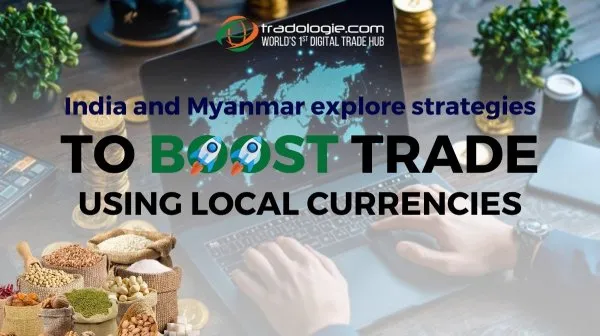
The indigenous currencies of Myanmar and India, the kyat and rupee, were the topic of discussion on Saturday over how to advance bilateral trade. On the fringes of the 12th East Asia Summit Economic Ministers' Meeting in Vientiane, Laos, Minister of Commerce and Industry Piyush Goyal met with Minister of Investment and Foreign Economic Relations of Myanmar, Kan Zaw. discussed methods to increase bilateral trade, particularly through the Rupee-Kyat currency mechanism, between our nations, as well as prospective cooperation in areas like lentils, diesel, gasoline, electric vehicles, etc. "Goyal stated in a post on social media site X.
India and Myanmar Strengthen Bilateral Trade Ties
In 2023-2024, bilateral trade between India and Myanmar was valued at USD 1.75 billion. India is considering fostering local currency trade with the United Arab Emirates, several African states, and Russia. Transaction costs would be lowered by local currency trading since there would be no need to exchange currencies twice. The Reserve Bank of India implemented a system in July 2022 to settle commercial transactions in foreign currencies using the Indian Rupee (INR).
As per GTRI, the purpose of the action was to assist nations in Africa and South Asia that were facing a scarcity of foreign money due to the post-Covid drop in exports and tourism, as well as those impacted by US sanctions. India's exports to Myanmar decreased from USD 807 million to USD 670.4 million in 2023-2024. However, imports rose from USD 954.74 million in 2022–2023 to USD 1.07 billion in the most recent fiscal year.
Government Takes Steps to Boost Pulse Imports
To suit domestic demand, India imports pulses from Myanmar, including tur, urad, and lentils. Aside from India, other nations that import agricultural products include Australia, Canada, Mozambique, Tanzania, Sudan, and Malawi. The government announced in April that the payment process for merchants bringing in pulses from Myanmar had been streamlined and made easier.
The consumer affairs ministry stated in a statement that importers have been requested to use the Special Rupee Vostro Account (SRVA) through Punjab National Bank for the Rupee/Kyat direct payment method. India imports pulses to make up for the deficit at home. Myanmar is the country's importer of tur and urad dals. On January 26, 2024, the Central Bank of Myanmar published instructions for SRVA payment operations.
Conclusion
In conclusion, talks between India and Myanmar on utilising local money for commerce represent a calculated move to deepen their economic relations. Both countries hope to lower prices and improve trade efficiency, especially in the energy and agricultural sectors, by enabling transactions in both rupees and kyats. This endeavour reflects both countries' commitment to strengthening their economic cooperation in the face of a changing global environment by addressing trade imbalances and promoting long-term economic stability.
If you want to export or import agro commodities in bulk, Tradologie.com is the best B2B platform. It facialites the bulk transactions without any middlemen through its state-of-the-art SaaS platform. Visit www.tradologie.com to explore B2B export opportunities and stay updated with the latest trends in the industry.
To register as a buyer, click here . To register as a seller, click here .
REFERENCE: Economic Times





.webp "Navigating the Basmati Export Disruptions: Diversifying to Africa and Non-Gulf Premium Rice Markets")