Import IRRI-9 Long Grain Rice in Bulk: Pakistani Trade Guide, Specs, Pricing & Suppliers
What is IRRI-9 Long Grain Pakistani Rice?
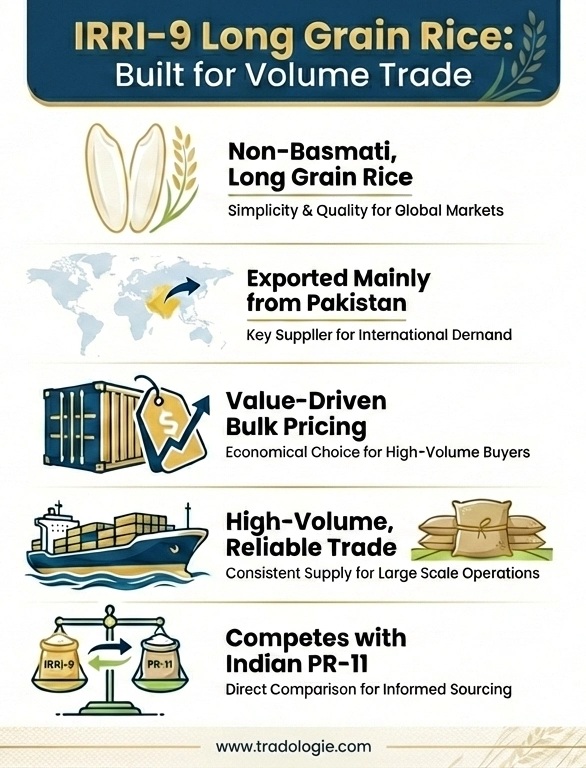
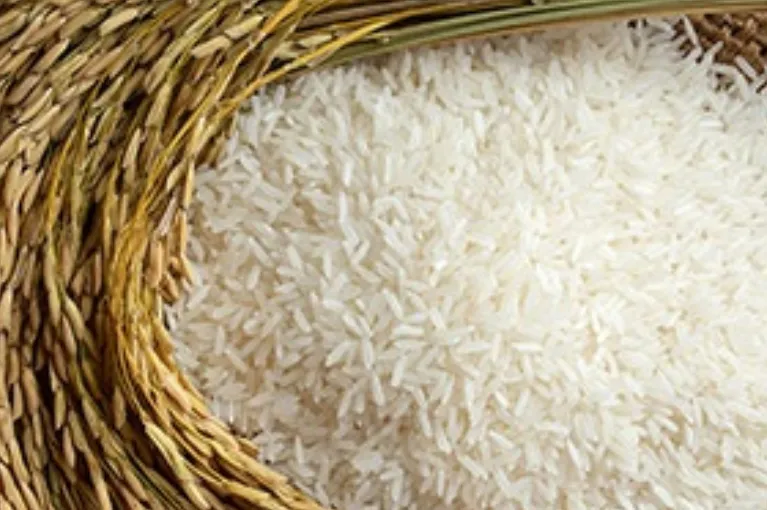
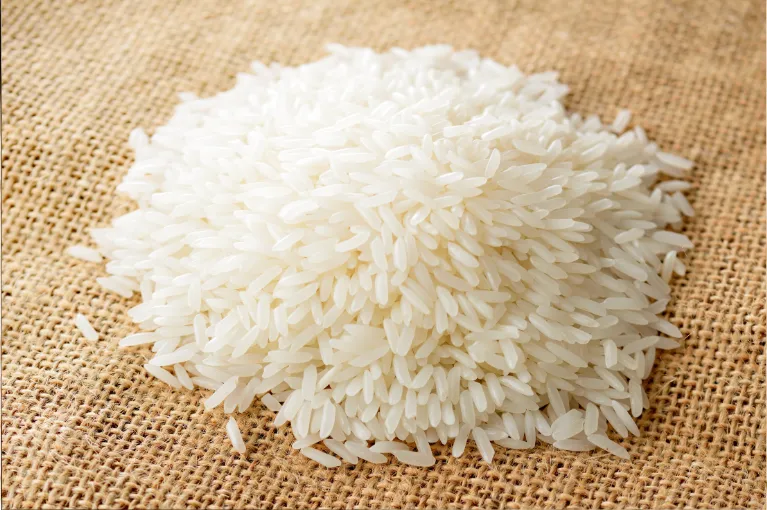
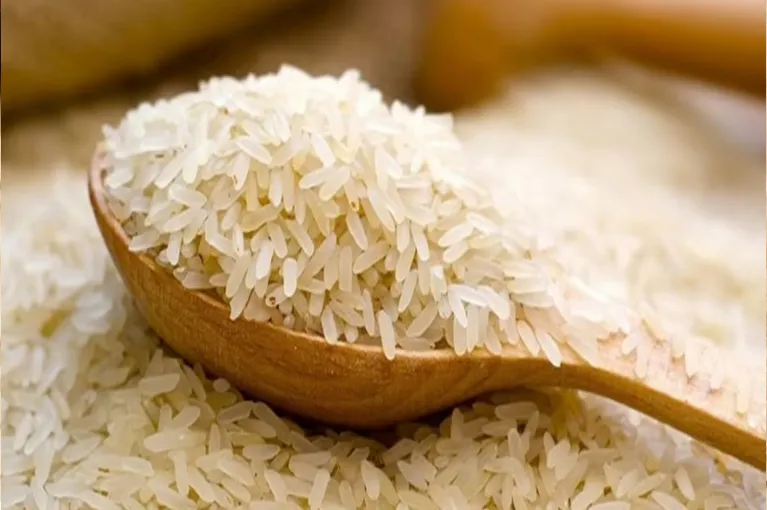
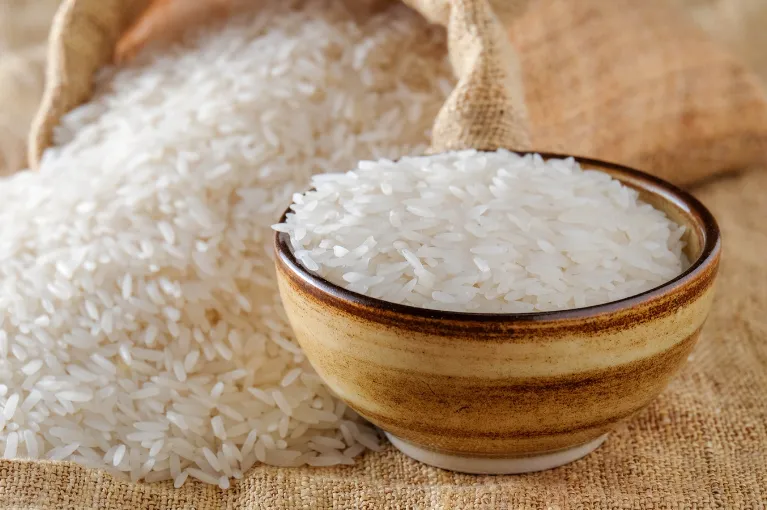
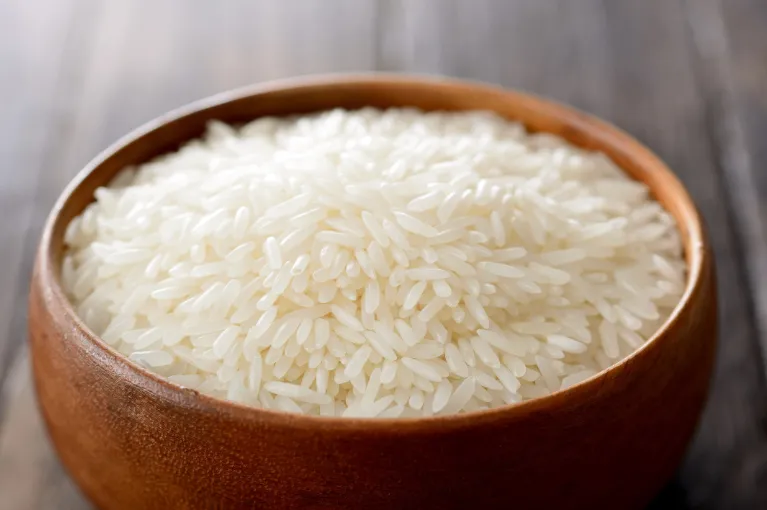
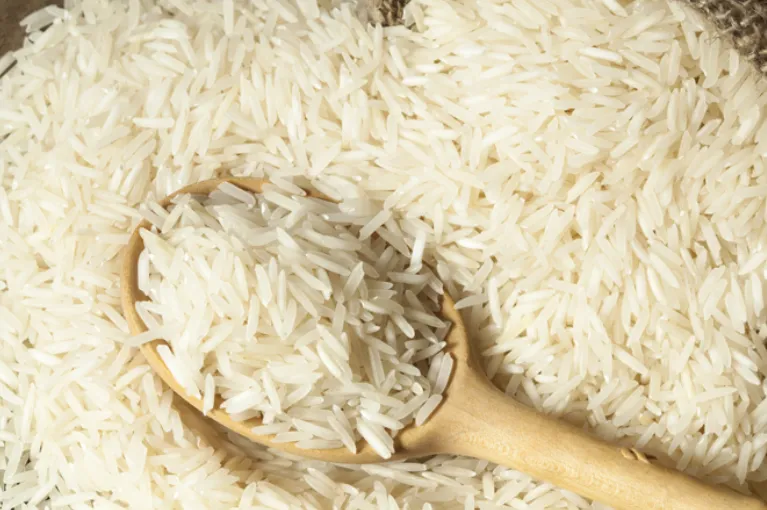
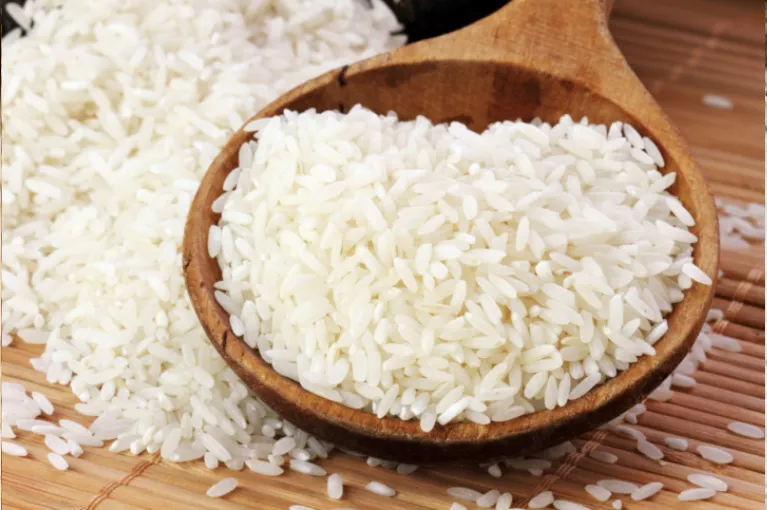
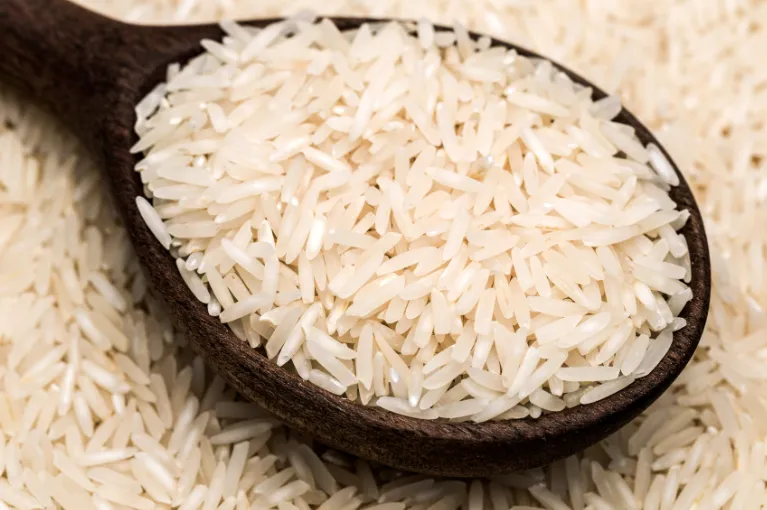
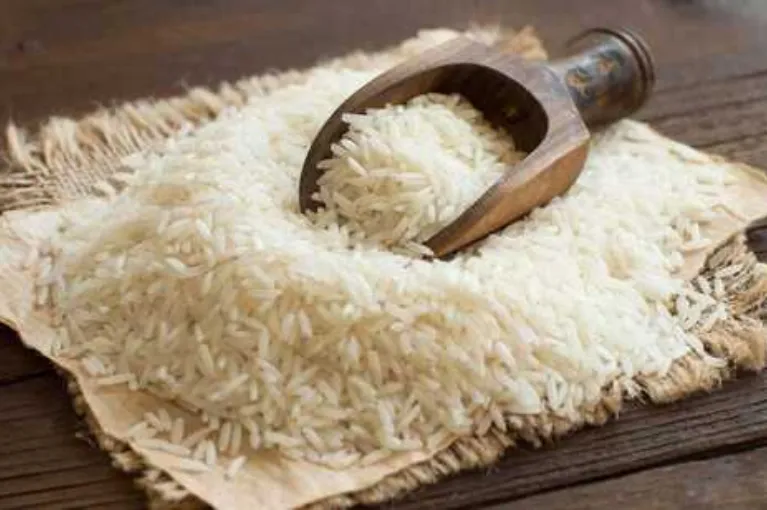
IRRI 9 long grain rice is a non-basmati rice that is widely grown and exported from Pakistan. It's plain, functional rice — no aroma play, no premium pitch, just among the parboiled rice varieties.
From a trade point of view, IRRI 9 long grain rice matters because it's grown at scale and priced competitively. That makes it suitable for bulk exports by long grain rice suppliers into markets where rice is a daily staple and cost control is important.
It's traded by rice traders not for premium offering, but because it moves in volume reliably. Buyers procure this parboiled rice variety when they need long-grain rice that cooks predictably and fits into large supply systems without pushing budgets.
How is IRRI 9 Long Grain Rice Different from Indian PR-11 Rice?
IRRI 9 long grain rice and Indian PR-11 sit in the same space. In fact, PR-11 is IRRI-9's closest and most direct competitor in global trade. They often compete head-to-head in the same tenders and markets.
- Origin makes the first difference.
IRRI 9 long grain rice comes out of Pakistan. PR-11 is grown and exported from India. Rice traders usually compare the two based on landed cost and shipment availability.
- The grain profile is similar, but not identical.
Both are long-grain, non-basmati rice. PR-11 generally runs slightly longer and more uniformly. At the same time, IRRI-9 is seen as a more value-led option by the long grain rice suppliers.
- Pricing behaviour differs.
IRRI-9 often undercuts PR-11 when Pakistan supply is strong. PR-11 can trade firmer during periods when Indian exports dominate the market.
- Supply scale vs flexibility.
India offers larger overall volumes of PR-11, which helps with big tenders. IRRI-9 competes by offering flexibility and quick movement in price-sensitive trades.
- Buyer choice comes down to timing and cost.
Most buyers don't show brand loyalty here. They switch between IRRI-9 and PR-11 depending on price, shipment timing, and current export policies.
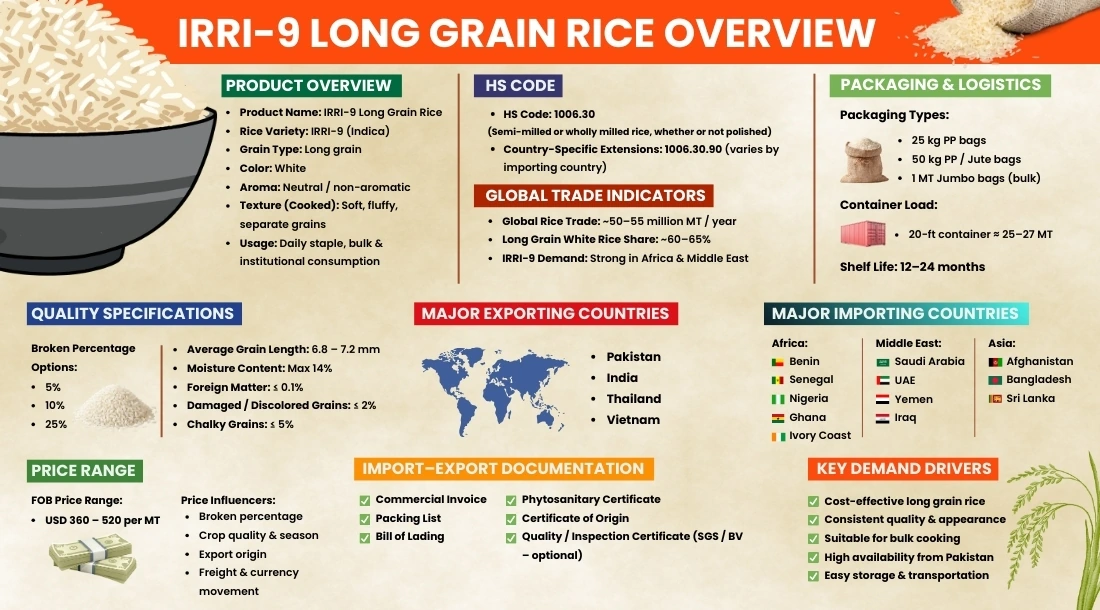
IRRI-9 Long Grain Specifications
| Moisture Content |
14% Max |
| Average Grain Length |
6.80 mm |
| Polishing Grade |
Double/Silky Polished |
| Broken Grains |
5% Max |
| Chalky Grains |
3% Max |
| Foreign Grains |
0.2% Max |
| Foreign Matter |
0.1% Max |
| Paddy Grain |
0.2 % Max |
| Under-Milled & Red-Striped |
2% Max |
Types, Grades & Variants - Import IRRI-9 Long Grain Non-Basmati Rice
IRRI-9 is traded as a practical, volume-driven rice, not as a branded product. When buyers import IRRI-9 rice, what they're really choosing is a rice among the parboiled rice varieties, not a different identity of the rice.
By Broken Percentage
- 5% broken - cleaner grade, used where buyers want better visual quality and tighter specs
- 10% broken - one of the most commonly imported grades for regular consumption
- 15-25% broken - widely imported for open markets and price-led programs
- 25%+ broken - limited use, mainly for processing or blending where cost matters most
By Processing Type
- Raw / white IRRI-9 - the dominant import format and mostly exported by IRRI 9 rice suppliers globally.
- Light parboiled IRRI-9 - imported in select markets where firmer grain and better handling are preferred
By Milling Standard
- Well milled - chosen when appearance and cleanliness matter
- Reasonably well milled - preferred for high-volume, cost-sensitive imports
By Origin
- Pakistan - primary origin for IRRI-9 imports, known for competitive pricing
- India (PR-11 as the closest alternative) - often compared directly in the same buying decisions and exported by long grain rice suppliers.
In real import trade, 10-25% broken, raw IRRI-9 makes up most shipment volumes in the global trade by IRRI 9 long grain rice suppliers. Buyers switch grades and origins mainly to manage price, availability, and shipment timing, not to change the rice itself.
Applications & End-Use Mapping - IRRI-9 Long Grain Rice
IRRI 9 is used where scale and consistency matter more than presentation. It fits into systems that cook rice in volume, day after day.
- Public food supply and welfare programs
IRRI 9 rice is commonly used in food distribution schemes where predictable yield and cost control are essential.
- Institutional kitchens and mass catering
Canteens, labour camps, hostels, and large catering operations prefer it because it cooks evenly and handles repeated preparation without much variation.
- Wholesale and redistribution trade
Rice traders use IRRI-9 for open markets and regional redistribution. It's easy to move, easy to price, and easy to re-pack.
- Food processors and bulk handlers
Some buyers use IRRI-9 for blending or secondary processing, where uniform grain and availability matter more than appearance.
- Import-dependent consumer markets
In many importing regions, IRRI 9 Long Grain Rice buyers end up using it as everyday table rice, forming part of regular household consumption rather than occasional use.
Buyers don't choose it for how it looks and smells on a shelf. It's a long grain rice and is chosen because it works reliably for mass consumption, across different kitchens and supply chains.
Supply & Demand Countries - IRRI-9 Long Grain Rice
IRRI 9 long grain rice trade is shaped by a clear split. Supply comes from a few exporting countries and long grain rice suppliers that can push volume, while demand sits in markets where rice is a daily staple and price discipline matters.
Top IRRI 9 Long Grain Rice Exporters
These exporters typically act as IRRI 9 Long Grain Rice sellers for bulk international buyers.
- Pakistan - The primary origin for IRRI-9. Large-scale production and competitive pricing keep Pakistan central to global IRRI-9 supply.
- Myanmar - Appears as a secondary source, mainly in price-led trades.
- Vietnam - Limited and selective presence, usually depending on crop cycles and pricing.
Supply competition is less about branding and more about who can ship on time, at the right breakage, and at the right price.
Top IRRI 9 Long Grain Rice Importers
These importers typically act as IRRI 9 Long Grain Rice buyers for bulk international sellers.
- West African markets - Regular demand for long-grain, value-focused rice used in everyday meals and open markets.
- Middle East - Imports driven by mass consumption, food service, and labour-intensive sectors.
- Southeast Asia (select markets) - Used as a value alternative alongside domestic rice.
- Price-sensitive Asian markets - Demand rises when IRRI-9 undercuts local or competing non-basmati options.
Global Market Overview - IRRI-9 Long Grain Rice
IRRI-9 sits inside the global rice trade tracked under HS Code 1006, which covers all traded rice — paddy, milled, semi-milled, parboiled, and broken. This is where volume really lives in the rice world.
Based on OEC (Observatory of Economic Complexity) data, global rice exports under HS 1006 are valued at around USD 30-35 billion annually.
IRRI 9 Long Grain Rice importers operate within this high-volume lane, specifically in the non-basmati, long-grain segment. This part of the market is driven by affordability, food security, and repeat consumption rather than branding or premium positioning.
What keeps the Pakistani Irri 9 rice active in the trade market is its spread. Supply is concentrated in a few exporting countries. The demand is scattered across Africa, the Middle East, and parts of Asia.
Key Demand Drivers - IRRI-9 Long Grain Rice
- Affordability without dropping quality too far
IRRI 9 long grain rice sits in a price band that works for many importers. It's cheaper than premium options but still cooks and handles well enough for daily use.
- Strong fit for food security needs
In several importing regions, rice is a staple. IRRI-9 helps governments, rice traders, and distributors keep supply flowing without stretching budgets.
- Reliable long-grain profile
Buyers want rice that looks familiar on the plate. IRRI-9's long-grain profile fits that expectation without carrying a premium tag.
- Flexibility across grades
The availability of multiple broken percentages allows buyers to manage costs depending on market conditions and end use.
- Ease of substitution
IRRI-9 competes directly with similar parboiled rice varieties. Buyers switch into it quickly when pricing or availability turns favourable.
- Repeat, consumption-led demand
Demand isn't event-driven. It comes from daily cooking, bulk kitchens, and regular household use, which keeps trade steady.
IRRI-9 demand grows quietly. It's pulled by need and practicality, not by marketing or trend cycles.
Production & Supply Dynamics - IRRI-9 Long Grain Rice
- Pakistan drives IRRI-9 supply
Pakistani Irri 9 rice is closely tied to Pakistan's rice belt. Production is concentrated, and export availability largely depends on the availability of the stock with the Irri 9 rice exporters.
- Crop grown with export intent
IRRI-9 isn't for the premium market supply. It's cultivated with bulk export markets in mind — long grain, manageable breakage, and competitive cost.
- Seasonal crop cycles matter
Supply loosens after harvest and tightens as stocks thin out. Buyers usually time purchases around these cycles rather than waiting for spot availability.
- Milling decisions shape grades
How IRRI-9 rice is milled decides whether it moves as 5%, 10%, or higher broken cargo. Exporters adjust milling output based on current market demand and price levels.
- Weather risk stays real
Flooding, irregular rainfall, or water shortages in Pakistan's growing regions can impact both yield and quality, showing up quickly in export prices.
- Few fallback origins
When Pakistani IRRI-9 tightens, buyers don't have many like-for-like alternatives. That's when Indian PR-11 usually enters comparisons.
IRRI-9 supply works smoothly when crops and logistics align. When they don't, the market reacts fast — prices move, and buyers adjust origins quickly.
Bulk Export Price & Bulk Cost Indicators - IRRI 9 Long Grain Rice
Indicative IRRI 9 Price Bulk Export Price:
USD 360-540 per metric tonne (FOB)
IRRI-9 prices stay firmly in the value-driven zone. They don't move on just demand— they move when crop, policy, or freight does.
What usually shifts the price:
- Broken percentage
Cleaner grades sit higher. 10-25% broken is where most volume trades and where pricing stays most competitive.
- Crop cycle and stock position
Prices ease post-harvest and firm up as stocks thin out. Timing matters more than negotiation style.
- Origin-side costs
Paddy prices, milling yield, and energy costs in Pakistan feed directly into export offers.
- Packaging format
Standard 25 kg and 50 kg PP bags are cheapest. Smaller or customised packs add incremental cost.
- Freight and delivery terms
Container availability and ocean rates often influence landed cost more than small changes in FOB rice prices.
Kindly Note: The IRRI-9 price is indicative, not fixed. In this trade, cost control comes from choosing the right grade at the right time, from the right suppliers and right logistics.
HS Code & Classification - IRRI-9 Long Grain Rice
IRRI-9 comes under HS Code 1006. That's the base rice category used in global trade.
For bulk exports, it usually goes out as HS 100630. Semi-milled or fully milled. Non-basmati.
Final HS declaration depends on milling and how the destination port reads the code. Most exporters align this with the buyer before shipping. Saves trouble at clearance.
Logistics, Packaging & Incoterms - IRRI-9 Long Grain Rice
- Packaging
IRRI-9 usually moves in 25 kg and 50 kg PP bags. That's the standard for bulk trade. Smaller packs exist, but most shipments stay volume-led for this long grain rice variety.
- Ports of loading
Exports typically move out of Pakistani ports, mainly Karachi and Port Qasim. Port choice depends on mill location and container availability.
- Storage & handling
Kept dry and ventilated, IRRI-9 stores without issues. It handles long transit well and doesn't need special treatment beyond basic care.
- Incoterms
Most deals are done on FOB terms.
CIF is common when buyers want a landed cost.
EXW appears occasionally for buyers managing inland logistics.
Irri 9 rice price is largely also determined by these factors.
Certifications & Compliance - IRRI-9 Long Grain Rice
- Phytosanitary certificate
This is basic and mandatory. Every IRRI 9 rice shipment moves with it.
- Certificate of Origin
Issued at export and required by destination customs to confirm the source country.
- Food safety compliance
Export-side food safety clearance is standard. Buyers expect the shipment to meet origin-country food regulations before it moves.
- Lab testing report
Commonly provided for moisture, broken percentage, and general quality parameters. Many buyers ask for it upfront, especially on repeat trade.
- Additional certifications (when required)
ISO or HACCP may be requested for institutional buyers or structured supply programs. Not universal, but relevant in certain markets.
- Country-specific compliance
Documentation requirements can vary by destination. What clears smoothly at one port may need extra paperwork at another, so exporters usually confirm this before shipment.
In Pakistani Irri 9 rice trade, compliance is kept clean and practical - enough to clear customs and keep shipments moving without unnecessary complexity.
Future Outlook & Opportunities - IRRI-9 Long Grain Rice
- Large, active trade base
Under HS Code 1006, global rice trade is valued at around USD 33-35 billion annually. IRRI-9 operates inside this steady, high-volume stream rather than a niche market. For an IRRI 9 Long Grain Rice importer, this means access to a steady, high-volume supply lane with predictable global trade flows.
- Non-basmati keeps volumes moving
Most of the trade under HS 100630 is non-basmati rice. This is where IRRI-9 sits — repeat demand, price-led buying, and regular shipment cycles.
- Africa and Middle East remain core
Import dependence in these regions continues to support demand. As long as rice stays a staple, HS 100630 flows stay active.
- Opportunities come from switching, not expansion
IRRI-9 benefits when buyers switch within the same HS category due to price gaps, supply tightness, or policy changes elsewhere.
- Execution matters more than positioning
In a crowded HS 1006 trade, exporters who manage specs, timing, and logistics well are the ones who see repeat orders.
The outlook for IRRI-9 is steady, not flashy. It stays relevant because it sits inside one of the most consistently traded food categories in the world. If you're planning to buy bulk IRRI 9 Long Grain Rice, choosing the right sourcing channel matters as much as price.
Why Buy IRRI-9 Long Grain Rice Through Tradologie?
- Built for bulk trade, not listings
You don't scroll products. You post a real requirement and suppliers respond against it. That's how serious buying actually happens.
- Direct access to verified exporters
You deal straight with long grain rice exporters who are active in the trade. No broker layers, no mixed signals.
- Live negotiation, real market pricing
Prices aren't static. Negotiations happen in real time, based on broken %, volume, and shipment terms.
- Specs stay front and center
Grain type, breakage, moisture, packing, port — everything is aligned upfront, not fixed later.
- Support without interference
Coordination is there when needed, but decisions stay between buyer and seller. Clean, professional, and transparent.
Tradologie works when volumes matter and clarity matters more. If you're sourcing IRRI-9 in bulk, it helps you connect with the right IRRI-9 Long Grain Rice exporters and close deals the way global trade actually works.
Transparency & Disclaimer
All prices, specifications, and trade data are indicative and subject to change based on season, origin, compliance requirements, and logistics. Buyers and sellers should verify details prior to contracting.