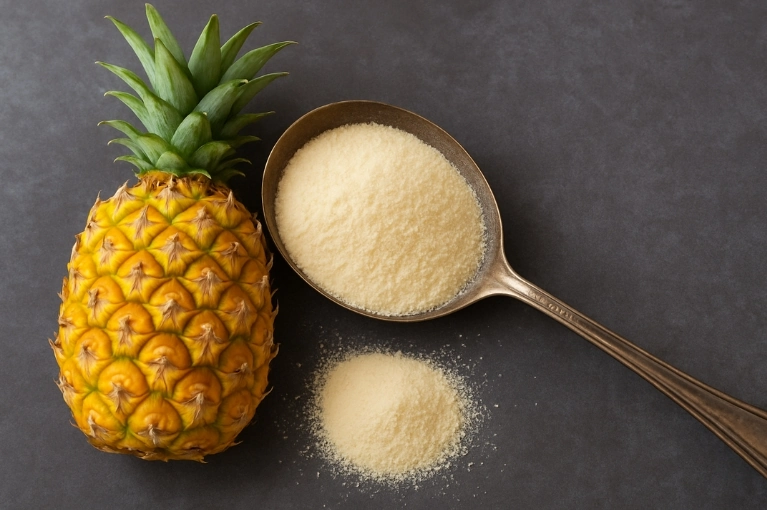
Pineapple Powder
Minimum Order Quantity : 5 MT
Shelf life : 1-24 months under cool and dry storage
Common Incoterms : FOB, CIF, CFR
Documentation : includes COA, MSDS, phytosanitary certificate, certificate of origin, and inspection reports
Facilitated by Tradologie.com
Offered By : Pineapple Powder Exporters

This is a Vegetarian and plant-based product

| Grade / Type | Physical Parameters | Purity / Size / Moisture / Tolerance | Applicable Standards | Testing & Inspection Methods | Specification Source | |
|---|---|---|---|---|---|---|
| Spray-Dried Pineapple Powder (Food Grade) | Light yellow to pale cream color, free flowing powder, characteristic pineapple aroma, no visible foreign matter | pH: 3.0-4.5, Total soluble solids (Brix): 60-70 (reconstituted), Acidity: 2-4% (as citric acid) | Purity ≥ 98%, Moisture ≤ 5%, Particle size: 80-120 mesh, Extraneous matter ≤ 0.5% | FSSAI, Codex Alimentarius, ISO 22000, HACCP | Moisture: Oven drying, Particle size: sieve analysis, Organoleptic test, Microbial count | Industry + Export Trade |
| Freeze-Dried Pineapple Powder (Premium Grade) | Bright natural yellow, fine powder, strong natural aroma, better retention of color & nutrients | pH: 3.2-4.2, Vitamin C retention high, Low water activity | Purity ≥ 99%, Moisture ≤ 3%, Particle size: 100-150 mesh | Codex, ISO 22000, US FDA (for exports), HACCP | Water activity meter, Vitamin retention, Microbial testing | Premium Food Industry |
| Organic Pineapple Powder | Natural yellow, no synthetic additives, mild natural aroma | Similar to spray or freeze dried but free from chemical residues | Purity ≥ 99%, Moisture ≤ 5%, Pesticide residue: as per organic norms | USDA Organic, EU Organic, NPOP India, Codex | Residue testing (GC-MS), Certification audits, Lab testing | Regulatory + Organic Trade |
| Industrial Grade Pineapple Powder | Yellowish to light brown, slightly coarse, acceptable for beverages, bakery, sauces | Acidity: 2-5%, pH: 3-5 | Purity ≥ 95%, Moisture ≤ 7%, Particle size: 60-100 mesh | FSSAI, Codex | Basic physico-chemical and microbial tests | Bulk Food Processing |
| Instant Beverage Grade | Free flowing, easily soluble in water, uniform texture | Solubility ≥ 95%, pH: 3-4.5 | Moisture ≤ 4%, Mesh: 100+, Anti-caking agents permitted | Codex, ISO, FSSAI | Solubility tests, Moisture, Microbial | Beverage Industry |
By Size / Calibration
Different buyers want different grinds. Beverage and instant drink companies usually ask for very fine dried pineapple powder because it dissolves fast and doesn't leave lumps. Bakery and seasoning players are more relaxed. Slightly coarse works for them. This is usually fixed in the contract because once production starts, changing it later becomes messy.
By Variety / Origin
Origin does make a difference. Pineapple from India, Thailand, the Philippines, or Vietnam doesn't taste exactly the same. Sweetness, colour, even aroma shifts a bit. Some buyers don't mind. Others are very particular. Big brands often keep more than one origin in their sourcing just to avoid last-minute supply issues.
By Processing Level
Most bulk trade runs on spray-dried powder because the cost makes sense. Freeze-dried is there, but mainly for premium segments. Better flavour, better nutrition, but also higher price. Some grades also come with carriers like maltodextrin. Not exciting, but it helps stability and flow during production.
By Moisture / Composition
Moisture is one of those small things that can create big trouble. If it's high, shelf life drops and the risk goes up. Buyers also look at fruit content and sugar levels. More fruit usually means better quality, but also higher cost. So the balance depends on the final application.
By Quality Grade
There is a clear split now. Premium buyers want colour, aroma, low residues, traceability. Organic and clean-label demand is slowly growing. On the other side, mass food companies are still focused on price and consistency. Both segments exist, and suppliers usually work across both.
Application-wise mapping The product doesn't sit in one box. Beverage guys use it in drink mixes, smoothies, and flavour bases. Bakery and confectionery add it to fillings, coatings, and premixes. Snack companies use it in seasoning. Dairy players put it in yoghurt, ice cream, and flavoured milk. Nutrition brands are using it more now for supplements and health blends. So one product, but many directions.
Industry-wise usage Most of the volume still goes to food processing. That's the core. Beverage and dairy come next. Health and wellness is growing, but the volumes are still catching up. Personal care and cosmetics are there too, but more niche and premium. For suppliers, this spread is useful. If one sector slows, others keep moving.
Processing vs retail vs industrial use Industrial buyers are very practical. They care about flow, moisture, and batch consistency. Retail brands think differently. They want good colour, natural labels, and strong aroma. Smaller buyers often want flexible packaging and smaller quantities. Processors usually want stability and long-term contracts. Everyone wants reliability, but for different reasons.
Export-oriented applications In exports, things change by region. Europe and the US push clean label and residue control. The Middle East looks more at price and speed. Southeast Asia is more cost-driven. So the same pineapple powder, but different expectations. The suppliers who understand this usually grow faster.
Top 10 Exporters of Pineapples, Fresh or Dried (HS 080430)
| Rank | Country / Region | Export Value (USD '000) | Export Value (USD Mn) | Quantity (Kg) |
|---|---|---|---|---|
| 1 | Costa Rica | 1,684,216 | 1,684.2 | 2,457,890,000 |
| 2 | Philippines | 740,991 | 741.0 | 1,128,540,000 |
| 3 | Netherlands | 348,523 | 348.5 | 362,115,000 |
| 4 | Belgium | 210,664 | 210.7 | 235,886,000 |
| 5 | United States | 183,514 | 183.5 | 148,222,000 |
| 6 | Spain | 152,347 | 152.3 | 156,445,000 |
| 7 | Thailand | 148,229 | 148.2 | 276,514,000 |
| 8 | Mexico | 124,991 | 125.0 | 176,389,000 |
| 9 | Germany | 109,452 | 109.5 | 132,740,000 |
| 10 | France | 94,336 | 94.3 | 115,518,000 |
| Rank | Country / Region | Export Value (USD '000) | Export Value (USD Mn) | Quantity (Kg) |
|---|---|---|---|---|
| 1 | United States | 1,347,228 | 1,347.2 | 1,795,420,000 |
| 2 | Netherlands | 511,406 | 511.4 | 658,342,000 |
| 3 | Spain | 399,175 | 399.2 | 503,588,000 |
| 4 | Germany | 365,748 | 365.7 | 472,190,000 |
| 5 | United Kingdom | 323,661 | 323.7 | 416,885,000 |
| 6 | France | 297,405 | 297.4 | 384,540,000 |
| 7 | Italy | 248,537 | 248.5 | 319,778,000 |
| 8 | Canada | 222,914 | 222.9 | 305,442,000 |
| 9 | Belgium | 186,729 | 186.7 | 256,981,000 |
| 10 | Japan | 175,366 | 175.4 | 241,653,000 |
If you look at the pineapple powder market, it's still small compared to big ingredientsBut the direction seems to be somewhat clear. The size is expected to move approximately from around USD 34.8 million in 2026 to nearly USD 54 million by 2033 right now.
The real push is coming from how food companies are changing their mindset. They don't want fresh fruit headaches anymore.They want something stable, easy to store, and easy to use. Consumers are also well aware, and at the same time keep demanding natural pineapple powder, clean-label, and functional products.So companies are slowly adjusting.
Another interesting shift is happening in nutrition and blended products. Fruit powders are now being used in hybrid mixes, supplements, and wellness formats. It's not a huge market yet, but it's growing quietly. And these are the kind of segments that suddenly scale once big brands step in.
Core industries The bulk demand is still coming from food processors. That's the backbone. Beverage, dairy, bakery, snack players — they use dried pineapple powder and other dried fruit powders because it makes life easier. No seasonality, no last-minute panic when fresh fruit prices jump. Nutrition and supplement brands are also buying more now. The health angle is working for them.
Consumer / industrial trends Consumers keep talking about natural pineapple powder, clean label, plant-based. Food companies are not ignoring it. They are slowly shifting from artificial flavours to fruit-based ones. At the same time, factories are thinking about stability. Longer shelf life, easy storage, and predictable costs. That’s what really drives the shift.
Innovation & new applications New use cases are opening up quietly. Ready-to-drink beverages, protein mixes, functional foods, plant-based dairy, even wellness products. Earlier this was a niche. Now it's becoming routine. The brands that move early create demand. Others just follow later.
| Parameter | Indicative |
|---|---|
| Indicative Bulk Price Range | USD 3,200 - 7,800 per metric ton (depends on spray-dried vs freeze-dried, quality, and origin) |
| Unit of Trade | USD per metric ton (MT) |
| Export Price Trend | Moderately stable; moves with fresh pineapple prices, energy costs, and drying technology |
| Regional Price Differences | Lower in Southeast Asia (Thailand, Vietnam, Philippines); higher in Europe and US due to compliance and certification |
| Premium Segment Pricing | Organic, freeze-dried, and clean-label variants can go above USD 8,000 - 10,000 per MT |
| Key Cost Drivers | Raw fruit availability, processing method, moisture control, packaging, and logistics |
| Seasonal Impact | Prices can rise during off-season fresh fruit supply or high export demand periods |
| Freight Sensitivity | High, as product is often exported in bulk to long-distance markets |
For the latest pineapple powder FOB price in India, get in touch with the trade facilitation team of Tradologie
Disclaimer: Prices are indicative and may vary based on grade, drying process, volume, origin, certifications (organic, HACCP, ISO), buyer compliance requirements, and logistics conditions in the global trade market.
| HS Code | Product Category / Meaning |
|---|---|
| 0804 | Fresh pineapple (raw material category) |
| 0804.30 | Fresh or dried pineapples |
| 2008 | Fruit, nuts and edible plant parts, prepared or preserved |
| 2008.20 | Pineapple, otherwise prepared or preserved |
| 2008.99 | Other processed or preserved fruit |
| 2106 | Food preparations not elsewhere specified |
| 2106.90 | Fruit powders, extracts, and ingredient blends |
| 2106.90.99 | Most commonly used global trade code for dried pineapple powder |
| Tax Classification (India) | Export: Zero-rated GST. Domestic: Typically 12-18% depending on product formulation and use. |
| Parameter | What Importers Focus On |
|---|---|
| Quality | Food-grade, hygienic processing, low microbial load, natural flavour, stable shelf life (moisture-controlled, airtight or nitrogen-packed) |
| Type & Grade | Spray-dried or freeze-dried, organic vs conventional, fine and free-flowing powder, consistent colour and aroma |
| Testing | Compliance reports (microbiology, heavy metals, pesticide residues, moisture, sulphur dioxide, third-party lab testing) |
| Regulatory Compliance | Certification as per FSSAI, Codex, EU, US FDA, and other destination market standards |
| Documentation | COA, MSDS, Certificate of Origin, Phytosanitary, FSSAI licence, Organic/Halal/Kosher if required, product specifications |
| Consistency | Uniform quality across shipments, stable supply contracts, predictable lead time |
| Packaging | Bulk export packaging (drums, food-grade bags, moisture-barrier lining, palletized shipments) |
| Traceability | Source transparency, batch tracking, farm-to-processing traceability, sustainability focus |
Packaging types Most shipments move in food-grade bags or cartons with inner liners. Bulk buyers usually go for 20-25 kg packs because they are easy to handle and stack. Premium buyers sometimes ask for smaller packs or customised packaging, but in bulk trade, practicality wins.
Storage & shelf life The product is stable, but only if handled properly. Cool, dry storage is enough. No fancy cold chain needed. And yes, depending on moisture and processing, the approximation of the shelf life usually runs between 12 and 24 months. But poor storage can ruin everything, so serious buyers check this closely.
Incoterms relevance Most deals happen on FOB because buyers like control over freight. CIF works when they want a complete solution. EXW is used when buyers already have logistics partners. The choice usually depends on trust and experience between both sides.
Export documentation Basic paperwork is standard. Needless to say, that invoice, packing list, certificate of origin, and lab reports are the heart of any agro commodity exports. Premium markets also expect traceability and compliance records. Smooth documentation means faster clearance. Weak paperwork slows everything down.
| Category | What Buyers Usually Expect |
|---|---|
| Mandatory Certifications | Food safety compliance, FSSAI licence, phytosanitary certificate, Certificate of Analysis (COA), export inspection, basic regulatory approvals as per destination market |
| Optional / Premium Certifications | HACCP, ISO 22000, FSSC, BRC, organic certification, non-GMO, clean-label, traceability and quality management systems |
| Region-Specific Compliance | Middle East - halal, hygiene, and shelf-life focus; Europe - strict pesticide, heavy metal, and traceability norms; North America - audits, transparency, clean-label; Asia & Africa - price-quality balance with compliance and reliable supply |
Growth segments The biggest growth is not going to come from traditional food anymore. It's coming from beverages, health products, plant-based foods, and functional nutrition. Smoothie mixes, ready-to-drink, protein blends, wellness formats — this is where the momentum is building. As more brands push convenience and health together, fruit powders will naturally get more space.
Value-added opportunities Just selling basic powder will not be enough in the long run. Buyers are already asking for customised blends, higher fruit content, clean label, and specific functionality. Some want colour, some want flavour, some want nutrition. The suppliers who move into formulation, blends, and private labels will get better margins. The rest will keep fighting on price.
Sustainability & traceability This part is getting serious now. Buyers are asking where the fruit comes from, how it's processed, and whether the supply chain can be tracked. It’s not just for branding. Large companies don’t want risk. If you can show transparency, residue control, and stable sourcing, you automatically move into better contracts.
Get in Touch
Most bulk buyers are beverage companies, bakery and confectionery manufacturers, dairy and flavouring brands, nutraceutical players, and health food companies. They need stable ingredients that behave the same every time, so powder works better than fresh fruit for large-scale production.
The process is simple. You just need to register as a verified buyer on Tradologie. Registration is completely free. Once your profile is approved, you can raise an inquiry or procurement request. Verified global suppliers participate and submit offers. You can compare price, origin, quality, and delivery terms in one place.
In most international trade, the usual starting point is one full container load. That typically works out to around 15–20 metric tons depending on packaging and product density. However, MOQ can change based on origin, trial orders, and supplier flexibility.
Buyers usually look at colour, flavour strength, moisture level, solubility, and purity. Processing method (spray-dried vs drum-dried), raw fruit quality, and consistency also play a big role. Compliance and traceability are becoming just as important as price.
Most serious buyers ask for food safety and compliance documents such as HACCP, ISO, FSSC, and residue testing. For premium segments, organic, non-GMO, and clean-label certifications are also becoming common.
Prices vary widely depending on grade, colour value, processing method, and volume. To know the exact pineapple powder export price per kg, get in touch with our trade facilitation team. They help you connect with verified suppliers and receive competitive global quotations.
Demand is strong in North America, Europe, the Middle East, and Southeast Asia. These regions use it in beverages, health foods, and processed products. Each market has different expectations, especially around quality and documentation.
Because it saves time and reduces risk. Instead of searching for suppliers individually, buyers get access to verified exporters, transparent price discovery, and structured negotiation. This helps in building long-term supply partnerships and ensures consistency across shipments.
-powder-(1).webp)
.webp)
.webp)
.webp)