Key Highlights
- Based on official reports, the United States is a critical destination for Indian rice exports to the USA, taking in 335,554 metric tonnes (MT) during the 2024–25 fiscal year.
- Long-grain aromatic Basmati rice serves as the main economic foundation of this trade lane, bringing in USD 337.10 million in revenue and offering highly stable returns compared to standard non-basmati options.
- Shifting consumer habits, a growing South Asian diaspora, and strict quality control setups maintain a steady demand for rice exported from India to USA.
- US buying houses prioritize properly aged, visually uniform crop lines to meet strict retail expectations and secure predictable transaction margins.
The international grain trade relies on strict product standards and highly established purchasing patterns. For rice millers, exporters, and procurement managers, the United States represents a premium consumer market. Success in this territory depends entirely on a supplier's capacity to consistently deliver exact grain specifications, clear biosecurity profiles, and reliable shipping timelines month after month.

Official trade figures reveal the scale of this agricultural relationship. Data compiled from export reports shows that the US imported approximately 335,554 MT of rice from India during the 2024–25 fiscal window. This volume reflects a clear reliance on Indian processing plants to satisfy domestic consumption gaps, making the India to USA rice export lane a major focus for commercial trade desks looking for stable, long-term business.
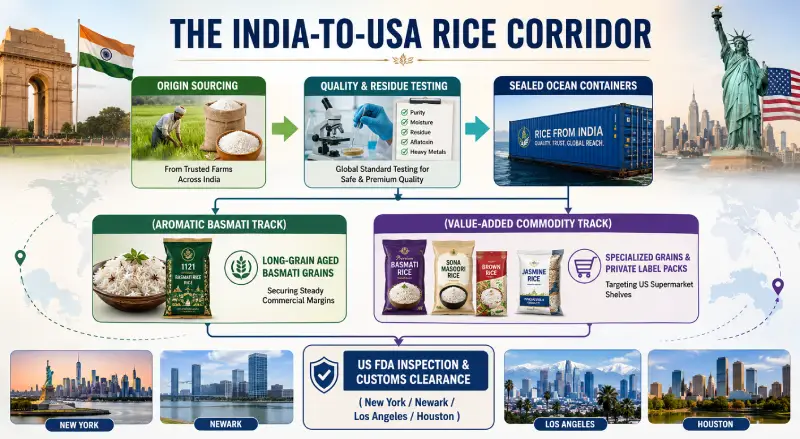
Understanding the Trade: Why USA Imports Rice from India
The steady Indian rice demand in USA is built on structural, cultural, and economic foundations within the North American food industry.
1. The Basmati Core
Long-grain aromatic Basmati rice serves as the primary value driver in this trade corridor, accounting for USD 337.10 million in sales. Because Basmati possesses specific geographical indications and strict regulatory definitions, it cannot be easily replicated by domestic US farms in states like Arkansas or California. This premium category explains a big part of why USA imports rice from India, remaining largely insulated from the sharp price fluctuations that often affect ordinary non-basmati varieties. By sourcing uniform crop lines—such as 1121 steam or parboiled Sella—exporters can align with the expectations of the North American retail sector while maintaining predictable margins per container.
2. Changing Consumer Habits and Demographics
The consumer base within the United States has broadened significantly over the past few decades. The growth of the South Asian diaspora, alongside a general shift in mainstream eating habits toward international and diverse cuisines, has turned long-grain aromatic rice into a regular supermarket item rather than a niche product. Because of this consumer shift, buyers look for premium aromatic grains that provide distinct elongation and clean, separate textures when cooked.
3. Institutional and Retail Infrastructure
Large-scale US food manufacturers, multi-location restaurant chains, and corporate hypermarkets require continuous, high-volume grain allocations. Because Indian mills offer a highly reliable volume engine capable of processing specific physical grades, US procurement desks choose to maintain steady, year-round purchasing contracts rather than rely entirely on localized supply lines.
Product Specifications: Sella vs. Steam vs. Raw
When American procurement teams source rice from India, they look at distinct physical and chemical parameters depending on their target consumer channel:
- Golden and Creamy Sella (Parboiled): This variant is highly sought after by high-volume food service providers and industrial catering crews across the US. The parboiling process gelatinizes the internal starch, which hardens the kernel. This allows the grain to withstand prolonged steaming times in commercial warmers without breaking apart or turning sticky—a critical benchmark for institutional food prep.
- Steam Basmati (1121/1509): Steam rice is widely used by mainstream hypermarkets for private-label packaging. It offers a balanced combination of strong natural aroma and a clean, bright white appearance. It retains its cooking length well, making it a highly practical option for competitive retail shelf placement.
- Traditional Aged Raw Basmati: Raw Basmati commands top-tier pricing in specialized ethnic grocery stores. These grains are carefully aged for 12 to 24 months to minimize moisture content, allowing the natural crop oils to mature. This process releases the deep fragrance that premium culinary consumers expect.

Sourcing & Technical Checks: Handling US Port Entry
You can't count on steady business with US buyers if you treat customs rules like an afterthought. Border checkers at main drop-off ports like New York, Newark, Los Angeles, and Houston don't play around when it comes to screening agricultural containers. To make sure your shipments clear customs without expensive port delays, you have to nail the quality checks right on the mill floor.
1. Checking for Bugs and Chemical Residues
To get past the strict food safety eyes at the US FDA, you can't just guess on quality. Exporters have to send their grain samples to NABL-approved labs for complete chemical screenings before packing. They use globally accepted testing methods to make sure the batch sits safely below US pesticide limits. If a single random spot check at the port shows unapproved chemical levels, your entire container load is getting locked down or destroyed
2. Cleaning and Sorting the Grains
Grains headed for premium American grocery shelves can't have field stones, black tips, or discolored kernels mixed in. To fix this, mills run the crop through heavy mechanical sifting screens and modern optical color sorting systems to pull out the bad seeds. Keeping your broken-grain percentage as low as possible—usually under 1% to 2% for premium labels—is your best defense against buyers trying to cut your prices after delivery.
3. Moving Your Sales Online to Avoid Middlemen
A major headache for growing Indian export houses is dealing with messy local broker chains and wasting time on random quote-seekers who don't even have active bank credit lines.
To clear out that noise, a lot of trade desks are taking their business development onto digital transaction networks like Tradologie. The setup works completely on active buyer requests. Before an overseas buyer can even start a price negotiation, they have to upload a verified company profile and clear background checks. This lets you bid directly on live, real orders inside a clear digital portal, cutting out unneeded middlemen and securing clear, bank-backed payment terms from day one.
Final Overview
The multi-million-dollar volume of rice exported from India to USA highlights a mature and steady agricultural relationship. For Indian exporters, the US is a premium market that values product consistency, strict processing discipline, and full compliance over cheap spot pricing. By maintaining precise quality metrics and focusing on high-value, aromatic crop lines, trade desks can secure a resilient, well-structured pipeline across consecutive shipping seasons.
Disclaimer
The information provided is for educational and informational purposes only. Rice export statistics, import regulations, quality standards, and food safety requirements are subject to change. Exporters should verify the latest APEDA data, US FDA regulations, and destination-country import requirements before shipping rice to the United States.



-export-from-india.webp "Corn (Maize) Export from India: Capitalizing on India's Non-GMO Edge, Pricing, HS Codes, and Key Destination Markets")