Key Highlights
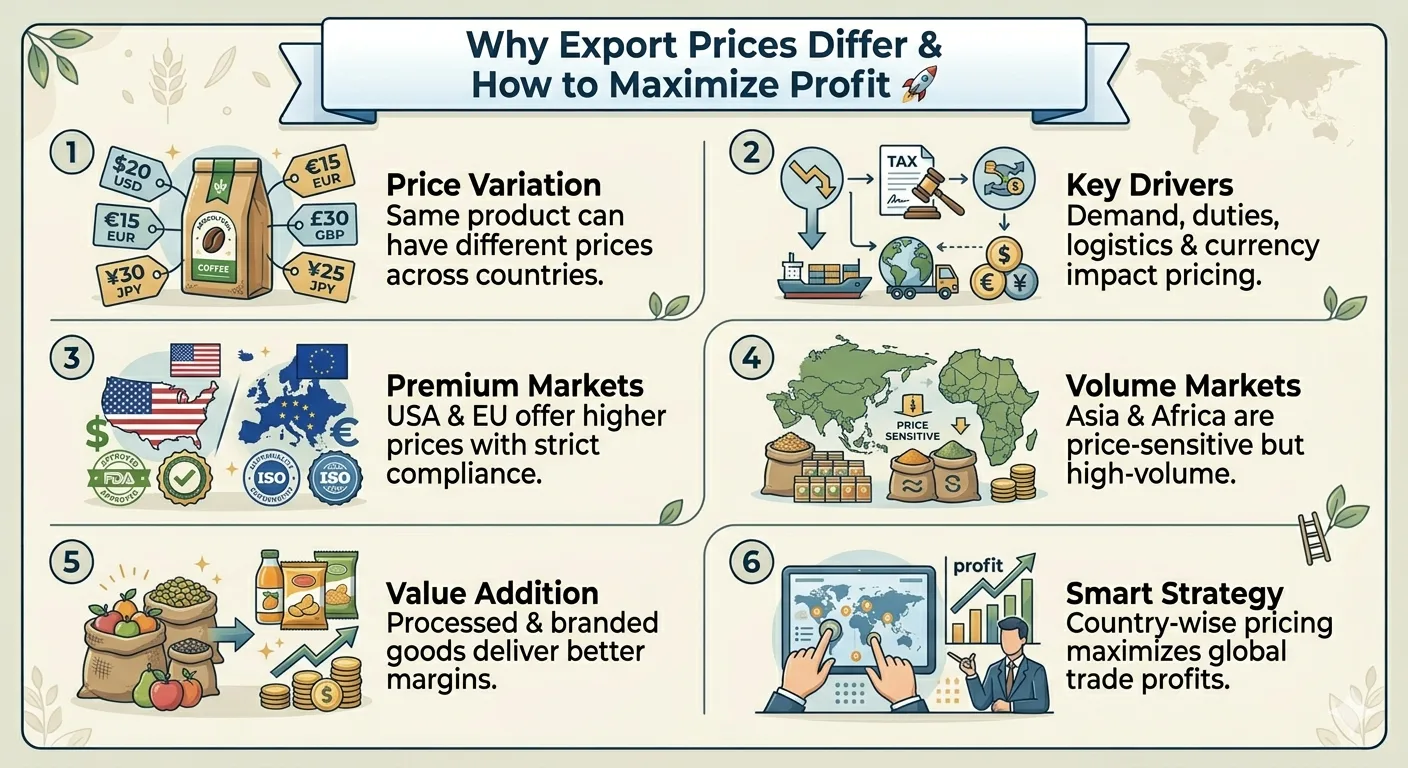
- Export prices vary due to demand, logistics, duties, and currency differences
- Same product can see $400+ price variation across countries
- High-compliance markets (USA/EU) offer premium pricing but higher costs
- Price-sensitive markets require competitive pricing and cost optimization
- Logistics and freight play a major role in final export pricing
- Direct buyers and value addition help increase export profit margins
- Country-wise pricing strategy is key to maximizing global trade profits
1.0 Introduction
Traders frequently encounter a sharp reality in global trade: the same commodity, processed under identical conditions, rarely commands the same price across different borders. A shipment to the UAE often yields a completely different realization than one sent to Germany or Vietnam. This discrepancy leads to the fundamental question of why export prices differ by country even when the product quality is a constant. Maintaining a rigid, uniform price across all markets is a strategic error that either prices you out of competitive regions or leaves substantial profit on the table in high-value ones.
Operating without a localized pricing strategy is the most direct path to margin erosion. International trade pricing is not a basic cost-plus exercise; it is a technical calibration of logistics, regional industrial demand, and destination-specific purchasing power. The ability to navigate these variables is what separates a high-growth export house from an operation struggling with thin spreads. This guide breaks down the structural drivers behind these price gaps and outlines how to optimize your margins across various international corridors.
2.0 Defining Country-Wise Export Pricing
At its core, country-wise export pricing is the strategic practice of adjusting the quote for a single commodity based on the specific economic and logistical realities of the destination marketIt acknowledges that the "value" of a product is not fixed at the factory gate. But rather, it is redefined by the time it reaches the buyer’s warehouse. This is the reason that a metric ton of the same agro-product can carry one price tag in a high-competition region like Southeast Asia and another in a high-compliance market like Western Europe.
These variations are the result of shifting variables that comprehensively include local demand-supply gaps, regional import duties, and the varying costs of inland and maritime logistics. Agriculture exporters can move away from static pricing and head toward a dynamic model that captures the maximum possible margin in every corridor. This can be done simply by understanding a simple concept that each country operates as a distinct economic silo. This technical foundation sets the stage for a deeper look at the specific drivers that force these prices to deviate globally.

3.0 Structural Drivers of Export Price Variance
Understanding factors affecting export pricing requires looking beyond the production cost. The final quote is a composite of several external variables that fluctuate based on the destination. This is the primary reason why export prices differ by country; the logistical and regulatory "load" on a shipment changes the moment it crosses a specific border.
Primary Pricing Variables
- Demand & Supply Dynamics: Prices are highly sensitive to local harvest cycles. If a target country is facing a domestic production deficit, the willingness to pay a premium for immediate supply increases. Conversely, in markets with a local surplus, exporters must price aggressively just to gain entry.
- Import Duties & Regulations: Taxation is a major price diverter. High-tariff regimes or countries with stringent non-tariff barriers—such as mandatory laboratory testing or specific phytosanitary certifications—force exporters to build these compliance costs into their base price.
- Logistics & Freight Costs: Geography dictates the margin. A shipment to a landlocked nation involving multiple transshipment points will naturally carry a higher price than a direct port-to-port delivery. Fluctuating bunker fuel surcharges and container availability also play a role in real-time price adjustments.
- Currency Exchange Rates: Volatility in the buyer’s local currency against the US Dollar can effectively make your product more expensive overnight. It is imperative that strategic pricing takes care of these fluctuations to ensure the buyer's purchasing power isn't suddenly compromised.
- Buyer Segment & Competition: An industrial processor buying in bulk for a factory line has a different price sensitivity than a high-end retail distributor. Furthermore, the presence of subsidized local competitors or aggressive neighboring exporters often forces a downward adjustment to remain viable.
3.0 Structural Drivers of Export Price Variance
Accurately identifying the factors affecting export pricing requires looking far beyond production costs. A quote is essentially a live calculation of external pressures that shift the moment goods cross a specific border. This is precisely why export prices differ by country; the fiscal and logistical "load" placed on a shipment is never constant.
Technical Breakdown of Price Drivers
- Regional Supply-Demand Gaps: Prices are tethered to the destination's harvest health. In markets facing a domestic production deficit, exporters can leverage immediate demand for a premium. However, in regions with a local surplus, you are forced into aggressive, thin-margin pricing just to displace local players.
- Tariff Barriers and Compliance Costs: Taxation is the most immediate price diverter. High-tariff regimes or countries with strict non-tariff barriers—such as mandatory phytosanitary testing or laboratory certifications—require these non-negotiable costs to be baked directly into the base quote.
- Logistical Complexity: Geography plays a very critical role and dictates the bottom line. Moving cargo to landlocked nations that involves multiple trans shipment points is fundamentally more expensive than a transit that involves port-to-port directly. Freight volatility, including bunker surcharges and container shortages, makes it important to do constant price recalibrations.
- Currency Parity: A sudden drop in a buyer's local currency against the USD can effectively price you out of the market overnight. Managing this risk requires a pricing strategy that accounts for the buyer’s actual purchasing power at the time of the Letter of Credit (L/C) opening.
- Competitive Ceiling: Your pricing is often capped by the presence of subsidized local competition or regional exporters with lower transit costs. An industrial buyer for a factory line will have a much lower price ceiling than a retail distributor looking for premium shelf space.
| Factor | Impact on Export Price |
|---|---|
| Market Shortage | Provides leverage for premium markups. |
| Trade Duties | Adds a mandatory fiscal layer to the final quote. |
| Freight Routes | Inland and maritime complexity inflates landed cost. |
| Forex Volatility | Impacts the buyer’s real-world budget and intent. |
| Local Subsidy | Set a hard ceiling on how much you can charge. |
4.0 Comparative Analysis: Country-Wise Price Variation
Exporters often find that the most accurate way to understand the volatility of global trade is through a direct commodity audit. The realization that the same metric ton of goods can carry a $400 price swing depending on the destination is the clearest proof of why export prices differ by country. To illustrate this, we can analyze the pricing architecture of Premium Basmati Rice, a commodity that sees significant fluctuation across different trade corridors.
Comparative Trade Data: Basmati Rice
| Country | Avg Export Price ($/MT) | Market Type | Primary Reason for Price Gap |
|---|---|---|---|
| Iran | $950 – $1,050 | High Volume / Bulk | High demand for long-grain varieties that include specific credit-term risks. |
| Saudi Arabia | $1,150 – $1,250 | Quality-Conscious | Strict quality standards that include mandatory aging and premium packaging. |
| USA | $1,400 – $1,550 | Compliance-Heavy | Extreme regulatory hurdles that include USDA testing and high inland freight costs. |
| Vietnam | $850 – $950 | Competition-Dense | Price ceiling dictated by proximity to local jasmine and long-grain rice surpluses. |
*The prices are indicative for informational purposes. Actual market price may vary.
Exporters can effectively navigate country-wise export pricing by recognizing that these figures are not just based on the raw material cost. In a market like the USA, the price is inflated by a "compliance layer" that includes rigorous pesticide residue testing and high-standard moisture control. While the price per ton is higher, the net margin might be similar to a lower-priced Iranian contract due to the sheer cost of meeting those entry requirements.
Conversely, the pricing in Southeast Asian markets like Vietnam is often suppressed because you are competing directly with massive local production. You can only maintain a presence in these corridors by optimizing your logistics and offering a price that accounts for the abundance of regional substitutes. Strategic traders choose their target countries by calculating whether a high-price/high-compliance market like the US offers better long-term stability than a high-volume/low-margin market like Iran. Understanding this balance is the only way to protect your spreads in a shifting global economy.
5.0 Strategic Market Tiering: Identifying Premium Import Hubs
Exporters can maximize their revenue by categorizing global destinations into distinct price tiers. Identifying which countries pay the highest price for imports is a data-driven exercise that involves mapping a nation’s purchasing power against its regulatory barriers. High-income economies with strict consumer safety standards naturally sit at the top of the country-wise export pricing hierarchy because they prioritize quality and compliance over the lowest possible unit cost.

Global Trade Pricing Tiers and Market Insights
| Country | Price Level | Product Type | Strategic Insight |
|---|---|---|---|
| USA & EU | Premium | Organic / Certified | High-margin markets that include complex ESG and pesticide residue compliance requirements. |
| UAE & Qatar | Premium | Luxury / High-Grade | Demand for top-tier aesthetics that include premium branding and immediate fulfillment. |
| Japan | High | Specialized / Niche | Extreme focus on uniformity and technical specs that include rigorous phytosanitary inspections. |
| African Nations | Price-Sensitive | Bulk Commodities | Volume-driven markets that include high price elasticity and a focus on essential nutrition. |
The premium paid by the United States or the European Union is often a reflection of the "entry tax" required to satisfy their domestic agencies.
Traders can secure higher realizations in these zones by providing documented proof of traceability and sustainability. In contrast, the Gulf markets like the UAE pay a premium for convenience and high-spec visual quality, especially in the hospitality and retail sectors.
You can successfully navigate these diverse tiers by aligning your production standards with the specific value drivers of each region, ensuring that you don't over-invest in compliance for price-sensitive markets or under-deliver for premium ones.
6.0 Strategic Framework: How to Maximize Export Margins
Long-term profitability in global trade requires a transition from being a passive price-taker to an active market strategist. Exporters can learn how to maximize export margins by deconstructing their cost silos and identifying where value is leaked. The most successful trade houses do not rely on market luck; they implement a technical roadmap that prioritizes high-realization corridors over high-volume, low-margin distractions.
Execution Pillars for Better Price Realization
- Target High-Value Corridors: A shift toward markets that carry a high "compliance premium" is a primary margin driver. While entry barriers in the EU or North America are steeper, the lack of commoditized competition in these zones allows for much healthier spreads.
- Build Localized Pricing Architecture: A country-specific pricing strategy is a technical necessity. Your quotes must reflect the specific purchasing power and local supply deficits of the destination rather than a flat global rate. This approach ensures you capture the maximum "willingness to pay" in every unique economic silo.
- Transition to Value-Added Goods: A move from raw commodities to processed or "ready-to-retail" products is the most direct way to understand how to get better prices in international market environments. Branded, packaged spices replace bulk sacks and shift the negotiation from a price-per-ton battle to a brand-value conversation.
- Disrupt Middleman Dependency: Every layer between the factory gate and the final importer erodes the margin. Direct B2B platforms and digital trade ecosystems provide the necessary infrastructure to bypass traditional commission agents and keep a larger share of the FOB value.
- Optimize Logistics: Freight remains the largest variable cost in most trades. Strategic shipment consolidation, long-term liner contracts, and the selection of ports with lower handling fees or better inland connectivity protect the bottom line.
| Strategy | Impact on Margin | Implementation Focus |
|---|---|---|
| Market Pivot | High | Shifting focus to high-compliance, premium-pay zones. |
| Value Addition | Exceptional | Moving from bulk raw materials to processed/branded goods. |
| Direct Trade | Medium-High | Eliminating brokerage fees through direct buyer engagement. |
| Freight Audits | Medium | Reducing landed costs through smarter route and mode selection. |
Exporters who treat their pricing as a dynamic technical lever rather than a static figure are the ones who survive market volatility. These strategies ensure your business remains resilient even when global commodity prices face downward pressure.
7.0 Critical Failures in Export Pricing Strategy
A flawed export pricing strategy often stems from a lack of regional technicality. The application of a uniform price across all global markets is the most frequent error. This "blanket pricing" model fails because every destination carries a unique set of logistical and regulatory overheads. You essentially forfeit your competitive edge in price-sensitive regions or leave significant revenue on the table in premium corridors.
Operational oversights further degrade the bottom line. Exporters frequently underprice their goods because they fail to account for hidden logistics costs that include detention charges, specialized packaging, and fluctuating bunker surcharges. Guesswork is no substitute for rigorous market research; it leads to quotes that miss the buyer's actual purchasing power or the local competitive ceiling. Avoiding these mistakes requires a move away from reactive, cost-plus calculations. You must recognize every country as a distinct economic entity. The elimination of these blind spots is the only way to ensure your quoted price actually translates into a realized profit.
8.0 Architecture of a Global Pricing Framework
Exporters must adopt a multi-layered export pricing strategy for different countries to protect their bottom line. This technical approach transforms your pricing from a fixed number into a strategic tool that maximizes your realization in every unique trade zone.
- Localized Market Research: A robust framework begins with the evaluation of destination-specific consumer behavior and supply-chain bottlenecks. This granular data allows you to move beyond basic cost-plus math and price according to the market’s real-world capacity.
- Comprehensive Cost Calculation: Accurate internal audits remain the bedrock of this process. Your calculation should account for every variable that includes factory-gate expenses, terminal handling charges, and insurance premiums.
- Competitor Benchmarking: This step ensures your price sits within the corridor’s existing industrial ceiling. You must align your quote with the prevailing market rates while still reflecting your product’s specific quality tier.
- Flexible Pricing Mechanisms: Global markets are never static. Your strategy must allow for rapid adjustments that respond to currency shifts or sudden changes in regional freight availability.
Integrating these four pillars ensures your pricing remains competitive without sacrificing your target spreads.
Conclusion
Success in the 2026 export market depends on your ability to move beyond static, uniform pricing. The structural variables that include logistics, compliance, and regional demand dictate that each trade corridor requires a unique financial calibration. By implementing a data-driven export pricing strategy for different countries, you secure your margins against global volatility. The objective is clear: stop treating pricing as a fixed cost and start utilizing it as a technical advantage.
Disclaimer
The information provided in this article is for educational and informational purposes only, based on general trade insights and market analysis. Export pricing may vary depending on product type, destination country, regulations, and market conditions. Readers are advised to conduct independent research and consult trade experts before making export decisions.
Author Profile
Pravarsh Sharma – Trade Export Specialist, Tradologie.com
Pravarsh Sharma is a trade export specialist at Tradologie.com, directly involved in international trade assistance and B2B global sourcing. With hands-on experience in export strategy, pricing, and buyer acquisition, he helps businesses maximize margins and scale their operations in global markets.