Key Highlights
- Canada imports over USD 40 billion worth of agricultural products annually.
- India is a major supplier of pulses, Basmati rice, organic powders, and processed foods to Canada.
- CFIA and SFCR compliance are mandatory for agro exports to Canada.
- Canada maintains some of the world's strictest food safety and traceability standards.
- Identity-preserved pulses and value-added food products offer strong export opportunities.
- Moisture control and residue compliance are critical for border clearance.
- Vancouver and Montreal serve as major entry ports for Indian agro products.
- Demand for plant-based proteins continues to strengthen India's export potential
Introduction:
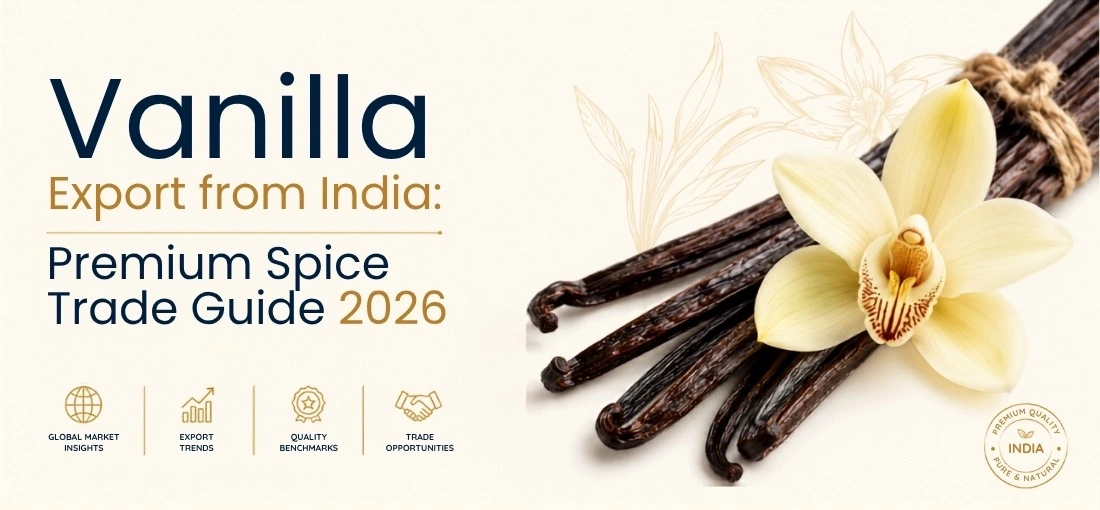
Global flavour houses and cosmetic brands rely heavily on a steady supply of natural vanillin to keep their premium product lines running through smooth manufacturing. But since vanilla is mostly grown in just a few traditional island nations, the global supply can get a bit unsteady whenever there is unseasonal weather or bad storms hit those areas. For global procurement offices, diversifying the supply ring has become an immediate operational priority. What we are seeing on the trade floor is a deliberate move to build long-term contract positions in secondary cultivating zones capable of delivering high-moisture, gourmet-grade material.
India's cultivation footprint—primarily running through the microclimates of Karnataka, Kerala, and Tamil Nadu—has transitioned into an essential fallback channel for western buying houses. The crop is managed as a high-value industrial input, anchoring premium product lines across international flavor houses and organic personal care chains. Successfully scaling a trade desk inside the vanilla export from India corridor requires a firm grasp of chemical profiling, moisture preservation, and the specific documentation needed to clear high-barrier destination ports.

Global Sourcing Metrics and Baseline Trade Flows
According to comprehensive trade tracking data from the World Integrated Trade Solution (WITS), India's outbound vanilla footprint (HS Code 090500) reached a total financial valuation of USD 1,725.43K, moving an absolute volume of 14,844 kilograms during the 2024 auditing period. This baseline reveals a highly targeted export strategy focused on mature, high-yielding western economic zones.
The bilateral distribution pattern highlights the core entry gateways for the Indian crop:
Destination Profile for Indian Vanilla Exports (2024)
| Target Sourcing Partner | Recorded Trade Value | Export Volume Lot | Strategic Trade Significance |
|---|---|---|---|
| Germany | USD 841.73K | 2,075 Kg | Main continental extraction hub; commands the highest price per kilo due to strict grade selection. |
| United States | USD 666.91K | 6,176 Kg | Largest volumetric consumer; feeds high-capacity nutraceutical and food compounding lines. |
| Poland | USD 128.00K | 2,899 Kg | High-growth regional logistics gateway into Central and Eastern European retail rings. |
| United Kingdom | USD 36.00K | 494 Kg | Premium spot market focusing entirely on certified organic whole beans. |
| United Arab Emirates | USD 23.25K | 770 Kg | Key transshipment node re-routing processed flavor inputs across the Middle East. |
Source: World Integrated Trade Solution (WITS) Customs Database 2024
Analyzing these shipment profiles clarifies that European extractors and North American blenders manage the majority of the inventory. The wide variation in volume-to-value ratios across these countries reflects the distinct quality tiers moving through customs ports. For instance, Germany’s high spend relative to its small volume indicates a heavy preference for long, gourmet-grade cured pods, whereas the US intake features bulk quantities of shorter extraction-grade beans destined for liquid alcohol processing.
Macro Demand Drivers and Long-Term Projections
An immediate operational pillar for global logistics desks is tracking the structural growth of the international flavor industry. According to Grand View Research, the global vanilla market sat at around USD 3.61 billion in 2024. Looking ahead at the 2025–2030 cycle, project models point to a steady annual growth rate of 6.2%, which should push the total market value up to USD 5.17 billion by 2030.
The underlying growth mechanics point toward specific sector transformations:
- Liquid Formulations Base: Liquid variants and high-density pure extracts captured the dominant commercial footprint, locking down 75.9% of the absolute revenue share during the 2024 window.
- Industrial Processing Core: Sourcing demands are anchored primarily by the food and beverage sector, which commands 45.3% of the absolute global purchasing allocation.
- Continental Procurement Hubs: Western Europe represents the largest regional market layer and holds 33.6% of global revenues. The German flavor houses are driving the bulk of continental refinement in this.
- Asia-Pacific Manufacturing: The region stands out as the fastest-growing market block, driven by corporate processing labs shifting their facilities closer to the primary agricultural sourcing points.

For an enterprise handling international trade contracts, this long-term expansion confirms that consumer aversion to synthetic vanillin is a permanent shift in market behavior. Food tech R&D teams are built around natural, clean-label plant derivatives, insulating high-purity spice exporters from the typical downward price corrections seen in less complex agricultural commodities.
Commercial Variations: Navigating Pod and Extract Forms
International buying offices evaluate outbound cargo based on curing depth, bean length, and final format utility rather than basic weight metrics. The product mix shifts across three core technical categories:
1. Whole Vanilla Pods (Gourmet vs. Extraction Grade)
The premier tier of the trade requires meticulously hand-cured vanilla pod export lines. Gourmet or Grade A beans feature a dark, oily sheen, lengths exceeding 14 centimeters, and a supple texture with moisture content carefully balanced between 30% and 35%. Sourcing desks route these pods straight into premium food services and retail packaging channels. Conversely, Extraction or Grade B beans are drier (typically 15% to 25% moisture), shorter, and may feature surface splits, but they retain high vanillin crystallization, making them the preferred raw material for bulk industrial extraction factories.
2. Cured Vanilla Beans (Bulk Sourcing)
Operating as the primary volume driver for standard blending desks is the vanilla bean export India pipeline. These lots are graded based on uniform aromatic profiles and precise vanillin percentages. Processing mills utilize rigorous sun-drying and sweat-curing steps over several months to convert the green orchids into stable, aromatic agricultural assets that resist vacuum-packing decay during long maritime transits.
3. Pure Vanilla Extracts
The fastest-growing, high-margin value-added segment is the vanilla extract export India corridor. Laboratories process extraction-grade pods through controlled multi-stage alcohol percolation systems to draw out pure vanillin fractions. Delivering standardized liquid profiles that match the rigid specifications of international pharmaceutical desks and clean-label cosmetic brands allows domestic processors to avoid the volatility associated with raw commodity trading.
Technical Quality Parameters and Border Clearance
Foreign food authorities and industrial procurement desks manage strict risk-assessment loops before onboarding a new international supplier. The technical criteria for batch acceptance are precise and heavily monitored:
Critical Quality Parameters for Vanilla Import Acceptance
- Vanillin Content: The definitive chemical marker for financial valuation; requires a minimum profile of 1.6% to 2.2% natural vanillin via HPLC testing.
- Moisture Equilibrium: Capped strictly between 30% and 35% for gourmet pods to preserve pliability; under 20% for extraction grades to prevent mold development inside vacuum sealed packs.
- Microbiological Assay: Zero tolerance for food-borne pathogens; batches must clear strict screening for Salmonella, E. coli, and mold spores.
- Heavy Metals & Pesticides: Strict compliance with destination-market limits; requires zero detectable trace residues of unpermitted agricultural chemicals.
Border inspectors don't compromise when a shipment fails the lab checks for heat damage or microbial spikes. Discovering even a fraction of lead, arsenic, or banned pesticide residue from poorly managed soil will trigger an immediate border rejection at the entry port. The exporter is then stuck with the worst-case logistical fallout: paying out of pocket for expensive return freight, or worse, watching the entire container get destroyed right at the terminal.
Export Documentation Framework
Customs agents at major international entry terminals evaluate incoming spice cargo entirely on documentation precision. Gaps in these files can lead to immediate terminal detention and expensive demurrage fees.
To ensure trouble-free border clearance, the trade desk must assemble a complete compliance folder:
- Import Export Code (IEC): Non-negotiable baseline for corporate export authorization, issued directly by the DGFT in India.
- Commercial Shipping Invoice: Declares the absolute transaction value, weight parameters, and custom item codes for duty check metrics.
- Phytosanitary Certificate: It is a type of official confirmation from the Ministry of Agriculture that verifies that the cargo has cleared targeted quarantine fumigation steps and will travel free of pests that can damage the food shipment.
- Certificate of Origin: It is a legal document that identifies the exact geographic zone of harvest and is essential for determining tariff preferences at destination borders.
- Bill of Lading: Official contract of ocean carriage specifying shipping lines, terminal target points, and legal title transition limits.
- Independent Laboratory Certificate of Analysis (CoA): Official HPLC laboratory readouts must accompany the container to confirm the active chemical percentages match buyer specifications.
Vanilla Price Per Kg India: Export Valuation Metrics
Wholesale trading values for this ultra-premium spice do not follow a flat, predictable trajectory. The vanilla price per kg India structure is highly sensitive to international spot fluctuations, crop yields in major competing origins, curing grade precision, and organic certification profiles.
The market pricing levels split significantly based on the final format of the commodity:
Indicative Export Price Ranges (2026 Estimates)
| Product Sourcing Format | Indicative Export Range (FOB India Port) | Primary Cost Driver |
|---|---|---|
| Extraction Grade Beans (Grade B) | USD 150 – USD 210 per kg | Driven by baseline vanillin content used for industrial solvent processing. |
| Premium Gourmet Pods (Grade A) | USD 280 – USD 380 per kg | Reflects length, high moisture retention, and uniform bean color profile. |
| Organic-Certified Gourmet Pods | USD 400 – USD 520 per kg | Commands a heavy premium for trace-verified, chemical-free estate sourcing. |
| Standard Liquid Extract | USD 85 – USD 140 per liter | Evaluated on pure vanillin concentrate per fold under automated runs. |
Mandatory Pricing Disclaimer: Export prices are indicative only and may vary based on product grade, organic certification, destination market, order volume, packaging requirements, quality specifications, and prevailing market conditions.
Market Outlook and Strategic Sourcing Recommendations
Relying strictly on spot-market buys when demand peaks is a surefire way to expose your supply chain to brutal price swings. If you want long-term commercial stability, you have to bypass the open market and set up direct, contract-backed deals with vertically integrated processors and experienced vanilla exporters India networks—specifically the ones running modern optical sorting lines and automated sterilization systems.
Locking in your volume commitments right after the harvest window does three things: it guarantees your inventory is always there, shields your margins from unseasonal weather price spikes, and gives you ironclad, batch-to-batch traceability from the farm gate all the way to western retail shelves. By combining structural quality compliance with complete document precision and strict adherence to international safety parameters, Indian vanilla enterprises can secure a premium, dominant position across the world's most active flavor consumption frontier.