Key Highlights
- Pulses are globally traded commodities under HS Code 0713.
- Major types include chickpeas, lentils, dry peas, and beans.
- Top exporters include Canada, Australia, Myanmar, and India.
- Pulses market size is around USD 87 billion with steady growth.
- High demand due to protein value and daily consumption patterns.
- Easy storage and transport make pulses ideal for bulk global trade.
- Used across households, food processing, and plant-based industries.
Intro:
If you step into the global agro trade space and look at what actually moves in bulk — not occasionally, but consistently — pulses food is always somewhere in that list.
Not because they’re trendy. But because they’re dependable.
They store well. They ship easily. And most importantly, they’re part of daily diets across continents.
That’s why, even today, pulses continue to move through structured trade systems under HS Code 0713, which broadly covers dried leguminous crops, not just pulses names.
And once you break that down, you start seeing categories like:
- 071310 → dried peas
- 071320 → chickpeas
- 07133 → dry beans
- 071340 → lentils
Now here’s where things get interesting.
If you look at actual trade data from 2024, you’ll notice that this isn’t a scattered market.
It’s quite concentrated.
Canada, for example, exported more than 2.6 billion kg of dried peas, making it the dominant player in that segment.
In chickpeas, Australia leads exports, followed by Turkey and India.
Myanmar has emerged as a major exporter, shipping over 1.5 billion kg globally in dry beans,
So when people ask what are pulses, the better way to look at it is this:
They are not just food items.
They are globally traded commodities with defined supply chains.
And that’s exactly why the market continues to grow.
The global pulses market is already sitting somewhere around USD 87 billion as of 2026, and if things continue the way they are, it’s expected to grow quite steadily over the next decade.
Not because suddenly more land is being cultivated.
But more because the system around pulses is getting tighter.
Better sorting. Cleaner grading. More structured buying through contracts.
That’s really what’s pushing the market forward.
What Are Pulses (And Where They Fit in Trade)?
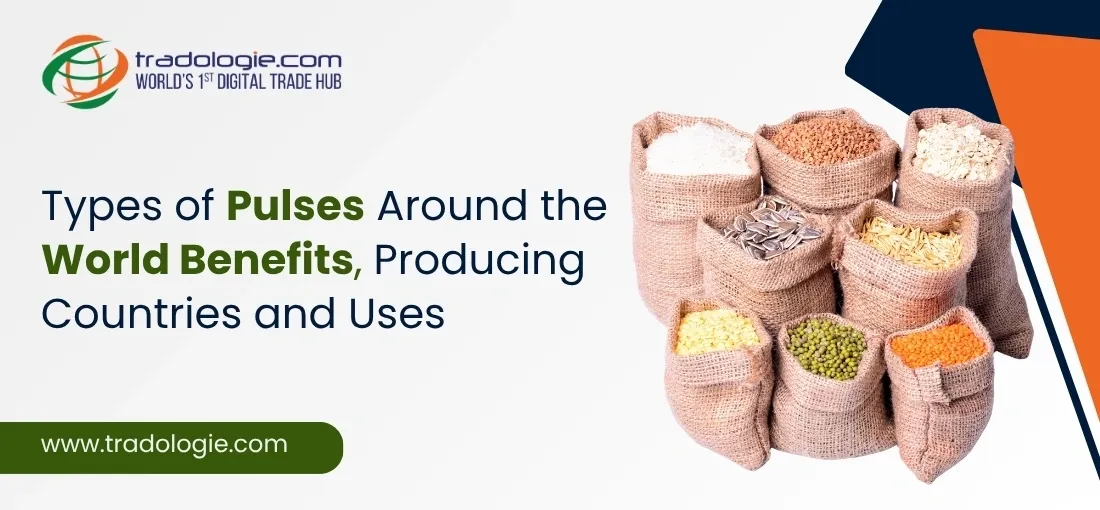
At a basic level, pulses are dried seeds of leguminous plants.
That includes:
- chickpeas
- lentils
- dry peas
- beans
But here’s something that often gets mixed up when people talk about types of legumes.
All pulses are legumes.
But not all legumes are pulses.
Fresh green peas? Not pulses
Soybeans? Not counted here.
Pulses are specifically those crops that are:
- dried
- stored
- traded in bulk
That’s why they’re such a strong part of the global commodity movement.
Different Types of Pulses Around the World - Pulses Names
Now instead of just listing them, it makes more sense to look at each type the way traders and buyers actually see them — by origin, movement, and usage.
Chickpeas (HS Code: 071320)
Chickpeas are probably one of the most globally connected pulses.
They move across regions in a way that very few agricultural products do.
Australia leads exports here, with large-scale, export-focused production. Turkey and India follow, but their roles are slightly different — India, for example, is also a major consumer.
The interesting part about chickpeas is how flexible they are in terms of usage.
In the Middle East, they turn into hummus.
In India, they become chana or besan.
In Western markets, they show up as roasted snacks or protein ingredients.
That wide usage base keeps demand steady.
And from a trade perspective, Kabuli chickpeas — the larger, lighter variety — tend to dominate exports because they’re preferred in international markets.
Lentils (HS Code: 071340)
Lentils are one of those crops that just make sense in trade.
They’re easy to cook.
Easy to process.
And easy to standardise
Canada is a big name here, no doubt about that.
A lot of it comes down to scale. Large farms, organised harvesting, and a system that’s built around exporting rather than just local consumption.
Then you have countries like India and Turkey.
They’re important too, but their role keeps shifting a bit.
Some years they export more, some years they pull back depending on how much gets consumed domestically.
From a buyer’s perspective, lentils are predictable.
That’s the key.
They don’t require complex processing, and they fit easily into both retail and bulk supply chains.
That’s why they’re widely used in:
- soups
- ready meals
- packaged foods
Dry Peas (HS Code: 071310)
Dry peas are one of those categories that don’t get talked about much, but quietly dominate trade volumes.
Canada leads here again, followed by the US, the European Union, Turkey, and Ukraine.
But what really sets dry peas apart is their use.
A large portion doesn’t go directly to kitchens.
It goes into:
- food processing
- protein extraction
- industrial food manufacturing
Which means demand here is not just consumer-driven.
It’s industry-driven.
And that gives this segment a different kind of stability.
Dry Beans (HS Code: 071331–071339)
This is where things get more diverse. Dry beans are not one product.
They’re a group.
Kidney beans, black beans, pinto beans — each with its own market.
Myanmar has emerged as a major exporter in this space, followed by Uzbekistan, China, and India.
But unlike chickpeas or lentils, beans don’t have a single global demand pattern.
Different regions prefer different types.
Latin America leans towards black beans. India consumes kidney beans. Other regions have their own preferences.
So instead of one market, you have multiple smaller markets working together.
Pigeon Peas (HS Code: 071360)
Pigeon peas are a slightly different case.
They’re heavily consumed in India, but production alone doesn’t always meet demand.
Which is why countries like Myanmar, Tanzania, and Malawi export to India regularly.
This creates an interesting cycle.
India produces, consumes, and imports — all at the same time.
And that keeps the trade active.
Benefits of Pulses (Why They Stay Relevant)
There’s a reason pulses have stayed relevant for so long. Not because of marketing.
But because they simply work. They provide a strong source of protein, especially in vegetarian diets.
They store easily without requiring cold chains. They support soil health, which makes them important for sustainable farming.
And they fit into multiple use cases — from home cooking to industrial food processing.
Where Pulses Are Used Today
Earlier, pulses were mostly associated with home kitchens.
That’s no longer the case.
They now move across:
- traditional cooking
- packaged food
- ready-to-eat meals
- plant-based protein products
And increasingly, they’re becoming part of structured procurement systems where large buyers source in bulk through contracts.
Final Thoughts
Pulses don’t try to stand out. They don’t need to.
They’ve already built their place. If you look at it closely, every type of pulse just finds its own place.
Chickpeas, lentils, beans, peas — they all move through different markets, different countries, different uses.
Some go into everyday meals. Some end up in factories. Some are traded in bulk without anyone really thinking twice about it.
And that’s the thing. Even as food trends keep changing, pulses don’t really go anywhere.
They just keep moving… in their own way, across markets, without much noise.
Disclaimer
This article is for informational purposes only. Trade data, market size, export figures, and HS code classifications are based on industry estimates and publicly available sources. Actual figures may vary depending on market conditions, country policies, and trade updates. Readers are advised to verify details from official trade bodies or government sources before making business decisions.
Frequently Asked Questions
1. What are pulses in simple terms?
Pulses are dried edible seeds of leguminous crops such as chickpeas, lentils, beans, and peas. They are widely traded and consumed globally.
2. What is the HS code for pulses?
Pulses are classified under HS Code 0713, which includes dried legumes like peas (071310), chickpeas (071320), beans (07133), and lentils (071340).
3. Which countries are the largest producers and exporters of pulses?
Major exporters include:
- Canada/b> (lentils, peas)
- Australia (chickpeas)
- Myanmar (beans)
- India (production + consumption)
4. Why are pulses important in global trade?
Because they are:
- non-perishable
- easy to store and transport
- part of daily diets globally
- used in both retail and industrial food processing
5. What are the main types of pulses traded globally?
The major categories include:
- Chickpeas
- Lentils
- Dry peas
- Dry beans
- Pigeon peas
Each has different demand patterns across regions.
6. What are the benefits of pulses?
Pulses offer:
- high protein content
- dietary fiber
- long shelf life
- sustainability benefits (improve soil health)
7. Where are pulses used today?
They are used in:
- home cooking
- packaged food
- ready-to-eat meals
- plant-based protein products
- industrial food processing
8. Is pulses trading a good business opportunity?
Yes, because demand is stable and global, with structured supply chains and bulk procurement systems.
9. Why does pulses demand keep growing?
Because they sit at the intersection of:
- affordability
- nutrition
- global food security
- plant-based diet trends