Key Highlights
- The major types of palm oil traded globally include Crude Palm Oil (CPO), RBD Palm Oil, Palm Olein, Palm Stearin, Red Palm Oil and Palm Kernel Oil.
- Dura, Pisifera and Tenera are the three main oil palm fruit types, with Tenera preferred for commercial plantations because of its higher oil extraction potential.
- Palm Olein is commonly used for cooking and deep frying, while Palm Stearin is used in margarine, shortening and bakery fats.
- Indonesia and Malaysia are the world's leading palm oil exporters, recording exports worth approximately US20.05billionandUS13.54 billion, respectively, in 2024.
- Palm oil buyers should compare free fatty acids, moisture, impurities, melting point, intended application and supplier certifications before purchasing.
Introduction
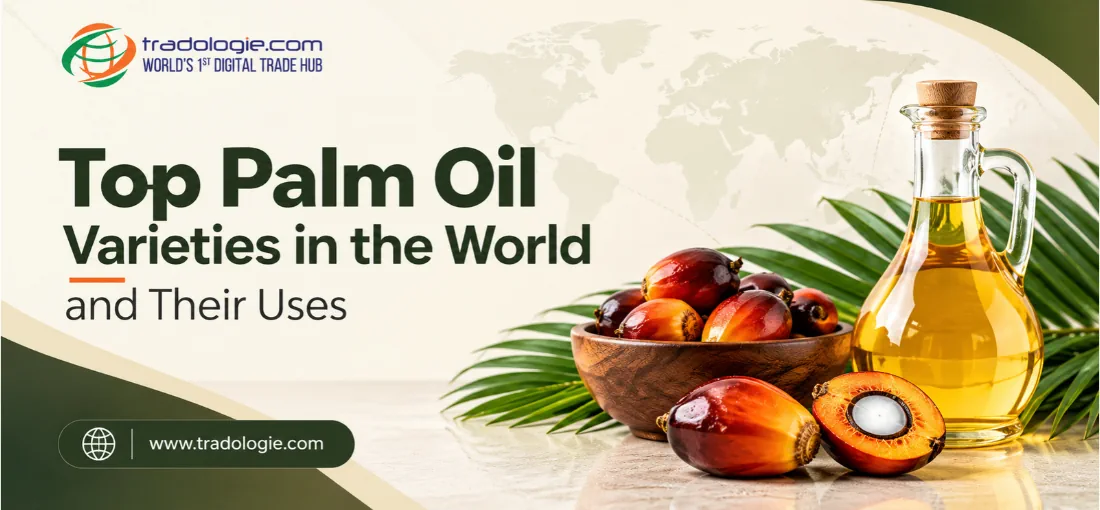
Palm oil is one of the most widely traded vegetable oils. It can be found in many food products, including cooking oils, packaged foods, soaps, cosmetics and industrial products. There are different types of palm oil and different methods of extracting, refining and processing the oil. It is therefore important to understand what the most popular types of palm oil are. This will help food manufacturers, importers and exporters determine what types of palm oil they should be working with.
Not only are there various types of palm oil , but they can also be categorised into different species. Dura, Pisifera and Tenera are all species of oil palm fruit. However, the types of oil that are actually traded internationally are crude palm oil, palm olein and palm stearin. Below are the types of palm oil and their features.
Keep reading this informative blog piece as it will give you all the important information on different types of palm oil in the global market and their commercial importance.

Different Types of Palm Oil in the Global Markets
The oil palm tree (Elaeis guineensis) bears fruit bunches. This fruit can then be processed to produce palm oil and palm kernel oil. Palm oil is extracted from the fleshy fruit (mesocarp), while palm kernel oil is extracted from the kernel.
There are three main types of oil palm fruit. These include:
1. Dura Palm
One recognised fruit type found in African oil palms is Dura. The key feature of this type is its thick kernel shell. This usually ranges between 2-8 mm.
As there is a thick shell, this limits the amount of oil-rich mesocarp. This means that there is less oil extraction potential when compared to Tenera. As a result, this makes it less suitable for modern plantations.
However, Dura is important for breeding. It is one of the two parental types used to develop Tenera hybrids. This contributes the thick-shell feature to the hybrid.
Traditionally, Dura was more commonly found in oil palm plantations. However, it continues to play an important role in breeding.
Key Features:
- Thick kernel shell
- Lower mesocarp content
- Lower oil extraction potential
- Used as a female parent in the traditional Dura x Pisifera cross.
2. Pisifera Palm
This type of palm fruit is the opposite of Dura. Its fruits usually have little to no hard kernel shell. This means that there is more oil-rich mesocarp.
This may suggest that it is the most productive type. However, many palms are female-sterile. Therefore, this makes them unsuitable for commercial use, as there will be few or no commercially useful fruit bunches.
They are particularly important for breeding. They are used as a male parent in the Dura x Pisifera cross. This produces the Tenera hybrid, which combines the favourable features of both parents. This results in a thin-shelled fruit with a high proportion of oil-rich mesocarp.
Pisifera is therefore important for improving productivity within plantations.
- Little or no kernel shell
- High mesocarp content
- Many are female-sterile.
- Used as a male parent in the traditional Dura x Pisifera cross.
- Used mainly to develop high-yielding Tenera planting material.
3. Tenera Palm
Tenera is produced by crossing Dura and Pisifera. It contains many of the favourable features of both parents. This includes the thin shell and high mesocarp content.
The shell is usually between 0.5-4 mm. This is much thinner than Dura. This means there is more mesocarp content.
Tenera delivers a higher oil yield per fruit bunch in comparison to other types. This makes it a preferred choice for plantations in Indonesia, Malaysia and other major producing countries.
Improved Tenera planting material can be used alongside suitable agricultural practices, fertilisation and harvesting to improve productivity.
Key Features:
- Thin shell
- Higher mesocarp content
- Higher oil extraction potential
- Hybrid type
- Preferred choice for modern plantations.
| Botanical Type | Shell | Commercial Importance |
|---|---|---|
| Dura | Thick | Used in breeding programmes |
| Pisifera | Little/no shell | Used mainly as a breeding parent |
| Tenera | Thin | Preferred choice for commercial planting |
These are botanically different and are not different grades of edible palm oil.
Main Types of Palm Oil in Commercial Use: Top Palm Oil Varieties
There are many various types of palm oil available in the commercial sector. Depending on how the oil has been processed, it can be crude, fractionated or refined.
4. Crude Palm Oil (CPO)
Crude palm oil is obtained by crushing the fleshy orange-red mesocarp. This is one of the primary raw materials used in the global edible oil industry. It is usually sent to refineries for further processing.
CPO contains natural carotenoids, tocopherols, tocotrienols, free fatty acids, moisture and impurities. It has a red-orange colour due to its high carotenoid content.
The quality of CPO depends on the maturity of the fruit, harvesting methods, processing time and storage conditions. Common factors that refineries examine are free fatty acid (FFA) levels, moisture, impurities and deterioration of bleachability index (DOBI).
Common Uses:
- Refined to produce edible cooking oils
- Used to produce palm olein and palm stearin
- Used to manufacture soaps and oleochemicals
- Used to produce processed food ingredients
5. RBD Palm Oil
RBD palm oil is obtained by refining crude palm oil to remove unwanted impurities, colouring agents, odours and excess free fatty acids. This is usually done through pretreatment, bleaching and deodorising.
This results in a pale yellow oil with a neutral taste and odour. It does not retain most of the carotenoid pigments found in crude palm oil.
This oil has relatively stable properties and can be used by manufacturers requiring consistent vegetable oil.
Common Uses:
- Used to produce packaged cooking oils
- Used in bakery and confectionery manufacturing
- Used to produce margarines and shortenings
- Used in instant noodles, biscuits and processed foods
6. Palm Olein
Palm olein is obtained by fractionating refined palm oil. This involves carefully cooling the oil to allow the higher-melting fat to form crystals. These can then be separated.
This usually has a low melting point and will remain in liquid form during normal tropical storage conditions. It has relatively good oxidation stability and can be used for high-temperature cooking.
RBD palm olein is available in different grades. One important grade is IV 56. This refers to an iodine value of approximately 56. There are also higher iodine-value grades available, such as super olein.
Common Uses:
- Used as a household cooking oil
- Used for deep frying in restaurants and food manufacturing
- Used to produce packaged edible oils
- Used to produce instant foods and snacks
7. Palm Stearin
Palm stearin is obtained by fractionating palm oil. It contains a higher proportion of higher-melting triglycerides than palm olein. This gives it a solid consistency.
Its melting properties make it a valuable ingredient for manufacturers requiring firmness. There are different grades available depending on the iodine value.
It is often blended with other vegetable oils. This is especially common when producing margarines, bakery fats and shortenings.
Common Uses:
- Used to produce margarines and vegetable shortenings
- Used to produce bakery fats and confectionery
- Used to produce speciality fats
- Used to manufacture soaps and detergents
- Used in oleochemicals
8. Red Palm Oil
Red palm oil is rich in carotenoids. It contains much of the natural red-orange colour found in the fruit. Unlike RBD palm oil, it is processed to retain more of the natural carotenoids.
It contains beta-carotene, carotenoids and vitamin E (tocopherols/tocotrienols). This makes it a suitable choice for specialty food ingredients.
It is used in traditional cooking, especially in parts of West and Central Africa. It can also be sold as a specialty edible oil.
Common Uses:
- Used in traditional cooking
- Used as a speciality edible oil
- Used in food formulations requiring natural colours
- Used in selected nutritious food ingredients

Palm Kernel Oil
Another important type of oil to consider when looking at different palm oils is palm kernel oil.
This oil is extracted from the kernel of the fruit. It is chemically different from palm oil, with a much higher proportion of lauric acid.
This means it has different properties and is a suitable choice for soaps, personal care products and oleochemicals.
9. Refined Palm Kernel Oil
Refined palm kernel oil is obtained by processing crude palm kernel oil to remove free fatty acids, impurities, odours and unwanted colouring.
This oil has a neutral taste and can be used for applications requiring consistent quality. It has a high lauric acid content.
It can be used in confectionery fats and speciality food ingredients.
Common Uses:
- Used in confectionery and coating fats
- Used in bakery and food manufacturing
- Used in personal care and cosmetic products
- Used in soap and detergent manufacturing
10. Palm Kernel Olein and Palm Kernel Stearin
Palm kernel oil can also be fractionated to produce two different products.
Palm kernel olein is the liquid fraction, while palm kernel stearin is the harder, higher-melting oil. These can be used in speciality food formulations.
They have different properties from palm olein and palm stearin, as they are obtained from palm kernel oil.
Common Uses:
- Palm kernel olein - Speciality edible oils, frying blends and selected food formulations.
- Palm kernel stearin - Confectionery fats, coatings, speciality fats and industrial products.
Types of Palm Oil and Their Uses
| Product | Key Feature | Common Uses |
|---|---|---|
| Crude Palm Oil | Unrefined, natural red/orange | Refining and processing |
| RBD Palm Oil | Refined, neutral taste/smell | Edible oils and food |
| Palm Olein | Liquid | Cooking and deep frying |
| Palm Stearin | Solid | Margarines, shortening and bakery fats |
| Red Palm Oil | Contains a high proportion of natural carotenoids | Speciality edible oils and cooking |
| Palm Kernel Oil | Extracted from the kernel | Soaps, cosmetics and oleochemicals |
| Refined Palm Kernel Oil | Refined, high lauric acid content | Confectionery and personal care |
| Palm Kernel Olein | Liquid | Speciality food formulations |
| Palm Kernel Stearin | Solid | Confectionery and speciality fats |
Countries Exporting Palm Oil
Looking at the data illustrates how important palm oil is in the commercial sector.
According to the World Bank's World Integrated Trade Solution (WITS), using UN Comtrade data, Indonesia and Malaysia are the largest exporters of palm oil.
Using HS code 1511 for palm oil and fractions, whether refined or unrefined but not chemically altered, the top exporters in 2024 were:
| Country | Value (2024) |
|---|---|
| Indonesia | US$20.05 billion |
| Malaysia | US$13.54 billion |
| Netherlands | US$1.18 billion |
| Thailand | US$860 million |
| Papua New Guinea | US$676 million |
The top two exporters account for the vast majority of this category.
Looking at just crude palm oil using HS code 151110, Malaysia exported approximately US3.30billionin2024.IndonesiawasnextwithUS2.72 billion.
This illustrates that there is a wide range of palm oil being traded internationally. It is not just raw palm oil but refined products too.
Things to Consider When Buying Palm Oil
Once you know what you want to buy, there are a few factors to consider when buying palm oil in bulk.
- Specifications - Free fatty acids, moisture, impurities and melting point.
- Application - Palm olein, palm stearin and RBD palm oil will have different uses.
- Certifications - Ensure there are the correct food-safety, quality and sustainability documents.
- Packaging - Will this need to be transported in bulk tanks, flexitanks, drums or other suitable packaging?
- Import Requirements - Ensure there are appropriate customs processes in place in the destination country. Are there any food-safety requirements? What about labelling and import duty?
- Supplier - Ensure they can supply the product, have experience exporting and possess the correct documentation. What are their payment terms?
When buying large quantities of palm oil, even small differences in the specifications can affect performance in manufacturing.
Conclusion
Palm oil is not a single product. There are many types of palm oil available in the commercial sector, including crude palm oil, refined edible oil, liquid palm olein and solid palm stearin.
To understand what the most common types of palm oil are, you need to look beyond the botanical categories and see what they are processed into. Dura, Pisifera and Tenera explain the different types of fruit. However, crude palm oil, RBD palm oil, olein and stearin are what you will actually be sourcing.
Knowing what types of palm oil there are, how they are specified and what they are used for is very important if you are involved in international trade. With the demand for palm oil still high, there is a large volume of trade. Knowing what products you are looking for is just as important as knowing the prices and export volumes.
Disclaimer
Palm oil specifications, international trade values, export volumes and regulatory requirements may change. Product characteristics can also vary according to processing methods, fractionation and quality grades. Buyers and exporters should verify the latest trade data, product specifications, food safety standards and destination-country import requirements before entering into a commercial transaction.