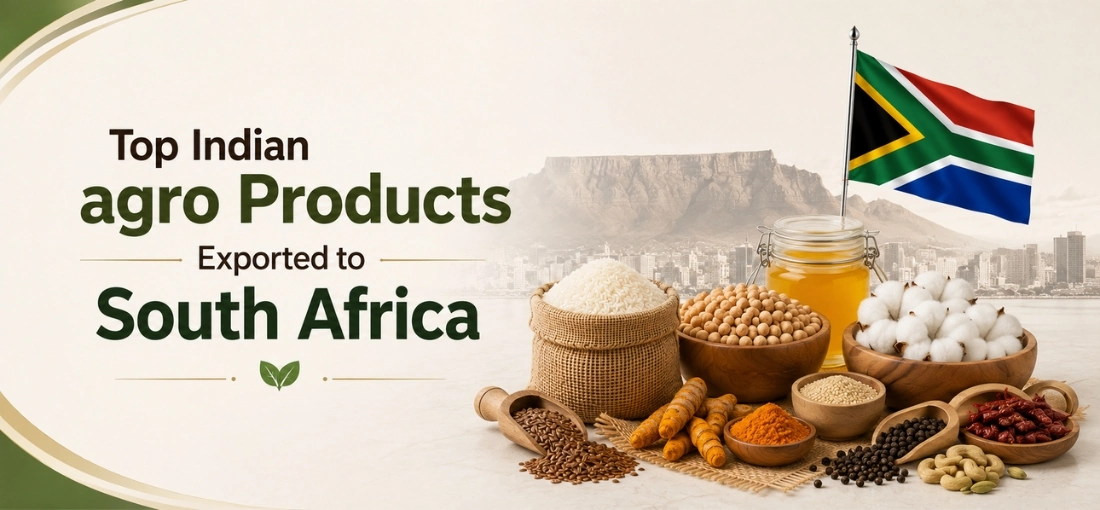
Key Highlights
- South Africa imported 259.49 thousand MT of agricultural products from India in FY 2024-25.
- India's agricultural exports to South Africa were valued at USD 278.11 million.
- Non-Basmati rice is India's largest agricultural export to South Africa.
- Spices, Basmati rice, marine products, and cereal preparations are among the top export categories.
- South Africa imports Indian products to meet demand for staple foods, spices, and processed food ingredients.
- Consistent quality, food safety compliance, and reliable supply chains are essential for exporters.
Introduction:
The India and South Africa food trade are quite stable. The local food supply chains in South Africa depend heavily on bulk imports from India to keep processing plants fed, meet institutional food demands, and stock retail shelves with staples that simply don't grow well in local soil.

Looking at the latest APEDA figures (FY 2024-25), India food export to South Africa stands as India's 44th largest market for agricultural exports. Total trade hit USD 278.11 million (₹2,351.83 crore), making up about 0.52% of India's global agricultural export volume.
Keep reading this informative piece of blog if you want to export food to South Africa. It will tell you the top agro products exported from India to South Africa.
India-South Africa Agricultural Trade Overview
The trade between both nations stays healthy because it is spread across multiple product categories rather than risking everything on one or two volatile crops. Importers handling South Africa food imports bring in everything from high-volume everyday grains to spices, seafood, and packaged foods.
The high-level APEDA baseline looks like this:
| Export Indicator | Value |
|---|---|
| Rank | 44th |
| Export Value (USD) | USD 278.11 Million |
| Export Value (INR) | ₹2,351.83 Crore |
| Quantity | 259.49 Thousand MT |
| Share in India's Agri Exports | 0.52% |
Shipping almost 260 thousand metric tonnes takes tight coordination between both sea and freight routes. This is true for major IndianIndian hubs like Mundra or JNPT and receiving ports in Durban or Cape Town. Spreading that volume across varied product lines keeps supply chains resilient if a single crop runs into bad weather or price spikes. You need to consider these statistical facts in mind to export successfully before you register as a seller on b2b trade platforms like Tradologie and export products to South Africa.
Top Agro Products Exported From India to South Africa
Five main categories account for the vast majority of shipment values coming out of India:
| Commodity | Export Value (USD Million) | Share |
|---|---|---|
| Non-Basmati Rice | 65.76 | 23.65% |
| Spices | 46.86 | 16.85% |
| Basmati Rice | 31.24 | 11.23% |
| Marine Products | 24.21 | 8.71% |
| Cereal Preparations | 17.15 | 6.17% |
These primary product lines form the baseline of Top Agro Products Exported to South Africa.
Export Non-Basmati Rice to South Africa
Non-Basmati rice is the undisputed heavy lifter here, bringing in USD 65.76 million and commanding over 23% of the total export pie.
The driver is simple: price and reliability. Retail chains, commercial catering businesses, and wholesale suppliers need affordable grains in massive quantities. For suppliers setting up a bulk rice export to South Africa , Indian mills provide the exact scale and cost-efficiency required to win contract bids.
IR64 Parboiled: The Workhorse Grain
There is no doubt in saying that IR64 parboiled rice is always the top choice for Indian rice exporters who register as a seller on b2b platforms, when they look to export non-basmati rice to South Africa. The reasoning is purely practical as well as economical. When you Export IR64 Parboiled Rice to South Africa , you ship a long-grain rice that gets steam-treated before milling. That parboiling hardens the starch. Now, is this beneficial? This is because the grain holds up far better during long sea voyages and prevents it from turning into a paste when cooked in massive commercial kitchen vats.
Export Indian Spices to South Africa
Spices hold the number two spot at USD 46.86 million and represent 16.85% of total agricultural shipments. We're talking constant container loads of turmeric, dried chilies, coriander, cumin, and pre-mixed masalas arriving at Durban docks.
Three main buying sectors keep this volume steady:
- Food Processing: Local food manufacturers and meat processors needing bulk raw spices for sauces, marinades, and packaged meats.
- Commercial Food Service: Restaurants and hotel kitchens requiring reliable bulk seasonings.
- Retail Demand: Strong household buying power from South Africa's deep-rooted South Asian community, particularly across KwaZulu-Natal.
To succeed as an Indian spices exporter in this market, you need tight quality control—period. Batches have to clear local pesticide and health regulations without slipping up.While most people look for seller registration formalities, these things are easy to ignore, but important in trade for new exporters.

Basmati Rice and Premium Rice Demand
While standard Non-Basmati covers the mass-market volume, Basmati holds its own highly profitable space. Generating USD 31.24 million (11.23% of trade), long-grain aromatic rice remains a non-negotiable staple for upper-tier retail and hospitality.
For an active Indian rice exporter , South Africa offers two clean market tracks: consumer-facing 1kg and 5kg packs for major supermarket shelves in Johannesburg, Pretoria, and Cape Town, alongside 10kg and 20kg bulk sacks straight to restaurant distributors.
Export Marine Products to South Africa
Seafood takes the fourth spot, pulling in USD 24.21 million (8.71% share).
It sounds odd to export seafood to a country surrounded by ocean, but South Africa's commercial fishing fleets concentrate heavily on deep-water cold-species like hake. To satisfy local appetites for warm-water species, distributors routinely export marine products to South Africa directly from Indian processing plants—mainly frozen Vannamei shrimp and prawns packed under HACCP-certified cold chains.
Export Meat to South Africa (Opportunity Section)
Buffalo meat isn't in APEDA's top five right now, but it is easily one of the most promising growth lanes.
India is a global powerhouse for frozen boneless buffalo meat. It offers lean, cost-effective, and most importantly Halal-certified protein. The main hurdle isn't demand for traders working to export meat to South Africa . It's clearing strict veterinary clearances and facility audits required by South African agricultural authorities. An Indian meat exporter that gets its paperwork and processing facilities fully certified stands to gain a huge advantage.
Why South Africa Imports Agricultural Products from India
Stripping away all the trade jargon, four real-world factors make this pipeline work:
- Unbeatable Cost-to-Volume: Indian suppliers deliver staple commodities at prices that keep local retail prices stable.
- Volume Security: India's massive harvest scale means exporters can commit to huge multi-container contracts without stock-outs.
- Direct Sea Routes: Shipping lines across the Indian Ocean keep transit times short and freight costs reasonable.
- Product Match: India produces tropical spices, warm-water seafood, and specialty rice that simply cannot be grown locally in South Africa.
Conclusion
At the end of the day, trade between India and South Africa works because both sides get exactly what they need. Reaching USD 278.11 million in FY 2024-25, primary staples like Non-Basmati, spices, Basmati, marine products, and processed cereals anchor a solid commercial trade route.
The numbers show a predictable, growing trade corridor. Whether your immediate target is to Export Non-Basmati Rice to South Africa , build a brand as an Indian spices exporter , or supply IR64 parboiled rice to South Africa , keeping quality consistent and passing port inspections is the only formula that matters.
Disclaimer
The information provided in this article is for educational and informational purposes only. Export statistics, customs regulations, food safety requirements, and South Africa's import policies may change over time. Exporters should verify the latest APEDA data, South African import regulations, and destination-country compliance requirements before exporting agricultural products.