Key Highlights
- India exported $51.91 billion of agricultural products in 2024-25.
- Rice remained the largest agricultural export category.
- Basmati and non-Basmati rice together earned nearly $12.5 billion.
- Spices generated $4.45 billion in export value.
- Fresh fruits and vegetables crossed $2 billion combined.
- Processed foods offer opportunities beyond raw commodity exports.
- The US, UAE, China and Saudi Arabia are major destinations.
- Quality, processing, packaging and logistics shape export opportunities.
Introduction:
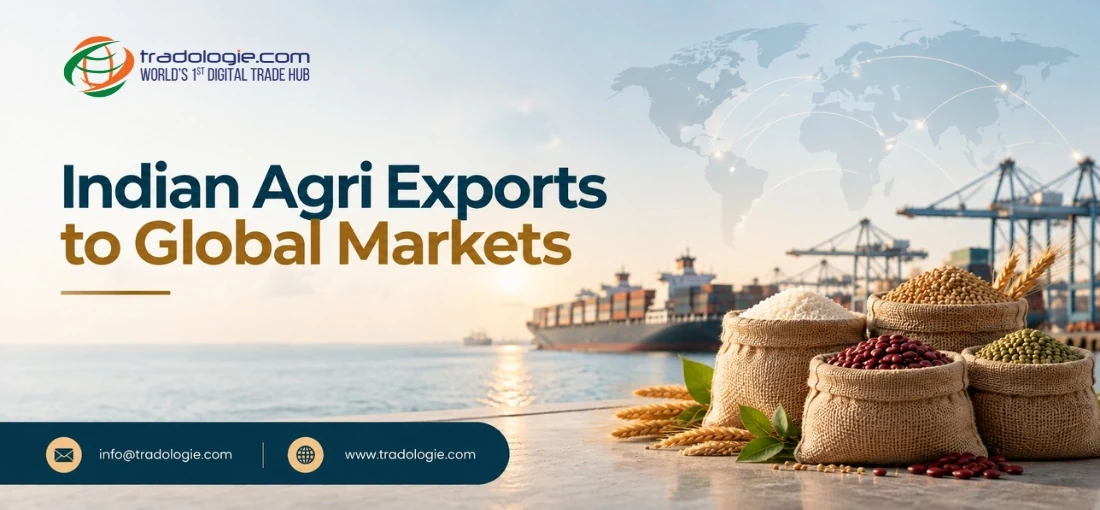
When it comes to top agri exports from India , the story is much larger than rice, although rice is still where the scale becomes impossible to ignore.
Look at the numbers for 2024-25. India exported $51.91 billion worth of agricultural products, including cotton , accounting for 11.86% of the country's total merchandise exports. Of that, products monitored by APEDA contributed $27.90 billion . These are not marginal export categories sitting at the edge of India’s trade economy. Agriculture is a sizable export business in its own right.
And the market is not confined to a handful of countries. Indian agricultural, horticultural and processed food products are sold across 100+ countries and regions, covering everything from staple grains and spices to fresh produce, processed foods and animal products.
What makes the export basket interesting is the difference between these products.
A container of non-basmati rice is a very different business from a shipment of fresh grapes. Basmati is sold around variety, aroma and grain characteristics. Spices can move as whole products, powders or processed ingredients. Fruit can be exported fresh or converted into pulp and juice. Pulses and groundnuts sit somewhere between commodity trade and food processing.
So when people talk about the top agri exports from India , the headline numbers tell only part of the story.

What India Is Actually Exporting: Top Indian agricultural exports
The figure from APEDA's 2024-25 data figures give a fairly clear picture of where the money is actually coming from. In the broader agricultural export basket, marine products were worth $7.41 billion , followed by non-basmati rice at $6.53 billion and basmati rice at $5.94 billion . Spices brought in another $4.45 billion , while buffalo meat accounted for $4.06 billion .
Then the numbers fall away quite sharply: sugar at $2.16 billion, coffee at $1.81 billion, miscellaneous processed items at $1.68 billion, unmanufactured tobacco at $1.48 billion and oil meals at $1.34 billion.
| Product | Export Value, 2024-25 |
|---|---|
| Marine Products | $7.41 billion |
| Non-Basmati Rice | $6.53 billion |
| Basmati Rice | $5.94 billion |
| Spices | $4.45 billion |
| Buffalo Meat | $4.06 billion |
| Sugar | $2.16 billion |
| Coffee | $1.81 billion |
| Misc. Processed Items | $1.68 billion |
| Unmanufactured Tobacco | $1.48 billion |
| Oil Meals | $1.34 billion |
Source: APEDA Farmer Connect, 2024-25 Principal Commodity export data.
There is a useful way to read this table.
India is not relying on one agricultural commodity to generate export revenue. At the same time, the trade is clearly concentrated at the top. Rice alone, if basmati and non-basmati are put together, accounted for roughly $12.5 billion in exports during the year.
That is a serious global business.
And below it sits a long tail of commodities that may not individually command the same numbers but collectively make the Indian export basket considerably deeper.
Rice Remains the Heavyweight
Rice is where India's agricultural export scale becomes particularly visible.
APEDA's data states that non-basmati rice exports from India were 14.13 million tonnes worth $6.53 billion in the year 2024-25. Basmati added another 6.07 million tonnes worth $5.94 billion . Together, that is more than 20 million tonnes of rice and nearly $12.5 billion in export value in a single year.
Those numbers are worth pausing over.
More than 20 million tonnes is not a niche export programme. It means an enormous network of farmers, rice mills, traders, exporters, ports, shipping lines, inspection agencies, packaging companies and overseas buyers working around the same commodity.
But basmati and non-basmati should not be treated as one market.
Basmati operates in a segment where grain length, aroma, variety, ageing and cooking characteristics influence the buying decision. It has a particularly established market in the Gulf and West Asia.
Non-basmati is a different proposition. Here, India's ability to supply large volumes at competitive prices becomes much more important. APEDA’s current data lists markets including Benin, Guinea, Côte d’Ivoire, Togo and Bangladesh among the major destinations for Indian non-basmati rice.
The sheer scale of the business explains why rice continues to dominate conversations around Indian agricultural exports.
Spices Are Not One Commodity
Spices are another major part of the export story, with $4.45 billion in exports during 2024-25.
But calling this simply a $4.45-billion “spice market” makes the business sound much simpler than it actually is.
Cumin, chilli, turmeric, coriander, pepper and other spices serve different buyers and different applications. A trader may buy cleaned whole cumin. A food manufacturer may need a finely processed powder. A seasoning company could be purchasing an ingredient against a very specific specification.
The processing level changes the business.
Cleaning, grading, sterilisation, grinding, blending and packaging all move the product further away from the farm and closer to the requirements of a finished-food manufacturer.
That is one of the recurring themes in Indian agricultural exports. The commodity may begin as something grown in a field, but the export business increasingly depends on what happens to it afterwards.

Fresh Produce Has a Completely Different Equation
Fresh fruits and vegetables make the contrast even clearer.
India exported 1.59 million tonnes of fresh fruits worth $1.17 billion in 2024-25. Fresh vegetables were larger by volume, at 2.15 million tonnes , but generated about $894 million.
Those two numbers tell an interesting story.
Fresh vegetables moved more tonnes than fresh fruits, yet generated less export value. That difference comes down to the nature of the products being traded, their prices and the markets they serve.
And then there is the problem of time.
Rice can be stored. A consignment of grapes cannot be treated in the same way. Harvest timing, grading, packaging, pre-cooling, transport and cold-chain management all become part of the export operation.
A buyer is not simply asking whether India has mangoes or grapes available. The question is whether the right quality can be harvested, packed and delivered to the right market at the right time.
That makes fresh produce one of the more demanding areas of agricultural trade.
The Bigger Opportunity May Be in Processed Food
There is another set of numbers in the APEDA data that deserves attention.
India exported $1.03 billion of processed fruits and juices and $934 million of cereal preparations in 2024-25. Processed vegetables added another $777 million.
These figures are smaller than rice or spices, but they point towards a different kind of export business.
Take fruit as an example. A fresh mango has a limited selling window and has to survive the journey in acceptable condition. Mango pulp, on the other hand, can be stored, transported and used by a food manufacturer months after the harvest.
The same principle applies to vegetables and cereals.
Processing changes the shelf life. It changes the buyer. It can change the packaging, the logistics and, in some cases, the margin available to the exporter.
For companies looking to export food commodities , this is an important part of the market to watch. India already produces enormous quantities of agricultural raw material. The commercial opportunity is increasingly about how much of that value can be retained before the product leaves the country.
Pulses, Groundnuts and Guar Gum Add More Depth
Some of the top agri products exported from India do not receive the same attention as rice, but their numbers are substantial.
In 2024-25, India exported 730,731 tonnes of pulses worth $778 million . Groundnut exports stood at 746,315 tonnes and $795 million , while guar gum generated $569 million in export value.
The three products are commercially very different.
Pulses have a broad food market because they are consumed directly in many countries. Groundnuts move into snacks, food processing and edible-oil applications. Guar gum is a much more specialised product, with food as well as industrial uses.
This is also where simply ranking commodities by export value starts to lose some meaning.
A commodity can be enormous in volume and relatively low in value per tonne. Another can be much smaller physically but serve a specialised industrial customer who buys against a particular specification.
Agricultural trade does not work on volume alone.
Where Are Indian Agricultural Products Going?
The destination picture is equally broad.
APEDA's 2024-25 data identifies the United States, UAE, China, Bangladesh, Saudi Arabia, Vietnam, Iraq, Malaysia, Indonesia and Benin among the leading destinations in India's broader agricultural export basket.
But there is no single “global market” for Indian agriculture.
Rice has one set of destinations. Basmati has another commercial profile. Spices can move across a much wider spread of markets because they are used as ingredients in thousands of food products. Fresh produce follows the routes where logistics, seasonality and market access make the trade workable.
The product largely determines the market.
That is an important consideration for an Indian exporter looking beyond the domestic market. Having a commodity that is available in India does not automatically mean there is a ready export market for it. Grade, specifications, packaging, certifications, price, freight and destination regulations all enter the equation once the buyer is overseas.
What Does It Take to Export Agricultural Products from India?
The export side of agriculture becomes considerably less straightforward once the buyer is sitting in another country.
A buyer may specify moisture content, grain size, residue limits, packaging or microbiological standards. A fresh-produce shipment may require specific handling and phytosanitary documentation. Food products can face additional requirements depending on the destination.
Rice is a good example. APEDA maintains specific export guidance and documentation requirements for the commodity, while export policies and destination conditions can change over time.
Then come the commercial questions.
How much stock is actually available? Is the quoted quality consistent? Can the exporter supply the same specification next month? Which port will handle the cargo? What are the payment terms? What happens if freight rates move sharply?
These questions rarely appear in a headline about agricultural exports, but they determine whether an export order actually turns into repeat business.
For a global buyer, the first shipment proves that an exporter can ship.
Several successful shipments prove something more useful: that the exporter can be relied upon.
Where Indian Agri Exports Go From Here
The raw material is not India's problem.
The country has the crops, the production base, established commodity markets and a rapidly developing food-processing sector. The export numbers already show what happens when those pieces connect.
In 2024-25, APEDA-monitored products alone accounted for $28.60 billion in exports across more than 30.6 million tonnes, according to the APEDA annual report. Non-basmati rice, basmati rice and buffalo meat occupied the top three positions in that basket, followed by processed products, fresh fruits, processed fruits and juices, cereal preparations, vegetables, groundnuts and pulses.
The interesting question is not whether India can export more agriculture.
It already does.
The larger question is what form that growth takes.
Another bulk shipment of raw commodities is one route. Higher-value processed food is another. Better grading, better packaging, stronger cold chains, more consistent specifications and closer relationships with overseas buyers can change the economics without necessarily requiring a dramatic increase in acreage.
India already has a huge agricultural base.
The next phase of the export business is likely to depend increasingly on how effectively that base is converted into products that global buyers can purchase repeatedly, at a known quality and against a specification they understand.
That is a much harder business than simply moving tonnes.
It is also a much bigger one.
Conclusion
India's agricultural export basket has moved well beyond the traditional image of a country simply shipping raw farm commodities overseas. Rice remains the heavyweight, with nearly $12.5 billion in basmati and non-basmati exports in 2024-25, while spices, fresh produce, pulses, groundnuts and processed foods add depth to the trade.
For businesses studying the top agri exports from India or looking to export agricultural products from the country, the numbers point towards a market that is already global in scale.
The next opportunity is not necessarily another commodity.
It may be the same commodity, processed better, specified better and sold into a market where the buyer is willing to pay for that difference.
Disclaimer
This content is for general informational purposes and is based on APEDA data and information provided in the source material. Export values, volumes, markets, regulations and commercial conditions can change. Exporters should independently verify current buyer requirements, product specifications, certifications, export policies and destination-country regulations before making commercial decisions.




-from-india-varieties--process-(1)-(1).webp "How to Export Groundnuts (Peanuts) from India: Varieties & Process")