The German Food Import Ecosystem
Key Highlights
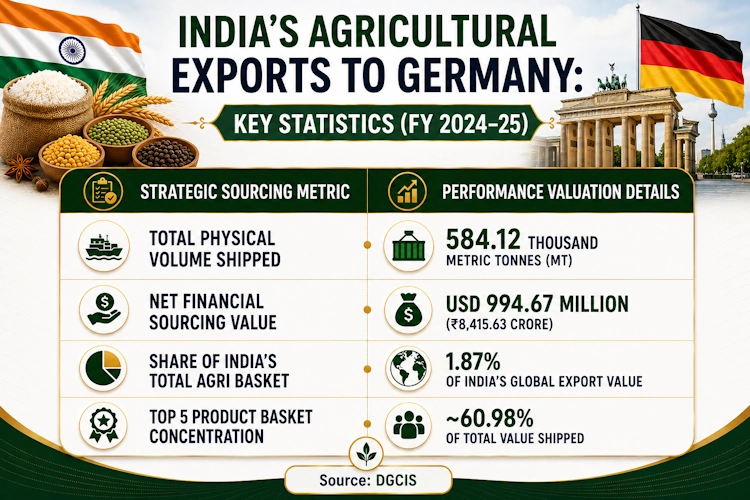
- Germany imported 584.12 thousand MT of agricultural products from India in FY 2024-25.
- India's agricultural exports to Germany were valued at USD 994.67 million , making Germany India's 14th largest agricultural export market .
- Coffee is India's largest agricultural export to Germany by value.
- Floriculture products, guar gum, spices, and marine products are among the top export commodities.
- German buyers prioritize traceability, food safety, and compliance with EU quality standards.
- Premium and value-added agricultural products continue to drive India's exports to Germany.
Introduction:
Germany has one of the largest and most strictly regulated food markets in Europe. The country relies heavily on international supply chains to meet its steady demand for high-quality food ingredients, beverages, and raw agricultural materials.

German consumers and food processing groups prioritize sustainability, trace-chemical safety, and strict compliance with EU maximum residue limits (MRLs). For international suppliers, establishing a presence in this lucrative market requires an absolute focus on quality consistency and standardized production processes. Top agriculture products imports in Germany and related products increased 1.9 percent from USD 139 billion in 2023 to USD 145.6 billion in 2024 according to USDA.
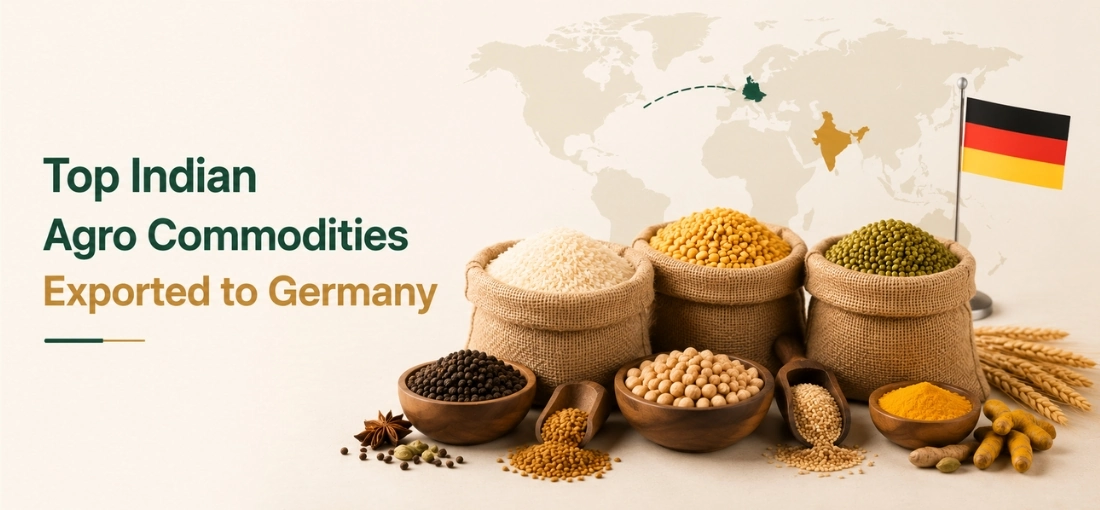
Keep reading this informative piece of blog. It will tell you the top Indian agro commodities exported to Germany . So let us get the ball rolling.
A High-Value Era for Indo-German Agri Trade
Within this competitive European trade framework, the strategy to execute agro products export from India to Germany channels has entered a high-value phase. Driven by deep commercial ties and a rising preference for authentic global sourcing, German distribution networks are looking toward Indian farming zones for critical inputs.
According to official trade data recorded for the FY 2024-25 fiscal cycle, Indian agricultural exports to Germany reached a vital economic milestone, with total outbound shipments approaching the USD 1 billion mark. Specifically, India exported a physical volume of 584.12 thousand metric tonnes (MT) of agricultural products to German ports.

Measuring the Fiscal Impact
This consistent flow of cargo generated a net export valuation of USD 994.67 million, which translates to a substantial institutional valuation of approximately ₹8,415.63 crore. This performance positions Germany as India's 14th largest global export destination for agricultural goods, accounting for a strategic 1.87% of India's total agricultural export value.
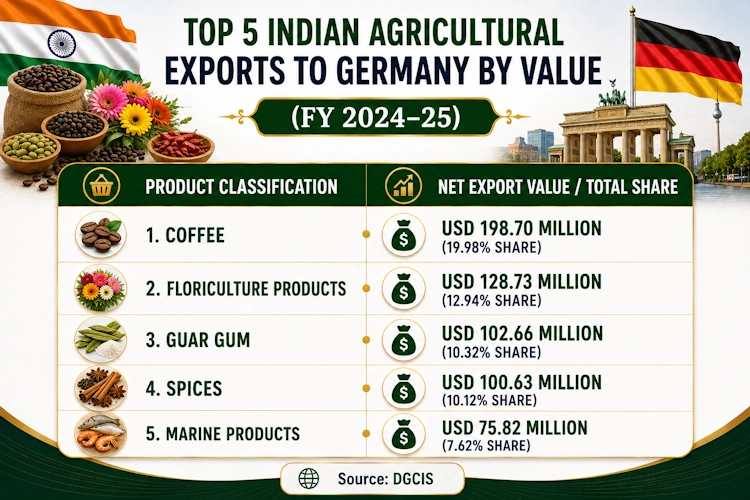
For commercial aggregators, mills, and large-scale processors planning their manufacturing allocations, the German market shows a distinct pattern of buying behavior. The market focuses heavily on high-value, specialized agro-commodities, rather than importing vast volumes of low-margin grain staples. The top five export categories, that are mainly Coffee, Floriculture Products, Guar Gum, Spices, and Marine Products, together generated USD 606.54 million. This accounts for approximately 60.98% of India's total agricultural exports to Germany.
To protect baseline profit margins and navigate the stringent European regulatory landscape, modern agricultural suppliers are shifting toward specialized digital procurement networks, bypassing traditional multi-layered broker systems to ensure full traceability from origin farms to final European destination docks.
The Core Sourcing Channels: The Top Agro Commodities in Demand
Analyzing the definitive performance charts of the leading product categories allows agri-enterprises to easily align their processing capacities with active global buying corridors.
1. Coffee: The Premium Beverage Segment Leader
Coffee stands out as India's single largest agricultural export to Germany by a significant margin. During the fiscal cycle, the mandate to export coffee from India to Germany generated a net export valuation of USD 198.70 million, contributing an absolute 19.98% of India's total agricultural exports to the country. Germany functions as a major global coffee processing and consumption hub, making it an essential destination for premium Indian coffee exporters to Germany .
German roasting plants and beverage brands heavily favor high-quality Robusta and Arabica beans, which are regularly sourced to satisfy the demands of both mainstream grocery brands and specialty cafe lines. To maintain long-term supply agreements in this high-premium market, Indian exporters focus heavily on ensuring low moisture levels, uniform bean grading, and full compliance with strict EU crop protection standards.
2. Floriculture Products: Cultivating Value in the European Market
Ranked as the second-largest export category into Germany, the floriculture sector has turned into a massive value contributor for Indian agri-businesses. Shipments of cut flowers, dried flower arrangements, and live plants generated an export value of USD 128.73 million, accounting for a highly valuable 12.94% of India's agricultural exports to Germany.
The German retail market maintains a robust, year-round demand for decorative floral elements and industrial horticultural inputs. Indian growers leverage advanced greenhouse technologies, temperature-controlled packing facilities, and rapid air-freight logistics corridors to ensure fresh, high-spec floral products reach European auction centers and wholesale buyers in peak condition.
3. Guar Gum: The Essential Industrial Hydrocolloid
Guar Gum emerged firmly as the third-largest export category from India to Germany, generating an export value of USD 102.66 million and representing 10.32% of the entire agricultural export basket. This specialized commodity is highly sought after by German industrial buyers due to its exceptional thickening, binding, and emulsifying properties.
The product serves as a critical ingredient across multiple German manufacturing sectors, including the commercial food processing industry, pet food manufacturing, cosmetics production, and specialized technical printing lines. To satisfy the strict purity demands of German corporate buyers, Indian processing plants run the raw guar splits through automated milling, multi-stage sifting, and rigorous microbiological testing laboratories.
4. Spices: High-Purity Seasonings for European Palates
Spices contributed a significant USD 100.63 million to the export ledger, accounting for 10.12% of India's agricultural exports to Germany. This performance reflects strong European demand for Indian seasonings and spice ingredients, providing an excellent environment for prominent Indian spice exporters to Germany.
The push to export spices from India to Germany's industrial kitchens and retail distributors covers a diverse array of whole and ground seasonings. This includes black pepper, ginger, turmeric, cardamom, and seed spices like cumin and coriander. It is worth noting that successful spice processors invest heavily in advanced steam-sterilisation units and multi-stage cleaning lines because German food regulatory bodies enforce incredibly strict checks for aflatoxins, ochratoxin A, and pesticide residues. The main challenge is to clear destination port laboratories without risk of shipment rejection.
5. Marine Products: Securing the Seafood Sourcing Line
Completing the top five export categories is the Marine Products sector, which achieved an export value of USD 75.82 million, contributing 7.62% of India's total agricultural exports to Germany. The German retail and food-service sectors maintain a steady, high-volume demand for premium frozen seafood items, particularly high-spec shrimp and prawns.
For commercial processing facilities along India's coastlines, this consistent demand provides a steady volume driver. To successfully enter German wholesale distribution channels, processing plants must maintain flawless cold-chain logs from the catch to final container delivery, while satisfying the strict veterinary health certifications mandated by EU border controls.
The Digital Transformation in Global Sourcing
While robust consumer demand and stable trade values provide a highly supportive environment, independent agricultural suppliers can easily damage their export profit margins if they rely on outdated, high-friction client acquisition networks to trade across Europe. Historically, companies spent immense sums traveling to international trade expos or purchasing unverified, static directories that are frequently clogged with dead contact data and historic customs records. Relying entirely on traditional commission-based brokers can obscure your market visibility, as these agents sometimes hide the true identity of the end-buyer to protect their position in the middle, leaving you exposed to counterparty risks and credit defaults during transit.
To bypass these friction points, the modern agricultural trade has shifted toward specialized digital procurement infrastructure. Online B2B trade platforms are becoming increasingly important in facilitating global agricultural trade by cutting out transaction friction. Platforms like Tradologie allow exporters to connect directly with buyers that are pre-vetted, import-ready. Such buyers who want to procure bulk commodities.
By negotiating directly with international procurement desks in real time, exporters can establish direct relationships and engage in transparent price discovery. This direct access allows businesses to protect their exact margins and secure fair market rates without extra broker fees. Furthermore, modern digital workflows protect trading capital by utilizing secure payment mechanisms—such as verified Letters of Credit (LC) and Escrow setups—insulating your cash flow from international trade risks while tracking documentation and port clearance milestones automatically.
Summary: A Strategic Blueprint for Exporters
Germany remains one of India's highest-value agricultural markets in Europe, driven primarily by high-value products such as coffee, floriculture products, guar gum, spices, and marine products. For forward-thinking agricultural processors, millers, and cold-chain operators, succeeding in this premium landscape means moving past slow-moving, non-transparent physical brokerage loops.
By understanding the detailed quality and volume demands across premium coffee beans, fresh floriculture setups, industrial guar gum matrices, high-purity spices, and frozen marine lines, and running your transactions through advanced B2B procurement systems that offer secure payment protection, your business can confidently establish a secure, scalable, and highly profitable presence within one of the most stable agricultural corridors in Western Europe.
Disclaimer
The information provided in this article is for educational and informational purposes only. Export statistics, EU regulations, customs procedures, maximum residue limits (MRLs), and import policies may change over time. Exporters should verify the latest DGCIS, APEDA, EU food safety regulations, and destination-country compliance requirements before exporting agricultural products to Germany.