.jpg "Best Indian Agro Products for Oman Market")
Key Highlights
- Oman imported 864.74 thousand MT of agricultural products from India in FY 2024–25.
- India's agricultural exports to Oman were valued at USD 532.43 million.
- Basmati rice is India's largest agricultural export to Oman.
- Oman depends heavily on food imports, creating steady demand for Indian agricultural products.
- Quality standards, Halal compliance, and reliable logistics are essential for exporters.
Introduction:
The commercial trade dynamic between India and the Sultanate of Oman has grown into a highly reliable economic partnership, particularly in the food and agricultural sectors. Oman’s unique geography, characterized by limited arable land and scarce freshwater reserves, means the country looks to international trade partners to secure its retail grocery lines and food-service industries. Because of its close geographical proximity across the Arabian Sea, India has naturally become a primary provider of essential food items to the Omani market.
For commercial food processors, large-scale millers, and international trading houses, the Gulf region offers excellent contract continuity. If you look at the real-world trade data, the strategy to export agro products to Oman has become an essential pillar for businesses looking to scale their global sales.
So, keep reading this informative piece of blog as it will tell you the top products to export to Oman from India. So, let us get the ball rolling.

Key Statistics on India's Exports to Oman
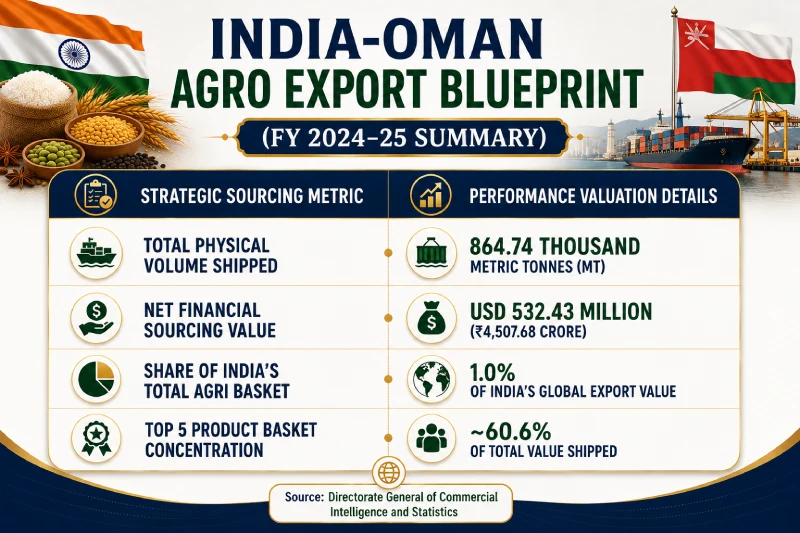
According to the official trade metrics recorded for the FY 2024–25 fiscal cycle, India successfully shipped a total export quantity of 864.74 thousand metric tonnes (MT) of agricultural commodities to Oman. This steady flow of containerized and bulk cargo generated a total agricultural export value of USD 532.43 million, which translates to an institutional valuation of approximately ₹4,507.68 crore.
This performance establishes Oman as a vital trading hub in the Middle East, accounting for exactly 1.0% of India's total global agricultural export value. For production desks planning their annual crop allocations, the Omani marketplace provides clear consumer demand channels.
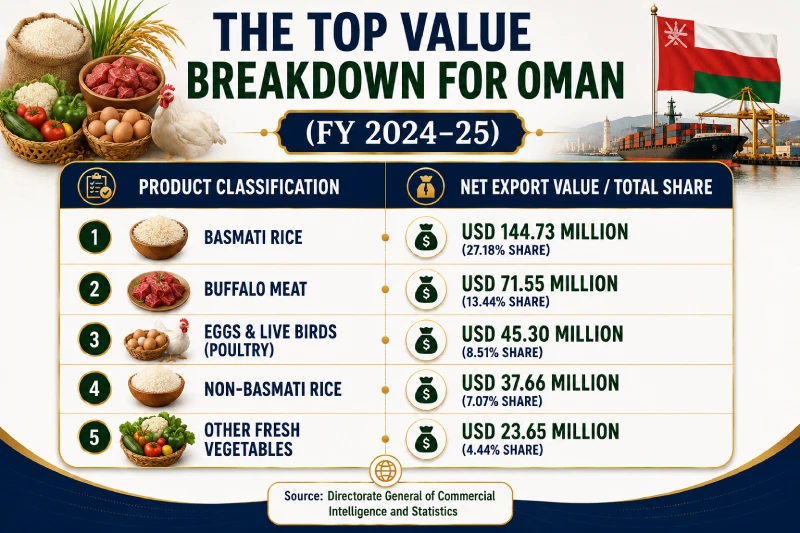
Rather than spreading out thin across dozens of small categories, the market concentrates heavily on a few key staple products. The top five export categories combined to generate USD 322.89 million, contributing approximately 60.6% of India's total agricultural exports to Oman.
To maximize profit margins and build long-term business footprints in the region, modern agricultural suppliers are moving away from unpredictable spot markets to export food products to Oman through direct distribution networks, making sure their shipments satisfy strict import quality and food safety standards.
The Core Sourcing Channels: The Top Agro Commodities Exported to Oman From India
Analyzing the definitive performance charts of the leading product categories allows agri-enterprises to easily align their processing capacities with active global buying corridors.
1. Basmati Rice: The Premium Staple Market Leader
Rice remains the undisputed product of the India-Oman agricultural trade lane if you are looking to export agro products to Oman. When you combine both Basmati and Non-Basmati varieties, the grain trade contributed a massive USD 182.39 million, representing 34.25% of the total agricultural export value shipped to Oman.
Looking at the premium segment alone, Basmati Rice export to Oman stands out as India's single largest agricultural by a notable margin. The crop generated a net export valuation of USD 144.73 million, contributing an absolute 27.18% of India's total agricultural exports to the country during the fiscal cycle.
Aromatic long grains are a fundamental component of the daily diet across Omani households and hospitality grids, creating a steady, year-round procurement requirement. For mills trying to optimize their shipping lanes, the strategy to export Basmati Rice to Oman wholesale networks stands as a highly stable business avenue.
Popular varieties include premium aged white Basmati and parboiled sella grains, which are regularly sourced to satisfy the high quality and visual appearance standards required by Gulf consumer networks.
2. Buffalo Meat: Anchoring the Protein Supply Chain
The secondary pillar anchoring the bilateral trade layout is the animal protein sector, which plays a critical role in securing Oman's core protein market requirements. Buffalo Meat exports to Oman ranked firmly as the second-largest export category from India. Outbound shipments generated a value of USD 71.55 million, accounting for a highly valuable 13.44% of the entire agricultural export basket.
For commercial slaughterhouses and cold-chain logistics groups, this consistent demand provides a highly predictable volume cycle. If you want to export Buffalo meat to Oman, it requires complete compliance with Oman's import regulations, including standard Halal certification frameworks alongside rigorous microbiological health compliance screenings managed by food safety inspectors at entry ports and other requisite safety certification as per the industry norms.
For commercial slaughterhouses and cold-chain logistics groups, this consistent demand provides a highly predictable volume cycle. If you want to, it requires complete compliance with Oman's import regulations, including standard Halal certification frameworks alongside rigorous microbiological health compliance screenings managed by food safety inspectors at entry ports and other requisite safety certification as per the industry norms.

3. Eggs and Live Birds (Poultry): The Fast-Moving Cold Chain Corridor
Ranked as the third-largest export category into the Sultanate, the poultry sector has turned into a major value contributor for Indian agri-businesses. Shipments of eggs and live birds generated an export value of USD 45.30 million, representing 8.51% of India's total agricultural exports to Oman.
Because Oman sits within a short deep-sea shipping window from India's western ports, logistics operators can transport fresh shell eggs and poultry items quickly under precise temperature controls. This reliable transit framework helps Omani retail chains keep their store shelves regularly stocked without having to worry about early product spoilage.
4. Non-Basmati Rice: Essential Everyday Grains
Reflecting a highly diverse consumer demographic that requires both premium options and affordable staples, Non-Basmati Rice ranked as the fourth-largest export category into the country. Outbound trade reached USD 37.66 million, contributing a stable 7.07% share of the overall export mix.
Exporters looking to export Non Basmati Rice to Oman find a highly reliable logistical pipeline for long and medium non-basmati white grains. This category satisfies the extensive volume requirements of commercial food service blenders, local packaging houses, and institutional catering complexes, allowing suppliers to maintain high asset utilization across their milling operations.
5. Other Fresh Vegetables: Daily Fresh Produce Pipeline
Completing the top five export categories is the fresh horticultural sector, which achieved a valuable valuation of USD 23.65 million, accounting for 4.44% of India's agricultural exports to Oman.
This category covers essential everyday produce items like onions, potatoes, tomatoes, and green chillies. Indian growers and exporters leverage modern sorting, grading, and packing lines to secure steady, long-term supply contracts with major Omani supermarket distribution networks, providing a highly reliable avenue for fresh produce trade.
The Digital Transformation in Global Sourcing
While robust consumer demand and stable trade values provide a highly supportive environment, independent agricultural suppliers can easily damage their export profit margins if they rely on outdated, high-friction client acquisition networks to trade across the Gulf.
Historically, companies spent immense sums traveling to international trade expos or purchasing unverified, static directories that are frequently clogged with dead contact data and historic customs records. Relying entirely on traditional commission-based brokers can obscure your market visibility, as these agents sometimes hide the true identity of the end-buyer to protect their position in the middle, leaving you exposed to counterparty risks and credit defaults during transit.
To bypass these friction points, the modern agricultural trade has shifted toward specialized digital procurement infrastructure. Online AI enabled trade solutions like Tradologie are becoming increasingly important in facilitating global agricultural trade by cutting out transaction friction. These systems allow exporters to connect directly with pre-vetted, import-ready buyers who want to procure bulk commodities, bypassing traditional middleman layers.
By negotiating directly with international procurement desks in real time, agriculture exporters can establish direct relationships and engage in transparent price discovery. This direct access allows businesses to protect their exact margins and secure fair market rates without extra broker fees. Furthermore, modern digital workflows protect trading capital by utilizing secure payment mechanisms—such as verified Letters of Credit (LC) and Escrow setups—insulating your cash flow from international trade risks while tracking documentation and port clearance milestones automatically.
Summary: A Strategic Blueprint for Exporters
Oman's stable retail markets and structural reliance on imported food products position it as one of India's most valuable, long-term strategic agricultural export markets in the GCC. For forward-thinking agricultural millers, processors, and cold-chain operators, succeeding in this high-yield landscape means moving past slow-moving, non-transparent physical brokerage loops.
By understanding the detailed volume demands across premium long-grain rice, frozen meats, poultry items, and fresh vegetable matrices, and running your transactions through advanced B2B procurement systems that offer secure payment protection, your business can confidently establish a secure, scalable, and highly profitable presence within one of the most stable agricultural corridors in the Middle East.
Disclaimer
The information provided in this article is for educational and informational purposes only. Export statistics, customs regulations, food safety standards, and import policies may change over time. Exporters should verify the latest APEDA data, Oman import regulations, and destination-country compliance requirements before exporting agricultural products.



.webp "How to Build a Global Network of Agricultural Importers & Exporters")
.webp "Top Ports in India for Agro Commodity Exports — Kandla, Mundra & Chennai")