Key Highlights
- Export seller registration is essential for legal international trade from India.
- IEC, RCMC, APEDA, and AD Code are key export registrations.
- Registered exporters can access government incentives and duty refunds.
- Registration builds trust with overseas buyers and speeds up negotiations.
- Transaction-oriented B2B platforms provide access to verified global buyers.
- Proper registrations help avoid customs delays and export disruptions.
Introduction:
Taking an Indian manufacturing unit or a merchant trading business global is easily one of the most effective ways to scale up revenues. Sourcing demands from international buyers are massive, and profit margins on Full Container Loads (FCL) beat local wholesale rates hands down. However, jumping can't go straight into international trade without export seller registration.
To run a compliant, profitable cross-border operation, every supplier needs to become a registered exporter . Taking the step to register as an exporter opens a path for a systematic export process in India that every exporter is obliged to follow.
Let's break down why completing your export seller registration matters, how the mandatory regulatory licenses work, and why signing up on modern digital trade portals can completely change your business trajectory.

What Is Export Seller Registration?
Export seller registration is a process that involves licenses and registrations that are mandated by the government of India to become an exporter. A systematic set of steps and protocol that every exporter is obliged to follow.
Setting up your trade operations involves two practical steps:
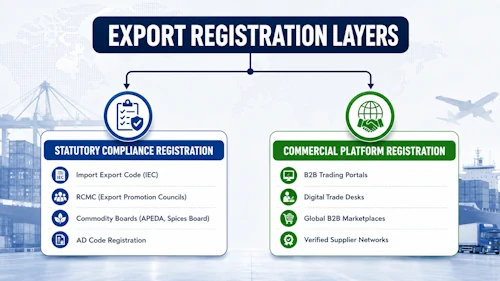
First, you need official legal clearances from government authorities like the DGFT. These are mandatory—without them, Indian customs won't allow your cargo onto a ship or cargo plane. Second, you set up verified supplier profiles on international B2B trading portals and digital trade desks.
Handling both steps gives your business a clean, verifiable footprint that both customs authorities and foreign corporate buyers can trust right away.
Core Government & Regulatory Exporter Registrations
Before you start booking container space, there are a few required legal approvals you need to line up.
1. Import Export Code (IEC)
Issued by the DGFT, this 10-digit code is the primary identification number for any Indian business looking to ship goods internationally. You'll need an active IEC for nearly every step of the export process—from filing customs paperwork on ICEGATE to booking shipping lines and receiving foreign currency payments at your bank. The code itself stays valid for life, though you do need to log into the DGFT portal once a year between April and June to confirm your business details are up to date.
2. Registration-Cum-Membership Certificate (RCMC)
Getting an RCMC from the Export Promotion Council that matches your industry—like EEPC for engineering goods or CLE for leather products—is essential if you want to benefit from government trade policies. While your IEC allows you to physically ship goods out of the country, having an RCMC is what actually unlocks government duty drawbacks, tax rebate programs like RoDTEP, and concessional capital goods schemes.
3. APEDA Registration for Agri and Food Exporters
If you are exporting agricultural produce, grains, fresh fruits, processed foods, or dairy products, getting an APEDA registration through the Agricultural and Processed Food Products Export Development Authority is legally required. This registration acts as your specific RCMC for the food sector. Beyond keeping you compliant with Indian law, it reassures international buyers that your processing setup adheres to global safety standards, while also making your business eligible for government transport and cold-chain subsidies.
4. Authorized Dealer (AD) Code Registration
An AD Code is a 14-digit number issued by the bank handling your foreign exchange transactions. Once you receive this code, you have to register it with the specific customs port where your cargo will be stuffed and inspected. If your AD Code isn't registered at that port, customs officers cannot generate your Shipping Bill, which halts the entire loading process.

Key Regulatory Registrations at a Glance
The table below outlines the core regulatory filings every Indian exporter must manage:
| License / Certificate | Issuing Body | Primary Function | Operational Impact |
|---|---|---|---|
| Import Export Code (IEC) | DGFT | Primary trade identifier | Essential for customs shipping bills and forex banking. |
| RCMC Certificate | Respective EPCs | Council membership proof | Unlocks tax refunds (RoDTEP), duty drawbacks, and trade fairs. |
| APEDA Registration | APEDA | Food & agri export clearance | Mandatory for shipping food/agri products; unlocks infrastructure subsidies. |
| AD Code Registration | Customs Ports via ICEGATE | Links bank to customs | Ensures automatic deposit of export duty drawbacks and incentive payouts. |
| GST Export Clearance | Central Board of Indirect Taxes | Tax tracking | Allows zero-rated export shipments or duty refund claims via LUT. |
Top Benefits of Export Seller Registration
Completing both statutory and digital B2B platform sign-ups delivers several immediate operational advantages:
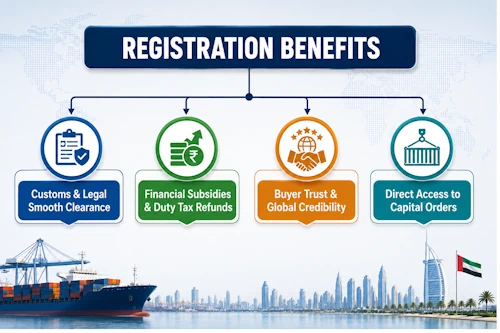
1. Unlocks Government Incentives and Duty Refunds
When you manufacture and package goods for export, you incur various local taxes and import duties along the way. Completing your official exporter filings allows you to claim those costs back through central government schemes. For instance, the RoDTEP program deposits un-rebated local and state taxes right back into your account, while Duty Drawback refunds the import duties you paid on raw materials. You can also take advantage of schemes like Advance Authorization to import raw inputs duty-free, helping you keep your production costs competitive on the global market.
2. Establishes Real Credibility with Overseas Procurement Teams
Foreign buyers are understandably cautious when dealing with a new supplier across borders, especially when an order involves wiring a 30% advance on a major container shipment. Once you become a registered exporter with an active IEC, an RCMC, and a complete online exporter registration on b2b trade platform, buyers can easily verify your credentials on official government databases. That transparency removes hesitation and makes commercial negotiations move much faster.
3. Prevents Expensive Port Delays and Cargo Holds
Moving ocean freight operates on tight terminal schedules. If your container arrives at the port without the right documentation in place—like missing port AD Code approvals or lacking proper food clearances—customs will simply hold the load. Daily storage fees and container demurrage pile up quickly, easily wiping out your profit margin on a deal. Taking care of your registration paperwork ahead of time keeps your cargo moving through terminal gates and onto the vessel without costly surprises.
4. Direct Access to Bulk Buyers and Live Tenders
Completing your export seller registration on digital B2B trading platforms puts you directly in front of procurement teams searching for container-load quantities. Instead of spending months chasing cold emails, you get direct access to active buy requirements and live price negotiations.
B2B Trade Platforms: Choosing the Right Registration Portal
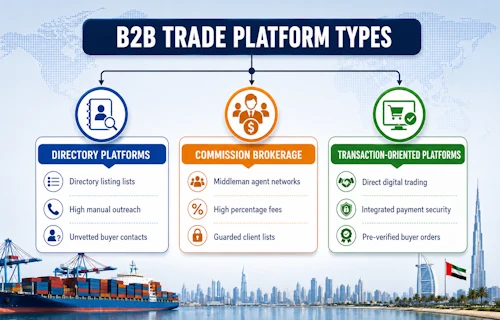
Once your government licenses are locked in, the next step is choosing where to list your products. Not all digital trade portals operate the same way. B2B platforms generally fall into three distinct models:
1. Traditional Directory Listing Platforms
Directory sites operate like massive online yellow pages. You pay an annual fee to publish a seller profile and catalog. Buyers search for keywords and submit inquiry forms. In practice, directories pass along raw leads, but they don't verify if the buyer is financially ready to trade. You often end up sifting through outdated contact info, spam inquiries, and unvetted shoppers, requiring an in-house sales team to make cold calls.
2. Commission Broker Networks
Brokers have traditionally dominated commodity trades, acting as intermediaries between suppliers and overseas buyers. An agent brings you a buyer, handles communication, and negotiates the deal. While brokers can bring in orders, they charge high commission fees per metric ton that slice into your profit margins. Worse, they guard the buyer's contact info, leaving you dependent on them and unable to build direct client relationships.
3. Transaction-Oriented B2B Platforms
Transaction-oriented platforms offer an end-to-end digital trading environment if you become a registered exporter on the portal. Buyers submit live, verified procurement orders specifying exact product grades, packaging needs, destination ports, and delivery schedules. Exporters negotiate prices and trade terms directly with pre-screened buyers on the platform. The system supports secure, standard trade instruments—like Letters of Credit (LC) or Telegraphic Transfers (TT)—protecting your margins while keeping the deal process transparent. You can go to the seller registration page and register as a seller on the transaction oriented platform.
B2B Trading Platform Models Compared
Here is how the main digital platform options stack up for an exporting business:
| Platform Feature | Directory Platforms | Commission Broker Networks | Transaction-Oriented Platforms |
|---|---|---|---|
| Upfront Registration | Annual subscription fee | Free setup / High per-ton fee | Trade Success Fee |
| Buyer Verification | Unverified / Raw leads | Verified by broker | Pre-verified background checks |
| Deal Negotiation | Manual (Email / Cold call) | Handled by middleman | Direct live online negotiation |
| Profit Margins | Moderate | Reduced (Eaten by commissions) | High (Direct factory pricing) |
| Client Ownership | Direct (Hard to reach) | Indirect (Broker owns relationship) | Direct & Long-Term |
| Payment Protection | None (Self-managed) | Managed by agent | Integrated LC / Advance Payment Support |
Step-by-Step Guide: How to Complete Your Registrations
To get your export operations up and running smoothly, follow this step-by-step checklist:
Step 1: Incorporate Your Business and Apply for an IEC
Start by setting up your business entity (Sole Proprietorship, LLP, or Private Limited) and obtaining your PAN card and GSTIN. With these ready, log onto the official DGFT portal to complete your online exporter registration and secure your Import Export Code.
Step 2: Register for an RCMC with Your Commodity Council
Identify the council that governs your product line. For agricultural commodities, apply for an APEDA registration via the DGFT portal. For manufactured items, engineering products, or textiles, apply to the relevant body (such as EEPC, TEXPROCIL, or the Spices Board).
Step 3: Complete Port AD Code Registration
Ask your bank branch to issue an official AD Code letter. Upload this document onto the ICEGATE portal to link your bank account with the specific sea and air ports you'll be shipping through.
Step 4: Complete Your B2B Trade Portal Registrations
With your statutory licenses active, finish your export seller registration on verified B2B trading portals. Upload your product catalogs, specify your monthly supply limits, and add clear photos of your processing facility and lab quality certificates to build trust with prospective buyers.
Final Thoughts for B2B Sellers
Expanding into international markets offers incredible growth, but trying to operate under the radar with incomplete documentation is a short-sighted strategy. Taking the time to register as an exporter secures your legal compliance, protects your shipments from customs delays, and unlocks significant financial refunds from the government. Pairing these statutory filings with a verified export seller registration on modern, transaction-oriented B2B trade platforms gives you direct access to genuine international buyers—helping you scale up a profitable, long-term export business.
Final Thoughts for Exporters
Expanding into international markets offers incredible growth, but trying to operate under the radar with incomplete documentation is a short-sighted strategy. Taking the time to register as an exporter secures your legal compliance, protects your shipments from customs delays, and unlocks significant financial refunds from the government. Pairing these statutory filings with a verified export seller registration on modern, transaction-oriented B2B trade platforms gives you direct access to genuine international buyers—helping you scale up a profitable, long-term export business.
Disclaimer
The information provided in this article is for educational and informational purposes only. Export registration requirements, government incentive schemes, and regulatory procedures may change over time. Exporters should verify the latest guidelines issued by DGFT, APEDA, ICEGATE, GST authorities, and the relevant Export Promotion Council before completing export registrations.