Key Highlights
- Per official data from the APEDA report, the United States is India's largest destination for agricultural exports, capturing 11.74% of total outbound agro-trade value.
- India's total agricultural export volume to the USA stands at 1,661.80 thousand metric tons, representing an export value of USD 6,249.07 million.
- Marine Products comprise the single largest component of this trade channel, accounting for 43.62% of the total export basket to the US.
- Shifting your cargo focus to high-value product classes can significantly optimize your container return potential, depending on procurement costs, freight, insurance, and local value addition.
The international food trade runs on verified data and precise compliance. For a merchant trading house evaluating cross-border opportunities and agro products export from India to USA, the primary objective is to target established export corridors where demand is stable and value-added processing can yield sustainable commercial returns.

As highlighted in the APEDA Analytical Report (2024-25), the United States is India's largest destination for agricultural exports, purchasing ₹52,873.51 Crore (USD 6,249.07 Million) worth of commodities in a single fiscal year.
While the actual net return per container always depends on variable factors—including the specific product, current FOB pricing, inland procurement expenses, ocean freight, insurance, and built-in margins—the US market offers strong commercial viability. Capturing this value requires aligning your processing operations with the exact product categories the US market is consistently absorbing.
Keep reading this informative blog if you are planning to start India to USA export business in agriculture commodities. It will tell you some of the major agro products exported from India to the USA.
The Big Five: Major Agro Products Exported From India to USA
An analysis of the product-wise data fields shows exactly where the trade value is concentrated. These five categories represent the top agriculture products exported from India to the USA.
1. Marine Products (USD 2,725.55 Million | 43.62% Share)
Marine products represent the single largest value component of this trade lane, generating USD 2,725.55 million. This category, consisting largely of frozen shrimp and processed seafood, accounts for nearly half of the entire value of India's agro-exports to the US. The strong purchasing power of US buyers, paired with high demand in the commercial food-service sector, makes frozen aquaculture lines a high-value category for seafood exporters who can maintain strict cold-chain integrity.
2. Spices (USD 626.06 Million | 10.02% Share)
The US continues to witness strong demand for Indian spices, accounting for an export value of USD 626.06 million. Sourcing whole or ground variants—such as black pepper, turmeric, and specialized blends—offers excellent margin potential. Spices exporters can significantly optimize their returns by shifting from generic bulk sacks to consumer-ready retail packaging, capturing higher value through local branding and grinding.
3. Other Commodities (USD 444.20 Million | 7.11% Share)
This diverse commodity grouping accounts for USD 444.20 million. It covers a wide range of secondary agricultural derivatives, industrial crop extracts, and niche raw materials required by North American food manufacturing plants. It offers an excellent option for diversified trading houses looking to optimize their shipping allocations and freight contracts.
4. Basmati Rice (USD 337.10 Million | 5.39% Share)
Long-grain aromatic Basmati rice accounts for USD 337.10 million in sales to the US. This premium grain is heavily insulated from the price volatility affecting ordinary non-basmati varieties. Sourcing aged, uniform crop lines (such as 1121 steam or parboiled sella) that match the strict culinary expectations of the North American retail sector allows basmati rice exporters to preserve steady margins per container.

5. Miscellaneous Preparations (USD 264.02 Million | 4.22% Share)
Earning USD 264.02 million, this represents an important value-added export category. It encompasses processed food products, ready-to-eat formulations, and convenience mixes. The steady demand for convenience foods among busy urban consumers in the US provides a highly predictable retail channel for processing firms capable of meeting international shelf-life and recipe standards.
Sourcing & Revenue Performance Table
Agro exporters can evaluate their operational costs against the official APEDA 2024-25 baseline to identify which categories align best with their processing capabilities:
India-USA Agro Export Breakdown
| Top Export Commodity | Export Value (USD Million) | Export Share Percentage | Primary Market Channel | Key Value Driver |
|---|---|---|---|---|
| Marine Products | $2,725.55 | 43.62% | US Food-Service Networks & Seafood Distributors. | High unit value per container; driven by steady institutional seafood demand. |
| Spices | $626.06 | 10.02% | Industrial Blenders, Seasoning Plants, & Retailers. | Margin growth achieved through localized cleaning, grinding, and branding. |
| Other Commodities | $444.20 | 7.11% | Industrial Processors & Bulk Commodity Buyers. | High-volume shipping that balances out seasonal trade desk logistics. |
| Basmati Rice | $337.10 | 5.39% | Ethnic Hypermarkets & Premium Culinary Chains. | Driven by consistent demand for premium, long-grain aromatic characteristics. |
| Misc. Preparations | $264.02 | 4.22% | Mainstream Supermarkets & Convenience Portals. | High margin potential derived from consumer packaging and retail value addition. |
Overcoming Technical Barriers: US Import Standards
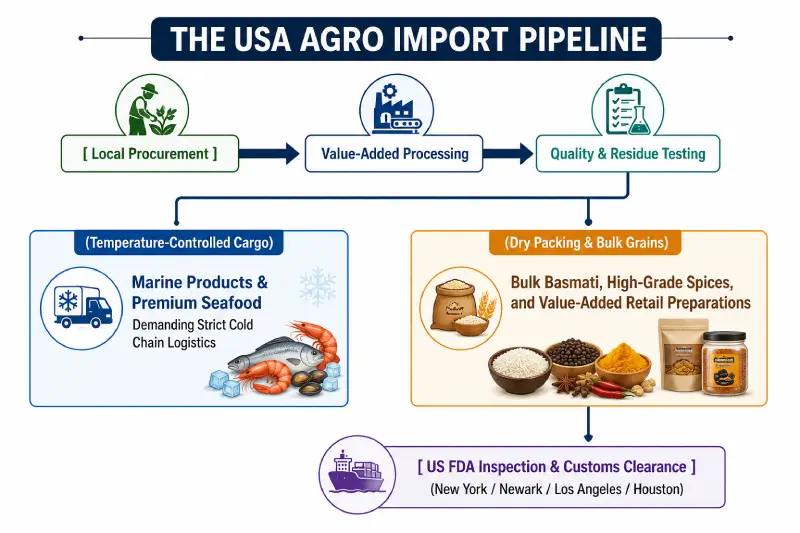
Securing consistent returns in the US market requires absolute precision at the origin factory floor. US regulatory authorities run strict border checks, and compliance issues can quickly wipe out profit margins through port delays or cargo rejections.
1. Enforce US FDA and Prior Notice Registrations
Every facility that manufactures, processes, packs, or holds food intended for consumption in the United States is required to be registered with the US Food and Drug Administration, which is commonly known as the FDA. Furthermore, your logistics team must file a mandatory Prior Notice with US Customs and the FDA before the shipment arrives at its destination port. This is done to ensure the biological and regulatory data trail matches perfectly.
2. Manage Chemical Residues and Contaminants
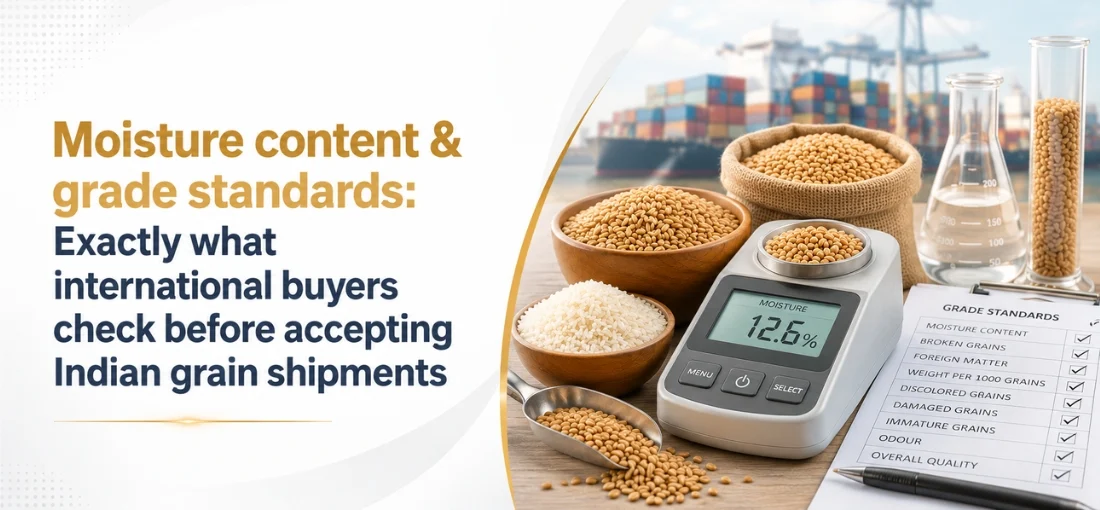
To satisfy US border screening for unapproved pesticides, heavy metals, and filth, Indian exporters routinely verify residue limits pre-shipment using NABL-accredited laboratories running globally accepted testing methods. For agricultural grains and dry commodities, implementing thorough mechanical sifting alongside modern optical color sorting systems removes field defects, allowing the cargo to reach the exact visual uniformity parameters required by enterprise buyers.
3. Streamlining the Sourcing Flow
A common point of friction for growing export desks is navigating fragmented local supply chains and filtering out unverified brokers who request quotes without real purchasing intent.
To introduce more structure into global business development, many trading houses leverage dedicated B2B digital marketplaces like Tradologie. The platform operates an inquiry-driven ecosystem where international buyers must submit verified corporate profiles and explicit sourcing requirements before starting a trade negotiation. By allowing exporters to engage directly with active buyers in a transparent digital bidding setup, this framework cuts out unnecessary intermediary layers and helps secure clear, documented payment terms—making it a useful digital channel for trade desks looking to optimize their international business development.
The Tactical Verdict
Establishing a scalable, long-term export pipeline to the United States requires moving away from casual trading habits and focusing heavily on manufacturing discipline. The premium nature of the US market means that buyers prioritize consistent quality, reliable lead times, and total regulatory transparency over cheap spot pricing.
By matching your processing lines with the exact high-value categories verified in the APEDA data, certifying your shipments through accredited testing bodies before loading, and utilizing secure digital trade networks to verify buyer requirements, you significantly de-risk your cross-border trade. This systemic approach ensures your container pipelines remain compliant, your transactions stay secure, and your export business maintains steady profitability across every consecutive shipping season.
Disclaimer
The information provided is for educational and informational purposes only. Export statistics, product demand, regulatory requirements, and import policies may change over time. Exporters should verify the latest APEDA, US FDA, and customs requirements before shipping agricultural products to the United States.