Key Highlights
- FCL Advantages: Utilizing Full Container Load (FCL) ensures maximum cargo safety, significantly lowers per-unit shipping costs, and speeds up your bulk agricultural trade.
- Container Selection: Choose 20ft containers for heavy grains, 40ft for lighter spices, and remember that Reefer cooling units drastically multiply your freight costs.
- FOB Breakdown: Accurate FOB pricing demands carefully calculating ex-factory costs, inland transport, customs agent fees, mandatory fumigation, and port terminal handling charges.
- Hidden Penalties: Protect your profit margins by avoiding heavy demurrage penalties for port delays and detention fees for holding empty containers too long.
- Profit Reality: Real agricultural export net profits hover between 5% and 12%, making high shipping volume and repeat orders the true keys to wealth.
- Safety Buffers: Always embed a 2% to 3% safety financial buffer into your final FOB quotes to absorb sudden transport delays or port strikes.
One exporter makes ₹50 lakh per container on a regular basis. Another exporter barely survives the season. This second exporter loses money to hidden charges. They also lose money to delayed ships. What makes them different? It is not just the quality of their product. It is how closely they watch their numbers and logistics.
In global trade, a shipping container is more than a steel box. It is a single unit of profit. You must understand your full container export cost in India down to the last rupee. If you do not, you are simply gambling. You are not really trading.
For exporters, margins depend completely on the cost sheet. This is especially true in the farm sector for goods like rice, spices, and pulses. The year 2026 brings heavy changes in freight prices. You cannot rely on old price quotes. You also cannot rely on quick, rough math. Doing so will ruin your business.
Let us look past textbook definitions. We will break down the real numbers of FCL shipping. Here is your inside guide to mastering your export container costs.
What is FCL Export? (And Why It Dominates Bulk Trade)
FCL stands for Full Container Load. This means you, the exporter, rent the whole container for your goods. You do not share space with another seller. Sharing space is called LCL (Less than Container Load).
FCL is very important to understand how bulk export from India operates. This is especially true for farm goods. In fact, it is required. Here is why:
- Safety: Farm products easily spoil from dirt or moisture. You do not want to mix your top-quality rice with another person's chemicals in an LCL shipment. That would be a huge disaster.
- Lower Costs: You will ship in high amounts. Because of this, the cost per container export from India drops. It is much cheaper than paying per square meter in an LCL setup.
- Faster Speed: FCL containers get loaded at your factory. Workers seal them right there. Buyers only open them when they reach the final stop. Less touching means fewer delays. It also means no one messes with your goods.
Container Types & Their Cost Impact
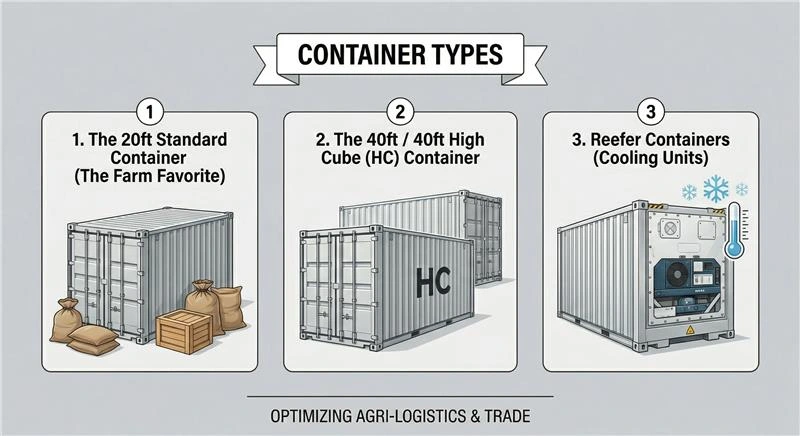
Not all containers are the same. Your choice changes your freight costs. It changes your port fees. It also changes how much you can pack.
1. The 20ft Standard Container (The Farm Favorite)
- Best For: Heavy, thick items. Think of rice, sugar, and wheat.
- Space: It holds about 24 to 28 Metric Tons (MT). This depends on the port's weight limits.
- Good to Know: Farm exports are heavy. You will hit the weight limit long before you fill up the space. A 20ft box works best for this reason.
2. The 40ft / 40ft High Cube (HC) Container
- Best For: Light goods that take up a lot of room. This includes spices, tea, and packed foods.
- Space: It holds almost twice the space of a 20ft box. However, it still has strict weight limits. The total weight usually caps around 26 to 29 MT. You cannot pack it full of heavy grains.
- Cost Change: It usually costs 20% to 40% more to ship than a 20ft box.
3. Reefer Containers (Cooling Units)
- Best For: Goods that go bad easily. This means fresh fruits, vegetables, and special plant extracts.
- Cost Change: The cost is huge. The FCL shipping cost in India for a Reefer is very high. It can easily cost two or three times more than a normal box. This is because it uses power and needs special care.
The Core Breakdown: Export Container Cost Breakdown For India
You need to know your FOB price calculation in India. To do this, you must track every step your cargo takes. You must track it from your factory to the ship. Here is exactly where your money goes.
1. Product Cost (Leaving the Factory)
This is your base cost to make or buy the goods. It includes raw materials and processing. It also includes packaging, like jute bags or wooden pallets. Finally, it includes worker pay.
- Pro Tip: Always pay for good export packaging. A broken bag inside the container can cause moisture damage. This can ruin the whole shipment.
2. Local Transport (Factory to Port)
You must move the empty box from the yard to your factory. Then, workers load it. Next, a truck moves the full box to the port. Common ports are Nhava Sheva or Mundra.
- Normal Cost: Expect to pay ₹15,000 to ₹50,000 or more. This changes based on the driving distance.
- Hidden Danger: Truck waiting fees. Let us say your workers take three days to load the box. The truck company will charge you a heavy fine for waiting.
3. CHA Charges in India for Export (Customs Agent)
Your CHA is your legal helper at the port. They take care of the shipping bills. They clear customs. They also handle port talks.
- Normal Cost: This is usually ₹3,500 to ₹8,000 per box.
- Pro Tip: Do not look for the cheapest CHA. A bad CHA might delay your customs clearing by two days. This delay will cost you much more in port fines than you saved on their fee.
4. Paperwork & Rules
Exporting farm goods takes a lot of paperwork.
- Health Certificate: This proves your cargo has no bugs or pests.
- Origin Certificate: The local Chamber of Commerce usually gives this paper.
- Bug Spraying Fees: This is called fumigation. It is needed for wood pallets and farm goods. It costs around ₹2,000 to ₹4,000.
- Checking Fees: Sometimes the buyer wants an outside group to check the goods. You must pay for this if they ask.
5. Port Charges in India for Export
These are also called Terminal Handling Charges (THC). The port workers charge this fee. It is the cost to physically lift your box onto the big ship.
- Normal Cost: Expect to pay ₹10,000 to ₹18,000 for a 20ft box.
6. Sea Freight (Shipping Costs)
This is the biggest cost in your export logistics cost in India. It also changes the most often. In 2026, world events change shipping routes. Ship space is tight. Because of this, freight prices jump up and down like the stock market.
- What is Happening Now: A 20ft box going to the Middle East might cost $400. That exact same box going to the USA could cost between $3,000 and $5,000.
- Good to Know: Freight price quotes usually only last for 7 to 14 days. You must accept them quickly.
7. Insurance & Bank Fees
- Sea Insurance: This usually costs 0.1% to 0.5% of the total goods value. It covers up to 110% of the CIF price.
- Bank Fees: Banks charge money to handle Letters of Credit. They charge to change foreign money into rupees. They also charge general service fees.
8. Hidden Surcharges (Profit Eaters)
- BAF / CAF: These are extra fees for fuel changes. They also cover money value changes.
- Demurrage: The shipping line charges this fee. They charge it if your full box sits inside the port for too long. You only get a few free days. After that, it can cost $150 per day.
- Detention: This fee happens outside the port. You pay this if you keep the empty box for too long before returning it.
Sample Cost Calculation: Agro Export Container Cost In India
Let us look at a real FOB price calculation in India. We will look at a 20ft box of normal rice. It travels from a mill in Haryana to the JNPT port.
We will guess there are 24 Metric Tons (24,000 kg) loaded in this one 20ft box.
| Cost Item | Guess Cost (INR) | Notes |
|---|---|---|
| Ex-Factory Goods Value | ₹8,40,000 | (24 MT @ ₹35/kg) |
| Export Bags (PP Bags) | ₹18,000 | Good quality, 50kg bags |
| Local Transport (Haryana to JNPT) | ₹65,000 | Truck for the full box |
| CHA & Customs Clearing | ₹5,500 | Standard clearing fee |
| Bug Spray & Health Cert. | ₹4,000 | Required for rice |
| Port Lifting Fee (THC) | ₹12,000 | Paid to port/ship line |
| Extra Papers (BL fee, Origin) | ₹4,500 | Standard paperwork |
| Total FOB Cost (Before Profit) | ₹9,49,000 | This is your break-even at port |
Note: Are you selling CIF (Cost, Insurance, Freight)? If yes, you must add the Sea Freight cost to this total now. You must also add the Insurance cost.
The Main Rule: Always add a 2% to 3% safety buffer to your final FOB price. Problems will happen. A truck might break down. The port workers might strike. If your price is too low, these problems will eat your profit right away.
Profit Per Container: The Volume Game
New exporters often want a 20% profit on just one box. Because of this, they set their prices too high. Then, they never find a buyer. Smart traders know the truth. Farm exports are about selling a lot of goods for a small profit each time.
Real net profits on normal farm goods are usually between 5% to 12%.
Let us say you make ₹60,000 net profit on one box of rice. That might not seem like a lot of money. However, what if you build a strong supply chain? What if you ship 50 boxes every month? Then, you are looking at ₹30,000,000 in profit each month. You must lower your cost per container exported from India. Then, you must sell more volume. The math will do the hard work for you.
4 Factors That Will Break (Or Build) Your Profits in 2026
- Freight Price Jumps: Ship space can disappear quickly in Asia. Global events can also cause problems. This can make sea freight jump by $1,000 in just one week. Did you agree to a fixed CIF price with your buyer? Did you forget to add a rule about freight changes? If so, you will have to pay for that extra cost.
- Money Exchange Rates: You agree on a price in US Dollars. But you pay your local bills in Indian Rupees. The exchange rate might change by 2 rupees between your quote and your payday. This small change alters your whole profit. Always protect your money value if you trade in large amounts.
- World Buying Cycles: Try to guess when people will buy more. Big holidays cause rushes. You will pay extra money to get space on ships before the Lunar New Year or Ramadan.
- Travel Delays: Ships sometimes have to take longer routes. This can add 10 to 15 extra days to the trip. A longer trip means your money is tied up for longer. It also means you pay more to hold your goods.
Common Exporter Mistakes
- Guessing CIF Prices: Never give a final delivered price without a firm freight quote. Always ask your shipping agent first.
- Forgetting Extra Port Fees: Do not assume the port process will be perfect. Always ask the shipping line for extra "free days" before you book the ship.
- Bad Local Bargaining: Do not fight over small amounts with your customs agent. Why do that when you are losing thousands of rupees on bad truck routes? Put your focus on the big numbers.
- Working Blindly: Many people use emails or WhatsApp to find world prices. This gives them bad information. Then, they give bad price quotes to buyers.
The Smart Exporter's Edge: Using Tradologie.com
You might have the best shipping plan in the world. However, your buying price might be too high. Or, maybe you cannot find real global buyers. If these things happen, your containers will stay empty.
The export world is changing right now. Websites like Tradologie.com are changing how bulk export from India works.
You do not have to guess anymore. Tradologie acts as a real-time price finder. It is a direct bridge to real buyers all over the world. You join live bidding events to buy and sell. Because of this, you cut out the middlemen and their fees. It helps you get the best profit. It shows you exactly what global buyers will pay today. You can then work backward to find your container costs. You lock in real profits before the goods even leave your factory.
Conclusion
A shipping container is more than a way to move things. It is a living balance sheet.
Knowing your full container export cost in India makes you a true expert. Map out your factory costs. Work hard to lower your local transport fees. Know that sea freight changes often. And never forget to add your safety cash buffers.
If you control the container, you control the costs. If you do that, you will win in the global market.