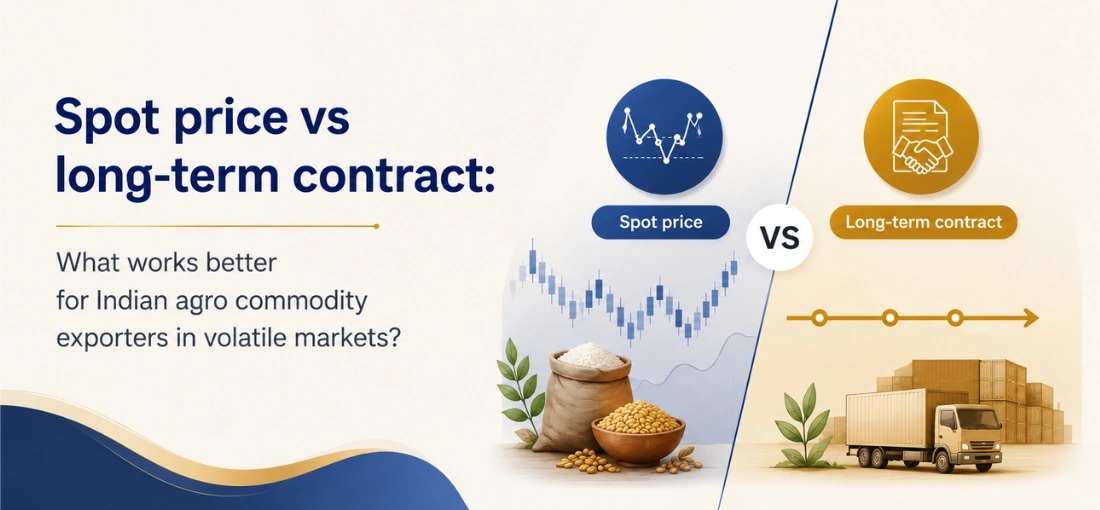
Key Highlights
- Spot pricing offers flexibility but exposes exporters to market volatility.
- Long-term contracts provide predictable revenue and stronger relationships with buyers.
- Fixed-price agreements can become risky during domestic commodity price spikes.
- Different commodities require different pricing strategies.
- Hybrid contracts help balance risk and profit opportunities.
Introduction:
Ask anyone running a shipping desk in Mundra or Chennai how they manage risk, and the conversation usually turns to a single, persistent challenge. How do you price your cargo when local and international markets refuse to settle down? Global trade always carries a baseline of uncertainty, but recent supply chain shifts have made price discovery an incredibly fluid process.
For Indian agro commodity exporters, pricing is a core operational decision that directly impacts survival.
Choosing a revenue model forces a firm to weigh two distinct pathways: Spot Price vs Long-Term Contract. Selling at immediate market rates leaves a business fully exposed to sudden shifts in global supply lines. On the flip side, committing to a fixed, twelve-month agreement can severely limit flexibility if domestic procurement costs spike at home while export sale prices remain locked by a legal signature.
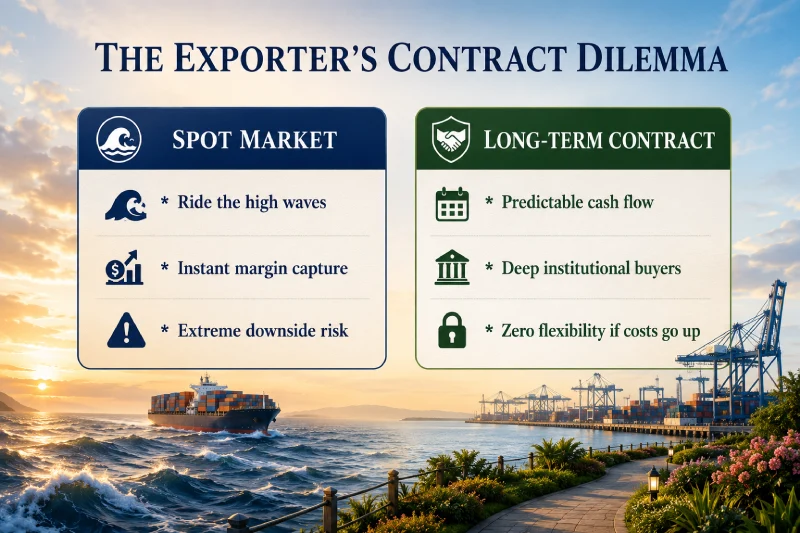
To figure out which path works best when markets get chaotic, we need to examine how these two approaches perform under real pressure.
Operating on Immediate Turnarounds: The Reality of the Spot Market
Capturing a sudden market peak is the main reason trading houses stay active in the spot market. If a major crop deficit hits a competing country—such as an unexpected weather delay blocking shipments from a rival nation—immediate cash rates at the ports can jump significantly within a few days. For an exporter holding uncommitted, ready-to-ship inventory, this window allows them to secure higher margins that can carry their balance sheet for the entire quarter.
However, relying entirely on spot transactions brings a specific set of operational headaches.
When a business trades solely on immediate delivery windows, predicting warehouse requirements for the following month becomes incredibly difficult. The sales team is essentially starting from scratch with every single container booking.
More importantly, when international demand cools down, prices can drop rapidly. If an exporter purchases large volumes of grain from local mandis at peak domestic rates, and global prices soften before a buyer signs on, the firm is left holding highly expensive inventory that is difficult to liquidate without a loss.
For small to mid-sized firms, an exclusive focus on spot sales creates an erratic revenue curve. Banking partners looking closely at these fluctuating statements often grow hesitant, which can make securing pre-shipment credit lines or trade financing a much tougher negotiation.

The Operational Baseline: Running on Long-Term Agreements
On the other side of the ledger are agro commodity export contracts built around steady, time-based deliveries. Institutional buyers, major international supermarket chains, and global food manufacturers heavily favor this route because they require absolute predictability. Their primary goal is ensuring that a stable stream of raw material arrives at their discharge berths at a cost their finance teams approved months prior.
For the Indian supplier, the advantages focus heavily on stability:
- Structured Cash Flow: Exporters can schedule factory runs, secure ocean freight space well in advance, and keep processing mills running on a predictable timeline.
- Enhanced Banking Leverage: A signed, multi-shipment contract with a verified international buyer serves as excellent collateral. Indian financial institutions prefer visible, low-risk revenue; they will regularly extend credit lines when backed by a verified, long-term letter of credit.
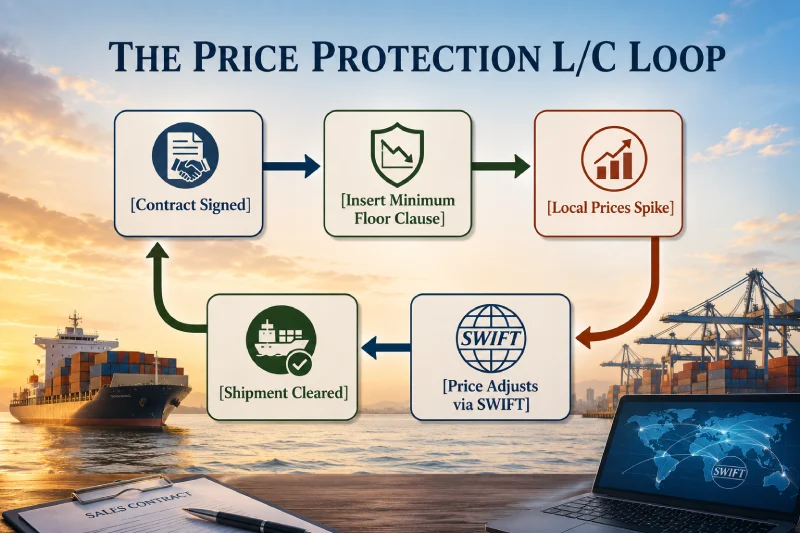
Yet, this stability comes with a major vulnerability when local input costs break loose.
If an exporter signs a fixed-price contract to ship agricultural goods over a long period, and a sudden domestic shortage causes raw crop prices to climb at the local mandi, their margins face an immediate squeeze. The exporter remains legally obligated to purchase high-cost raw materials locally while selling at the lower, pre-agreed international rate. In this situation, fulfilling the contract means absorbing a direct financial loss, while walking away risks a default that can permanently damage the firm's commercial reputation.
How Pricing Dynamics Play Out Across Specific Commodities
To see how these forces interact, we have to look past generalities. Different crop lines face distinct regulatory environments, and your pricing strategy must adapt to the specific nature of the commodity being bagged.
1. The Premium Tier: Basmati Rice Export Contracts
When handling fragrant long-grain rice, the pricing conversation is guided heavily by brand reputation and strict quality standards. Because true Basmati requires specific aging and precise milling, international buyers prioritize continuity of supply and consistent quality over finding the absolute cheapest offer.
Because of this premium positioning, experienced millers rarely sign simple, flat-rate long-term deals. Instead, they structure agreements that protect both sides from extreme market shifts.
If an exporter locks into a year-long supply arrangement with a large distributor in Saudi Arabia or the UK, the Basmati rice export contracts should ideally feature a "floating baseline." This structure links the final invoice price directly to seasonal minimum support prices (MSP) or mandi averages in Punjab and Haryana, ensuring the exporter isn't crushed if local paddy costs rise sharply mid-year.

2. Managing High Volume: Sugar Export Pricing Strategy
Sugar behaves under completely different rules. It is a massive, high-volume commodity that is deeply vulnerable to government trade interventions, shifting export quotas, and macro currency swings. Consequently, building a successful sugar export pricing strategy requires constant risk mitigation.
Here, a hybrid approach is often the most practical way to protect a business. Shippers frequently split their seasonal volume right down the middle:
- 50% Committed Volume: Tied to structured, long-term institutional contracts to cover fixed milling costs, labor, and warehouse overheads.
- 50% Unhedged Volume: Kept entirely free for the spot market, allowing the trade desk to deploy inventory rapidly if international prices spike due to crop shortfalls in Brazil or Thailand.
3. Short Supply Windows: Spice Export Agreements
Spices are low-volume, high-value items that are highly sensitive to weather variations and maximum residue limit (MRL) testing at international borders. Because a sudden crop failure in a specific growing state can instantly dry up the availability of whole turmeric or seed spices, spice export agreements require maximum legal flexibility.
| Contract Type | Ideal Operational Use | Primary Advantage | Main Risk Factor |
|---|---|---|---|
| Spot Transactions | Surplus grain lots, high-volume seed spices | Fast cash turnaround, immediate margin capture | Total exposure to sudden port gluts and price drops |
| Fixed Long-Term | Branded retail lines, processed food inputs | Operational peace of mind, simpler bank financing | Absolute vulnerability to domestic crop price inflation |
| Hybrid / Floating | Premium Basmati varieties, high-end spice blends | Protects margins on both sides of the border | Requires complex negotiation and deep client trust |
Tying a spice house to a rigid, fixed-price long-term contract can turn problematic very quickly if domestic crop yields disappoint. The exporter can easily find themselves forced to source raw spices at astronomical local prices just to fulfill their international delivery promises.
To avoid this trap, many experienced spice exporters rely on short-term rolling agreements. Instead of locking in a price for a full twelve months, they negotiate contracts in three-month blocks. This window gives them enough time to execute a clean shipment while providing a natural pause button to reset pricing before the next crop cycle begins.
The Tactical Verdict
So, which path actually wins out when markets turn volatile?
The reality is that neither approach works perfectly as a standalone solution anymore. The Indian export desks that consistently protect their margins have walked away from the idea of picking a single model. Instead, they manage their contract book much like a balanced financial portfolio.
They build their operational foundation on a handful of deeply vetted, long-term corporate buyers who value reliability over finding the absolute lowest price. This consistent volume pays the warehouse rent, satisfies the bank auditors, and keeps the processing machinery moving on a steady schedule.
But they rarely commit their entire warehouse to a single long-term deal. They always leave a calculated portion of their seasonal tonnage uncommitted, waiting for those moments when spot market demand peaks. True resilience in global trade belongs to the organizations that pair a highly disciplined operational back-end with the tactical flexibility to pivot their pricing model the moment market conditions change.
Disclaimer
The information presented is for educational and informational purposes only. Commodity prices, export policies, freight rates, currency fluctuations, and market conditions can change rapidly. Exporters should conduct independent market analysis and seek professional legal, financial, and trade advice before entering into spot transactions or long-term export agreements.
Want to export agro commodities globally? Connect with genuine buyers on Tradologie today.




-from-india-varieties--process-(1)-(1).webp "How to Export Groundnuts (Peanuts) from India: Varieties & Process")
-export-from-india.webp "Corn (Maize) Export from India: Capitalizing on India's Non-GMO Edge, Pricing, HS Codes, and Key Destination Markets")