
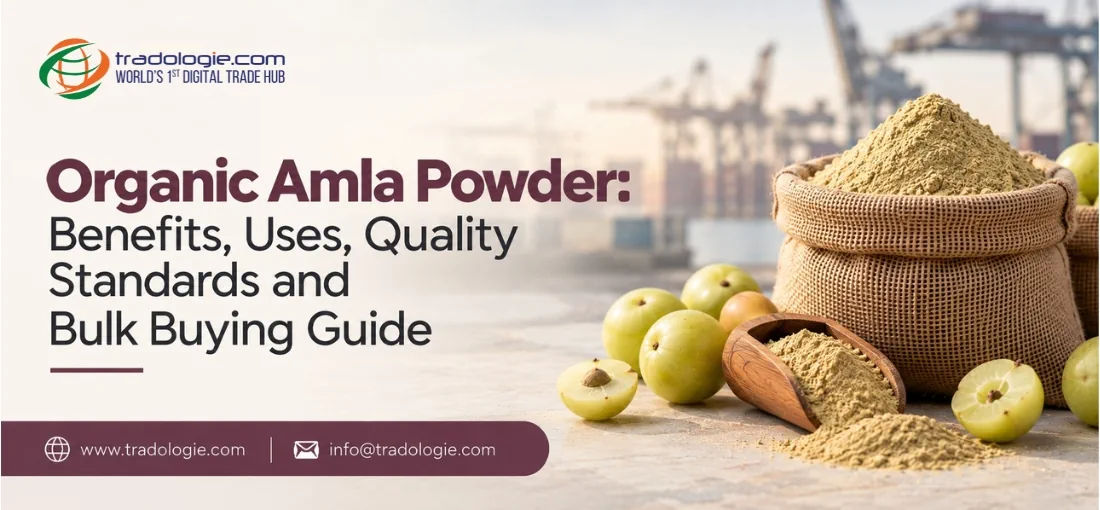
Key Highlights
- Organic amla powder serves food, nutraceutical and cosmetic markets.
- Amla contains vitamin C, polyphenols, tannins and flavonoids.
- Powder and amla extract are different raw materials.
- Buyers should check moisture, mesh size, residues and microbial limits.
- NPOP certification is important for certified organic exports.
- India exported 368,155 tonnes of certified organic products in 2024-25.
- Carmel Organics, Organic India, Jeeva Organic and Ambra Organics are listed suppliers.
- Batch consistency matters for repeat bulk procurement.
Introduction:
Rice looks deceptively simple when it is sitting in a sack. But guess what? Once it reaches the kitchen, the differences between varieties become much easier to see. Some long grain rice types stay long and separate after cooking, some become softer and more cohesive, some carry a distinct aroma, while others are chosen mainly because they are affordable, dependable and available in large volumes.
That is where long grain rice becomes an interesting category. It includes some of the world's best-known rice varieties. However, it is worth noting that they do not all serve the same purpose from a b2b HORECA perspective. Basmati is bought for its aroma and characteristic elongation. Jasmine has its own fragrance and cooking profile. Then there is the much larger non-aromatic segment, where varieties such as IR-64, Sona Masuri, Ponni and Swarna that move through everyday food markets in substantial quantities.
For consumers, choosing between long-grain rice varieties may come down to what they are cooking that evening. In international trade, the decision is considerably more specific. Grain length, variety, milling quality, moisture, broken percentage, cooking behaviour and the final application can all change the value of a shipment.

Long Grain Rice Is a Category, Not One Variety
Amla is one of those ingredients that has been sitting in Indian kitchens and traditional medicine for so long that its commercial potential can be easy to overlook. The fruit itself is hardly unfamiliar. What is more interesting is what happens after it is dried and ground. Suddenly, a seasonal fruit becomes an ingredient that can be stored, measured, blended and shipped to a food manufacturer in another country. That is where the market for organic Indian Amla Powder starts to make sense.
A nutraceutical company may use the powder in a botanical blend, a beverage manufacturer may want it for a functional drink, while a cosmetics business could be looking at the same fruit from an entirely different angle. The buyer's requirement changes with the application, and once the order moves into bulk quantities, details such as moisture, particle size, processing and certification stop being small technicalities.
They become part of the purchase.
Why Amla Works So Well as a Commercial Ingredient
There is a lot packed into this small, sour fruit.
Amla, or Phyllanthus emblica, contains vitamin C and a wide range of plant compounds that are mainly polyphenols, tannins and flavonoids. Scientific reviews have examined its nutritional composition, antioxidant activity and several other biological properties. In fact, the research is substantial, although the evidence for individual health effects is not equally strong across every claim made about the fruit.
For the food and ingredients industry, that gives amla an interesting combination. It has a nutritional story, a long history of traditional use and a flavour that people already associate with the fruit.
Then there is the convenience of the powder.
Fresh amla is not something an international manufacturer can simply keep on a shelf for months. Once processed into a properly dried powder, however, it becomes a much easier raw material to handle. A manufacturer can order it in bags, store it under suitable conditions and use a measured quantity whenever it goes into production.
There is also a difference between amla powder and amla extract. The bulk buyers need to precisely be clear about it. After all, you don't want to make the wrong buying decision, don't you? Powder generally represents the dried and milled fruit, while an extract may be processed to concentrate particular compounds. They can end up in the same broad product category, but they are not the same raw material.
Where Organic Amla Powder Is Actually Used
The Organic Amla Powder Uses are spread across industries that have very little to do with one another.
Food and Beverages
Amla has a naturally sharp, sour flavour, so it is not the sort of ingredient that quietly disappears into a recipe. That can be useful in beverages, drink mixes, functional foods and traditional preparations where the fruit character is part of the product.
A manufacturer developing a drink, for instance, may use amla if it is feasible alongside other fruits or sweetening ingredients to balance its acidity. Another food company might be more interested in it as a botanical ingredient than more than just a prominent flavour.
The formulation decides a lot.
Nutraceuticals and Dietary Products
This is where the nutritional and phytochemical profile of amla becomes commercially interesting. The powder can be used in capsules, tablets, sachets, powdered blends and other botanical formulations.
The requirements can become quite specific here. A manufacturer may want a particular mesh size because the powder has to blend evenly with other ingredients. It may also have defined limits for moisture, microbial load, heavy metals or pesticide residues.
The buyer is no longer simply asking whether the amla is good.
The buyer is asking whether it behaves consistently inside a production process.
Hair and Personal Care
Amla has a long association with Indian hair-care traditions, and that connection has carried into modern personal-care products.
Amla powder can be used in hair masks, herbal preparations and other cosmetic formulations. In this market, colour, aroma and fineness can matter considerably because the ingredient is being judged not only as a botanical raw material but also as something that needs to fit into the appearance and feel of the finished product.
Ayurvedic and Herbal Products
This is probably the most natural extension of amla's traditional identity. The fruit has been used in Ayurvedic practice for generations, and powdered amla continues to be incorporated into herbal preparations and blends.
For suppliers, this creates an interesting market because the same fruit can be sold into food, wellness, cosmetics and traditional herbal channels, with each buyer asking slightly different questions.

What Makes the Powder Organic?
This is where the commercial conversation gets more serious.
There is a difference between saying that amla was grown naturally and being able to sell a product as certified organic. India's Food Safety and Standards (Organic Foods) Regulations, 2017 recognise the National Programme for Organic Production (NPOP) and the Participatory Guarantee System for India (PGS-India) as certification systems for organic food. So basically your product needs to be properly certified before you call it organic.
For an Indian supplier serving domestic buyers, the applicable certification and food-safety requirements need to be established for the product. For export, NPOP becomes particularly relevant because it provides India's certification framework for organic production and trade.
APEDA says NPOP covers organic production standards, accreditation of certification bodies, inspection and certification of operators, and the use of the India Organic logo. Its standards have also been recognised by the European Commission and Switzerland for specified unprocessed plant products and are accepted by Great Britain, while India's mutual recognition arrangement with Taiwan has been in place since 2024.
So if an importer asks for Amla Powder for Export , the conversation should go beyond the words “organic.”
The certificate, operator, product and shipment documentation all need to line up.
India's Organic Trade Has Become a Serious Supply Network
The scale of India's certified organic sector gives some perspective.
During 2024-25, APEDA's NPOP data recorded 2.25 million hectares of organic cultivated area , with another 1.71 million hectares under conversion. Certified organic farm production was about 4.39 million tonnes, while India's organic exports reached 368,155 tonnes worth US$665.97 million.
The export basket is much broader than many people assume. Cereals and millets accounted for 189,094 tonnes, processed food for 84,318 tonnes and medicinal plant products for 6,884 tonnes. The latter category alone was valued at about US$88.57 million.
Amla is not separately identified in those headline export numbers, so they should not be presented as an amla market size.
What they do show is the infrastructure surrounding India's organic trade. There are processors, traders, grower groups and certified operators already working within a system designed for traceability and export.
For an Organic Amla Powder Exporter , that wider ecosystem is important.
The Quality of the Powder Starts Before Milling
There is a temptation in the dried-ingredient trade to treat milling as the main event. It is not.
The fruit arriving for processing has already brought its own characteristics with it. Variety, maturity, growing conditions and post-harvest handling can influence the raw material before anyone switches on a grinder.
Then comes drying.
The temperature and method used to remove moisture can affect colour, aroma and the final character of the powder. Storage after milling matters too, particularly because a dry botanical ingredient can pick up moisture if it is exposed to unsuitable conditions.
This is why two products sold under the same name can perform differently.
A manufacturer that uses amla regularly will notice these differences much sooner than someone buying a small retail packet.
What Should Be Checked Before You Buy Organic Amla Powder in Bulk?
When businesses Buy organic Amla Powder in bulk , the specification should be settled before the price becomes the main discussion.
A proper purchase specification can include the botanical identity, origin, moisture, particle size, colour, foreign matter, microbiological limits, pesticide residues and heavy metals. The exact numbers should be agreed according to the intended use and destination rather than copied from a generic supplier sheet.
A certificate of analysis for the actual batch is useful here.
So is a sample.
But there is a catch: one good sample does not necessarily prove consistency.
If a nutraceutical manufacturer develops a formulation around a particular powder and the next shipment arrives with substantially different moisture, colour or fineness, the problem quickly becomes a production issue. The supplier therefore needs to demonstrate that the agreed specification can be repeated.
That is much more useful than simply calling the powder “premium.”
Choosing Organic Amla Powder Suppliers in India
There is no shortage of amla processors, herbal-ingredient businesses and organic Amla powder suppliers in India . For a bulk buyer, however, the supplier's catalogue is probably less important than the operation behind it.
A few questions usually reveal quite a lot.
Where is the fruit sourced? Who processes it? Is the supplier certified under the relevant organic system? How is the fruit dried? What particle sizes are available? Can batch-level laboratory reports be provided? How is the powder packed? And, perhaps most importantly, can the supplier maintain the same specification when the next order is placed?
For export buyers, certification should be checked against the actual operator and product rather than accepted because a website carries an “organic” badge.
APEDA's NPOP system recorded 1,324 processors and 611 traders among its certified operators in 2024-25, alongside more than 10,000 individual producers and grower groups.
That is a substantial ecosystem, but it also means buyers have enough choice to be selective about documentation and processing capability.
Top Organic Amla Powder Exporters In India
Just like any other industry, the organic amla powder export industry is also dominated by a few big players. Here is the list of top organic amla powders exporters in India. These exporters have their significant presence across different countries.
| Company | Location | Amla Powder Offering | Export / Bulk Capability |
|---|---|---|---|
| Carmel Organics Pvt. Ltd. | Madhya Pradesh | Organic Amla Powder | Organic herbs and spices in powdered form; export-oriented supplier |
| Vallon FarmDirect Pvt. Ltd. | India | Amla Powder / Organic Amla Products | Bulk and international supply |
| Organic India Pvt. Ltd. | India | Amla and herbal products | Established international distribution network |
| Jeeva Organic | Odisha / Madhya Pradesh | Organic Amla Fruit Powder | Bulk B2B supply, export documentation and long-term contracts |
| Ambra Organics | Greater Noida, Uttar Pradesh | Organic Amla Powder | Bulk orders, private label and international exports |
| Phaldhara | India | Amla Powder | Bulk supply for food, beverage and nutraceutical applications |
| DNB Agro | India | Amla Powder | Bulk and export supply |
| Dhatu Organics | India | Organic Amla Powder | Wholesale and B2B supply |
| Shivesh International | New Delhi | Organic Amla Powder | Manufacturer/exporter serving international buyers |
Bulk Amla Powder Is a Different Purchase From Retail Amla
The difference becomes obvious once the quantities rise. A retail customer may be interested mainly in the ingredient, packaging and price. An industrial buyer has to think about how many kilograms are required every month, how the material will be stored, what packaging works for the production facility and whether the supplier can maintain deliveries.
An exporter has another concern altogether. The powder needs to travel well, the packaging has to suit the shipment, and the documentation must remain consistent with what has been declared to the buyer and the destination authorities.
That is where a bulk amla powder supplier earns its place in the supply chain.
Not simply by having the product available, but by being able to supply the same product again.
The Export Side Is Where Documentation Really Shows Its Value
Organic food exports involve more than a commercial invoice and packing list.
Depending on the destination and the product, buyers may require organic certification, transaction certificates, certificates of analysis, product specifications, traceability information and labelling details. NPOP provides the certification framework for India's certified organic exports, and APEDA maintains the associated traceability system.
The destination market still has to be checked separately. Recognition of India's organic certification in particular markets does not mean every product is automatically cleared under every foreign regulatory requirement.
That distinction is especially important with botanical ingredients.
An importer may be perfectly comfortable with Indian organic certification but still require additional residue testing or a particular specification before accepting the shipment. A supplier accustomed to export documentation will usually understand this part of the transaction much better than a trader who is simply arranging bags of powder.
Where the Market Goes From Here
Amla does not need to reinvent itself to find a bigger market. It already has something many botanical ingredients spend years trying to build: recognition.
Consumers know the fruit. Traditional systems have used it for generations. Modern research continues to examine its nutritional and phytochemical composition.
The commercial opportunity is really in making that familiar ingredient reliable enough for modern manufacturing.
That means controlled processing, sensible specifications, organic certification where it is claimed, proper testing and the ability to repeat a shipment without the product changing underneath the buyer.
For Indian suppliers, that is where the difference between selling amla powder and building an export-grade ingredient business begins to show.
Conclusion
Organic amla powder has found a place well beyond the traditional markets associated with the fruit. Food manufacturers, nutraceutical companies, cosmetics businesses and herbal-product makers can all use it, although their specifications may be quite different. For bulk trade, the important details sit in the background: sourcing, drying, testing, certification and consistency. Suppliers who can control those details have a much stronger foundation for repeat domestic and international business.
Disclaimer
This content is for general informational purposes and is based on the product, certification, supplier and trade information provided in the source material. The listed companies are potential sourcing options, not a ranking or confirmation of current availability. Buyers should independently verify organic certification, batch-level testing, specifications, supplier credentials and destination-country requirements before placing an order.




-(2).webp "Top High Demand Herbal Commodities for Export 2026 Market Guide")