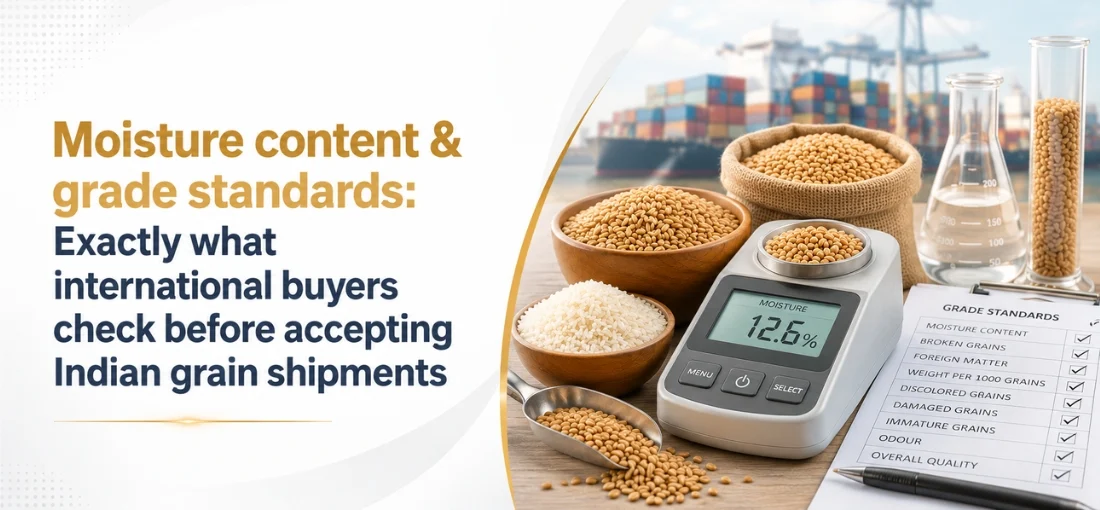
Key Highlights
- Moisture content is one of the first parameters international grain buyers verify.
- Excess moisture can lead to mold growth, cargo heating, and shipment disputes.
- Buyers closely inspect broken grains, chalkiness, and foreign matter levels.
- Millet exports face additional scrutiny for immature and shriveled seeds.
- Pesticide residues and MRL compliance are critical for market access.
- Independent pre-shipment testing helps prevent costly destination-port claims.
Introduction:
Shipping agricultural goods is among the most tricky jobs. It’s none other than their perishable characteristics compared to electronics that demand a level of caution while loading and exporting. Understanding the exact international grain inspection requirements is the only way to protect your business from painful disputes, forced cargo auctions, or expensive terminal demurrage fees.
If you deal in large-scale agribusiness, you already know the brutal truth of this industry: international buyers do not trust marketing talk, and they certainly do not care about tight domestic margins. They trust cold, hard laboratory metrics. Whether you want to export rice in bulk or export millets in bulk, your cargo faces a wall of strict regulatory protocols and contract checks the second it arrives.
Keep reading this information piece of blog if you are planning a deal in bulk international grain trade. This blog will provide you all the vital information related to Indian grain export quality standards and moisture testing for grain exports.

The Big Gatekeeper: Moisture Testing for Grain Exports
If you ask any seasoned port surveyor what kills a grain deal fastest, they won't say high tariffs or shifting market prices. They will tell you it's water. Managing grain moisture content standards is the ultimate balancing act in international shipping.
In fact, any excess internal moisture turns the box into a literal pressure cooker when grain is packed into a dark steel container for a thirty-day voyage across hot maritime corridors. The intense heat of tropical waters causes the grain to sweat. That trapped moisture gradually rises to the top of the container, hits the cool metal ceiling at night, and rains back down onto the cargo as heavy condensation. It is not at all surprising that within weeks, a shipment can turn into a caked, heated mass of mould.
Because of this constant risk, international buyers and importing-country standards generally impose strict moisture limits to reduce spoilage risk. While final numbers depend entirely on your specific sales contract, INCOTERMS, and the destination country's regulations, the market follows some common benchmarks. Here is a clear look at typical, illustrative commercial targets required across major global trade lanes:
Illustrative Commercial Moisture Targets for Grain Trade
| Commodity Type | Common Moisture Target Baseline | Destination Region | Primary Logistical Risk if Exceeded |
|---|---|---|---|
| Long-Grain Parboiled Rice | 14.0% | European Union / Middle East | Internal heating, yellowing, and weeping kernels. |
| Premium Basmati Rice | 13.0% – 14.0% | Gulf Cooperation Council (GCC) | Loss of distinctive aroma, chalkiness, and breakage. |
| Sorghum / Jowar | 13.0% | East Asia / North Africa | Rapid mold growth and potential aflatoxin development. |
| Pearl Millet / Bajra | 12.0% | West Africa / European Union | Rancidity of surface lipids and insect infestation. |
If an automated moisture meter at the destination port pulls an average reading above your contractually agreed limits, it complicates things immediately. Depending on your tolerance provisions and arbitration clauses, a buyer rarely rejects a bill of lading automatically out of hand; instead, they commonly negotiate steep price discounts, seek heavy compensation claims, or accept the cargo with formal financial claims. For Indian rice suppliers, this means your processing mills back home typically dry the raw crop down uniformly before loading, rather than trying to average out wet and dry batches inside the container.
Decoupling the Grade Metrics: Broken Kernels, Chalkiness, and Foreign Matter
Once your cargo passes the moisture checks, the port inspectors move on to physical grade analysis. They will pull mechanical probe samples from random sections of the container to check if the shipment actually matches the contractual parameters specified in your Letter of Credit.

1. The Broken Percentage Split
In bulk rice exports, "brokens" are the ultimate price dictator. If you contract to ship 5% broken white rice, the destination lab will run a specific sieve test to separate whole kernels from split ones. If the broken count hits 7% due to rough handling during port stuffing or brittle milling, the buyer will typically demand a price discount or activate a penalty clause.
2. The Chalkiness Factor
Chalk refers to the opaque, milky white part of a rice kernel caused by incomplete starch development during a poor crop season. While it looks bad visually, the real issue for global rice buyers is structural integrity. Chalky grains are soft; they shatter easily under minimal pressure during industrial polishing or cooking, lowering the overall grade and value of the batch.
3. Foreign Matter and Contamination
This is where inspectors look very closely. Foreign matter is split into two categories:
- Inorganic Matter: Stones, dust, glass, or plastic particles from dirty mill floors.
- Organic Matter: Weed seeds, husks, straw, or dead insects.
Importing countries maintain strict tolerances for foreign debris. While an isolated stone or field wire won't automatically condemn an entire multi-ton shipment, destination officials will base their decisions on sample size, hazard analyses, and strict regulatory assessments. If things cross safety thresholds, it can stall your clearance indefinitely.
Understanding Millet Grade Standards and Global Demand
With the global push toward climate-resilient foods, the market for ancient grains is expanding. However, global millet buyers look at quality metrics through a very different lens than standard wheat or corn buyers. Millets like Bajra (Pearl Millet) and Ragi (Finger Millet) have sensitive oil profiles on their outer layers, making them uniquely vulnerable to spoilage during long sea voyages.
Inspectors look closely at the percentage of immature or shrivelled seeds when you export millets in bulk. This largely depends on the specific specifications laid out by the buyer or the guidelines related to the grains of the importing region. If the crop was harvested too early, these underdeveloped seeds can go bitter and rancid under transit heat, and they can ruin the flavor profile of the entire batch.
Chemical Residues and Fumigation Rules
You can ship grain with great moisture and flawless physical appearance, and still watch your business stall at the destination port because of chemical compliance. This is a vital point of friction for modern Indian grain export quality standards.
Western inspection agencies rely on ultra-sensitive testing to scan incoming shipments for Maximum Residue Limits (MRLs) of pesticides. A common pain point for Indian exporters is the chemical Tricyclazole, a fungicide used by local farmers to fight rice blast disease. While India allows standard domestic usage, European Union regulations strictly enforce tiny MRL ceilings for imports. Bulk rice exporters and millet suppliers must align with the latest updated EU pesticide database. This is because if your milling house buys grain from farms that use this chemical heavily, then your container can face immediate rejection, and sometimes re-export or destruction at the European border. Most probably such things are inspected before dispatch during third-party inspections.
Furthermore, buyers check the cargo's fumigation certificates with extreme scrutiny. Grains may require fumigation depending on importing-country regulations and specific pest risks to kill any hidden insect eggs inside the kernels. While treatments like Phosphine gas are common, many countries have heavily reduced or restricted Methyl Bromide use under environmental regulations. If the destination inspector finds live weevils walking across the cargo, you won't see an automatic lockdown of the entire ship hold, but you will face quarantine inspections, added treatment charges, and expensive re-fumigation bills at foreign port rates.
The Tactical Verdict
In the high-volume commodity trade, a sales contract is only as good as your quality control records. The export houses that survive over the long haul are the ones that completely stop treating quality compliance as a last-minute paperwork chore.
If you want to protect your margins from severe terminal disputes, you typically need to embed independent testing protocols directly into your local supply chain. Partnering with international inspection bodies to pull samples directly at your Indian milling site before the cargo is loaded into ocean containers is a smart play. By proving that your moisture levels, physical grades, and chemical residues align perfectly with your buyer's specific contract benchmarks before the ship ever leaves Indian waters, you take the financial guesswork out of your operation. You ensure that every single bill of lading translates into a predictable, highly profitable, and smooth transaction at port.
Disclaimer
The information provided is for educational and informational purposes only. Moisture limits, grade specifications, pesticide residue requirements, fumigation standards, and quality parameters may vary depending on the commodity, buyer contract, destination market, and applicable regulations. Exporters should verify all quality and compliance requirements with accredited inspection agencies, laboratories, and import authorities before shipment.




-export-from-india.webp "Corn (Maize) Export from India: Capitalizing on India's Non-GMO Edge, Pricing, HS Codes, and Key Destination Markets")
.webp "Why Castor Oil Export from India Holds Global Importance")