Key Highlights
- The UAE relies heavily on India for a steady supply of food and agricultural products.
- Short shipping times between India and the UAE help reduce logistics costs and delivery risks.
- The India-UAE CEPA agreement has strengthened bilateral agricultural trade.
- Basmati rice, non-Basmati rice, pulses, and buffalo meat are among India's top exports to the UAE.
- Jebel Ali serves as a key distribution hub for food exports across the Middle East and North Africa.
- Strong trade ties continue to create new opportunities for Indian agro exporters.
Introduction:
The global agricultural trade landscape is shifting rapidly, but one specific bilateral connection has evolved from a standard buyer-seller transactional loop into a critical, co-dependent regional supply chain hub. For agribusiness operators looking to export agriculture products to the UAE, understanding the deeper macro-economic relationship between India and this gulf country is essential.
According to the latest APEDA Analytical Report on India's Agriculture exports to UAE, the total Indian agricultural and processed food exports to the UAE have reached 3.812 million metric tonnes, yielding an export value of ₹22,918.14 crore (approximately USD 2.587 billion). The UAE now commands a highly strategic 8.96% of India's total global APEDA export value.
While the UAE maintains diversified import relationships with key agricultural global markets like Brazil, Saudi Arabia, Australia, the USA, Pakistan, Turkey, and the Netherlands, India stands out as one of the UAE's largest and most strategic food suppliers, particularly for rice, cereals, meat, spices, and processed agricultural products.

If you look past simple market data, a fundamental question emerges: why exactly does this deep trade connection exist? For international millers, trading desks, and logistics enterprises looking to tap into this ecosystem, the strategic alignment stems from deep geographical advantages, highly preferential bilateral economic policies, and an unyielding consumer demand for specific premium agricultural sectors. India plays a critical role in strengthening the UAE's food security strategy.
1. The Proximity and Logistics Advantage: Eliminating Maritime Transit Times
The absolute foundation of the UAE’s food import reliance on India is geographical proximity. In the business of moving bulk food supplies, transit time is directly tied to your underlying overhead costs and the risk of spoilage.
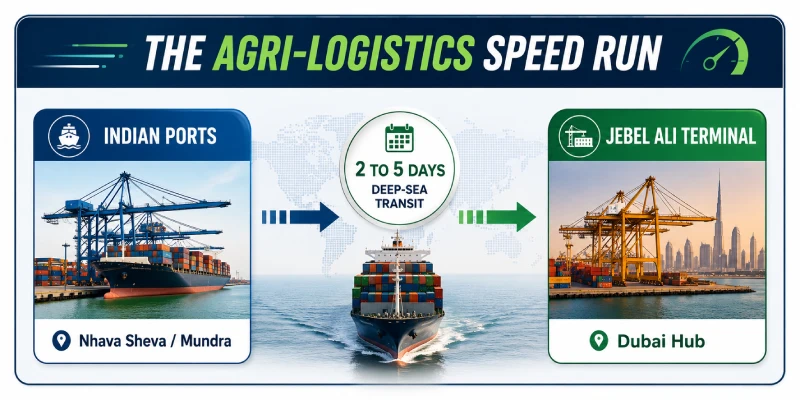
When global suppliers plan to ship products into the Gulf, using Western or trans-Atlantic shipping lines introduces long, complex transit routes that take weeks to complete. Conversely, high-capacity Indian cargo terminals—such as Mundra Port in Gujarat or Nhava Sheva in Mumbai—can place container shipments directly into Dubai’s Port of Jebel Ali with efficient maritime transit timelines, typically around 3–5 days from Mundra and 4–6 days from Nhava Sheva depending on the vessel service and routing.
This short maritime transit timeline completely transforms the trade economics of perishable goods. Short travel distances mean lower container detention fees, smaller fuel burn surcharges, and a drastically lower risk of moisture accumulation or pest issues inside cargo holds during the voyage.
Furthermore, this fast transport network is heavily reinforced by comprehensive bilateral infrastructure projects. Initiatives like the India-UAE Food Security Corridor, backed by massive corporate partnerships involving global operators like DP World and Al Dahra, have integrated electronic tracking and automated customs clearing channels across the Arabian Sea.
This integrated digital supply setup allows Emirati procurement managers to maintain incredibly lean, just-in-time inventory strategies inside their storage elevators, knowing they can call in multi-ton re-supply volumes from Indian processing hubs with minimal friction.
2. The Comprehensive Economic Partnership Agreement (CEPA) Catalyst
Trading volume alone cannot sustain long-term dependency without matching political alignment. The implementation of the historic Comprehensive Economic Partnership Agreement (CEPA) between India and the UAE has permanently reshaped the regional trade framework.
CEPA provides preferential tariff access and reduces duties on many agricultural products. Under this highly preferential tax regime, alternative global production regions struggle to match the land-to-port cost efficiencies achieved by Indian exporters.
The policy landscape is designed to encourage corporate integration. Rather than forcing independent companies to handle complex trade compliance tasks alone, CEPA improves regulatory cooperation and facilitates trade compliance.
This structural alignment helps reduce regulatory friction and customs processing time at Emirati borders. For major food processing blenders, institutional catering suppliers, and retail packaging networks across the UAE, sourcing their core raw materials from India is a logical corporate strategy to insulate their underlying operational margins from global volatility.
3. High-Value Rice Trade: Feeding the Premium GCC Retail Grid
To understand the sheer volume of this trade connection, you have to look closely at the primary grain categories driving the APEDA export manifests. Rice is an absolute cultural and dietary cornerstone inside the UAE, consumed daily by both the extensive South Asian expat population and the premium domestic culinary sector.
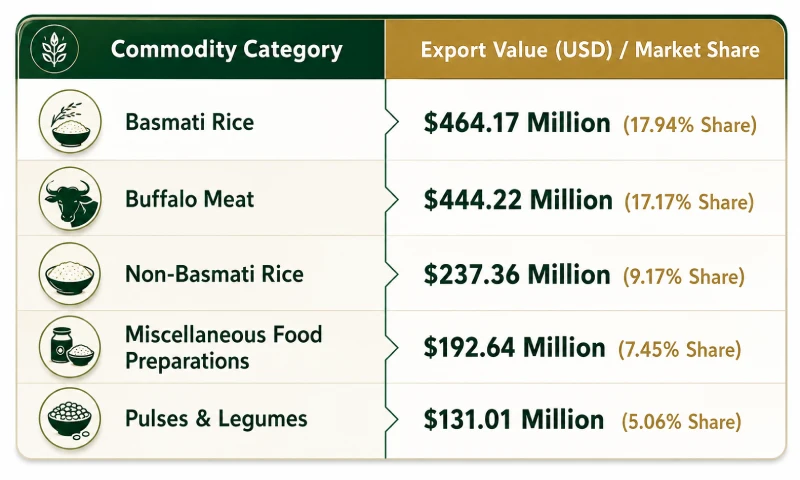
The data reflects this extreme concentration. According to recent APEDA country-wise statistics, the mandate to export rice to UAE accounts for a massive portion of the bilateral trade value:
- Basmati Rice Leadership: Generating an annual export value of USD 464.17 million, long-grain aromatic varieties represent a dominant 17.94% of India's total APEDA trade to the UAE.
- Non-Basmati Volume Stability: Standard non-basmati long and medium grains bring in an additional USD 237.36 million, claiming a stable 9.17% share of the import layout.
For processing mills trying to scale their international trading lines, the push to export Basmati Rice to UAE distribution grids is a highly reliable path to capture high-value market share. Within this category, the strategy to export 1121 Basmati Rice to UAE packaging houses stands out as a highly active business lane.
Industry demand indicates that 1121 Steam and Golden Sella are among the most preferred premium Basmati varieties in the UAE. Emirati purchasing desks prize these varieties for their exceptional grain length elongation, high-purity grading sheets, and low moisture traits. These exact physical characteristics are highly sought after to satisfy strict culinary specifications enforced across top-tier hospitality and restaurant networks throughout Dubai and Abu Dhabi.

4. The Pulses & Legumes Pipeline: Securing the Core Protein Reserve
Beyond the grain trade, another critical pillar of the UAE’s food system is its commercial relationship with Indian legume processing lines. The APEDA analytical data shows that the requirement to export pulses to UAE markets generates a valuable USD 131.01 million, capturing an essential 5.06% share of the overall agricultural export value.
The UAE also serves as a major processing and re-export hub for pulses destined for the wider Middle East and North Africa (MENA) region. Local processing plants require continuous volume lines of raw, unrefined legumes to keep their sorting and packing facilities running efficiently. This constant demand creates a highly predictable export pipeline for international suppliers:
- The Chickpeas Pipeline: Exporters looking to export Chickpeas to UAE channels find a highly responsive market, driven by steady consumption across industrial kitchens and consumer retail brands.
- Premium Sorting Focus: Within this segment, the specific drive to export Kabuli Chickpeas to UAE distributors represents a high-margin sector, as buyers heavily favor large grain sizes, consistent sorting metrics, and low physical blemish rates.
- Split Legume Volume: Simultaneously, the push to export Chana Dal to UAE packaging entities provides essential volume stability, ensuring that regional food blenders can consistently satisfy the daily dietary protein needs of the local labor and consumer demographic grids.
5. Bypassing Intermediaries: How Global Exporters Solidify This Trade Lane
While the natural and political advantages of the India-UAE trade route are undeniable, independent agricultural mills and suppliers can easily damage their export profit margins if they rely on outdated, non-transparent client acquisition models. Historically, businesses have spent enormous sums traveling to regional trade shows or buying unverified, static business directories that are frequently clogged with outdated customs records and dead contact info.
Even worse, turning your contracts over to traditional, high-commission middlemen and third-party brokers can cloud your visibility. These agents often hide the true identity of the end-buyer to protect their position in the middle, leaving you exposed to counterparty credit risks and unexpected payment disputes during transit.
To bypass these friction points, the modern agricultural trade has shifted toward specialized digital procurement infrastructure. Digital platforms like tradologie.com have stepped in to solve these structural transparency challenges, operating as a clean, real-time B2B trade lane built to streamline transactions along the India-UAE food corridor.
How Tradologie facilitates UAE-India trade:
- Direct Access to Verified Buyers: Tradologie provides direct access to verified import-ready buyers who want to procure in bulk. You skip the guesswork and hook straight into active grain procurement managers.
- One-to-One Live Negotiation: You can negotiate with the buyers live one-to-one, finalizing trade deals without any interference in pricing by the platform. This pure price discovery allows you to protect your exact export margins.
- Deeply Verified Sourcing Requirements: Sourcing requirements are verified using Tradologie's AI-assisted verification process together with internal verification procedures. The platform thoroughly checks the profile and active licensing of the buyers before allowing them to upload buying mandates.
- End-to-End Export Facilitation: You get complete end-to-end export facilitation support through a dedicated trade manager until your transactions are finalized. Your account team helps you handle strict municipal food testing and clear port authorities without delays.
- Capital Protection and Secure Escrow: Tradologie supports secure payment mechanisms such as Letters of Credit (LC) and Escrow setups, insulating your cash flow from international trade risks.
Summary: A Strategic Blueprint for International Agri-Enterprises
The UAE's strategic food import relationship with India is a calculated, highly efficient economic framework. By linking India’s vast production capacity and diverse climate layers directly with the UAE’s world-class logistics infrastructure and capital backing, this partnership has built a remarkably resilient food supply chain.
For forward-thinking agricultural exporters, millers, and processing enterprises, succeeding in this high-yield landscape means moving past slow-moving, non-transparent physical brokerage loops.
By taking advantage of the structural tax savings provided by CEPA, understanding the detailed APEDA volume demands across premium long-grain rice and legume sectors, and running your transactions through advanced B2B procurement systems that offer secure payment protection, your business can confidently establish a secure, scalable, and highly profitable presence within one of the most vital food corridors on earth.
Disclaimer
The information provided in this article is for educational and informational purposes only. Trade statistics, export values, customs regulations, tariff benefits, and import requirements may change over time. Exporters should verify the latest APEDA data, CEPA provisions, UAE customs regulations, and destination-specific compliance requirements before entering into international trade agreements.



-export-from-india-price-markets--guide.webp "Masoor Dal (Red Lentil) Export from India: Price, Markets & Comprehensive Trade Guide")