Key Highlights
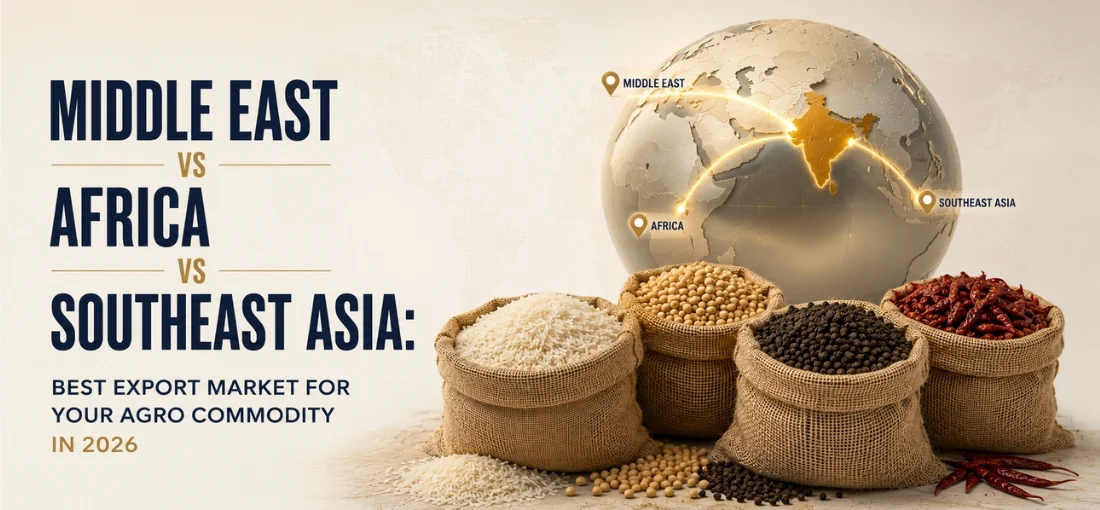
- No single region is the best export market for every agro commodity.
- The Middle East offers strong opportunities for premium rice and spices.
- Africa remains a high-volume market for staple commodities like rice and sugar.
- Southeast Asia acts as a major processing hub for agro-industrial inputs.
- Export success depends on matching the right commodity with the right market.
- Buyer expectations vary significantly across regions, impacting pricing and margins.
Introduction:
Choosing where to export food products is rarely a matter of picking a single destination and sticking with it for all your crops. The international trade landscape is constantly shifting, and what works beautifully for one grain might completely fall flat when you try to apply it to a shipment of spices or perishables. If you are looking to identify the most profitable food export markets as we navigate 2026, you have to look at the map through the lens of your specific commodity.
A single region cannot be a blanket answer for every trade desk. Instead, finding your path requires matching the specific consumption habits, storage capabilities, and income levels of a destination to the exact cargo sitting in your warehouse.
Let us take a close, balanced look at how the Middle East, Africa, and Southeast Asia stack up. The truth is in the numbers, but more importantly, it is in how those numbers translate into real-world port clearances and container bookings.
The Premium Hub: Why the Middle East Demands High-Value Aromatics
The Middle East operates with considerable purchasing power, particularly across the Gulf Cooperation Council (GCC) nations. This region relies very heavily on agricultural imports to feed its urban centers. But do not make the mistake of treating this market as a destination for cheap, unrefined volume. The real value here lies in premium, highly specified food items.
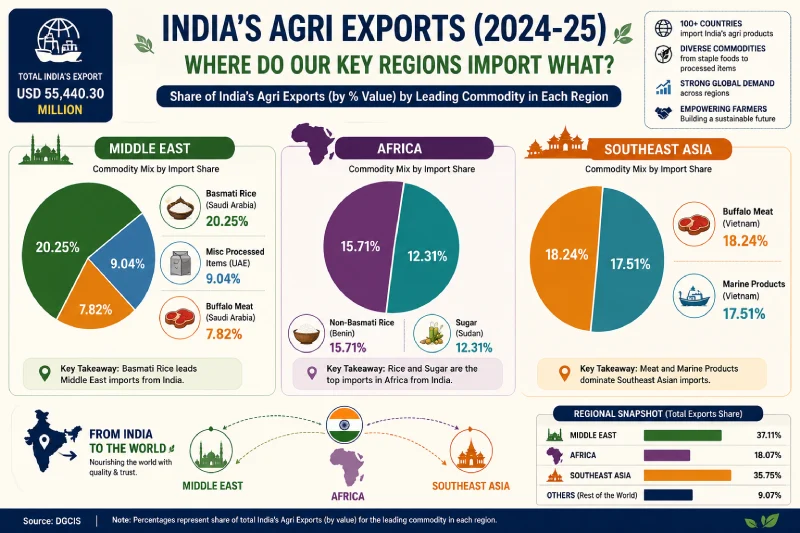
If your business intends to export rice in bulk, the Middle East is an exceptionally strong contender—provided you are moving premium varieties like Basmati. Look at the baseline trade data. Saudi Arabia alone handles over 20% of the entire Indian Basmati export value, pulling in more than 1,200 USD Million in a single cycle. The United Arab Emirates follows a very similar pattern, absorbing roughly 6.13% of that premium trade.
The story changes completely, though, if you try to bring low-grade, long-grain broken varieties into these ports. Buyers in Riyadh, Dubai, and Muscat look for specific parameters: aged grains, low moisture, and impeccable optical sortex grading.
The exact same premium requirement applies when you export spices in bulk. Nearly 8% of international spice imports among major South Asian hubs flow into the UAE. What buyers want isn't bulk, ungraded material, but shelf-ready whole seeds and premium powders with consistent quality and packaging. The Middle East offers plenty of opportunity, yet the bar is set high when it comes to quality.

High-Value Commodity Layout: Middle East Destination Breakdown
| Target Product | Key Buying Market | Value Contribution / Share | Buyer Quality Mandate |
|---|---|---|---|
| Basmati Rice | Saudi Arabia | $1,203.67 Million (20.25%) | Well-aged, premium grain with strict moisture limits |
| Basmati Rice | United Arab Emirates | $364.55 Million (6.13%) | Premium packaging, multi-stage sorting profiles |
| Spices | United Arab Emirates | $347.02 Million (7.99%) | Low residue limits, clean sortex grading |
The Volume Engine: How Africa Shapes Massive Essential Grain Flows
Africa presents an entirely different structural dynamic for international trade desks. It is a market driven by an immense demand for sheer volume and daily staples. As urban populations expand rapidly across the continent, finding stable, accessible sources for essential nutrition has become the primary operational goal for regional procurement heads.
For traders looking to export bulk food products, certain West African coastal nations have transformed into major global destinations. Let's look at the actual distribution of cargo on the water to see how this plays out. Benin currently commands over 15.7% of the total non-basmati rice export value from major global suppliers. Guinea holds over 8%, while Cote D'Ivoire and Togo take 7.97% and 6.46% respectively.
When you put those pieces together, you realize that this single coastal corridor acts as a massive engine for essential food grains. This is where you go to move volume.
The commodity focus here is strictly on utility and shelf-life stability. Traders who excel in this region understand that expensive, delicate packaging is a hindrance. The market requires durable, multi-wall woven bags that can withstand ambient storage and multiple handling stages at busy ports like Cotonou or Lomé.
Sugar follows an identical pattern. Sudan handles 12.31% of the export share for bulk raw sugar, with Libya and Somalia closely trailing at 11.22% and 10.65%. If your commercial strategy focuses on moving massive, high-tonnage vessels of core staples rather than small, high-margin boutique containers, the African continent stands out among the best countries for food exports. Africa also stands out as one of the best regions in the world if you want to export non-basmati rice in bulk.
High-Volume Commodity Layout: African Destination Breakdown
| Target Product | Key Buying Market | Value Share / Allocation | Operational Logistical Requirement |
|---|---|---|---|
| Non-Basmati Rice | Benin | 15.71% of product exports | Durable, multi-wall packaging for ambient transit |
| Non-Basmati Rice | Guinea | 8.21% of product exports | High bulk tonnage, streamlined port clearance files |
| Raw Sugar | Sudan | 12.31% of product exports | Breakbulk shipping capability, raw grade processing |
| Raw Sugar | Libya | 11.22% of product exports | Just-in-time matching to limit warehouse delays |
The Regional Processor: How Southeast Asia Utilizes Technical Agro Inputs
Across Southeast Asia, imported agricultural products do more than satisfy consumer demand. They also serve as the lifeblood of a sprawling food-processing sector, where milling, manufacturing, and blending industries turn raw inputs into higher-value products.
This regional reality shows up clearly when you analyze the flow of specialized animal proteins and technical ingredients. Vietnam, for instance, operates as a massive processing destination, absorbing more than 18.2% of the total bulk buffalo meat export volume from primary global suppliers. Malaysia takes a solid 15.21% slice of that exact same trade.
These items are highly valued because they provide the baseline raw materials for local food manufacturing, institutional catering, and ready-to-eat product lines that are consumed locally or re-exported across the ASEAN zone.

Spices tell a similar processing story. While the Middle East buys whole spices for consumer kitchens, Southeast Asian hubs like Thailand and Vietnam take massive quantities of raw spices to feed their extraction plants, where they produce essential oils, oleoresins, and industrial food flavorings. Thailand accounts for roughly 3.51% of the core spice trade.
Furthermore, the regional livestock and aquaculture sectors create an immense, continuous pull for animal feed inputs. Oil meals move heavily along these sea lanes, with Thailand pulling in 7.19% of the bulk meal allocations to keep its local farms running efficiently. Sourcing here means speaking the language of industrial manufacturing tolerances, chemical assay limits, and predictable delivery timelines.
Processing Input Commodity Layout: Southeast Asia Breakdown
| Target Product | Key Buying Market | Value Share / Allocation | Industrial End-Use Application |
|---|---|---|---|
| Buffalo Meat | Vietnam | 18.24% of product exports | Institutional catering, ready-to-eat blending blocks |
| Buffalo Meat | Malaysia | 15.21% of product exports | Mainstream food manufacturing, local distribution |
| Spices | Thailand | 3.51% of product exports | Industrial oleoresin extraction, oil processing labs |
| Oil Meals | Thailand | 7.19% of product exports | Aquaculture inputs, localized animal feed blending |
Technical Verdict
When you sum everything up, the question of where to establish your international supply lines in 2026 doesn't have a single, generic answer. If your inventory consists of premium aromatics, specialty items, and consumer-facing retail goods, the Middle East offers the high-margin environment your balance sheet needs.
If your operational strengths lie in handling massive, high-volume shipping runs of basic staples where efficiency is everything, the expanding ports of Africa provide an ideal destination.
For trading houses moving technical inputs, manufacturing feedstocks, or animal processing items, the industrial corridors of Southeast Asia are a perfect fit. By tailoring your export destinations directly to the physical reality of your commodity, you protect your transacted capital and keep your supply lines highly profitable.
Disclaimer
The market insights, trade shares, destination analysis, and commodity trends discussed are for informational purposes only. Import demand, trade policies, freight costs, buyer preferences, and regulatory requirements may change over time. Exporters should independently verify market conditions and commercial opportunities before making export decisions.