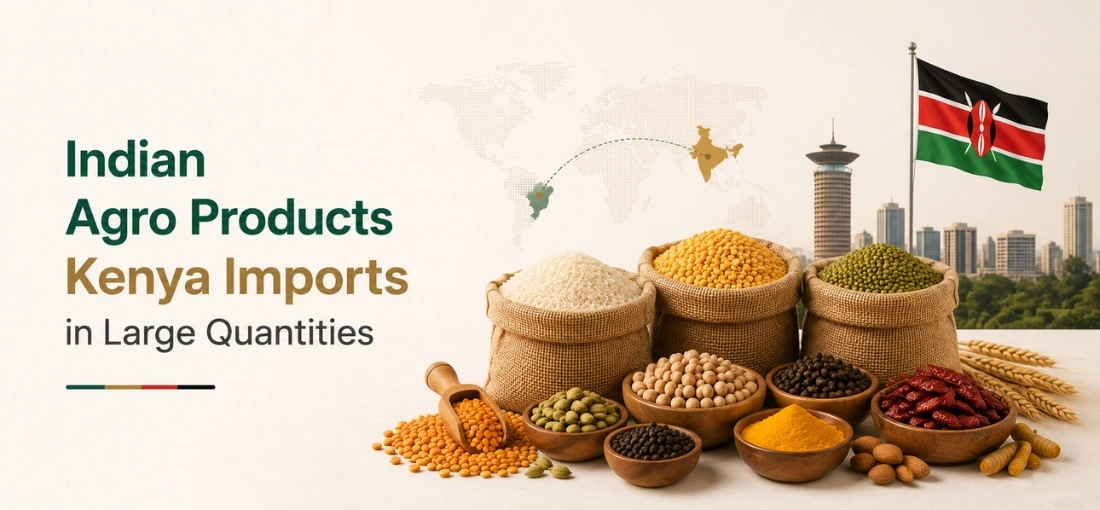
The East African Food Import Engine
Key Highlights
- Kenya imported 611.14 thousand MT of agricultural products from India in FY 2024-25.
- India's agricultural exports to Kenya were valued at USD 389.55 million .
- Non-Basmati rice is India's largest agricultural export to Kenya.
- Molasses, Basmati rice, floriculture products, and alcoholic beverages are among the top export categories.
- Kenya serves as a major gateway to East African agricultural trade.
- Strong demand for staple foods and industrial raw materials creates long-term export opportunities
Introduction:
Kenya operates as the economic and logistical gateway to East Africa, anchoring the region's commercial trade corridors. With a rapidly growing population and a fast-expanding urban manufacturing sector, the country relies significantly on international trade pipelines to satisfy its domestic demand for core food staples, industrial food ingredients, and raw agricultural inputs. The port of Mombasa serves as a critical entry hub to export top agricultural commodities Kenya imports , distributing bulk imports not just within Kenya, but across landlocked neighboring markets. For international agri-businesses, securing a footprint in the Kenyan market offers a reliable anchor point for broader African market distribution.

Keep reading this informative piece of blog if you are looking to export agriculture commodities to Kenya . You will get to know the top 5 agriculture products exported from India to Kenya.
Indian Agro Exports to Kenya in FY 2024-25: Volume, Value and Trade Highlights
Within this active maritime corridor, India Kenya agricultural trade lanes have achieved a high-yield phase. Kenya's corporate procurement networks, large-scale industrial processors, and wholesale distributors are turning increasingly to Indian production clusters to fill gaps in domestic yields and secure bulk raw supplies.

Looking at the hard numbers from the FY 2024-25 fiscal cycle, the volume of Indian agro exports to Kenya tells a story of clear commercial reliance. Indian exporters successfully processed and shipped a massive total volume of 611.14 thousand metric tonnes (MT) of agricultural products to Kenyan ports.
Indian Agriculture Exports to Kenya (FY 2024-25 Summary)
| Strategic Sourcing Metric | Performance Valuation Details |
|---|---|
| Total Physical Volume Shipped | 611.14 Thousand Metric Tonnes (MT) |
| Net Financial Sourcing Value | USD 389.55 Million (₹3,301.36 Crore) |
| Share of India's Total Agri Basket | 0.73% of India's Global Export Value |
| Top 5 Product Basket Concentration | Over 77.0% of Total Value Shipped |
This heavy flow of bulk containerized trade reached a total financial valuation of USD 389.55 million, which translates to an institutional market value of approximately ₹3,301.36 crore. This solid performance means Kenya accounted for exactly 0.73% of India's total global agricultural exports by value for the year, cementing its position as an essential destination market in East Africa for Indian agricultural products.
A Laser-Focused Sourcing Trend
For millers, crushing plants, and logistics managers trying to align their production lines, the Kenyan market features an incredibly concentrated import profile. Rather than spreading buying power evenly across hundreds of small crop lines, the marketplace focuses heavily on a few essential staple crops and industrial inputs.
The top five commodities together generated approximately USD 300.54 million, accounting for over 77% of India's total agricultural exports to Kenya. To safeguard their delivery timelines and bypass the typical risks of spot trading, modern African procurement managers are abandoning multi-layered middleman broker channels, choosing instead to handle transactions through direct digital B2B workflows.
The Core Sourcing Channels: The Top Agro Indian Commodities in Demand In Kenya
Analyzing the definitive performance charts of the leading product categories allows agri-enterprises to easily align their processing capacities with active global buying corridors.
1. Non-Basmati Rice: The Core Staples Heavyweight
Rice exports to Kenya remain the undisputed champion of the India-Kenya agriculture shipping corridor. When you combine both premium long grains and standard options, the complete rice trade contributed a massive USD 161.83 million, representing over 41.5% of India's total agricultural exports to Kenya.
Looking at the everyday staples market, the strategy to execute a non-basmati rice export to Kenya stands out as India's single largest agricultural export to the country by a long shot. This grain segment alone pulled in an export value of USD 105.30 million, contributing a vital 27.03% of India's total agri exports to Kenya.
Kenyan consumer networks require massive volumes of long-grain white rice and parboiled varieties to supply everyday retail grids and commercial food distribution channels. For Indian mills, this steady buying behavior provides an exceptionally predictable volume pipeline year after year.
2. Molasses: Powering East African Food Processing
Ranking as the second-largest export category into the Sultanate of regional trade, Molasses has turned into an essential value driver for Indian suppliers. Outbound shipments achieved a financial valuation of USD 68.28 million, accounting for a highly valuable 17.53% of India's agricultural exports to Kenya.
This performance reflects strong demand from Kenya's food processing and industrial sectors. To keep their manufacturing lines running smoothly, Kenyan buyers utilize the strategy of molasses export from India corridors to source high-grade industrial sweeteners, fermentation inputs, and animal feed binders directly from Indian sugar processing centers.
3. Basmati Rice: Premium Grains for Retail Networks
Fulfilling the demand for premium culinary options across Kenya's urban centers and growing hospitality spaces, Basmati Rice exports to Kenya ranked firmly as the third-largest export category from India. The aromatic long-grain segment pulled in a valuation of USD 56.53 million, making up 14.51% of the overall export mix.
This steady performance indicates clear consumer demand for premium Indian rice varieties. Exporters focused on managing a basmati rice export to Kenya pipeline find an active market for aged, slender grains like the classic 1121 variety, which are heavily favored by upscale local packaging houses and high-end restaurant chains.
Top 5 Agricultural Commodities Exported from India to Kenya (FY 2024-25)
| Product Classification | Net Export Value / Total Share |
|---|---|
| 1. Non-Basmati Rice | USD 105.30 Million (27.03% Share) |
| 2. Molasses | EUSD 68.28 Million (17.53% Share) |
| 3. Basmati Rice | USD 56.53 Million (14.51% Share) |
| 4. Floriculture Products | USD 49.95 Million (12.82% Share) |
| 5. Alcoholic Beverages | USD 20.48 Million (5.26% Share) |
4. Floriculture Products: Growing Horticultural Trade
The floriculture sector ranked fourth on the export table, bringing in a valuable trade valuation of USD 49.95 million and contributing 12.82% to the overall agricultural export basket.
This performance highlights India's growing presence in the horticultural trade with Kenya. While Kenya itself is a well-known global producer of cut roses, its regional trading operations import significant volumes of specialized seed stocks, dried floral elements, and live decorative plant components from Indian nurseries to support domestic variety diversification and regional export packaging.
5. Alcoholic Beverages: Commercial Value-Added Expansion
Completing the top five export categories is the Alcoholic Beverages sector, which generated an export value of USD 20.48 million, accounting for 5.26% of India's agricultural exports to Kenya.
This category has shown steady expansion due to the rise of urban retail distribution networks and international hotel chains across Nairobi and Mombasa. Indian beverage brands leverage automated high-volume bottling systems and standard commercial shipping packaging to lock in long-term supply agreements with East African hospitality chains.
Direct Sourcing vs. The Traditional Middleman Trap
While the consumer demand across East Africa is solid and the trade numbers look promising, independent agricultural suppliers can easily watch their profit margins disappear if they rely on old physical broker structures. Historically, companies have spent high fees traveling to far-flung international exhibitions or buying static business directories that are usually out of date.
Even worse, working entirely through old commission-based brokers blocks your view of the market. These middlemen often conceal the true identity of the end-buyer just to protect their commission cut, leaving you completely exposed to payment defaults or cargo delays while your containers are in transit across the ocean.
To solve these clear challenges, modern global agricultural trade has shifted heavily toward direct B2B procurement technology. Online AI enabled platforms like Tradologie are playing an increasingly important role in helping agricultural exporters find new clients without the usual middleman friction. These digital spaces allow you to connect directly with pre-vetted, import-ready corporate buyers who want to procure bulk commodities, bypassing traditional middleman layers entirely.
By dealing directly with international procurement managers online in real time, you can handle your own contract negotiations and enjoy transparent price discovery. This direct access allows businesses to protect their exact margins and secure fair market rates without paying broker cuts. Modern online workflows also protect your trading capital by using secure payment mechanisms—such as verified Letters of Credit (LC) and Escrow setups—insulating your cash flow from international trade risks while tracking documentation and port clearance milestones automatically.
Summary: A Strategic Blueprint for Exporters
Kenya's steady commercial markets and long-term structural reliance on imported food products make it one of India's most reliable, high-potential agricultural export destinations in East Africa. For forward-thinking agricultural millers, industrial processors, and large-scale crop aggregators, succeeding in this high-yield landscape means moving past slow-moving, non-transparent physical brokerage loops.
By tracking the exact volume demands across everyday non-basmati grains, heavy industrial molasses flows, premium basmati options, and specialized floriculture lines, and managing your corporate sales through digitized trading pipelines that offer robust payment security, your enterprise can confidently establish a secure, scalable, and highly profitable presence within the global food system.
Disclaimer
The information provided in this article is for educational and informational purposes only. Export statistics, customs procedures, food import regulations, and trade policies may change over time. Exporters should verify the latest DGCIS data, Kenya import regulations, and destination-country compliance requirements before exporting agricultural products.