-from-india-varieties--process-(1)-(1).webp "How to Export Groundnuts (Peanuts) from India: Varieties & Process")
Key Highlights
- Groundnuts fall under HS Code 1202 and 120220 (shelled peanuts).
- India is a high-volume, price-competitive peanut exporter globally.
- The global peanut market is valued at ~USD 81 billion with steady growth.
- Major export types include Java, Bold, Blanched, and oil-grade peanuts.
- Export prices range between ₹75–₹115 per kg (FOB) depending on quality.
- Key markets include Vietnam, Indonesia, EU, and the Middle East.
- Compliance (especially aflatoxin testing) is critical for export success.
Intro:
Every commodity has a commercial value in the global trade market and the same goes for the groundnut. If you want to export groundnut from India in bulk, then you need to look at it from a commercial lens, not just supply and demand.
It’s about how the same commodity seamlessly integrates in the export process into multiple industries at the same time for global exports.
A shipment of bulk peanut shipment leaving India today can eventually find its way:
- in a snack manufacturing facility in Indonesia
- in a large-scale crushing unit in Africa
- or within a peanut butter processing plant in Europe
That’s what makes bulk moongphali exports distinctly versatile. They are not a single-use crop.They are a multi-channel commodity, and that’s exactly why peanut exports from India remain consistent across markets.
Under trade classification:
| HS Code | Description |
|---|---|
| 1202.30.00 | Groundnuts in shell (not roasted) |
| 1202.41.00 | Shelled groundnuts — whole kernels |
| 1202.42.00 | Shelled groundnuts — broken/other |
| 1202.42.70 | Oil-stock grade |
| 1508.10.00 | Crude groundnut oil |
| 1508.90.00 | Refined groundnut oil |
| 2008.11.00 | Roasted/processed peanuts |
And most global groundnut exports happen in kernels.
Keep reading this informative piece of blog as it will cover every aspect of exporting peanuts from India in bulk.

What Is the Global Market Size of Groundnut as a Commodity?
Knowing the market size of a commodity like groundnut is of paramount significance if you want to get into its trade. The peanut market is not small, and more importantly, it’s not unstable.
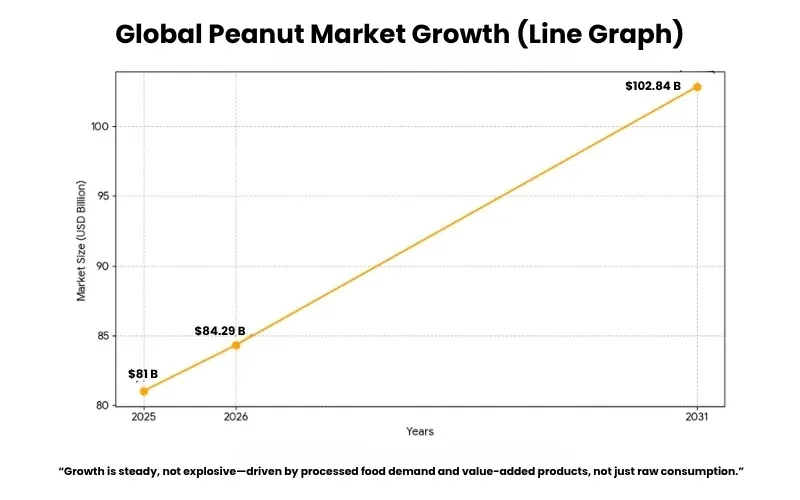
The peanut market is already quite sizable according to Mordor Intelligence, sitting at around USD 81 billion as of 2025. And if things continue along the same lines, it’s expected to keep growing steadily over the next few years — crossing roughly USD 84 billion in 2026 and moving towards the USD 100 billion mark by 2031.
Not explosive growth.
But consistent, gradual expansion — the kind that usually comes from stable demand across food industries rather than short-term spike. The demand is driven by:
- rising demand in processed food
- increasing peanut butter consumption
- expansion of snack industries globally
But here’s the real insight.
The growth is not coming from “more peanuts being grown”.
It’s coming from:
- better processing
- more industrial use
- higher value conversion (like peanut butter, protein products)
So the commodity is moving up the value chain, not just increasing in volume.
Global Export Landscape - Top Groundnut Exporting Countries
Now let’s actually break down the numbers and see which are the top Groundnut exporting countries according to the Word Bank that dominate the trade landscape.
2024 Export Snapshot (Shelled Groundnuts – HS Code 120220)
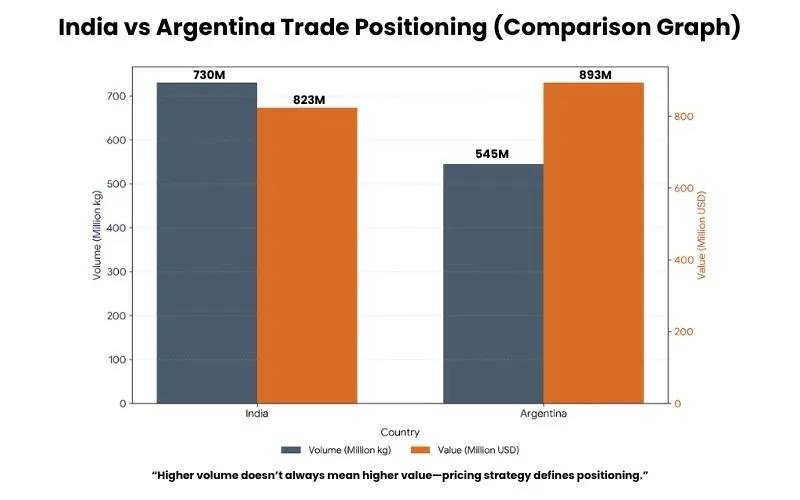
- Argentina → $893 million | 545 million kg
- India → $823 million | 730 million kg
- USA → $418 million | 284 million kg
- Brazil → $359 million | 226 million kg
- Netherlands → $295 million | 134 million kg
What This Data Actually Tells You
At first glance, it looks like Argentina is leading.
And yes — it is, in terms of export value.
But look closer.
India exported more volume than Argentina (730M kg vs 545M kg).
That changes the story.
Real Trade Interpretation
- Argentina → premium pricing strategy
- India → high-volume, price-competitive strategy
- USA → stable but smaller export focus
- Brazil → growing exporter with improving quality
- Netherlands → re-export hub (not primary producer)
So India’s position is not “second”.
It is strategically different.
Moongphali exports from India dominates in:
- bulk shipments
- cost-sensitive markets
- flexible supply
While Argentina dominates in:
- premium segments
- high-value contracts
Types of Peanuts Exported from India (With Real Commercial Use Cases)
Now let’s break this down properly — not loosely about the types of peanuts in global trade.
Java Peanuts
Java peanuts are smaller kernels, typically uniform in size, and widely used in high-volume snack processing.
They are heavily exported to:
- Indonesia
- Vietnam
- Philippines
Now here’s why.
Snack manufacturers in these countries prefer Java peanuts because:
- smaller kernels roast evenly
- they fit automated processing lines better
- pricing is more suitable for mass consumption
So Java peanuts are not “low quality”.
They are optimized for scale and processing efficiency.

Bold Peanuts
Bold peanuts are larger kernels and used where size and appearance matter.
They are commonly used in:
- peanut butter manufacturing
- premium snack packaging
- export markets with retail focus
Countries like:
- UAE
- European nations
prefer bold peanuts because:
- uniform size improves processing
- better visual appeal increases product value
So bold peanuts are positioned more towards premium consumption markets.
Blanched Peanuts
Blanched peanuts are processed kernels where the skin is removed.
This makes them ready for:
- chocolate production
- bakery products
- confectionery
For buyers, this reduces:
- processing time
- labor cost
So these are not raw commodities anymore.
They are closer to value-added exports.
Oil-Grade Groundnuts (Industrial Use Case)
This is where most content online is completely weak — so let’s fix it properly.
Oil-grade peanuts are selected based on:
- oil recovery percentage (key factor)
- moisture level
- acceptable but not premium appearance
These are used by:
- edible oil mills
- industrial processors
Now here’s how buyers evaluate them.
Not by size.
Not by appearance.
But by:
“How much oil can I extract per metric tonne?”
So if a shipment gives:
- higher oil yield → better price for crusher
- lower oil yield → lower value
This is a completely different buying model, driven by industrial economics, not retail demand.
Groundnut Price per KG Export (Real Trade Intelligence)
Now let’s answer this properly.
Typical Export Price Range (2025 Market)
- Java → ₹90–₹110/kg
- Bold → ₹100–₹125/kg
- Blanched → ₹115–₹145/kg
- TJ/HPS → ₹105–₹130/kg
- Oil-grade → ₹70–₹90/kg
Converted:
- ₹75 – ₹115 per kg (FOB export level)
Why Price Changes (Actual Factors)
Prices don’t fluctuate randomly.
They move based on:
- aflatoxin levels (highest impact)
- kernel size uniformity
- oil content
- moisture
- crop season (Kharif vs Rabi)
So when buyers negotiate, they are not bargaining blindly.
They are adjusting for risk and usability.
Demand Trends (Actual Market Drivers — Not Surface Level)
Now let’s go deeper — this is where real value is.
Vietnam
Imports peanuts not just for consumption, but for:
- processing
- re-export
So it acts as a value-add hub, not just an end market.
Indonesia
Strong demand for:
- Java peanuts
Because local snack industries need:
- smaller kernels
- cost-effective sourcing
European Union
Focuses on:
- strict aflatoxin compliance
- premium quality peanuts
Which is why:
- rejection rates are higher
- prices are higher
Global Trend Shift
Demand is growing due to:
- peanut butter consumption increasing globally
- processed snack industry expansion
- protein-based food demand rising
So peanuts are no longer just a snack.
They are becoming part of processed and functional food systems.
Certifications, Compliance & Export Requirements (Full Detail)
This is where deals succeed or fail.
APEDA Registration
Mandatory for peanut exporters in India.
Without it:
- export cannot legally happen
Phytosanitary Certificate
Ensures:
- product is pest-free
- meets importing country requirements
Aflatoxin Testing
The most critical step.
Done via:
- certified labs
- pre-shipment testing
Required especially for:
- EU markets
Fumigation Certificate
Confirms:
- pest control treatment
Certificate of Origin
Required for:
- customs clearance
- tariff benefits
Additional Certifications (Serious Exporters Use)
- ISO
- HACCP
- BRC (for Europe)
These increase:
- buyer trust
- acceptance rate
How to Find Global Groundnut Buyers
Now this is where things become practical. Because knowing how to export is one part. Finding the right global peanut buyers is what actually drives business.
And the thing is, buyers don’t sit in one place.
They are spread across platforms, networks, and trade channels.
1. Transaction-Oriented B2B Platforms (Most Effective)
This is where things have changed significantly in recent years.
Instead of relying on scattered contacts, exporters now use structured platforms that directly connect with:
- global groundnut importers
- bulk groundnut buyers
- food processing companies
The advantage here is not just visibility.
It’s transaction flow.
You can:
- receive real inquiries
- negotiate directly
- compare demand from different countries
- build long-term buyer relationships
And unlike listing directories, these platforms are designed for actual deal execution, not just presence.
That’s why they are often the most effective route for exporters entering or scaling in global markets.
2. Trade Shows & International Exhibitions
Trade shows still play a strong role, especially for exporters looking to build credibility.
Events related to:
- food processing
- agro commodities
- FMCG
bring together:
- importers
- distributors
- wholesalers
This allows face-to-face interaction, which helps in:
- building trust
- understanding buyer requirements
- closing high-volume deals
However, the downside is:
- high cost
- time investment
- uncertain conversion
So while effective, they are not always scalable.
3. Middlemen & Trade Agents
This is one of the oldest channels in global trade.
Middlemen already have:
- existing buyer networks
- country-specific knowledge
- negotiation experience
For new exporters, this can help in:
- faster entry
- reduced effort in buyer search
But it comes with a trade-off.
Margins get reduced, because:
- commissions are involved
- pricing control shifts partially
So this model works better for those prioritising speed over margin.
4. Listing Platforms & Export Directories
These include:
- online exporter directories
- trade listing websites
They provide visibility.
But not necessarily transactions.
You may get:
- inquiries
- exposure
But conversion depends heavily on:
- your follow-up
- your credibility
- your negotiation
So they act more like a starting point, not a complete solution.
Final Thoughts
Groundnut export is not just about supply.
It’s about:
- understanding specifications
- managing compliance
- matching product to market
India plays a strong role in global trade — not by competing in one segment, but by adapting across multiple ones.
And that’s what keeps peanut exporters in India relevant across markets.
Because in this trade…
It’s not the product that decides success.
It’s how well you understand the system around it.
Disclaimer
This article is for informational purposes only. Export prices, market size, trade data, and compliance requirements mentioned are indicative and based on industry insights and publicly available sources. Actual figures may vary depending on market conditions, crop cycles, and international trade policies. Readers are advised to verify details with official authorities such as APEDA and relevant export bodies before making business decisions.