Key Highlights
- India's agri-food exports reached $54.73 billion in 2025-26.
- Marine products were the largest export category by value.
- Rice exports crossed $11.5 billion across Basmati and non-Basmati.
- Spices, buffalo meat, coffee and sugar have large global markets.
- The US, UAE and China are major markets across several products.
- Fresh fruits and vegetables depend heavily on logistics and cold chains.
- Processed foods offer scope for higher-value exports.
- The right export opportunity depends on product, market and specifications.
Introduction:
India's agricultural export story has become much bigger than a few familiar commodities. When talking about top agri exports from India , rice still sits near the centre of the picture, but India's export basket now stretches across marine products, spices, buffalo meat, coffee, sugar, fruits, processed foods, pulses, oilseeds and a long list of other products. The interesting part is not simply how much India exports. It is where that trade is going, which products are gaining commercial weight and where the next opportunities could emerge.
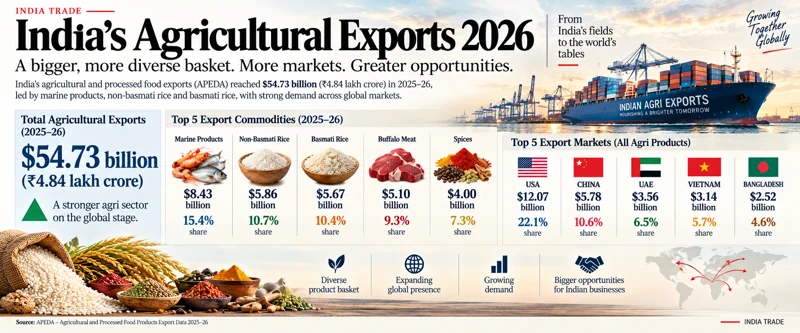
The latest APEDA analytical data for 2025-26 puts India's exports of agricultural and processed food products covered in the report at $54.73 billion , equivalent to about ₹4.84 lakh crore. Marine products were the largest category by value, followed by non-basmati rice and basmati rice.

That makes 2026 an interesting time to look at top agri exports from India . The export basket is already large. The bigger question is what Indian businesses can do with it from here.
Rice still gives India one of its biggest export advantages
If someone asks what to export from India, rice would naturally appear high on the list.
The numbers explain why.According to the APEDA report, India exported 15.04 million tonnes of non-basmati rice worth $5.86 billion in 2025-26. Basmati added another 6.52 million tonnes worth $5.67 billion. Together, the two categories accounted for more than $11.5 billion in exports during the year.
Non-basmati rice went particularly strongly into Benin, Bangladesh, Guinea, Togo and Côte d'Ivoire, while Saudi Arabia, Iran, Iraq, the UAE and Yemen were among the major destinations for basmati.
There is an important distinction here.
India is not dependent on one type of rice or one type of buyer. Non-basmati gives exporters access to large-volume commodity markets, while basmati allows Indian suppliers to participate in a more premium segment.
That combination has helped make rice one of the country's most established agricultural export businesses.
APEDA's current data also shows that India's non-basmati exports continue to cover a wide range of varieties, including Sona Masuri, Ponni, HMT, IR-64, Kolam, Kalanamak, Jeera Sambha and Swarna.
Marine products have an even bigger export footprint
Rice may be the commodity most people associate with India's agricultural exports, but marine products were actually the largest category in the attached 2025–26 export analysis.
The report records 1.996 million tonnes of marine products valued at $8.43 billion , accounting for 15.4% of the total value covered.
The United States was the largest destination at $2.31 billion, followed by China at $1.55 billion. Vietnam, Japan and Belgium were also significant markets.
For Indian exporters, this is an important reminder that agricultural trade is no longer just about crops moving from farms to overseas wholesalers.
Processing, cold chains, quality control and international food-safety requirements increasingly determine how much value India can capture from its agricultural production.
Marine exports demonstrate that clearly.
Spices remain one of India's most recognisable global products
India's spice industry has something that many agricultural commodities would like to have: a strong identity in international markets.
The APEDA data puts spice exports at $4.00 billion in 2025-26 , with 1.41 million tonnes shipped overseas.
The United States was India's largest market for spices at $551 million, followed by China at $516 million, the UAE at $346 million, Bangladesh at $313 million and Saudi Arabia at $194 million.
The opportunity here extends beyond raw spices.
Indian exporters increasingly operate across whole spices, ground spices, spice blends, oils and oleoresins and other processed formats. That creates room for businesses to move further along the value chain instead of competing only on the price of an agricultural commodity.
For anyone studying the top agricultural exports from India , spices are therefore worth watching for both volume and value-added opportunities.

Buffalo meat, coffee and sugar show how diverse the basket has become
The next few categories make the broader story even clearer.
Buffalo meat exports were valued at $5.10 billion in 2025-26, with Vietnam, Egypt, Malaysia, the UAE and Saudi Arabia among the major markets.
Coffee contributed another $2.08 billion , with Italy, Germany, Russia, the UAE and Belgium among the leading destinations.
Sugar exports stood at approximately $1.99 billion , with Somalia, Sudan, Libya, Djibouti and Sri Lanka accounting for substantial shares of the trade.
These are very different businesses.
Their buyers, logistics, pricing structures and regulatory requirements are not the same. Yet all three have developed sizable international markets from India.
That is one of the more interesting aspects of the country's agricultural export economy: there is no single Indian export model.
Fresh fruits and vegetables have room to travel further
Fresh produce is another area where India's production strength is already considerable.
The APEDA data records $1.29 billion in fresh fruit exports during 2025-26, with Iraq, the UAE, the Netherlands, Uzbekistan and Nepal among the major markets.
Fresh vegetables contributed another $860 million , led by markets including the UAE, Malaysia, Sri Lanka, Nepal and Bangladesh.
APEDA's broader fresh fruits and vegetables data puts combined exports at $1.92 billion in 2025-26, with fruits contributing $1.16 billion and vegetables $760.08 million. The agency identifies the UAE, Iraq, the Netherlands, Nepal, Malaysia, Bangladesh, Sri Lanka, the UK, Uzbekistan and Oman among major destinations.
There is a commercial reason these markets matter.
Fresh produce cannot be treated like a container of a shelf-stable commodity. Timing, cold-chain infrastructure, phytosanitary requirements and transit conditions can decide whether an export works.
That makes logistics almost as important as the product itself.
Processed food could be where more export value is created
India's agricultural export opportunity does not necessarily end when the crop leaves the farm. Cereal preparations were worth about $1.01 billion in the 2025-26 APEDA analysis, while processed fruits and juices contributed about $938 million and processed vegetables about $934 million.
APEDA's current data separately records processed fruits, juices and nuts at $662.79 million for FY26, while its broader processed-fruits-and-vegetables category records $731.22 million for processed fruits and $1.90 billion for processed vegetables and pulses.
This is where the top agri exports from India start becoming a different kind of conversation.
A processed product can travel differently from a fresh commodity. It can have a longer shelf life, a different buyer base and, depending on the product, more room for branding and value addition.
For Indian food businesses, that can change the economics of export.
The United States, UAE and China keep appearing for a reason
Look across the APEDA data and certain markets repeatedly appear.
The United States is a major buyer of Indian marine products, spices, processed foods, dairy and several other categories.
The UAE appears across rice, fruits, vegetables, spices, meat, tea and processed foods.
China is particularly important for marine products, spices, oil meals and vegetable oils.
Then there are markets such as Saudi Arabia, Bangladesh, Vietnam, the Netherlands, the UK, Germany, Malaysia and Indonesia, each playing important roles in particular product categories.
There is therefore no single answer to the question of the top exports markets for India . The more useful approach is to connect the product to the market.
A market that is enormous for Indian rice may not be equally important for coffee. A country buying large quantities of spices may not be a major destination for fresh fruits.
That distinction matters when an exporter is deciding where to spend time and money.
Top Agri Exports from India in 2025-26: Products, Export Value & Major Markets
| Rank | Agricultural Export from India | Export Quantity | Export Value | Major Import Markets |
|---|---|---|---|---|
| 1 | Marine Products | 1.996 million MT | $8.43 billion | USA, China, Vietnam, Japan, Belgium |
| 2 | Non-Basmati Rice | 15.045 million MT | $5.86 billion | Benin, Bangladesh, Guinea, Togo, Côte d'Ivoire |
| 3 | Basmati Rice | 6.521 million MT | $5.67 billion | Saudi Arabia, Iran, Iraq, UAE, Yemen |
| 4 | Buffalo Meat | 1.420 million MT | $5.10 billion | Vietnam, Egypt, Malaysia, UAE, Saudi Arabia |
| 5 | Spices | 1.407 million MT | $4.00 billion | USA, China, UAE, Bangladesh, Saudi Arabia |
| 6 | Coffee | 307,800 MT | $2.08 billion | Italy, Germany, Russia, UAE, Belgium |
| 7 | Sugar | 4.114 million MT | $1.99 billion | Somalia, Sudan, Libya, Djibouti, Sri Lanka |
| 8 | Miscellaneous Preparations | 1.179 million MT | $1.83 billion | USA, UAE, Malaysia, UK, Australia |
| 9 | Unmanufactured Tobacco | 319,100 MT | $1.37 billion | Belgium, UAE, Indonesia, Russia, Armenia |
| 10 | Fresh Fruits | 1.848 million MT | $1.29 billion | Iraq, UAE, Netherlands, Uzbekistan, Nepal |
| 11 | Castor Oil | 730,100 MT | $1.15 billion | China, Netherlands, USA, France, Japan |
| 12 | Oil Meals | 3.550 million MT | $1.04 billion | China, Bangladesh, Germany, South Korea, Nepal |
| 13 | Cereal Preparations | 657,400 MT | $1.01 billion | USA, UAE, UK, Nepal, Canada |
| 14 | Tea | 282,100 MT | $988 million | UAE, Iraq, USA, Russia, Iran |
| 15 | Pulses | 1.001 million MT | $970 million | China, UAE, Bangladesh, USA, Sri Lanka |
So, what to export from India in 2026?
There is no universal answer. But the current numbers provide a useful starting point.
Rice remains one of the country's largest opportunities, particularly non-basmati and basmati. Marine products have an even larger export value in the latest APEDA analysis. Spices continue to benefit from India's established reputation. Coffee, buffalo meat and sugar have sizable international markets, while fresh fruits, vegetables and processed foods offer opportunities where logistics and value addition can make a difference.
The attached APEDA analytical report also shows sizable export categories in pulses, oil meals, vegetable oils, groundnut, dairy products, tea, processed fruits, processed vegetables, sesame seeds, guar gum and other cereals.
That breadth is important.
An exporter does not necessarily need to enter the most crowded commodity market. There can be room in a smaller category where Indian production, processing capability or product quality matches an overseas requirement particularly well.
The next opportunity may come from going deeper, not simply exporting more
This may be the more interesting question for 2026.
India already has an enormous agricultural production base. The country does not need to invent an export industry from scratch.
What it needs is more of the right connections between Indian supply and overseas demand.
A rice mill that has traditionally sold domestically may have an exportable variety. A spice processor may have a product suitable for a different market. A fruit exporter may find that a particular destination is willing to pay for a specific grade or packaging format.
The commercial opportunity often sits in that gap.
APEDA's own export policy material points to the importance of processing, value addition, post-harvest management, cold-chain infrastructure and technology in expanding India's agricultural exports.
That is particularly relevant for smaller and mid-sized exporters.
India's export map is already broad. The next step is making it deeper.
The latest figures tell a fairly straightforward story.
India's agricultural export basket is no longer built around just a handful of traditional commodities. Rice, marine products, spices, meat, coffee, sugar, fruits, vegetables, processed foods, pulses and oilseeds are all contributing to the country's overseas trade.
But the next phase may look different from the last one.
Instead of simply asking which product India exports the most, exporters may increasingly need to ask where demand is growing, which markets pay for the right specification, how much freight changes the economics and whether a commodity can be sold in a more processed or differentiated form.
That is where the top agricultural exports from India become more than a list of products.
They become a map of where Indian businesses are already competitive — and where there may still be room to go further.
Conclusion
India enters 2026 with a remarkably diverse agricultural export basket. Rice remains a major strength, marine products lead the latest export-value table, while spices, coffee, meat, sugar, fruits, vegetables and processed foods add depth to the story. The opportunity ahead may lie less in finding one new blockbuster commodity and more in matching India's existing products with the right overseas markets. For exporters asking what to export from India, the numbers suggest that there is already plenty to work with.
Disclaimer
This content is for general informational purposes and is based on the APEDA analytical data cited in the source material. Export values, volumes, markets and trade conditions can change between reporting periods. Exporters should independently verify current regulations, buyer requirements, tariffs, logistics costs and market conditions before making commercial decisions.