Key Highlights
- Securing consistent re-orders is far more profitable than constantly spending capital to find new leads.
- International buyers prioritize suppliers who deliver identical grain or spice quality across consecutive shipments.
- Radical transparency regarding port delays or vessel roll-overs builds long-term institutional trust.
- Proactive compliance tracking protects your buyer from unexpected customs audits on their end.
- Providing flexible, hybrid payment structures to verified buyers acts as a massive competitive moat.
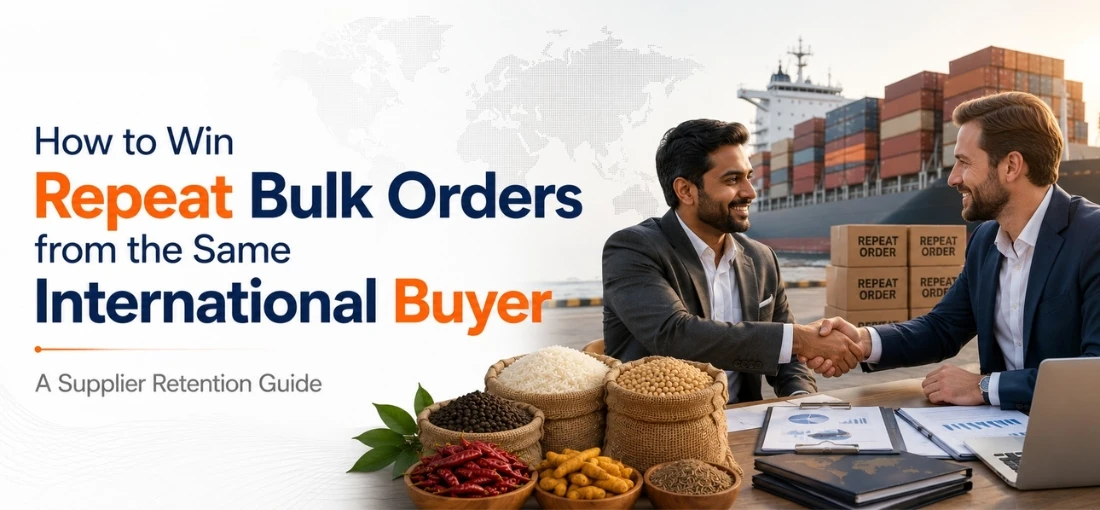
In the high-stakes world of agricultural commodity exports, closing your first deal with an overseas trading house is only half the battle. The real financial stability—the kind that allows you to scale up your milling infrastructure and lock in predictable year-round revenue—comes from turning that one-time buyer into a lifelong partner. When an international corporate desk issues a purchase order, they are taking a calculated risk on your logistics. If you deliver a flawless experience, you eliminate their need to look anywhere else.
Learning how to get repeat export orders requires shifting away from a short-term, transactional mindset. It comes down to establishing absolute consistency on the processing floor, practicing proactive communication during maritime crises, and positioning your trading house as an unshakeable, risk-free extension of your buyer’s own supply chain.

The Pillars of Buyer Retention: Beyond the First Sample
The absolute quickest way to kill your chances of getting repeat export business is delivering a brilliant first "sample container" and then letting your operations slack on the subsequent bulk run. Large-scale food processors and automated packaging plants calibrate their machinery to exact physical tolerances. If your first shipment clears their line perfectly, but your second batch arrives with uneven specifications, you throw their entire production schedule into chaos.
To secure repeat bulk orders from buyers, an exporter must systematically anchor their relationship around five core commercial pillars:
1. Sharp, Competitive Pricing
Agri-commodities run on razor-thin margins. While buyers value reliability, you cannot expect them to absorb unnecessary overheads. Your trade desk must stay sharply aligned with local mandi realities and global index movements to offer sustainable, realistic rates. True retention happens when a buyer realizes your quotes consistently reflect fair market value without arbitrary peak-season price padding.
2. Flawless, Timely Delivery
Out on the water, a delay of even 24 hours can cause a buyer to miss their internal factory processing slot or face steep port storage fees. Maintaining an unshakeable track record for meeting vessel cut-offs is your strongest currency. When you export wheat in bulk, your logistics team must have pre-vetted trucking networks and container loops locked down so that cargo hits the port yard exactly on schedule, every single time.
3. Custom Packaging Options
Global buyers face vastly different retail, wholesale, and environmental regulations depending on their home market. A standard 50kg bag won't work for every destination. Offering tailored, flexible packaging solutions—ranging from jumbo bulk bags (FIBCs) and specialized vacuum-sealed packs to multi-wall paper bags with client-specific stenciling—makes your trading house incredibly easy to work with.
4. Upselling Value-Added Products
Moving raw commodities leaves you highly exposed to generic price wars. You can build a massive competitive advantage by offering processed, value-added alternatives from the same sourcing line. For example, if you export rice in bulk, don't just stop at raw whole grains; offer pre-steamed variants, parboiled options, or broken-rice fractions specialized for industrial starch plants.
Similarly, if you export spices in bulk, expanding your portfolio to include ground powders, cracked fractions, or oleoresins shows the buyer you can service their advanced manufacturing needs as they scale.
5. Flexible Payment Terms
For an initial transaction, enforcing a strict, ironclad Letter of Credit (LC) or a heavy upfront advance is standard practice to protect your capital. But once a buyer proves their credibility across three or four consecutive voyages, keeping them on rigid, restrictive terms will eventually drive them to look for alternative suppliers. Easing into open, flexible credit lines—like shifting to a 30% Telegraphic Transfer (TT) deposit paired with a Documents Against Payment (DP) sight collection—frees up their operational cash flow and builds an intense level of commercial loyalty that newer competitors cannot poach easily.

Radical Transparency: Managing the Friction Points
No maritime supply chain is completely immune to disruptions. Port congestion, sudden customs policy changes, container shortages, and vessel roll-overs are part of daily trading realities. However, what separates speculative middlemen from reliable export partners is how they communicate when these issues inevitably hit.
A typical unverified supplier will hide a port delay or a failed milling deadline until the last possible second, hoping to fix the issue before the buyer notices. This complete lack of transparency panics the buyer's procurement team, forcing them to scramble for emergency spot coverage.
If a regional railway strike or a customs system outage slows down your container movement, notify your buyer immediately with a clear, fact-based update. Present the exact nature of the bottleneck, the revised vessel gate-in timeline, and your structural plan to mitigate any storage costs. When you provide data-driven solutions instead of silent delays, you build deep institutional trust. The buyer realizes that even when things go wrong, your trade desk is fully capable of managing the crisis.
Compliance Shielding: Protecting the Buyer's Border Gate
A major element of successful International Buyer Retention involves proactively protecting your client from regulatory audits in their home market. When customs officials or food safety boards flag an incoming shipment for improper paperwork or incomplete biosecurity stamps, the buyer faces severe corporate penalties, high port demurrage, and potential brand damage.
If your company specializes in Export Dried Fruits in bulk, you must stay completely ahead of changing international biosecurity mandates. High-value cargo like raisins, almonds, or walnuts are highly sensitive to transit conditions. Don't wait for your client to send you an updated list of prohibited weed seeds or revised fumigation protocols. Your compliance team should actively monitor the latest plant quarantine portals across your target destination corridors.
When you proactively share updated lab certifications, pre-loading gas chromatography scans, and verified phytosanitary files well ahead of the vessel's arrival, you remove all the administrative stress for their operations team. You make clearing your cargo the easiest part of their week.
Strategic Relationship Mapping: The Retention Checklist
To ensure your export desk is systematically locked into your client's long-term procurement calendars, your post-shipment follow-up should match the structural checkpoints detailed below:
The International Buyer Retention Checklist
| Relationship Phase | Core Operational Touchpoint | Practical Retention Action | Long-Term Retention Value |
|---|---|---|---|
| Post-Discharge Follow-Up | 5 Days after cargo clears destination customs. | Request direct feedback from the buyer’s quality control team regarding bag durability and grain moisture upon unsealing. | Proves your desk cares about real-world outturn quality, not just getting paid. |
| Market Intelligence Sharing | Bi-weekly agricultural update briefs. | Send brief, objective summaries of local mandi pricing trends, monsoon progression, and incoming crop size estimates. | Positions your trade house as a valuable strategic advisor rather than a generic vendor. |
| Regulatory Alignment | Prior to new seasonal crop cycles. | Request updated country-specific pesticide MRL lists and premium packaging preferences. | Eliminates compliance errors before processing lines even begin running. |
| Financial Structuring | After 3 successful consecutive transactions. | Evaluate transitioning from strict upfront LCs to flexible hybrid structures, like a 30% TT deposit with 70% DP terms. | Creates a massive financial border that stops newer, unverified competitors from poaching your client. |
The Tactical Verdict
Winning repeat bulk orders from buyers isn't about offering flashy discounts or relying on casual social relationships. In the modern corporate agri-commodity arena, retention is won through hard, boring operational execution.
By treating absolute quality uniformity as a non-negotiable law on your mill floors, protecting your clients from destination customs audits through flawless documentation, and extending your product offerings across their broader procurement needs, you build a massive competitive moat around your business. You strip all the risk out of the equation for their buying desk, transform your trading house into an irreplaceable global partner, and ensure your export volume remains clean, predictable, and highly lucrative across every single season.
Disclaimer
The information provided is for educational and informational purposes only. Buyer retention strategies, payment terms, logistics performance, packaging requirements, and compliance obligations may vary depending on the commodity, destination market, buyer policies, and trade regulations. Exporters should evaluate commercial risks and contractual obligations before implementing any retention strategy.