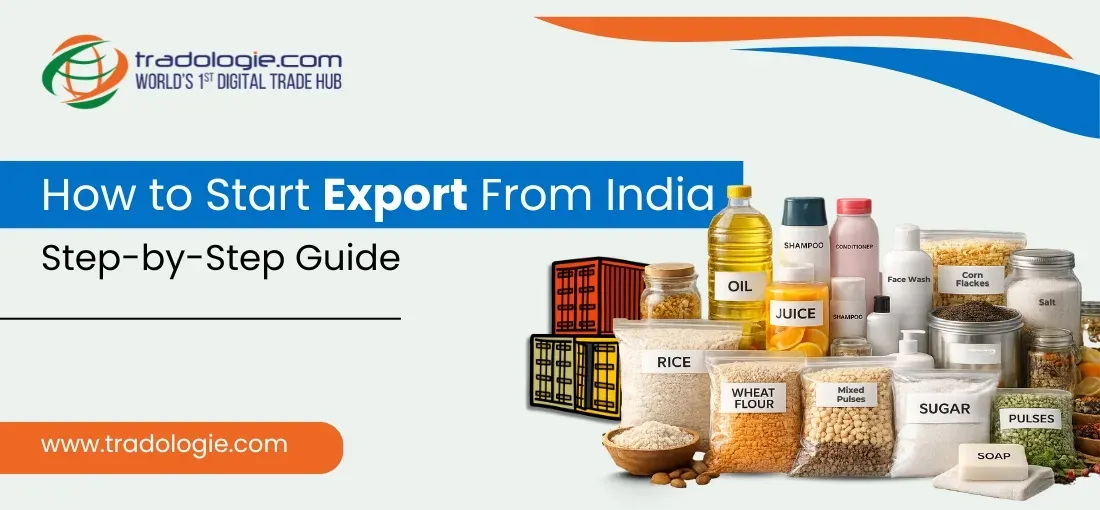
Starting export from India requires seven mandatory regulatory registrations including IEC, GST, and ICEGATE. Businesses must establish a legal entity, secure financial compliance, and register with relevant export authorities before executing international shipments.
Key Highlights:
- Starting Export from India
- Export business must be legally registered (Proprietorship, LLP, Pvt Ltd, etc.)
- PAN is mandatory for all export-related registrations
- Open a Foreign Exchange-enabled current account with an RBI-authorized bank
- GST registration required to claim zero-rated export benefits
- Importer Exporter Code (IEC) is compulsory under Foreign Trade Policy
- RCMC needed to claim export incentives and register with Export Promotion Councils
- ICEGATE and AD Code registration required before first shipment
- Annual IEC update must be completed before June 30 to avoid deactivation
Expanding into the global market requires much more than financial capital. It fundamentally demands strict adherence to established statutory frameworks. Many enterprises aim to execute large-scale bulk trade shipments. These consignments might involve vast metric tons of non-basmati rice, highly specialized spices, or heavy industrial goods. For such ambitious operations, navigating India's specific export regulations forms the critical first step.
The Directorate General of Foreign Trade (DGFT) has worked diligently to improve this landscape. Over the years, they have significantly streamlined the administrative process. While bureaucratic friction has decreased, absolute precision in compliance remains paramount. This guide draws directly from the official guidelines provided by the Indian Trade Portal. It clearly delineates the systematic progression required to legitimately commence your export operations from India.
Establishing a Robust Organizational Entity
Before a single shipping container leaves the port, your business architecture requires absolute solidification. This foundational structure is certainly not an afterthought. To effectively establish your enterprise, consider these critical steps:
- Determine Legal Incorporation: You must formally constitute your firm under a recognized statutory framework. Exporters face several distinct legal options for this vital first step.
- Select a Business Structure: Your organization could take the form of a Sole Proprietorship or a traditional Partnership. Alternatively, an enterprise might register as a Limited Liability Partnership (LLP) or a Public/Private Limited Company.
- Understand Market Scrutiny: The realm of B2B bulk commodity trading operates on deep trust. Within this highly competitive sector, overseas buyers ruthlessly scrutinize vendor credibility.
- Signal Operational Stability: International buyers look for unmistakable signals of stability before committing to the large-scale procurement of agricultural commodities, such as shipments of lentils, pigeon peas, or broken rice. An officially registered entity instantly signals this necessary permanence.
- Invest in Professional Presentation: Presenting an attractive, professionally designed corporate logo is highly advisable. Together, these foundational elements establish the requisite market trust for securing high-volume, cross-border transactions.
Procuring the Permanent Account Number (PAN)
Financial identity is non-negotiable. Every aspiring exporter must obtain a PAN from the Income Tax Department. This 10-digit alphanumeric identifier is the linchpin for all subsequent regulatory registrations and financial tracking. Online applications can be swiftly processed through the Protean (formerly NSDL) or UTITSL portals. Alternatively, an instant e-PAN is available via the Income-tax E-filing portal. Without this foundational document, advancing to customs clearance or international banking is strictly prohibited.
Securing a Foreign Exchange Authorized Bank Account
International trade runs on complex, cross-border capital flows. Therefore, a standard domestic business bank account is entirely insufficient. Exporters must open a Current Account with a bank specifically authorized by the Reserve Bank of India to deal in Foreign Exchange. It is imperative to verify that the selected branch is not classified as a "no foreign exchange involved" (NFEI) branch. Smooth inward remittances are the lifeblood of bulk export operations, making this banking infrastructural step a critical priority.
Ensuring Compliance with Tax Authorities (GST)
Tax efficiency is not merely an administrative checkbox. It directly dictates the ultimate bottom line of your bulk trade operations. The current statutory regime provides significant, structured relief to international traders. Specifically, under Section 16 of the Integrated Goods and Services Tax (IGST) Act of 2017, goods exported out of India are legally classified as a "zero-rated supply." Exporters must formally register with the tax authorities to actively leverage this substantial financial benefit. This crucial registration process is conducted entirely online via the official government portal at gst.gov.in. Comprehensive compliance ensures that your enterprise can seamlessly claim vital input tax credits. Alternatively, businesses can secure direct refunds on unutilized credits. Preserving these tight profit margins is absolutely critical. This is especially true when navigating highly competitive, high-volume shipments—whether you are moving 500 metric tons of lentils or dispatching specialized, premium spice consignments.
| Statutory Concept | Financial Implication for Bulk Trade | Required Action for Exporters |
|---|---|---|
| Zero-Rated Supply | Exported goods attract a 0% GST rate. This keeps international pricing highly competitive for large-volume contracts. | Declare exports accurately under a Letter of Undertaking (LUT) or pay IGST upfront and claim a subsequent refund. |
| Input Tax Credit (ITC) | Recovers the GST paid on domestic raw materials, packaging, or services utilized during export preparation. | File monthly GSTR-1 and GSTR-3B returns meticulously via the official GST portal. |
| Unutilized Credit Refund | Provides a direct cash flow injection for accumulated tax credits that cannot be otherwise offset domestically. | Submit RFD-01 refund applications promptly, backed by valid shipping bills and export invoices. |
Acquiring the Importer-Exporter Code (IEC)
The IEC is the master key to international borders. As mandated by Para 2.05 of the Foreign Trade Policy, no export can be legally executed without this mandatory, PAN-based code. The application for an e-IEC is filed online via the DGFT portal (www.dgft.gov.in) using form ANF 2A. The process requires a nominal application fee of exactly ₹500, payable via net banking or credit/debit card, alongside a cancelled pre-printed cheque and proof of address. Crucially, every IEC holder must electronically update or confirm their details annually before June 30 to maintain their operational status and avoid deactivation.
Obtaining the Registration-Cum-Membership Certificate (RCMC)
Market penetration often relies on institutional backing. The RCMC, which remains valid for exactly 5 years, is issued by respective Export Promotion Councils (EPCs) or Commodity Boards. Exporters must declare their main line of business when applying. For example, a firm specializing in bulk agro-commodities would typically seek registration with bodies like APEDA or the Spices Board. Conversely, multi-product exporters whose primary category is yet to be settled can obtain their RCMC directly from the Federation of Indian Exporters Organization (FIEO). This certificate is an absolute prerequisite for claiming various export incentives and duty drawbacks.
Completing ICEGATE and AD Code Registrations
The customs port is the last regulatory obstacle. Exporters must register on the ICEGATE portal using validation metrics such as PAN, GST, and a Class III encrypted Digital Signature Certificate (DSC) after the IEC and GST registrations are active. The Foreign Remittance Account (Authorized Dealer or AD Code) for filing shipping bills and a separate Refund/Incentive Account for receiving GST refunds and drawback incentives must then be registered before the first shipment is shipped.
Strict, verifiable procedures regulate the shift from domestic supplier to foreign exporter. Businesses put themselves in a position to succeed in the cutthroat world of international bulk trade by methodically securing these seven fundamental pillars. The emphasis can completely change to using digital B2B market infrastructures to connect with verified global buyers once the regulatory foundation is established. This will guarantee that high-volume shipments from Indian ports are efficiently transported to the rest of the world.
.webp "Top 10 Cow Dung Export Companies in India with Market Size and Global Demand")