The fast-moving consumer goods (FMCG) sector is a massive part of global business. Because of this, getting a distributorship with a giant like Nestlé is a very popular goal. However, you need more than just money to succeed. You must also understand local supply chains. You need to know how agricultural sourcing works. Handling huge volumes of bulk trade is also a must.
This guide explains how to become a Nestlé distributor in India step by step. We will look at this opportunity as more than just a local retail business. Instead, it is an important part of a huge, worldwide trade network.
The Magnitude of Nestlé India's Distribution Network
You need to look at Nestlé's finances and logistics to understand the true size of their network. Nestlé India shared their financial reports for the year ending March 31, 2025. The company made an amazing ₹200,775.0 million in product sales. Their total assets also grew to ₹121,933.2 million in 2025 to support this massive income.
Operating at this huge scale requires a very precise distribution network. A distributor is not just a middleman. Instead, they are local logistics experts. They must move fast-selling goods across large areas. Partnering with such a big brand helps you enter the market quickly. However, it also means you must strictly follow their high operational rules.
Categorization of Distributorships & Channels
Nestlé almost never gives a new person the right to sell every single product at once. The company divides its distribution into different parts. This helps them run logistics smoothly and follow local laws. You must understand these different setups for your business plan:
- Format Types: There are different ways to apply. You can be a Super Stockist. This means you supply to smaller distributors in rural areas over a large space. You can be a Direct Distributor. This involves supplying city shops and small family stores. Finally, you can be an Institutional or HoReCa Distributor. In this role, you supply bulk goods to hotels, restaurants, cafes, and office cafeterias.
- Product Divisions: The company often divides roles based on how products must be handled. For instance, the Chilled/Dairy group needs strict cold chain transport. On the other hand, the Ambient group includes items like Maggi and Nescafé. These just need normal dry storage. Also, Nestlé Nutrition deals with baby formula like NAN Pro. This requires special care. It also means you must strictly follow special marketing laws, like the IMS Act in India.
Understanding the FMCG Bulk Trade and Supply Chain Dynamics
Running a distributorship is mainly about managing bulk trade. Distributors buy goods in huge amounts on pallets. Then, they break these large orders down into smaller ones. These go to local wholesalers and large modern stores.
The logistics for this are very complex. You need temperature-controlled trucks for items that go bad quickly. This includes dairy and chocolates. You also need standard trucks for dry items like noodles and coffee.
In the business-to-business world, a Nestlé distributor is a very important bridge. They connect the maker's giant warehouses with many small retail shops. Moving your inventory quickly is very important. Distributors need to use smart inventory systems. A common one is FIFO, which means First In, First Out. This helps reduce wasted products. It also makes sure the buyer gets items that will last a long time on the shelf.
The Agricultural Perspective: Sourcing at the Grassroots
Nestlé is unique in the bulk trade world because it is deeply tied to Indian agriculture. The company does more than just make things. It actively builds its raw material supply chains right from the farm.
Take the dairy sector as an example. Nestlé has a project called Fresh Milk Procurement and Dairy Development (FMPDD). Their reports show this project covers about 60,000 square kilometers. This huge area spreads across Punjab, Haryana, and Rajasthan. Nestlé works with about 80,000 dairy farmers in this zone. Also, their Moga factory collects an amazing amount of milk. During peak seasons, it takes in over 1.3 million kilograms of milk every single day.
Potential distributors really need to understand this farming background. The success of these local farming projects matters a lot. It directly affects the availability of the goods in your warehouse. It also impacts the pricing and quality of those finished products.
Eligibility and Prerequisite Infrastructure for Distributorship
Getting a contract with Nestlé means you must show you have strong facilities. The company checks everything very carefully. They do this before adding any new partners to their supply chain.
- Commercial Space: You need a good, safe warehouse. It must have proper airflow. The size should be between 1,500 and 3,000 square feet. The exact size depends on whether your area is a city or a village.
- Logistical Assets: You must have access to commercial delivery trucks. You can own these or rent them. Examples include a Tata Ace or a Mahindra Bolero Pickup. These are needed to make sure your local deliveries arrive on time.
- Technological Readiness: You must have computers ready for business software. This software needs to track your inventory digitally. It will also connect with Nestlé's central databases. Most importantly, you must be ready to use Nestlé's special Distributor Management System (DMS). This software tracks your sales to stores as they happen. Using this technology daily is a huge rule you must follow for the company.
- Statutory Compliance: You must have the right legal paperwork. This includes an active GST registration. You also need an FSSAI license for food safety. A valid local trade license is required too. Finally, you must provide standard identity documents (KYC).
Manpower and Human Resources
Money and buildings are just the starting point. Actually doing the work requires good people. A distributor must hire a hardworking sales and operations team. You must also keep them happy so they stay. This team usually includes:
- Distributor Sales Representatives (DSRs): These are your field workers. They visit retail shops and take orders. They also make sure products look good on the shelves. DSRs usually take orders directly from Nestlé’s Territory Sales In-charge (TSI).
- Delivery Personnel & Loaders: These workers are needed to load trucks and finish local deliveries.
- Inventory Managers/Computer Operators: These staff members type data into the DMS system every day. They also manage how stock moves in and out of the warehouse.
Financial Commitments: Investment and Profit Margins
Having cash on hand is the most important part of bulk FMCG trade. A future distributor must have enough working capital. You need this cash to offer credit to local shops. At the same time, you still need to pay the manufacturer upfront.
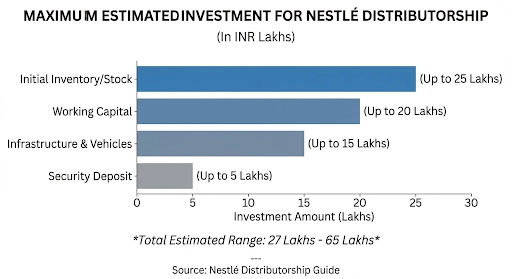
Here is an estimated breakdown of the money you will need:
| Investment Category | Estimated Cost (INR) | Description |
|---|---|---|
| Security Deposit | 2,00,000 - 5,00,000 | Refundable deposit held by the company. |
| Initial Inventory/Stock | 10,00,000 - 25,00,000 | The first bulk purchase to seed the market. |
| Infrastructure & Vehicles | 5,00,000 - 15,00,000 | Godown setup, computers, and delivery trucks. |
| Working Capital | 10,00,000 - 20,00,000 | Liquid cash to manage market credit and operations. |
| Total Estimated Investment | 27,00,000 - 65,00,000 | Varies heavily based on the region's tier. |
Understanding Margins and Breakeven
- In the FMCG business, selling large amounts is how you make a profit.
- Standard profit margins for Nestlé items are usually between 4% and 8%.
- However, these products sell very fast. This speed guarantees a good return on your investment, as long as you keep your running costs low.
- Because the stock moves so quickly, a good business usually gets its initial money back soon. This breakeven point often happens within 1.5 to 3 years.
- The exact time depends heavily on how well you run things locally. You must reduce wasted products and plan smart delivery routes.
Company Support and Claim Management
A distributorship is a true partnership. The parent company gives you important, ongoing help. Nestlé supports its network with local marketing items. This includes store displays and banners. They also run special trade deals to help sell specific items.
Handling product claims is another very important part of the job. In FMCG trade, you will always deal with some damaged goods. You will also have expired stock, especially with fresh food. Nestlé has clear rules for this. Distributors can claim refunds or get new items to replace the bad ones. This ensures the distributor does not lose all their money on supply chain accidents.
The Application Process: Navigating the Rules
Making your partnership official involves several formal steps. Here is how the process works:
- Market Mapping: Do some research on your target area before you apply. Find where the current supply chain is weak. Look for potential big business clients in the region.
- Initial Contact: You usually apply through Nestlé India's official website. Look for the "Partner with Us" section. You can also contact the Regional Sales Manager (RSM) or Area Sales Manager (ASM) for your state directly.
- Proposal Submission: Hand in a complete business plan. Show them your financial details. Explain the buildings and trucks you already have. Share your plan for growing bulk trade in your area.
- Site Inspection & Due Diligence: Nestlé's local team will come visit you. They will inspect your warehouse and delivery trucks. They do this to make sure your setup meets their strict safety and quality rules.
- Agreement & Onboarding: Once approved, you will sign legal contracts. You will also transfer the security deposit. Finally, your team will get special training on Nestlé's rules and software.
Strategic Advantages for Import-Export and B2B Operations
Finally, having a Nestlé distributorship gives you a huge advantage in business. This is especially true if you do import-export or big B2B trade. The giant company's list of products acts as a "door opener" for you. You get to control local deliveries for famous brands like Maggi, Nescafé, and KitKat. Because of this, large buyers instantly trust you. This includes big hotels, restaurant chains, and large modern supermarkets.
Also, you get to learn Nestlé's very strict supply chain rules. You learn about their goals, like sourcing materials without cutting down forests. You also learn their advanced inventory systems. This gives you a great blueprint for success. You can use these smart logistics models for your own separate business. For example, you can apply them to your farm exports or imported goods. Doing this will raise your entire business up to international standards.
Frequently Asked Questions (FAQs)
Q: What is the total investment required for a Nestlé distributorship in India?
A: The total estimated investment ranges from ₹27,00,000 to ₹65,00,000. This covers your refundable security deposit, initial stock purchase, infrastructure, delivery vehicles, and necessary working capital.
Q: What is the average profit margin for a Nestlé distributor?
A: Standard profit margins for Nestlé products generally range between 4% and 8%. Due to the high volume and fast-moving nature of these goods, distributors typically see a return on investment (breakeven) within 1.5 to 3 years.
Q: How do I apply to become a Nestlé distributor?
A: You can initiate the process by visiting the "Partner with Us" section on Nestlé India's official website, or by directly contacting the Regional Sales Manager (RSM) or Area Sales Manager (ASM) for your state to submit your business proposal.
Q: How much warehouse space do I need?
A: You will need a commercial, well-ventilated warehouse space measuring between 1,500 and 3,000 square feet, depending on whether your target market is a rural area or an urban city center.
Q: What mandatory licenses and documents are required?
A: To partner with Nestlé, you must be fully compliant with local laws. This requires an active GST registration, an FSSAI license for food safety, a valid local trade license, and standard KYC documents.
Q: Do I need to arrange my own transport and software?
A: Yes. You must own or rent commercial delivery vehicles (like a Tata Ace or Mahindra Bolero) and have a computer setup ready to run Nestlé's mandatory Distributor Management System (DMS) for daily inventory and sales tracking.