Let's face a hard reality about global food logistics: a massive consumer market means absolutely nothing if your cargo gets permanently jammed at the port of entry. For years, mainstream trade analysis has focused heavily on shifting tariff sheets and raw demand metrics. But for anyone trying to run a profitable rice export business today, that kind of thinking completely misses the mark. The real determining factor for success isn't the duty you pay at the gate—it is your command of the hyper-complex, slow-moving maze of non-tariff barriers, localized laboratory testing, and rigid biosecurity certifications.
This operational reality is nowhere more visible than in the Chinese grain market. While China represents an enormous bulk rice export opportunity, clearing their border demands flawless technical accuracy. A single mismatched digit on a shipping manifest or a minor deviation in warehouse sampling will cause destination authorities to ground your containers, hit your desk with massive storage penalties, or reject your entire lot outright.
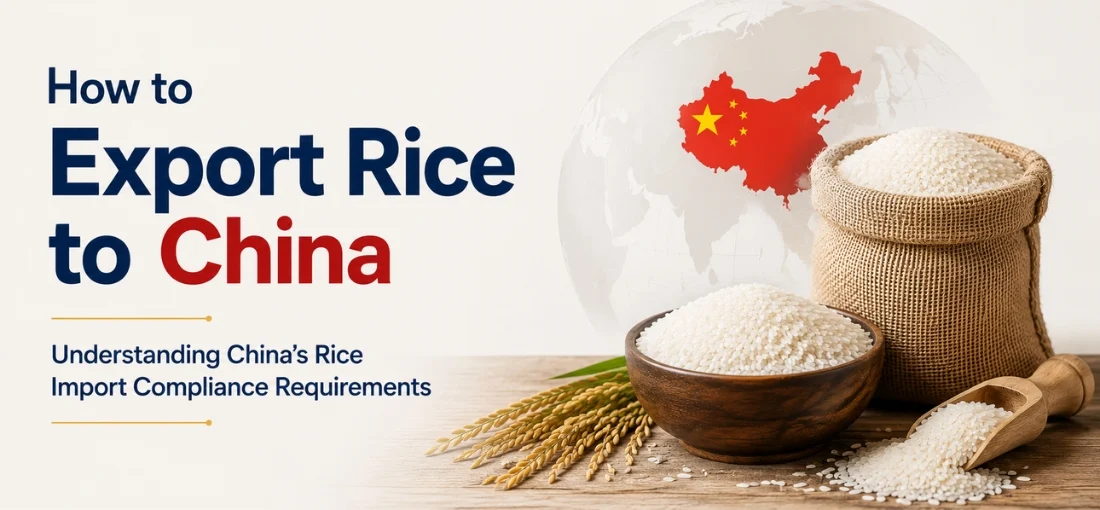
Keep reading this informative piece of blog. It will be your complete guide on how to export rice to China with complete documents.

Export Profile: Indian Rice Shipments to China
To evaluate this trade lane accurately, it helps to look at how volume targets fluctuate based on strict regulatory regimes. Your spreadsheet must map out the distinct financial and volume profiles for high-volume industrial grains versus premium specialty rice across the recent fiscal cycles:
| Commodity Classification | Fiscal Cycle | Volumetric Export Weight (Metric Tons) | Total Financial Valuation (USD Millions) | Core Market Segment |
|---|---|---|---|---|
| Basmati Rice | 2024-25 | 4,250 | 5.10 | Premium niche hospitality and specialty retail outlets. |
| 2025-26 | 3,890 | 4.95 | High-income consumer segments and gourmet dining lines. | |
| Non-Basmati Rice | 2024-25 | 285,400 | 122.70 | High-volume industrial blending, starch manufacturing, and processing feeds. |
| 2025-26 | 312,150 | 140.45 | Bulk wholesale catering networks and commercial food manufacturing. |
Clarifying the GACC and DPPQS Dual-Registration Rule
A frequent trap for automated shipping desks is assuming that simply registering your manufacturing or processing unit on the General Administration of Customs of China (GACC) CIFER platform is enough to secure green-lane entry. That is a dangerous half-truth.
According to official APEDA protocols, GACC approval and DPPQS (Directorate of Plant Protection, Quarantine and Storage) registration function as an inseparable, mandatory pair. While manufacturers and manufacturer-cum-merchant exporters use the CIFER interface to lodge their profiles, actual export shipments are legally permitted to leave India only if they originate from facilities that are explicitly registered with DPPQS and fully approved by GACC.
Crucially, the regulatory framework explicitly accommodates the Merchant Exporter Provision. This means you do not need to own the physical milling floor or the processing facility to capitalize on this trade lane. Merchant trading desks are fully authorized to export rice to China, provided they source their lots exclusively from these dual-registered, GACC-approved facilities and maintain absolute adherence to the established Standard Operating Procedures (SOPs).

The APEDA Sampling Matrix and Lab Requirements
You cannot handle a high-stakes customs audit by trying to patch up your quality control protocols after your container doors are already padlocked. To keep your shipments moving without bleeding money at the terminal, your warehouse teams must integrate APEDA’s exhaustive sampling and laboratory metrics directly into your packing timeline:
- The Detailed Sampling Grid: Moving past basic, arbitrary spot checks, you must deploy a strict sampling matrix based on the precise physical mass of your export lot. Homogeneous lots require a minimum of 3 samples. For lots scaling between 50–500 kg, you must draw 5 separate samples. Any large-scale lots moving above 500 kg demand a strict 10-sample draw. This distribution must adjust dynamically depending on your final container and carton count.
- Laboratory Sample Preparation: Once the field draws are complete, the warehouse must prepare a specific 1 kg laboratory sample using the standard quartering method. This composite sample must be securely labeled according to statutory guidelines and physically delivered to an accredited testing facility within a strict 48-hour window.
- International PCR Sourcing Standards: To confirm the cargo is completely free of Genetically Modified Organisms (GMOs), the laboratory assays must adhere strictly to international molecular testing protocols. Your testing partner must officially pass and certify against ISO 21571, ISO 21569, ISO 21570, and ISO 24276 standards.
- On-Site Quality Control Systems: The testing facility itself must run an active ISO 17025 quality management system. The technical verification requires the continuous use of positive controls, negative controls, certified reference materials, and meticulously calibrated testing equipment to completely eliminate false readings or baseline anomalies.
The Official Checklist: Documents Needed to Export Rice to China
To maintain operational velocity and protect your cash flow from unexpected administrative delays, your documentation desk must assemble and maintain an active paper trail for every outbound container. Before the vessel ever departs the harbor, ensure your custom house agents have cross-referenced and verified this exact seven-point document checklist:
- Valid GACC Registration Profile (verified through the CIFER interface)
- DPPQS Facility Approval Certificate
- Formal Annexure-I Application (explicitly detailing your APEDA RCMC number, GACC registration number, processing unit location, lot numbers, and specific shipment manifests)
- Official GMO Certificate of Analysis (issued under the required ISO PCR standards)
- Registration-cum-Allocation Certificate (RCAC)
- Official Phytosanitary Certificate
- Complete Outbound Shipping Documents (Bill of Lading, Commercial Invoice, and Packing List)
The Defensive Onboarding Blueprint for Exporters
Because these compliance measures function as an unforgiving, automated dragnet, smart trading companies need to run a tight, technically disciplined ship long before their cargo rolls toward the harbor.
First, protect your financial capital from unexpected port delays by keeping your logistics contracts completely insulated. Never ship agricultural cargo under standard three-day terminal free-time windows. Work with your freight forwarders to secure a minimum 14-day factory-to-dock free-time clause directly in your ocean bills of lading. This contractual buffer ensures that if a destination border post selects your container for a random botanical inspection or a document review, the processing delay will not trigger immediate, expensive demurrage and detention fees that wipe out your transaction margins.
Second, protect your cargo from environmental threats. Wrap your pallets heavily in high-gauge shrink wrap and use continuous strings of clay desiccants to block container sweat and mold during the long ocean voyage across the equator.
Finally, implement absolute administrative accuracy. Ensure your documentation teams verify every commercial invoice, packing list, and weight certificate against the official export inspection papers before the vessel departs. Automated customs databases flag typographical errors and minor weight discrepancies instantly. Avoiding these clerical errors prevents your container from being diverted to a physical staging yard for manual inspection, protecting your delivery timelines and safeguarding your capital from unnecessary port storage costs.
Summary
The era of the speculative, volume-heavy commodity broker is drawing to a close. The future belongs to supply-chain-literate trade desks that treat international compliance not as an administrative hurdle, but as a core competitive advantage. By professionalizing your processing standards, securing your logistics lines, and mastering the fine print of these emerging dual-registration frameworks, you can insulate your business from volatility and transform a shifting regulatory landscape into a highly profitable, sustainable international corporate asset.
Want to export rice to China? Register as a seller on Tradologie.com today.