Key Highlights
- Pricing Freedom: The government lifted the Minimum Export Price (MEP) policy in late 2024, allowing open market demand to drive competitive FOB pricing.
- Profit Margins: Bulk farm exports are a volume game; expect realistic net profit margins between 8% and 15% by bypassing third-party middlemen.
- Top Destinations: Saudi Arabia and Iraq drive massive volume, while the US and UK demand strict, chemical-free premium organic retail bags.
- Quality Metrics: Buyers demand strict specifications: a minimum 8.2mm pre-cooked length, under 5% broken grains, and moisture strictly below 12% to prevent mold.
- Mandatory Compliance: Securing an APEDA Registration-cum-Membership Certificate (RCMC) and obtaining Phytosanitary health certificates are absolute legal requirements for all Indian rice exporters.
- Verified Sourcing: Skip outdated directories; leverage customs data platforms like Volza and verify global buyer financial safety through the ECGC before shipping.
Global farm trade relies on products with high cultural and monetary value. Indian Basmati rice is a perfect example of this. It grows only in the foothills of the Himalayas. This long, thin, and fragrant grain is more than a basic food. It is a top-tier global product. For large-scale traders, knowing how to export Basmati rice from India is vital. This knowledge means the difference between just surviving and making huge profits. India completely rules this market.

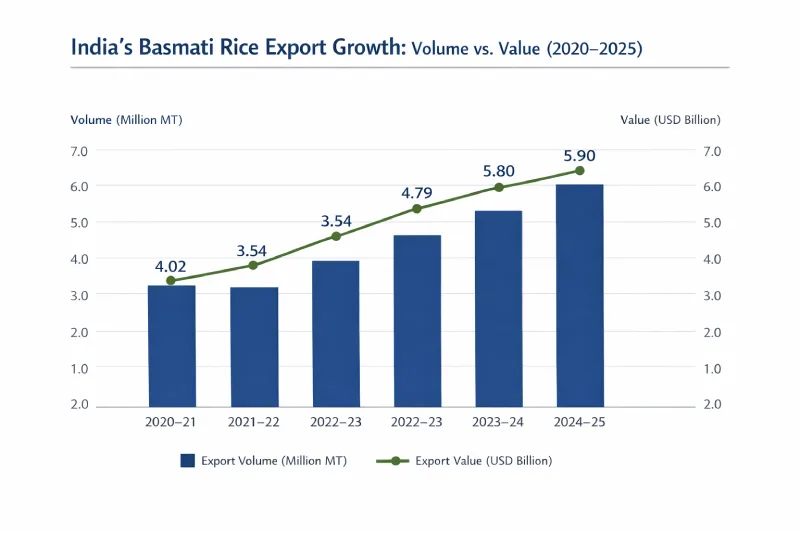
The Agricultural and Processed Food Products Export Development Authority (APEDA) reports big numbers. India shipped out about 6.06 million Metric Tonnes (MT) of Basmati rice in the 2024-25 year. This trade brought in roughly $5.9 billion. The big picture looks great. But the daily reality for Basmati Rice sellers is tough. You must understand changing prices. You must deal with tight shipping costs. You also must check global buyers very carefully.
To beat rivals in 2026, exporters must dig deeper than basic trade lists. This guide breaks down prices, profits, and ways to find the best buyers.
1. The Economics of Basmati: Export Price Dynamics
Basmati rice prices change often. Many things shift the final cost. Trade laws play a big role. Farm yields from the monsoon matter too. Local food storage needs also shift prices.
In the past, India used a strict Minimum Export Price (MEP) rule. However, the government officially lifted this MEP policy in late 2024. Now, exporters have the freedom to price their rice competitively. This massive change helped India win back global market share. Without the MEP floor, prices are driven strictly by open market demand. In bulk trade, prices change based on the rice type. The way the rice is milled also changes the price. The 1121 Golden Sella and Pusa Basmati are the top sellers worldwide. Most international deals use Free On Board (FOB) rules. APEDA tracks this FOB pricing to issue your export papers.
What Changes the Price?
- Age of Rice: Rice aged 12 to 24 months costs more. It holds its smell better. It also grows much longer when cooked.
- Processing Type: Raw, steamed, and parboiled (Sella) rice have different prices. Golden Sella is very popular in the Middle East.
- Shipping Costs: Traffic jams in places like the Red Sea change shipping rates. This clearly changes the final cost for Basmati Rice importers.
To navigate these complex price dynamics and secure profitable FOB contracts, modern exporters rely on dedicated digital infrastructure. Tradologie allows you to bypass unpredictable middlemen and negotiate directly based on live, open-market demands.

2. Breaking Down Profit Margins: Is Exporting Lucrative?
Many new Basmati Rice Exporters make a common mistake. They think big sales mean massive profits. This is not true. Bulk farm exports rely on selling large amounts. The profit per bag is average.
A normal bulk export business makes between 8% and 15% net profit. This depends on a few major things. You need a fast supply chain. You need good currency exchange rates. You also make more money if you buy right from the rice mills. Avoid third-party middlemen if you can.
Typical Export Cost Breakdown (Per MT Estimate)
| Cost Category | Percent of Total | What Affects This Cost? |
|---|---|---|
| Paddy Buying & Milling | 65% - 70% | Farm support prices, milling speed, broken grain count. |
| Bags & Branding | 5% - 8% | Woven PP bags, jute bags, custom brand labels. |
| Local Transport | 8% - 12% | Trucking from Punjab to ports like Kandla or Mundra. |
| Taxes & Permits | 2% - 4% | Health papers, APEDA fees, port checks. |
| Net Profit | 8% - 15% | Business size, fixed contracts, banking rates. |
To make the most money, do not ship broken grains. Also, work directly with farmers to lock in good prices early in the season.
3. Sourcing the Best: A Guide for Basmati Rice Buyers
Global Basmati Rice buyers must check quality closely. The market has many levels. Buyer needs change based on their home country. Buyers in the Middle East want long, fluffy rice. Buyers in Europe and the US care more about chemical limits. They watch pesticide levels very closely.
Smart buyers ask Indian suppliers for strict details:
- Length: Before cooking, premium 1121 rice must be at least 8.2mm long.
- Moisture: Water levels must stay under 12%. This stops mold during long sea trips.
- Purity: Less than 5% broken rice is a must. The grains should never look chalky.
- Smell: It must have the real, natural Basmati scent.
There is also a big push for organic rice. US and EU buyers want USDA Organic and Non-GMO tags. Basmati Rice importers will pay 15% to 25% more for these labels. But, the seller must prove exactly which farm grew the rice.
4. How Basmati Rice Sellers Find Verified Buyers
Finding buyers is the hardest part for mid-sized sellers. Waiting on open websites like Alibaba is an old method. Today, the best sellers use data to find real buyers.
Smart Steps to Find Buyers:
- Use Customs Data: Smart sellers look at shipping records on sites like Volza or Zauba. This shows exactly who is buying Indian rice right now. It shows how much they buy and how often.
- Check Embassy Desks: APEDA has portals for trade leads. Also, talk to Indian embassies in places like Saudi Arabia. They have safe, approved lists of buyers.
- Go to Trade Shows: Face-to-face meetings work best for bulk food. Go to big events like Gulfood in Dubai. You will meet big buyers there who do not shop online.
- Check Buyer Money: Finding a buyer is not enough. You must ensure they can pay. Use the Export Credit Guarantee Corporation of India (ECGC). They check if the buyer is safe to work with.
5. Top Export Destinations and Market Habits
You need to know where the demand is. This helps you plan your packaging. Data from the Food and Agriculture Organization (FAO) shows clear trends.
- Saudi Arabia & Iraq: These countries buy the most volume. They buy huge amounts of 1121 Sella. They like large bags, mostly 10kg to 40kg.
- UAE: The United Arab Emirates eats a lot of rice. They also buy it to quickly sell to other Middle Eastern countries.
- USA & UK: These markets want premium and organic rice. They buy small retail bags. They are very strict about farm chemicals.
6. APEDA Rules and Export Paperwork
India watches Basmati exports very closely. This protects the Basmati name. You must learn the rules to succeed.
First, you need an RCMC paper from APEDA. Without this, you cannot use the online portal. You cannot get your final export permit, known as the RCAC.
Important Papers You Will Need:
- Invoice & Packing List: Basic papers showing what is in the box and its price.
- Origin Paper: This proves the rice is from India. It helps buyers save on local taxes.
- Health Paper: A Phytosanitary certificate proves there are no bugs or plant diseases.
- EIC Check: The Export Inspection Council checks the quality before it goes on the ship.
- Fumigation Proof: This shows the cargo was treated to kill bugs during the trip.
APEDA works fast. They usually give permits in 2 to 3 days. But, your price must match the real market. If your price is too low, they will block your permit.
7. The Future: Technology and Farm Tracking
The Basmati export business is changing fast. In 2026, technology is your best tool. Buyers want to know the whole story of their rice. They use blockchain to trace the rice journey. They want to see the exact farm in Punjab or Haryana where it grew.
Big companies are spending money on contract farming. They give seeds directly to farmers. They tell them exactly how to grow the crops. This keeps the rice quality the same every time. It also controls chemicals.
New exporters must do the same. Even on a small scale, controlling the farm level is key. This wins long-term buyer trust. People will always want Basmati. However, they will not accept bad quality or hidden farming methods anymore.
To meet these modern demands for full transparency and digital tracking, utilizing a smart procurement platform is essential. Tradologie provides the technological infrastructure to connect you directly with vetted stakeholders, ensuring a traceable and trustworthy supply chain from the farm to the final delivery.
To meet these modern demands for transparency and scale your operations globally, utilizing a digital platform is essential. Tradologie equips you with the infrastructure to showcase your traceable, farm-to-table quality directly to a worldwide audience.