Key Highlights
- EU food imports are governed by some of the world's strictest compliance standards.
- Full traceability from farm to port is mandatory for market access.
- Exceeding EU MRL limits can trigger shipment detention and RASFF alerts.
- Mycotoxins, heavy metals, and pesticide residues remain key compliance risks.
- HACCP systems and ISO 17025 testing are critical for exporters.
- Strong documentation and phytosanitary certification help prevent customs delays.
The European Union represents one of the most lucrative consumer markets for agricultural products on the planet, but it also functions as the most heavily regulated. Shifting your supply lines toward European ports is not a simple matter of matching a buyer's price and booking container space. In this market, navigating Agricultural Commodity Export Compliance acts as the actual gatekeeper of trade. If your cargo fails to clear a single border inspection point due to a minor documentation error or a trace chemical variance, the financial penalties, port storage fees, and potential product destruction costs can instantly erase your margins.
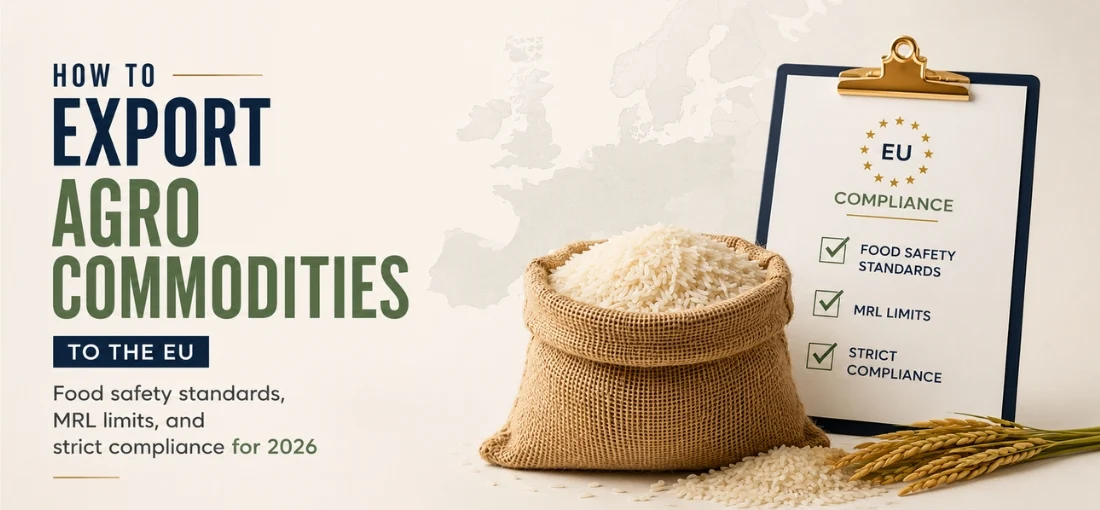
Success when Exporting Food Products to the European Union in 2026 requires a systemic approach to quality control. This process must begin right at the farm level long before the crop ever approaches a processing mill. Meeting EU Food Safety Standards for Agro Exports means understanding that the Union treats public health not as a variable commercial preference, but as a rigid legal mandate.

Let us break down the core components of the European regulatory framework, exploring how to build a compliance strategy that keeps your containers moving fluidly through customs.
Getting a Grip on Traceability
"Farm to Fork." That is the phrase behind the entire European system. Legally driven by General Food Law Regulation EC No 178/2002, the rule is simple on paper but incredibly tough on the ground. To get past the gate, your business has to trace every single ingredient back to its roots. An unbroken path from the specific field it grew in, through the processing floor, right to the container door.
This isn't just about keeping neat spreadsheets for an annual audit. Imagine an inspector at a massive terminal like Rotterdam deciding to run a random spot check. Right then and there, your paperwork has to show a bulletproof chain of custody. No delays allowed.
To pull this off seamlessly, milling and packaging setups must use distinct batch numbers for every single production shift. It is the only reliable way to isolate cargo if a problem pops up downstream. Mixing lots from different regional aggregators without logging the switch? That is just playing with fire. A single gap in that paperwork during a tight inspection window can lead to immediate customs holds or the shipment being turned away.
The Traceability Chain: Core Compliance Components
| Supply Chain Stage | Operational Requirement | Required Documentation | Key Compliance Risk |
|---|---|---|---|
| Farm Level | Log all agricultural practices, seed origins, and field locations. | Field books, chemical application logs, seed purchase invoices. | Unapproved pesticide drift or undocumented crop blending. |
| Processing Plant | Establish unique batch codes separating production shifts and raw material lots. | Milling records, batch allocation sheets, internal hazard analysis logs. | Cross-contamination of batches during large-scale runs. |
| Border Control | Present a clear, unbroken audit trail from the destination port back to origin. | Phytosanitary certificates, commercial invoices, independent lab assays. | Missing links in documentation causing immediate customs holds. |

Navigating Pesticides and the Rapid Alert System
Pesticide management is, hands down, the biggest tightrope walk for any team looking to move cargo into Europe. Let a single chemical trace cross the line, and custom officials will stop your containers. Under the active rules governing EU Pesticide Residue Regulations , a massive central database spells out the exact parts-per-million boundaries for every single crop line.
Worse yet, the goalposts shift constantly. When Brussels hasn't explicitly set a custom threshold for a specific molecule on your specific crop, a default safety net under EU MRL Limits 2026 often drops the tolerance down to a razor-thin 0.01 mg/kg . For all practical purposes, you are dealing with a limit so low it requires absolute precision. There is zero wiggle room.
One bad batch can put your whole seasonal operation through the ringer. Serious non-compliance can trigger a notification in the Rapid Alert System for Food and Feed (RASFF). RASFF is a high-speed information-sharing network used by member states to flag health risks. While it is an alert system rather than a formal "blacklist," landing in this network puts a major red flag on your operations across the entire European trading grid.
A RASFF alert typically leads to increased scrutiny and higher inspection frequencies at the border. Your cargo may sit on the docks for extended periods waiting for risk assessments and lab results, racking up demurrage fees and frustrating buyers who cannot afford empty retail shelves.
The MRL Residue Risk Sequence
| Stage | Process Metric | Trigger Condition | Operational Impact |
|---|---|---|---|
| 1. Field Application | Crop chemical monitoring | Use of unauthorized inputs or improper pre-harvest intervals. | Accumulation of banned active ingredients in the plant tissue. |
| 2. Border Laboratory | Random port sampling | Lab discovery of chemical residues exceeding the default 0.01 mg/kg limit. | Consignment may be detained, sampled, or rejected at entry. |
| 3. RASFF Activation | Public safety alerting | Official notification of serious risk shared across the EU network. | Increased control measures and heightened scrutiny for future exports. |
Taming the Natural Threats: Mycotoxins and Heavy Metals
Chemical sprays, though, are only half the battle. Natural toxins and biological contaminants are searched for just as aggressively by European food inspectors. For businesses handling bulk grains, tree nuts, or oilseeds, your largest operational risk comes from mycotoxins—specifically Aflatoxins and Ochratoxin A.
These toxic compounds are secondary metabolites produced by mold strains that thrive when storage moisture is ignored, or when cargo endures long ocean voyages inside humid shipping containers. The thresholds allowed by the EU are exceptionally low, often dropping down to single-digit micrograms per kilogram. To survive this filter, a strict post-harvest drying protocol must be implemented before anything goes into a bag.
Heavy metals like lead, cadmium, and arsenic undergo similar scrutiny, particularly for root vegetables, spices, and processed ingredients. Because plants pull these toxic metals directly from the ground, checking the background profile of your cultivation soil through independent testing remains a critical prerequisite for long-term European trade.
Setting Up a Total Compliance Plan
Hoping for the best at the harbor gate won't cut it. You can't just test a few samples at the point of loading and assume everything is fine. Compliance has to be built directly into the fabric of your everyday processing workflow.
| Step | Focus Area | Operational Protocol | Goal / Target Metric |
|---|---|---|---|
| 1 | Residue Profiling | Pre-audit farm logs directly against active EU chemicals criteria. | Identify and eliminate unauthorized chemical uses prior to harvest. |
| 2 | Facility Hazards | Enforce continuous HACCP guidelines directly on the processing floor. | Prevent physical and biological cross-contamination during packing. |
| 3 | Independent Assay | Route representative batch samples to accredited ISO 17025 laboratories. | Verify chemical and mycotoxin levels using mass spectrometry. |
| 4 | Document Logistics | Compile complete digital traceability files and necessary certificates. | Secure seamless customs clearance at the first European port of call. |
- HACCP Certification: Every processing facility handling cargo destined for Europe must operate under a fully functional, audited Hazard Analysis Critical Control Point (HACCP) system. This requires identifying physical, chemical, and biological risks at every node of your milling or packing line and establishing strict corrective actions for when a variance occurs.
- ISO 17025 Testing: It is important to note that you should not solely rely on basic internal laboratory lookups. Sample lots from each batch must be verified by an independent, third-party laboratory accredited to ISO 17025 standards before any vessel leaves your domestic ports. These labs utilize high-precision liquid chromatography and mass spectrometry to ensure your chemical footprint sits comfortably below European thresholds.
- Phytosanitary Certification: Most plant-based shipments require an official Phytosanitary Certificate issued by your country's national plant protection organization. This document verifies that the cargo has been officially inspected, found free from quarantine pests, and aligns with the specific health regulations of the importing EU member state according to their specific product categories.
Technical Verdict
The European market doesn't look at food safety as a flexible commercial preference. It is an absolute, non-negotiable threshold. The rules might feel unforgiving, but they also protect the integrity of the market for everyone involved.
By taking charge of your field logs, running real independent lab checks before loading, and keeping a hawkeye on storage moisture, you take the guesswork out of the logistics. The trade desks that treat these barriers as standard operational blueprints are the ones that keep their cargo moving and their partnerships steady.