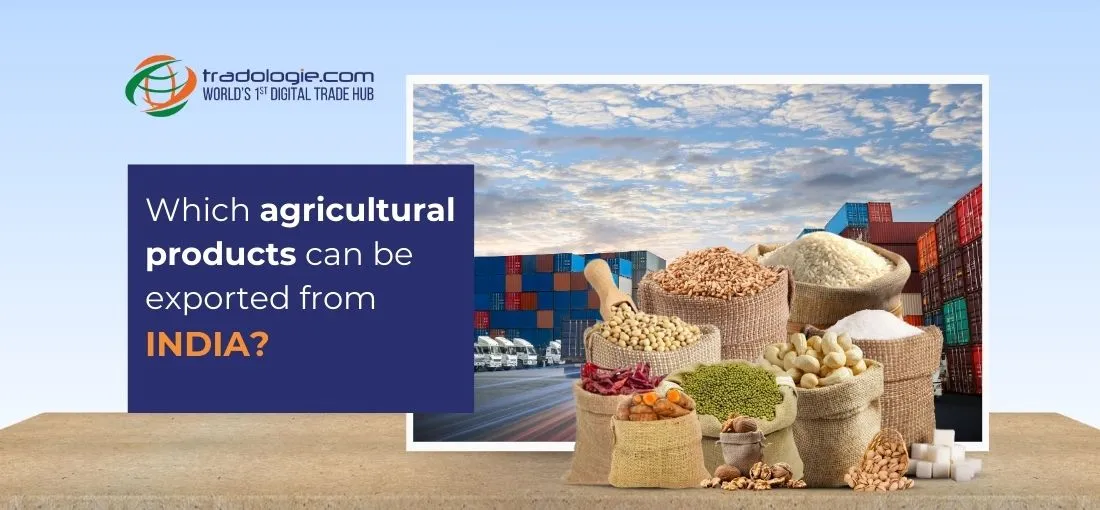
Which Agricultural Commodities Can Be Exported From India
India, because of the wide range of agroclimatic conditions, massive farmlands, and a rich & diverse agricultural legacy, contributes significantly to global food security and cross-border movement of agro-commodities.
India stands as one of the most prominent exporters of agricultural commodities such as rice, wheat, pulses, sugar, edible oil, spices, fruits, vegetables, and dairy products.

Let us examine India's agricultural export policies in the current geopolitical scenario, their effect on world markets, and how Tradologie.com, a B2B SaaS platform facilitating imports and exports of bulk agro-commodities, is transforming the cross-border movement of agro-commodities.
India’s Current Agricultural Export Landscape
India exported agro-commodities valued at more than $53 billion in the 2023-24 financial year, which showcases the nation’s resilience despite the global trade challenges. Here are the key commodities and the major export destinations for the staples.
1. Rice: India’s Staple For the World
India is the world’s largest rice exporter, accounting for 40% of global movement of rice. In 2023–2024, the exports of basmati rice rose by about 18%, with the USA, Europe, and the Middle East being the main markets. Non-basmati rice exports, however, have been affected by government restrictions on white rice to ensure domestic food security. The lifting of the restrictions led to a surge in global supply and a fall in rice pricing.
Key rice importers: UAE, Saudi Arabia, Iran, and African nations.
2. Wheat: Most in Demand but Prohibited
Wheat exports have been restricted from India since May 2022 due to domestic food security concerns. Government-approved shipments continue to select countries such as Bangladesh, Indonesia, and Sri Lanka. India remains one of the world's leading wheat producers, helping to ensure regional food supply stability.
3. Spices: Flavors from India
India is the largest exporter of spices and has witnessed its global sales surpassing $3.5 billion in 2023–24. The top exported spices include turmeric, cumin, chili, cardamom, and pepper.
Key Spice markets: USA, China, UAE, and Europe.
4. Pulses: Rising Global Demand
In 2023-24, India exported $2.5 billion worth of pulses, with rising demand from neighboring nation’s such as Bangladesh, Nepal, and Sri Lanka. India, as a major consumer and exporter, also imports pulses to help stabilize its domestic markets.
5. Sugar: Supply Constraints
India is a significant exporter of sugar, but due to reduced production, the government has restricted exports, allowing only a certain amount to be exported under a quota basis. Domestic policy actions caused a 20% decline in sugar exports when compared to 2023.
Key sugar importers: Indonesia, Bangladesh, and the Middle East.
6. Edible Oils: Imports Dominate, Exports Grow<
India is still a net importer of edible oils, but it is exporting more groundnut and mustard oil. The over $1 billion worth of edible oil exports have been fueled by demand in Asia and Africa.

7. Fruits & Vegetables: Fresh & Profitable
In 2023–2024, India had exported $1.2 billion worth of fresh fruits and vegetables. Bananas, pomegranates, mangoes, and grapes are the top fruits exported. Top vegetables exported include potatoes, okra, and onions.
Key fruit & vegetable markets: Gulf countries, Europe, Southeast Asia, and the USA.
8. Dairy Products: Growing Global Presence
In 2024, exports of dairy products, such as butter, ghee, and powdered skim milk, increased by 15%. Two important markets for Indian dairy products are still the Middle East and Southeast Asia.
9. Organic Products: Rising Health Awareness
Exports of organic foods, such as cereals, pulses, and spices, are expanding quickly. The United States and Europe were the top destinations for India's $1.5 billion worth of organic exports.
Tradologie.com: The Most Secure Way To Tap Into Global Agro-Commodities Marketplaces
Tradologie.com is transforming agricultural exports & imports by cutting out intermediaries and simplifying transactions between buyers and suppliers of agro-commodities globally. Here’s how:
Direct Verified Connections: Connects registered exporters with ready-to-purchase verified importers through a secure digital platform.
Competitive Pricing: Facilitates real-time price negotiation digitally, maintaining a fair price for both importers and exporters.
Quality Assurance: By facilitating third-party inspection by respectable organizations at ports and guaranteeing transparency in sourcing in a uniform manner in accordance with buyer specifications, the platform helps streamline bulk agro-commodities procurement.
Fast & Secure Transactions: The platform facilitates payments and documentation in accordance with internationally recognized financial channels, including telegraphic transfers, advance payments, and bank LCs.
For businesses looking to source high-quality Indian agro-products, Tradologie.com provides a seamless, efficient, and secure platform facilitating imports end-to-end.
India is well-positioned to expand its global agricultural footprint in the coming years. With India’s position as a global agricultural powerhouse remaining strong and exports exceeding $53 billion in 2023-24, there remains a major opportunity for exporters to tap into global marketplaces. Platforms like Tradologie.com are playing a pivotal role in enhancing trade efficiency and security by fostering direct, transparent, and cost-effective trade.