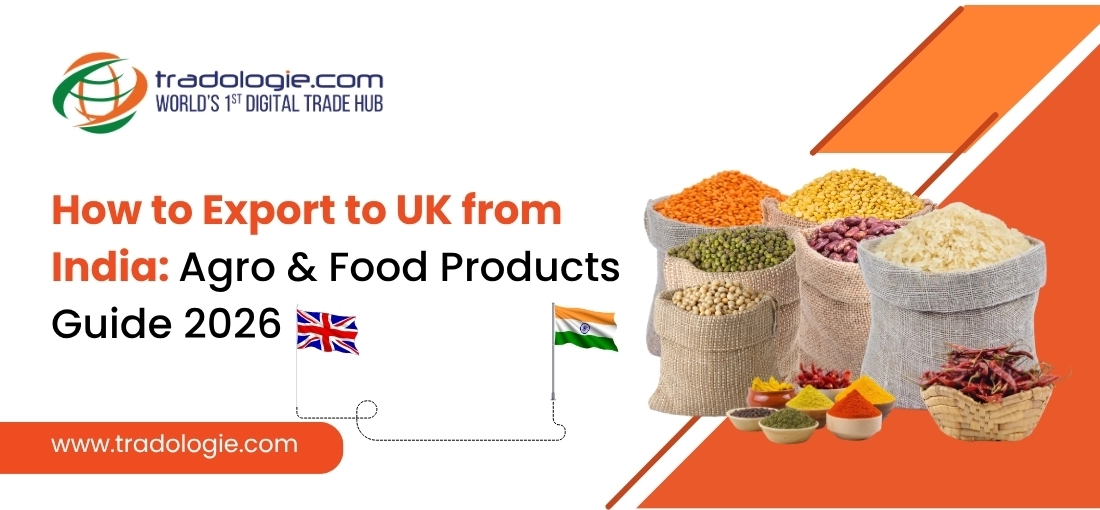
Global trade is changing fast. Indian food companies face new rules. If you want to know how to export to UK from India, selling bulk goods takes careful planning. You need to know the local laws. You also need good market knowledge.
India currently exports over USD 48 billion in FY 2024 (APEDA) in farm products to the world. At the same time, the UK buys a lot of food from other countries. The UK imports over USD 37 billion (total agricultural and food imports, per UK Department for Business and Trade data) globally. However, the UK has not bought very much from India in the past.
This gap gives you a huge chance to grow. You just need to understand the new UK border rules. You also need to prepare for new trade deals. Doing this will help you win large, profitable supply contracts.
1. The 2026 Market for India to UK food export
This year is a very important time for bulk farm trade. India and the UK signed a new trade deal in July 2025. This deal is called the Comprehensive Economic and Trade Agreement (CETA). Both countries are still approving it. We expect it to start working by mid-to-late 2026.
Once active, CETA is expected to completely change how we trade. It will open up the market in new ways. You will no longer just fight for small shelf spaces. Instead, you can win a large market share using tax-free trade routes.
To win in this new market, you must change your approach. Stop sending small, mixed shipments. Focus on building large, smart supply chains. Your goal is to sell directly to UK wholesale buyers. You should also target food factories and big grocery chains.
2. Decoding Post-Brexit Exports From India to the UK: The BTOM Framework
The BTOM was progressively implemented between April 2023 and October 2024, replacing the EU's SPS regime that previously governed UK food imports. As of 2026, all BTOM controls — including documentary, identity, and physical checks — are fully operational across all product risk categories.
The UK created the Border Target Operating Model (BTOM) after leaving the European Union. This system sets the health and safety rules for all imported goods. The Department for Environment, Food and Rural Affairs (DEFRA) manages these rules.
Your first big task is finding your product's risk level. The UK places all goods into different risk categories.
| Product Category | BTOM Risk Level & Inspection Type |
|---|---|
| Products of animal origin (dairy, marine, meat derivatives) | Medium Risk: 100% documentary + risk-based physical inspection |
| Fresh fruits and vegetables (non-regulated) | Low Risk: Simplified documentary checks |
| Ambient processed vegan goods | Low Risk: Frictionless customs corridor |
| Regulated plants and plant products | Medium-High Risk: Phytosanitary certificate + physical inspection |
| Organic certified produce | Low-Medium Risk: Organic certificate verification required |
3. UK Import Rules: Food Safety and Chemicals
For understanding UK import regulations, food is the foundation of a successful export business. The Food Standards Agency (FSA) watches over all incoming food. They work closely with DEFRA. Together, they are very strict about food safety.
Indian exporters must watch their chemical use very closely. The UK sets Maximum Residue Levels (MRLs). These limits control the tiny amounts of farm chemicals left on food. For example, they limit specific fungicides in basmati rice. They also limit growth chemicals in table grapes.
Your shipments must also pass strict bacteria tests. If your food fails these MRL tests, the UK Port Health Authorities will reject it right away. A rejected shipment causes huge money losses for a business.
4. UK Rules for Food Labels and Packaging
Getting your product into the UK is only the first step. You must also pack it legally for buyers. The UK has strict laws for protecting buyers and the environment. DEFRA and the FSA manage these packaging rules.
- Natasha's Law (Allergen Rules): All packed food needs a full list of ingredients. You must highlight all 14 major allergens. For instance, you must put them in bold text. This is an FSA rule.
- Extended Producer Responsibility (EPR): Importers must pay for the packaging waste they bring in. This is a DEFRA rule. Because of this tax, UK buyers like Indian suppliers who use green packaging. You should use bulk bags that easily break down or recycle.
- Required Details: Your outer bulk boxes must show clear facts. You must list the country of origin. You must state the exact weight or volume. You must also include tracking numbers required by the FSA.
5. Important Certificates for B2B Sales
Basic government papers will let your cargo leave India. However, private certificates are what actually make UK buyers trust you. Big UK grocery stores and food factories demand these extra checks.
- BRCGS (Brand Reputation Compliance Global Standards): This is the top standard for food safety in the UK. It shows you manage quality well.
- GlobalG.A.P.: You need this if you want to export fresh fruits and vegetables. It proves your farm uses safe and green practices.
- SMETA (Sedex Members Ethical Trade Audit): UK buyers care deeply about how workers are treated. SMETA checks prove you pay fair wages and offer safe working conditions.
6. Shipping, Cold Storage, and Sea Routes
Bulk farm trade relies heavily on safe transport. The main sea route starts at big Indian ports. You will likely ship from Nhava Sheva in Mumbai or Mundra in Gujarat. Your cargo will travel directly to UK ports like Felixstowe or London Gateway.
A normal sea trip takes about 24 to 30 days. Some foods go bad quickly, like frozen shrimp or fresh grapes. For these foods, keeping them cold the whole time is vital.
You must use special active cooling containers called reefers. These containers must have tools that track the temperature every minute. When your ship arrives, UK Port Health Authorities will check these temperature records. If the temperature changes too much during the trip, they will destroy the whole container.
7. Managing Money and Payment Risks
Selling bulk goods to other countries brings financial risks. You must set up safe ways to get paid. This is very important.
- Letter of Credit (LC): Always ask new buyers for an irrevocable LC. It must come from a trusted UK bank. This guarantees you get paid when you show the correct shipping papers.
- ECGC Insurance: Indian sellers should use the Export Credit Guarantee Corporation of India (ECGC). This insurance covers up to 90% of your risk. It protects you if the foreign buyer does not pay.
- Locking Exchange Rates: Supply contracts often last for a whole year. The value of the British Pound (GBP) and the Indian Rupee (INR) goes up and down. This can wipe out your profits. You should use your bank to lock in a good exchange rate early on.
- UK Import VAT and Buyer Costs: * UK buyers must pay a 20% Import VAT on most food types when it enters the country (per HMRC).
- UK businesses can get this money back later on their taxes. However, paying it upfront hurts their cash flow. It can lower how much they buy.
- You should think about this when setting payment rules. You can offer smaller first orders. You can also give them more time to pay. This helps the buyer and speeds up your first sale.
8. How the New CETA Deal Will Help Exporters
Note: CETA was signed in July 2025 and is currently pending ratification by both parliaments. The benefits below will apply once the agreement formally enters into force. Exporters should monitor www.gov.uk/government/collections/uk-india-trade-agreement for official ratification updates.
| Trade Mechanism | Pre-CETA Condition | Expected Post-Ratification Reality | Strategic Impact on Exporters |
|---|---|---|---|
| Import Duties | Up to 33% on select agri-goods | Will be zero duty on major tariff lines | Significantly higher profit margins. |
| Origin Rules | Complex third-party verification | Will allow self-certification of origin | Reduced administrative overhead. |
| Processed Foods | Heavy tariffs restricting volume | Will enable duty-free access | Enables scalable bulk export. |
Important — CETA Commodity Exclusions: The India-UK trade agreement does not extend tariff liberalisation to all agricultural categories. The following product groups are explicitly excluded and will continue under existing WTO Most Favoured Nation (MFN) tariff rates even after CETA enters into force: sugar, milled rice, pork, chicken, and eggs. Exporters in these categories should not factor CETA duty savings into their pricing or margin models.
9. High-Demand Categories for UK Agri Imports from India
The UK is a rich market looking for high-quality Indian farm goods. There are several product types that are growing very fast right now.
- Herbs and Spices: India is the top seller of raw and mixed spices to UK packing companies.
- Fruits and Vegetables: Premium Alphonso mangoes sell very well. Table grapes and dried onions also get high wholesale prices.
- Seafood: Frozen prawns and prepared fish are becoming more popular.
- Plant-Based Proteins: UK buyers are eating more vegan food. Because of this, bulk organic lentils and soy proteins are in huge demand.
10. Example: Selling Maharashtra Grapes to the UK
Let us look at a possible future story of a grape farmer in Nashik. This will show you how to use CETA once it is active. In the past, this farmer lost a lot of money to a 14% UK import tax. They also faced long waits at the border.
To win in the new market, the farmer will first get a GlobalG.A.P. certificate. This allows them to sell to top UK grocery stores. Next, they can use the new CETA rules to prove where their grapes grew. Doing this will completely remove the 14% tax.
To keep their money safe during shipping, they will buy ECGC insurance. They will also lock in their currency exchange rate with their bank. In the end, their grapes will enter the UK smoothly and tax-free through the BTOM system. This smart plan is projected to increase their total profit by 22% for every single container.
11. Strategic Step-by-Step Process to Export Food Products to the UK
- Get Your Basic Licenses: First, get an Importer-Exporter Code (IEC) from the DGFT. Then, register with APEDA to get your RCMC paper.
- Get Health Certificates (EHC): Are you selling animal products or strict plant goods? If yes, you must get an EHC from the right Indian office.
- Test Your Products: Hire approved labs to test your food samples. They must check for MRLs, heavy metals, and bad bacteria. Make sure you pass all FSA rules.
- Find the Exact UK Tariff (HS) Code:
- The UK uses an 8-digit code for your goods. This code decides your tax rate, VAT, and border checks.
- Guessing the wrong code is risky. A small mistake can increase your taxes by 10% or more.
- You must check your code on the UK Government site: trade-tariff.service.gov.uk. Do this before you file shipping papers or talk to your freight team.
- Wrong codes cause most of the UK border delays for Indian food. Always check the code for every new product.
- Finish Your Customs Papers: Make sure your UK shipping agent files the right entry papers. They must use the UK Customs Declaration Service (CDS).
- Check Your UK Buyer's EORI Number:
- Your UK buyer must have an Economic Operators Registration and Identification (EORI) number. The UK tax office (HMRC) gives them this number.
- If they do not have it, the UK border computers cannot process your shipment. Your cargo will sit stuck at the port, even if your Indian papers are perfect.
- Check their EORI status before you agree to the sale. Do not wait until the ship leaves.
- Buyers can get this number easily at gov.uk/eori.
- Get Ready for CETA Rules: When CETA finally starts, you will be able to self-certify where your food comes from. This gets you lower taxes. Start organizing your farm records now. Then, you can use these benefits on day one.