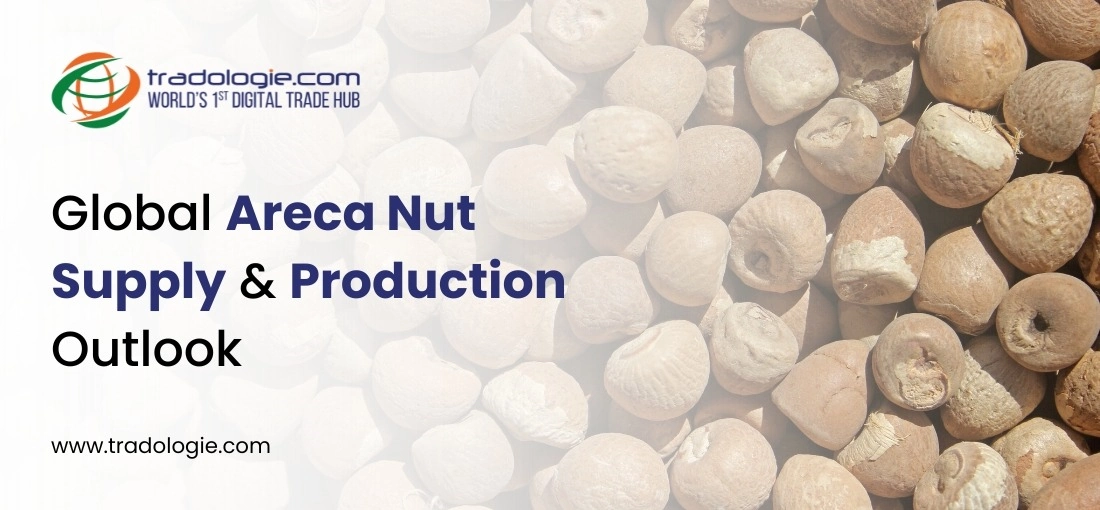
Global Areca Nut Supply & Production Outlook
Key Highlights
- Areca nut demand doesn't really swing with trends. It moves on habit. People buy it daily, almost automatically, which means bulk Areca nut exporters deal with repeat orders rather than unpredictable spikes.
- Most of the world's supply still comes from the same belt — India and its neighbors. So a weak monsoon or a slow harvest there shows up in prices everywhere else, sooner or later.
- India sets the benchmark. Nearly half the crop, most of the processing, and the variety buyers recognize first. When Indian supply tightens or expands, the whole market adjusts around it.
- Chali grades travel better. Longer shelf life, fewer storage headaches, less wastage in transit — simple logistics advantages that quietly make them the default choice for bulk shipments.
- On paper the category looks small inside the global food trade, but in reality it's sticky. Traditional use, local habits, and limited substitutes keep volumes steady year after year.
- Add slow but steady demand from Middle East and diaspora markets, and the picture becomes clear: not a flashy market, just a dependable one — the kind traders prefer when margins matter.
Introduction:
Most agricultural commodities earn their place in global trade through scale or versatility. Areca nut does it differently. It travels on habit.
For millions of consumers across South and Southeast Asia, it isn't a seasonal indulgence or a premium snack. It's routine — folded into daily chewing, cultural rituals, small retail packets, and local trade cycles. And when a product becomes routine, demand stops fluctuating and starts repeating. For suppliers and bulk Areca Nut exporters, that kind of predictability is gold.
Today, what once looked like a regional crop is quietly shaping into a structured trade opportunity.
From a trade perspective, the trajectory is fairly straightforward. The market sits near USD 1.0 billion in the mid-term, with expectations that it may approach USD 2.1 billion over the next decade. The growth isn’t speculative; it’s gradual and repeatable — exactly the pattern bulk commodity traders prefer.
And in bulk agricultural trade, steady usually wins.
Supply Still Begins in the Same Geography — and That Matters
Unlike globally diversified crops like almonds or coffee, areca remains geographically anchored. Production isn't scattered across continents. It's concentrated, and deeply so.
India alone accounts for over 45% of total production and domestic consumption, with cultivation clustered in Karnataka, Kerala, and Assam. Add Bangladesh, Myanmar, and Indonesia, and you’re already looking at the majority of the world’s supply.
That concentration shapes the market's behavior.
- Weather patterns in South Asia directly influence global availability
- Regional harvest cycles dictate export timing
- Pricing tends to follow crop health rather than speculation
- Buyers watch origin risk almost as closely as quality
In short, areca isn't a commodity you source anywhere. It's a crop you source where it grows best.
Demand Isn't Fashionable — It's Habitual
There's a quiet advantage to products tied to daily consumption rather than trends. They don't boom. They don't crash. They simply keep moving.
Across India, Bangladesh, and neighboring markets, areca nut consumption is culturally embedded. It shows up in small retail counters, neighborhood shops, weddings, and everyday routines. It's less “food product” and more “social staple.”
In volume terms, India, Bangladesh, Myanmar, and Indonesia together account for more than 70% of global consumption.
That's not discretionary buying. That's structural demand.
- Regular, repeat purchases drive stable trade cycles
- Consumption remains resilient even during price swings
- Retail channels absorb large volumes consistently
- Bulk Areca Nut exporters benefit from predictable offtake
For bulk traders, this kind of demand is easier to plan around than volatile specialty markets.
India Sets the Tone — in Production and in Variety
Every commodity has an origin that defines benchmarks. For areca, that's India.
The Indian variety alone holds roughly 75% market share, supported by quality perception, strong domestic consumption, and established processing networks. Within that, Chali areca nuts dominate with nearly 70% share, largely because of their longer shelf life and easier storage.
This isn't a small detail. It's logistics.
Longer shelf life means:
- Lower storage risk
- Easier international shipping
- Reduced spoilage losses
- More reliable inventory management
In bulk trade, shelf stability often decides which variant travels farther. Chali's dominance isn't just preference. It's practical.
Where the Market Fits in the Bigger Food Economy
If you look purely at global food numbers, areca might seem tiny. It represents only about 0.5% of total food and beverage value, and roughly 1.2% of the broader agricultural commodities market.
On paper, that looks niche.
But that's the wrong way to read it.
Areca behaves more like a specialty industrial crop — small in percentage terms, yet critical within its ecosystem. In traditional medicine and herbal products, its share climbs closer to 2.5%, and in the natural stimulants segment it reaches over 4%.
Those segments aren't mass-market. They're loyal-market.
- Demand tends to be sticky
- Substitution is limited
- Cultural preference outweighs price shifts
- Consumption patterns persist for decades
And sticky demand is exactly what B2B bulk Areca Nut suppliers prefer.
New Regions, Quiet Growth
While South Asia still anchors the trade, fresh pockets of demand are emerging.
Ethnic markets in the Middle East and North Africa, along with diaspora communities in Europe, are steadily increasing imports. It's not headline-grabbing growth, but it's consistent.
These are smaller, higher-margin markets that often rely on imported supply rather than domestic production.
- Rising ethnic retail channels
- Small but premium export lots
- Stable year-round procurement
- Less competition than core Asian markets
For bulk Areca Nut exporters, these corridors add diversification without replacing the core.
Regulation, Risk, and Reality
No outlook is complete without acknowledging the regulatory conversation around areca's health effects. Several countries have debated restrictions or labeling requirements tied to excessive consumption.
Yet, despite scrutiny, demand hasn't meaningfully collapsed.
Cultural habits tend to outlast policy discussions. In many producing regions, areca farming remains an important rural livelihood, prompting governments to support cultivation through infrastructure and extension programs.
So the trade moves forward — cautiously, but steadily.
- Policy risk exists but hasn't disrupted supply chains
- Farming support continues at regional levels
- Domestic consumption provides a strong safety net
- Export markets adapt rather than disappear
In practical terms, it's evolution, not contraction.
What the Numbers Suggest for Traders
Put all the pieces together — concentrated supply, habitual demand, steady CAGR near 8%, and rising regional diversification — and the picture isn't speculative. It's methodical.
The market isn't racing. It's accumulating.
Which, in commodities, is often better.
- Long-term contracts make sense
- Storage-friendly variants reduce risk
- Core Asian demand ensures baseline offtake
- Emerging markets add incremental upside
Areca nuts won't suddenly become glamorous. It doesn't need to.
It's simply becoming more organized, more visible, and more tradable at scale.
And for bulk areca nut suppliers who prefer dependable margins over dramatic cycles, that's exactly the kind of opportunity worth watching.