Key Highlights
- A CHA, bank and Tradologie can simplify the export process.
- Exporters still need the required registrations and compliance.
- IEC, FSSAI, APEDA and GST may apply depending on the product.
- A CHA helps with customs clearance and export documentation.
- Banks support payment mechanisms such as Letters of Credit.
- Tradologie connects exporters with verified buyer requirements.
- Live negotiations allow exporters to compete directly on price.
- Successful exports still depend on quality, compliance and fulfilment.
Introduction:
There is a common perception that if you want to export agricultural products and commodities like rice, sugar, wheat, pulses, dry fruits, edible oil etc., then you need a large organisation, an overseas sales team, expensive business trips and a long list of people working behind the scenes.
It can certainly become that complicated as an export business grows in rare case. But getting started does not necessarily require all of it.
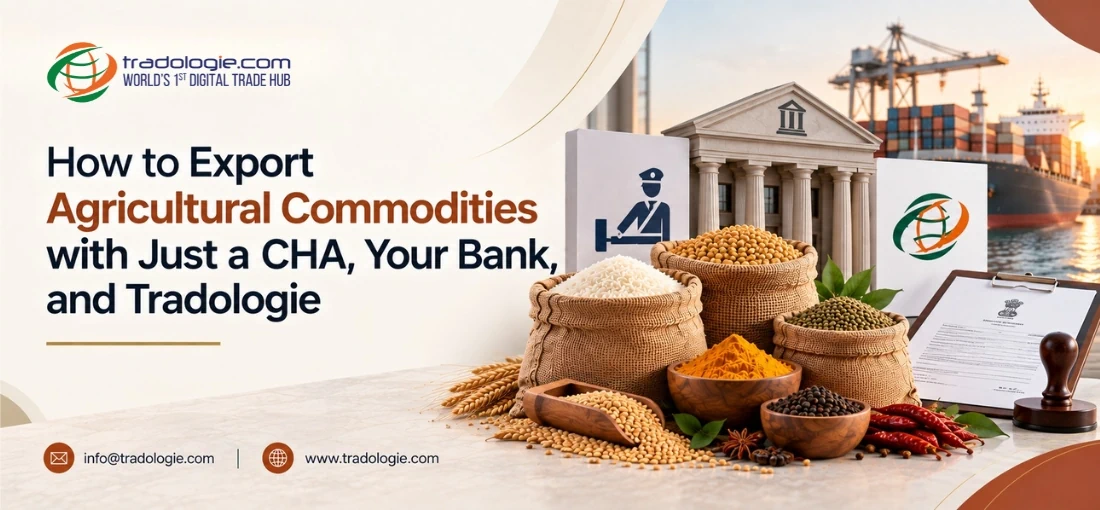
For an Indian business looking to start export business, three pieces of the puzzle can make the process considerably more manageable: a Customs House Agent (CHA), your bank and a platform that can connect you with genuine international buyers.
The CHA helps you navigate customs and documentation. Your bank becomes an important part of the payment and trade-finance mechanism, particularly when the transaction is structured through a Letter of Credit. And a platform such as Tradologie can address perhaps the most difficult part of the equation — finding a serious overseas buyer and getting the order.
That does not mean these three elements replace the registrations and compliance required to export. They make the export process easier to execute once those fundamentals are in place.
Keep reading this informative piece of blog as it will tell you how to export food products with just a CHA, bank, and Tradologie.

How to export agricultural products: start with the right registrations
Before thinking about the shipment, the first requirement is to make sure the business is legally ready to export.
An Indian exporter generally needs an Importer Exporter Code (IEC) from DGFT. If the commodity is a food product, the appropriate FSSAI licence is important, while agricultural and processed-food products falling under APEDA's scheduled categories may require APEDA registration/RCMC. GST, banking arrangements and any commodity- or destination-specific certifications also need to be considered.
Tradologie's current exporter requirements similarly identify IEC, GST, business registration, FSSAI for food products, APEDA registration for agro exports and banking requirements among the basic prerequisites for sellers.
So the first lesson for anyone looking at an agricultural commodity export is quite simple: a platform can help you find the buyer, but it does not remove your responsibility to be a compliant exporter.
Once that foundation is ready, the process becomes much more straightforward.
The CHA: the person who helps move your shipment through customs
This is where a Customs House Agent — now formally referred to as a Customs Broker — becomes extremely useful.
A CHA is not merely somebody who fills out a few forms at the port. A licensed Customs Broker acts as an intermediary between the exporter and Customs and assists with the customs-clearance process, documentation and coordination required for the shipment.
For someone learning how to start agricultural exports from India , this can remove a considerable amount of operational complexity.
In practical terms, your CHA can help coordinate the documentation and customs-clearance side of the shipment, communicate with Customs authorities, assist with filing and clearance procedures and coordinate with other parties involved in moving the cargo.
They can also help you connect with logistics providers such as freight forwarders and transporters, depending on the arrangement you have with the broker and your broader logistics setup.
That is particularly useful for a first-time exporter learning to start export business.
You may understand your commodity very well. You may know exactly how much rice, wheat, pulses or spices you want to sell. But customs procedures, port documentation and shipping coordination are a different area altogether.
There is no need to learn every operational detail yourself before making your first shipment.
You do, however, need to understand what your CHA is doing on your behalf.
Your bank: where payment security becomes important
The second part of this combination is the bank.
International trade naturally creates a question that both buyer and seller have to answer:
How does the seller know that the buyer will pay, and how does the buyer know that the seller will actually fulfil the transaction?
One of the established mechanisms used in international trade is the Letter of Credit (LC).
In an LC transaction, the buyer's bank issues the credit in favour of the exporter, subject to the terms and conditions stated in the LC. The exporter then presents the stipulated documents, and payment is made by the bank when the documentary conditions of the credit have been complied with.
In simple terms, the bank becomes an important part of the payment-security structure.
If the exporter fulfils the LC's documentary requirements and the goods are shipped in accordance with the agreed terms, the bank processes payment according to the LC. It is not quite accurate to think of this as the bank simply promising to pay under every circumstance; the protection depends on the specific LC terms, documentary compliance and the banks involved.
That distinction matters.
An exporter should always read the LC carefully and make sure the shipping and documentation requirements can actually be met.
This is one reason banks and experienced trade professionals become so important in an agricultural export process in India.
The bank is not merely where the export proceeds eventually arrive. Depending on the transaction structure, it can be part of the payment mechanism that gives both sides greater confidence in a cross-border transaction.

The third piece is the one exporters often struggle with most: the buyer
This is where the commercial reality come if you want to export food products
Getting an IEC is a process.
Obtaining an FSSAI licence is a process.
Completing APEDA registration, where applicable, is a process.
Finding a buyer who is genuinely ready to purchase your commodity is a different matter altogether.
This is often the hardest part of how to export agricultural commodities .A supplier can have tonnes of rice sitting in a warehouse and still have no export business if there is no buyer willing to purchase it at a commercially viable price.
Traditionally, exporters have addressed this through overseas travel, trade fairs, agents, cold calling, email campaigns and foreign sales teams. Those methods can work, but they can also be expensive and time-consuming, particularly for a new exporter. This is where Tradologie comes into the picture.
Tradologie connects exporters with verified global buyers
Tradologie is designed around a different starting point: instead of asking an exporter to hunt for buyers first, it provides access to buyer requirements that match the commodities registered by the exporter.
Tradologie currently states that its platform gives verified sellers access to more than 1 million verified global buyers , with AI-matched requirements based on the products and export capabilities listed by the seller.
That is an important distinction.
You do not receive random enquiries for products you cannot supply. The requirements are matched to the commodities you have registered.
If you deal in rice, you can pursue relevant rice requirements. If you also have the capacity to export pulses, spices or other agricultural commodities, those categories can become part of your buyer-matching profile.
The platform describes these as actionable buyer requirements, giving exporters the opportunity to select requirements they can actually fulfil.
And that is where the process moves from simply displaying your product to actually pursuing an order.
Live negotiation turns a buyer requirement into a commercial opportunity
Once a relevant requirement appears, the exporter can decide whether the order makes sense.
The requirement can contain details such as quantity, product specifications, quality parameters, delivery location and payment terms. Buyers can also specify inspection requirements and other conditions.
If you can meet those conditions, you participate in the live negotiation.
You quote your best competitive price and negotiate directly through the platform. Tradologie says exporters can also see competing pricing during live negotiations and respond with their own quotations or counteroffers.
This makes the process considerably different from receiving a random lead.
You are not calling somebody who may or may not be interested.
You are looking at a defined purchasing requirement and deciding whether you can compete for it.
The buyer, meanwhile, can compare the offers and evaluate the supplier's profile and portfolio through the exporter microsite.
If the buyer finds the commercial offer suitable and is satisfied with the supplier's profile, the transaction can move towards an order or Letter of Intent.
The bank, the CHA and Tradologie each solve a different problem
This is where the three-part combination makes sense and works together as a perfect combination.
Tradologie helps you find the commercial opportunity.
Your bank helps structure the payment mechanism.
Your CHA helps execute the customs-clearance side of the shipment.
None of the three replaces the others.
| Export Stage | Responsible Party |
|---|---|
| Export Need | Exporter |
| Who Helps | Tradologie |
| Find Buyers & Negotiate | Tradologie |
| Payment Mechanism | Bank |
| Customs & Documentation | CHA |
| Product & Export Compliance | Exporter |
Imagine an exporter has a buyer requirement for a container of rice. Tradologie provides the opportunity to negotiate with that buyer. Once the commercial terms are agreed, the payment structure can be formalised. If an LC is selected, the relevant banks establish the documentary payment mechanism. The exporter then prepares the goods according to the agreed specification, while the CHA helps with the customs documentation and clearance process.
The freight forwarder and logistics partners then help move the cargo towards the destination.
Suddenly, what initially looks like a complicated international transaction becomes a sequence of manageable responsibilities.
That is the real advantage.
Why this combination works particularly well for new exporters
Someone trying to export agricultural products from India does not necessarily need to build a large international organisation on day one.
You need a compliant business.
You need a reliable product supply.
You need a bank that can support your trade transaction.
You need a competent Customs Broker who understands the shipment and can manage the customs side properly.
And, perhaps most importantly, you need access to serious buyers.
That last part is where Tradologie's model is particularly relevant. The platform describes itself as a transaction-oriented system rather than a conventional lead-generation portal, with verified buyer requirements, live negotiations and transaction facilitation.
For a new exporter, that can change the economics of getting into international trade.
Instead of spending heavily simply to discover who might buy your product, you can spend your energy on responding to requirements that are already in the market.
That does not guarantee that every quotation will turn into an order. Buyers still compare price, quality, specifications, supplier credibility and delivery capability. Tradologie itself notes that a seller's competitiveness, portfolio and participation in negotiations influence the ability to convert requirements into confirmed orders.
And that is how it should be.
A platform can bring the opportunity to you.
The exporter still has to win the business.
The practical roadmap for agricultural exports
For anyone looking at how to start agricultural exports from India, the journey can therefore be thought of in three stages.
First, become export-ready. Get the IEC, FSSAI licence where applicable, APEDA registration where applicable, GST and banking arrangements, and any other product- or destination-specific certifications.
Second, build the transaction team. Have a reliable CHA or Customs Broker to assist with customs clearance and documentation, a bank capable of handling international trade transactions and appropriate logistics partners for moving the goods.
Third, find the order. This is where Tradologie can provide the commercial connection to verified global buyers. Register your products, receive relevant AI-matched import requirements, participate in live negotiations, quote competitively and work towards securing the order.
Once the order is secured, the rest of the process becomes execution: finalise the contracts and payment terms, prepare the goods, complete inspection and documentation requirements, clear customs, dispatch the shipment and receive payment according to the agreed mechanism.
That is a much more practical way of looking at agricultural commodity export.
It is not about trying to do everything yourself.
It is about putting the right pieces together.
The CHA handles the customs side.
The bank provides the financial and payment framework.
And Tradologie helps bring the buyer and the exporter together.
For someone looking to export agricultural products from India, that combination can provide a much more manageable starting point than trying to build an overseas sales operation, customs department and international trade-finance function all at once.
Because ultimately, agricultural exports are not difficult because one person cannot do every task.
They become difficult when the tasks are not connected.
Conclusion:
Finally, Tradologie, your bank and CHA are the perfect combination to start an agricultural export business. Tradologie provides you with verified ready-to-purchase buyers. Your bank takes the guarantee of your payment through a letter of credit and a CHA handles the custom clearances process. This smooth and seamless process is important for new exporters who aren't very familiar with the export process and want to embark on a successful export journey.
If you want to export or import agricultural commodities in bulk, register as a buyer or seller on Tradologie today.

-distributorship-in-india.webp "How to Get HUL (Hindustan Unilever) Distributorship in India (Food Division)")
.webp "Perishable vs Non-Perishable Agro Products in B2B Bulk Trade")