Key Highlights
- Global agriculture market projected to reach $17.89 trillion by 2030 (6.6% CAGR)
- Direct buyers = higher margins, better pricing control, and long-term contracts
- Eliminating middlemen improves transparency, payment security, and profit retention
- Best buyers include importers, food processors, and HORECA chains
- B2B platforms provide access to verified, purchase-ready buyers (RFQ-based system)
- Success depends on product-market fit, certifications, and technical specifications
- Long-term profits come from repeat orders and strong buyer relationships
The 2026 trade landscape has moved past the era where basic market access was enough to sustain a business. Today, the primary challenge for most exporters is the sheer volume of "noise" in the system—unverified inquiries and ghost leads that consume operational resources without delivering a return. Mastering how to find direct buyers for export business has become a prerequisite for those looking to move beyond a local footprint and into a sustainable international presence. The global agriculture market size has reached $12974.17 billion in 2025. It is expected to grow to $17896.95 billion in 2030 at a compound annual growth rate (CAGR) of 6.6% according to The Business Research Company.
The structural weight of layered commissions often creates a glass ceiling for growth. When intermediaries hold the exclusive keys to the client relationship, the producer remains one step removed from the critical feedback loops that drive product innovation. Shifting toward a direct B2B model is a move toward commercial clarity. This path enables a tighter synchronization with the factory floor, ensuring technical specifications and quality benchmarks remain intact without the typical information loss seen in tiered supply chains.
This guide breaks down the transition from reactive selling to a proactive, data-centric strategy for securing a high-caliber buyer network.
Defining the Direct Buyer Network
Establishing a foundational understanding of the "direct buyer" is the first step in moving from a transactional mindset to a structural trade strategy. In the agro-export sector, a direct buyer is any entity that takes title to your product for industrial use, large-scale resale, or consumption—effectively removing the "friction" of third-party middleman.

Core Categories of the Direct Network
- Industrial Importers & Wholesalers: These merchant importers and food organizations manage distribution at a national level. They differ from brokers because they purchase inventory outright to fuel their own retail networks, re-export chains or food processing needs.
- Food Processing Units: These are merchant importers, manufacturers utilizing agro-commodities as raw materials and even millers. These agro buyers value technical repeatability and a steady bulk supply far more than a fluctuating spot-market price.
- HORECA Groups: This covers the procurement needs of the Hotel, Restaurant, and Catering sectors. These are high-velocity buyers that require predictable volume to keep their own operations running without interruption.
For those evaluating how to get bulk buyers for agriculture products, the structural distinction between a buyer and an agent is paramount. Agents provide market access for a commission, but the direct buyer owns the goods.
This is the bedrock of agro-exports. Dealing directly to a large extent with the end-purchaser eliminates the "information loss" inherent in tiered supply chains. It allows you to lock in the technical specifications and recurring bulk contracts that define a resilient international trade operation.
| Factor | Middlemen / Unknown Buyers | Genuine Direct Buyers |
|---|---|---|
| Pricing Power | Fixed by third-party commissions | Transparent and negotiated directly |
| Contract Nature | Ad-hoc, unpredictable spot deals | Long-term, high-volume recurring orders |
| Information Flow | Filtered and often opaque | Direct feedback from the factory floor |
| Payment Security | High risk of defaults and delays | Standardized L/C and verified credit lines |
| Margin Retention | Diluted by layered trade fees | Maximized through unencumbered trade |
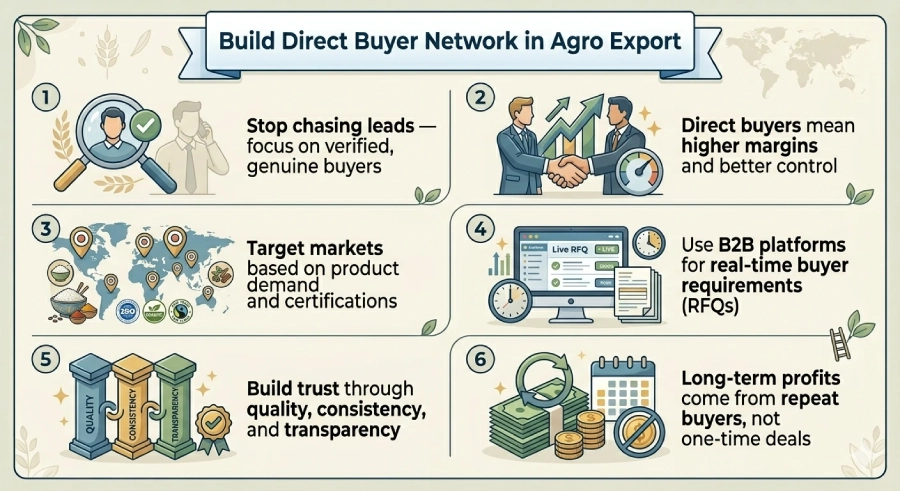
The Strategic Roadmap: Building Your Direct Network
Moving from a reactive sales model to a proactive, direct-to-buyer network requires a shift in how you allocate your business development resources. It is not about the quantity of leads, but the caliber of the connection. Below is the technical framework for identifying and securing high-value international relationships.

Step 1: Identify the Right Target Markets
The foundation of a direct network isn't built on broad global searches; it’s built on surgical country selection. One of the best ways to find international buyers for export success is to stop chasing every lead and start analyzing where your product fits the actual industrial deficit. You aren't just looking for "a country that eats rice," but a market where the local processing capacity is outstripping their domestic harvest.
Market selection is essentially a technical audit of three core areas:
- The Production Gap: Look for corridors where consumption is rising but local output is stagnant. These are the regions where buyers are desperate for supply-chain stability rather than just a low spot price.
- Certification Alignment: Focus on countries where your current paperwork—whether that’s ISO, HACCP, or specific organic labels—is already the gold standard. This removes the "regulatory friction" that usually kills a deal before it even starts.
- Technical Specifications: Leverage your technical specs. If your inventory has a specific edge—maybe high oil content or a precise grain length—you should be talking to the manufacturing hubs that need those exact benchmarks for their factory lines. There is no point in marketing a premium, high-spec commodity to a mass-market wholesaler who only cares about the lowest price.
Focusing on two or three high-potential corridors allows you to adapt your documentation to the local trade pulse. It’s a level of precision that signals professional intent. A generic, mass-mailed proposal can’t compete with that. When you speak the specific language of a buyer's industrial requirement, you aren't just a vendor anymore; you're a strategic partner.
Step 2: Prepare an Export-Ready Business Profile
Your profile is the digital equivalent of a factory visit. In the search for how to get bulk buyers for agriculture products, the "introductory email" is usually where potential deals go to die because it lacks the technical depth a high-volume importer requires. A genuine bulk buyer isn't looking for a sales pitch; they are looking for a risk assessment.
Your profile needs to lead with high-spec clarity:
- Verified Certifications: Don't just list them. But, highlight the specific standards like ISO 22000, HACCP, or APEDA-benchmarked facilities that guarantee your product won't be rejected at a foreign port. For a bulk buyer, compliance is more important than price.
- Technical Product Specs: Move past "A-Grade" descriptions. Include moisture levels, purity percentages, and harvest cycles. If you're dealing in commodities, the buyer needs to know if your stock can integrate into their existing processing lines without a hitch.
- Operational Transparency: Clearly outline your production capacity and lead times. A bulk buyer needs to know you can handle a ten-container order just as easily as a single trial shipment.
- Pricing Framework: You don't need to give a final quote, but providing a transparent pricing structure—including your FOB or CIF terms—signals that you understand the mechanics of international trade.
When you present a profile that answers the "boring" logistical questions upfront, you immediately distinguish yourself from the thousands of amateur exporters flooding their inboxes. You aren't just selling a product; you are proving you have the infrastructure to deliver it.
Step 3: Use B2B Platforms to Access Verified Buyers
The traditional "cold call" approach is largely obsolete in 2026. One of the best ways to find international buyers for export success today is to leverage B2B ecosystems that do the heavy lifting of verification for you. High-volume trade requires a digital environment where the "intent to buy" is already established before you even initiate contact.
Platforms like Tradologie have changed the mechanics of this search by focusing on risk reduction:
- Access to "Purchase-Ready" Buyers: Instead of chasing leads that might never materialize, these platforms give you a direct line to importers who have already been vetted for financial stability.
- The RFQ (Request for Quote) System: By using structured RFQ systems, you can see the exact technical specs and volume requirements of global buyers in real-time.
- Neutral Negotiation Environments: These platforms facilitate live bidding and transparent price discovery, ensuring fair competition.
Step 4: Learn How to Contact Importers Directly
The focus shifts to engagement once you’ve identified your target market. It’s less about pitching and more about demonstrating reliability.
- Direct Negotiation on Tradologie: Engage in live negotiations to bypass initial vetting phases.
- "Zero-Fluff" Email Outreach: Use precise subject lines like: Supply Inquiry: [Product] - [Moisture %] - [Origin].
- Leveraging Importer Databases: Use customs data and directories to target active importers.
- LinkedIn for Relationship Mapping: Reach decision-makers like procurement heads with personalized messages.
Personalization is key. Generic messages will be ignored.
Step 5: Participate in Trade Shows & Virtual Events
Trade shows remain a powerful way to secure bulk buyers and build trust through physical product interaction.
- Physical Exhibitions: Events like Gulfood or Anuga are where large contracts are finalized.
- Global Listing Platforms: Maintain visibility on platforms like Alibaba, Global Sources, or Indiamart.
- Government-Supported Delegations: Participate in events organized by APEDA or Ministry of Commerce.
Step 6: Build Long-Term Buyer Relationships
Long-term success in export depends on maintaining strong relationships and consistent supply.
- Consistency Without Compromise: Maintain uniform product quality across shipments.
- Trust Through Transparency: Communicate delays or issues proactively.
- Intelligence Over Sales: Provide market insights and updates to buyers.
- The Follow-Through: Stay connected even after delivery.
Best Ways To Find International Buyers
A multi-channel approach works best, combining digital platforms with traditional trade methods.
- B2B Trade Ecosystems: Platforms like Tradologie help connect with verified buyers.
- Trade Exhibitions: Events like Gulfood enable direct deals.
- Export Promotion Councils: Use APEDA and Chambers of Commerce for verified leads.
- Direct Industrial Outreach: Target specific companies using LinkedIn and trade data.
- Trade Referrals: Use satisfied buyers to expand into new markets.
Common Mistakes To Avoid
Building a profitable trade desk is as much about what you reject as what you pursue. When researching how to find genuine buyers for export business, many exporters fall into the trap of "volume bias"—treating every WhatsApp inquiry as a viable lead.
Trusting an unverified buyer without a background check on their previous shipment history is the fastest way to lose both your inventory and your working capital.
Beyond the risk of fraud, internal operational lapses often kill the deal:
- The Documentation Gap: Sending a generic, incomplete proforma invoice or missing a specific laboratory certificate signals amateurism. A serious importer won't risk a port rejection because of your paperwork.
- Communication Friction: Slow response times or vague answers regarding harvest cycles suggest a lack of operational control.
- Pricing Naivety: Quoting a flat rate without accounting for fluctuating freight or currency risks often leads to margin loss midway through the contract.
Ignoring follow-ups is the final mistake. Most high-volume contracts aren't signed on the first email; they are secured through consistent and professional persistence.
How To Build Long-Term Export Clients
The real profit in exporting isn’t in the first container; it’s in the "replenishment cycle." Understanding how to build long-term export clients is what separates a stable trade house from a speculative one.
In the 2026 market, buyers aren't just purchasing a commodity—they are purchasing certainty that their supply chain won't collapse.
The foundation of long-term relationships rests on four key pillars:
- Radical Consistency: Your tenth shipment must match the first in quality, packaging, and specifications.
- Operational Transparency: Inform buyers early about delays or issues and provide alternative solutions.
- Pricing Integrity: Avoid opportunistic pricing. Stick to agreed terms to build trust and secure long-term contracts.
- Proactive Engagement: Share market insights, crop cycles, and policy updates to position yourself as a partner, not just a vendor.
When you prioritize your buyer’s business stability, you naturally outperform competitors who only compete on price.
Conclusion
Transitioning into a successful international exporter in 2026 requires moving beyond the "hit-and-run" transactional mindset. By mastering the technical framework of how to find and secure direct buyers, you shift the power dynamic in your favor.
Whether you are leveraging automated RFQ systems of B2B ecosystems or closing high-value contracts at global trade exhibitions, the goal remains the same: building a supply chain rooted in transparency and technical consistency.
Consistency is the ultimate currency. When you combine precise market selection with a client-first retention strategy, you don’t just find buyers—you build a resilient trade business that thrives regardless of market volatility.
The roadmap is clear: stop chasing leads and start building partnerships.
Disclaimer
The information provided in this article is based on industry insights, trade data, and general export practices. Market conditions, buyer behavior, and export regulations may vary depending on country-specific requirements.
Readers are advised to conduct due diligence and verify buyer credibility before entering into trade agreements.