.webp "Guar Gum Export from India")
Key Highlights
- India exported 453,612 MT of guar gum during FY24
- Guar gum exports generated approximately USD 568.96 million in FY24.
- India is the world's leading producer and exporter of guar gum.
- Rajasthan is the largest guar-producing state in India.
- Global guar gum market reached approximately USD 785.2 million in 2025.
- Around 90% of exported industrial-grade guar gum is used in oil and gas drilling applications.
- Food, pharmaceutical, textile, paper, and energy industries are major consumers.
- Pharmaceutical-grade guar gum commands the highest export value.
Introduction:
International industrial buying desks place an immense commercial value on high-performance, plant-derived hydrocolloids. When it comes to managing viscosity, binding water, or stabilizing multi-phase solutions under extreme processing environments, few natural elements match the sheer versatility of Cyamopsis tetragonoloba. On the global trade floor, managing a guar gum export from India desk means dealing with a massive volume asset that acts as a structural pillar for sectors ranging from energy extraction to automated food production systems

India is the primary global sourcing source for this commodity. It processes local crops into specialised powder formats that meet the precise biochemical needs of foreign manufacturing facilities. Therefore, securing consistent profit margins depends on matching the right refining grade with the exact industrial specification required at the destination port. This is true especially for an active trade group.
Global Sourcing Footprint and Market Worth
The absolute scale of this export corridor is visible in the hard logistics numbers tracked at local deep-water container ports. According to verified data from the Directorate General of Commercial Intelligence and Statistics (DGCIS), India's outbound guar gum shipments reached a massive volume layer of 453,612.57 metric tons (MT) during the FY24 cycle. This heavy physical movement translated to an absolute export valuation of USD 568.96 million for that fiscal period.
The broad market expansion highlights a highly consistent upward trajectory over the years. Historical market analytics published by Grand View Research show the global guar gum market sat at around USD 525.3 million back in 2017. Tracking a steady compound annual growth rate (CAGR) of 4.4% up to 2025, the total sector valuation scaled to USD 785.2 million. This growth is heavily supported by changing consumer habits in convenience food sectors alongside deep processing integrations across Western and Asian industrial manufacturing lines.
The primary domestic cultivating footprint is tied directly to the arid and semi-arid farm belts of North and Western India. The core production zones span across:
- Rajasthan (the absolute volume core)
- Gujarat
- Haryana
- Punjab
- Uttar Pradesh
- Madhya Pradesh
- Tamil Nadu
- Maharashtra
- Karnataka
- Andhra Pradesh
Industrial Segments: Fracturing Fluid vs. Food Processing
The broad commodity mix divides cleanly based on particle sizes, viscosity behavior, and chemical residue tolerances. Sourcing offices split the crop into distinct commercial processing tracks to service different downstream buying networks.
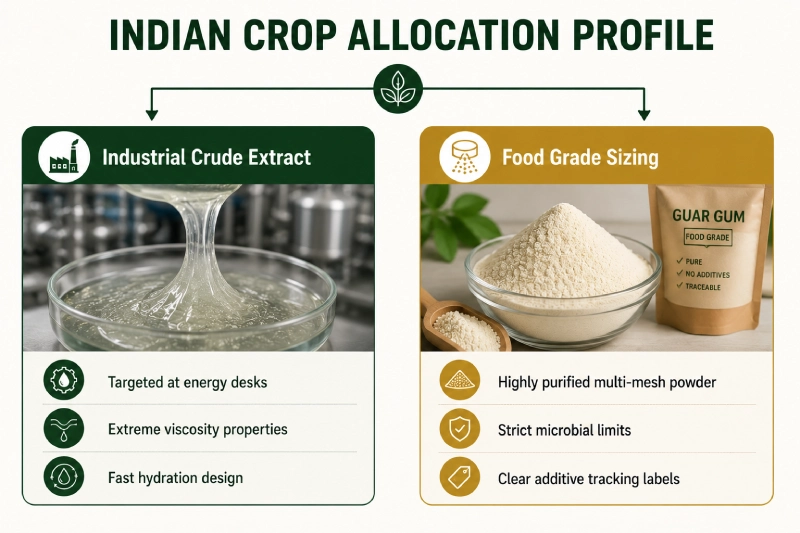
1. Energy Sector Integrations (Industrial Grade)
The energy extraction sector drives a massive portion of bulk shipping orders. Data from local processing logs points out that roughly 90% of the entire export volume is routed directly into shale gas and oil extraction industries.
In horizontal drilling and hydraulic fracturing setups, logistics teams rely on fast-hydrating industrial powder to thicken fracturing fluids. The natural polymer acts as a suspending agent, carrying proppants deep into rock formations under high pressures to keep fracturing seams propped open.
2. High-Purity Manufacturing (Food & Pharma Grade)
On the other side of the trade floor is the specialized food grade guar gum export track. Convenience food brands use this refined powder as an additive to extend and stabilise shelf life. Its unique properties, that are hydrogen bonding, allow it to bind water efficiently, control viscosity in aqueous solutions, and form thin, durable films. This makes it an ideal thickener or binder in ice creams, baked goods, dairy products, and even processed meats. Buyers pay a premium in such industries for high-mesh powders that mix smoothly without altering final flavour balances.
Technical Specifications: Powder to Green Seeds
Wholesale prices are dictated by the depth of refinement and the final physical form of the agricultural delivery. Sourcing desks organize contracts around three core asset layers:

1. Refined Splits (The Semi-Processed Asset)
Before grinding down to fine powders, factories crack the raw guar seed export India stocks to strip away the outer hull and germ layers. The remaining carbohydrate core is the refined split. Many international processors purchase these splits in bulk container loads to run the final milling processes inside their own domestic factories, avoiding the high logistics costs of shipping fully finished powders.
2. Micro-Mesh Powders
Operating as the primary revenue generator for domestic refiners is the guar gum powder export India pipeline. Sizing mills run the splits through high-speed pneumatic pulverizers to deliver specific mesh textures. Food and pharmaceutical buyers generally mandate ultra-fine mesh numbers to ensure immediate cold-water dispersion, while industrial printing or paper-sizing mills choose coarser, slower-hydrating varieties.
Operational Logistics: Sourcing to Border Clearance
Transitioning bulk cargo cleanly from Indian regional milling clusters to overseas industrial depots requires a synchronized quality loop. For a professional trade desk, the process moves through several distinct field stages:
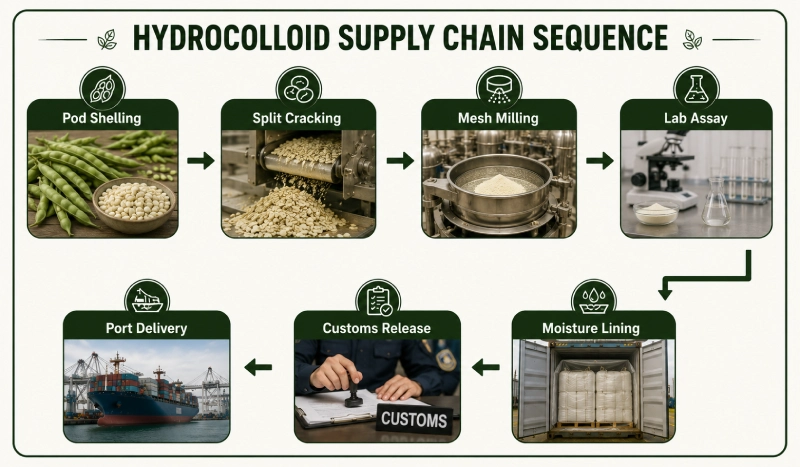
- Procurement: Buying raw seeds from local agricultural yards across key harvesting belts.
- De-husking: Mechanically cleaning the hull to separate the high-viscosity split from the protein-heavy germ.
- Milling: Pulverizing the splits into uniform particle sizing based on buyer contract terms.
- Hydration Testing: Checking viscosity levels in laboratory testing tanks to verify exact centipoise (cP) ratings.
- Bagging: Stowing the powder into multi-ply paper bags with thick internal moisture barriers to prevent caking during sea transits.
- Customs Clearance: Gathering mandatory commercial manifests and shipping certificates to pass exit port checks.
Border Clearance Compliance and Critical Certifications
Clearing high-barrier customs entry gates requires absolute documentary precision. Rather than managing complex certification requirements via dense descriptive paragraphs, professional export desks rely on a structured compliance index to verify that every container load matches the exact statutory mandates of foreign border agencies:
Global Custom Clearance Verification Index
| Target Document Layer | Legal & Regulatory Purpose | Operational Execution Note |
|---|---|---|
| Import Export Code (IEC) | Legal baseline required for any corporate shipping operation leaving Indian territory. | Issued permanently by the DGFT branch office. |
| Phytosanitary Certificate | Verifies that the container has cleared mandatory plant quarantine inspections. | Signed directly by regional plant protection officers. |
| Viscosity Analysis Report | Independent laboratory confirmation of the batch's active centipoise (cP) properties. | Verified via automated Brookfield viscometer assays. |
| Pentachlorophenol (PCP) Clearance | Critical chemical assay verifying the total absence of prohibited wood preservatives. | Mandatory for clearing European and North American entry ports. |
| HACCP & ISO 22000 Records | Confirms that the processing floor operates under clean, verifiable food safety management frameworks. | Essential for all premium food-grade contract allocations. |
| Kosher & Halal Endorsements | Confirms compliance with specific dietary requirements for food-grade lines. | Provided by verified third-party authentication boards. |
Guar Gum Price Per Kg: Commercial Valuation Benchmarks
Wholesale value structures are highly sensitive to industrial energy trends, seasonal monsoon patterns across Western India, and final mesh purity metrics. Sourcing managers evaluate contract offers based on specific grading brackets:
Indicative Export Price Ranges (2026 Estimates)
| Product Sourcing Format | Indicative Export Range (FOB India Port) | Primary Market Application |
|---|---|---|
| Refined Industrial Splits | USD 1.05 – USD 1.35 per kg | Purchased for secondary overseas milling and localized powder configuration. |
| Fast-Hydrating Drilling Grade | USD 1.45 – USD 1.85 per kg | Standardized formulation for viscosity adjustment in hydraulic fracturing runs. |
| Food Grade Powder (200 Mesh) | USD 2.10 – USD 2.75 per kg | High-purity configuration utilized for shelf life extension in convenience foods. |
| Pharmaceutical Grade Powder | USD 3.20 – USD 4.50 per kg | Ultra-refined multi-mesh layout required for suspension consistency in medicines. |
Mandatory Pricing Disclaimer: Export prices are indicative only and may vary based on product grade, organic certification, destination market, order volume, packaging requirements, quality specifications, and prevailing market conditions.
Market Outlook and Strategic Procurement Setup
Relying strictly on spot-market buys when demand peaks is a surefire way to expose your supply chain to brutal price swings. If you want long-term commercial stability, you have to bypass the open market and set up direct, contract-backed deals with vertically integrated processors and experienced guar gum exporters India networks—specifically the ones running modern optical sorting lines and automated sterilization systems.
Locking in your volume commitments right after the harvest window does three things: it guarantees your inventory is always there, shields your margins from unseasonal weather price spikes, and gives you ironclad, batch-to-batch traceability from the farm gate all the way to foreign industrial bays. By ensuring proper storage in temperature-controlled environments, international buyers can shield their industrial operations from unexpected price hikes and keep their supply chains running smoothly year-round.