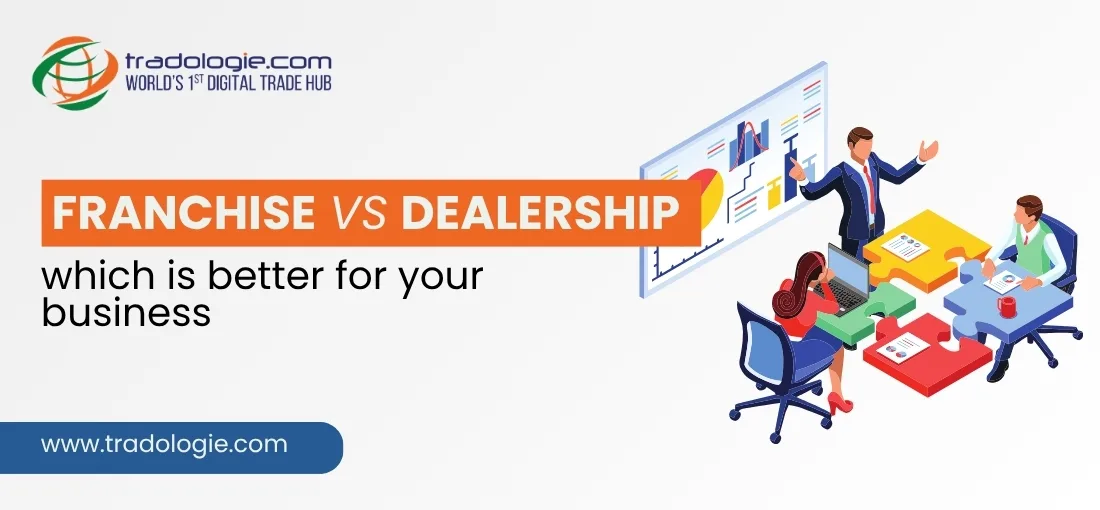
Expanding a business today needs a clear plan. Choosing between a franchise and a dealership is a big deal. It changes how you run things. It also shifts your costs and how you adapt to the market. This choice matters deeply for companies in bulk trade, farming goods, and fast-moving consumer goods (FMCG). You must understand both paths. You need to see how each model fits into global supply chains and local buyer needs.
What is the Difference? Franchise vs. Dealership
A franchise runs under strict rules from a main company. The buyer gets a known brand and ready-made systems. They also get full support from the parent company. But, they give up a lot of business freedom.
On the other hand, a dealership is like an independent seller. Dealers buy products directly from the makers. They usually buy in very large amounts. Then, they sell these goods themselves. Dealers get to set their own prices. They also control their stock and how they market to locals.
| Feature | Franchise Model | Dealership Model |
|---|---|---|
| Daily Control | Low (must follow brand rules) | High (make your own choices) |
| How You Earn | Share profits, pay royalty fees | Keep margins on bulk sales |
| Support Given | High (training and marketing) | Low (focused just on supply) |
| Best For | Retail, food, standard services | FMCG, farm tools, bulk B2B trade |
The Agriculture Focus: Farm Equipment and Raw Goods
In the farming sector, a dealership is often the best choice. A 2025 report by FranchiseBAZAR looked at the farm equipment market. This includes items like tractors, smart farming tools, and water pumps. The report found that this market is highly profitable. It works like an asset that keeps growing.
Dealers in this space make money in three main ways:
- Profits from selling the actual machines.
- Money made from fixing and servicing the equipment.
- Income from selling extra spare parts.
What happens when you trade raw farming goods? Market changes control the speed of business. A dealership lets owners move fast. They can change their stock based on harvest sizes or local needs. They do not have to wait for corporate approval.
Franchises are less common in farming. However, the journal Economics of Agriculture notes they still have value. They are great for creating standard rules in food processing. They also help keep quality high across borders.
Moving High Volumes: Bulk Trade and FMCG Products
Agility is key for companies focused on import and export. You might move huge amounts of basmati rice, premium spices, or pulses. You might also deal in frozen poultry. Doing this requires a setup that values large volumes over strict brand rules.
The dealership model naturally fits this kind of B2B trade. A 2025 market report by FranchiseAlpha points this out. Dealerships are built for trading goods like FMCG items.
Distributors moving regional FMCG goods need freedom. They must be able to ask for bulk discounts. They need to manage their own warehouses. They also need to change prices quickly to beat local rivals. Franchises often struggle here. They have fixed prices. They also face strict area limits. This makes it hard to survive the tight profit margins found in global commodity trading.
Money Matters: Upfront Costs and Long-Term Profits
The way you spend capital is very different in each model. This directly changes your return on investment (ROI) over time.
- Starting Costs: Franchises ask for a large upfront fee. This pays for the right to use the brand's name and ideas. Dealerships mostly need cash to buy the actual products to fill their warehouses.
- Ongoing Fees: Franchises require regular payments. These royalties usually take 4% to 8% of total sales. Owners must also pay into a shared marketing fund.
- Keeping Profits: The business platform GetDistributors shared insights in 2025. They noted a huge benefit of the dealership model. Dealers do not pay any royalty fees. They keep all of their profit margins. This helps bulk traders boost their ROI by simply selling their inventory faster.
Selling Across Borders: Territories and Rules
International trade brings up big questions about selling rights. Franchises are very strict about this. Parent companies set firm borders. They stop franchisees from sending goods outside their set areas. They do this to protect their own global markets.
Dealerships work much better for international bulk sales. Independent distributors often get rights that are not exclusive. This means they can sell across borders. They can also take advantage of different price levels in other countries.
The International Trade Administration shared a study in 2025. It showed that independent distributors handle about 65% of mid-market cross-border FMCG trade. They lead the market because they are free to move. They can cross borders without corporate delays or export bans.
Managing Supply Chains and Cold Storage Logistics
Many farming goods can spoil quickly. This includes frozen poultry, premium buffalo meat, or sensitive FMCG items. Moving these goods involves a lot of risk. Who takes on this risk depends on your business model.
- The Franchise Way: Parent companies usually pick the transport vendors. They also tightly check the cold storage methods. This makes daily operations easier for the owner. But, it locks the franchisee into set, unchangeable transport costs.
- The Dealership Reality: Independent dealers build their own transport networks. They must pay for and manage them. Because of this, they take on all the financial risk. They pay the price for shipping delays, port issues, or spoiled goods.
However, taking this risk has a big upside. Dealers can hunt for cheaper freight rates. The Global Cold Chain Alliance reported on this in 2025. Independent farming distributors who built their own cold storage saw great results. They earned a 14% higher profit margin on bulk exports compared to those stuck with corporate shipping rules. For traders moving huge amounts of spices, pulses, or meats, this freedom is a major advantage.
Legal Rules and How to Exit the Business
Every good business plan needs a way out. The legal steps to end a business relationship are very different here.
Leaving a franchise is tough. The contracts are complicated. They often include strict rules that stop you from starting a similar business for years. You also lose all the local brand trust you built. In the end, you do not own the brand. You only borrow it.
Dealership agreements are much simpler. They focus on buying goods and keeping the supply flowing. They are not about licensing a brand. Ending a dealership is usually a clean break.
If the global market drops, an independent dealer has options. They can sell off their warehouse stock. They can also quickly start selling a different brand's products using their same warehouse. A 2026 survey by Trade Finance Global proved this point. It found independent dealers are 40% more likely to survive sudden market crashes. Their legal freedom makes this possible.
Daily Control vs. Corporate Support
Having total control has both pros and cons. Dealerships let you run your own marketing. You build your own local name. You can even sell products from competing brands in the same building. You use another company's goods to build your own empire.
But this freedom brings heavy risks. You must set up your own shipping. You have to train your sales team from scratch. You also absorb all the blows when the market dips.
Franchises lower these risks. They give you tested rulebooks and training. Does your business rely on giving customers a highly familiar experience? If so, the franchise system offers a very strong safety net.
Conclusion: Picking the Right Model for Your Needs
There is no single best choice. There is only the best choice for your specific supply chain and risk level.
Do you want to move high volumes of farm goods? Do you want to sell FMCG products across borders? If yes, the dealership model gives you the freedom, price control, and profit focus you need.
Do you prefer a proven brand? Do you want fewer daily operational headaches? If yes, franchising is the smart route. Look closely at your startup funds. Think about how much daily control you want. Most importantly, look at the exact types of goods you plan to trade before you sign any contract.
Frequently Asked Questions (FAQs)
What is the main difference between a franchise and a dealership?
A franchise operates under a parent company's strict rules and brand identity. A dealership is an independent business that buys and resells a manufacturer's products.
Which business model gives the owner more daily control?
The dealership model provides significantly more daily control. Dealers independently manage their pricing, bulk inventory, and local marketing strategies.
Why are dealerships better for bulk trade and agricultural goods?
They offer the flexibility to quickly adjust to market shifts. Dealers can negotiate bulk prices and manage independent cold storage without waiting for corporate approval.
How do the initial costs compare between the two models?
Franchises require a large upfront fee to use the brand's name and systems. In contrast, dealerships require capital primarily to purchase the physical inventory you intend to sell.
Do I have to pay ongoing fees in a dealership like I do in a franchise?
No. Dealerships do not require ongoing royalty fees or mandatory marketing fund contributions. You keep 100% of the profit margins on your bulk sales.

.webp "How to Get ITC FMCG Distributorship in India: Aashirvaad, Sunfeast & Bingo Products")