Key Highlights
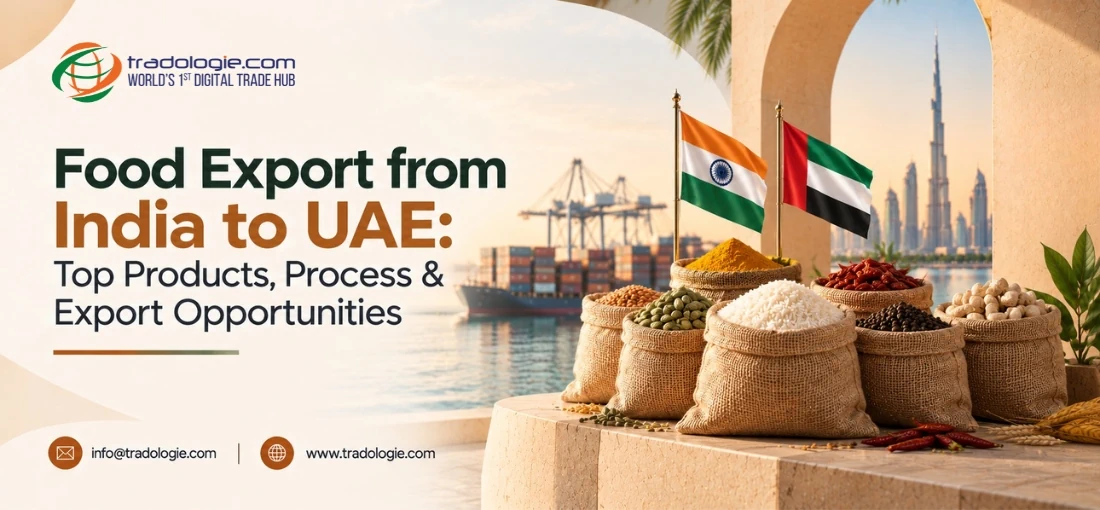
- UAE is a major destination for Indian food exports.
- India exported $487.9 million of rice to the UAE in 2024.
- Processed and packaged foods offer growing opportunities.
- Biscuits, snacks, juices, pulses and cereal products have potential.
- Fresh fruits and vegetables remain important export categories.
- UAE buyers look beyond price to quality, packaging and consistency.
- Indian FMCG brands can enter through UAE distributors and retailers.
- The bigger opportunity is exporting value, not just volume.
Introduction:
The story of food export from India to UAE is not a new one. Indian rice, spices, fruits, nuts and processed foods have been reaching the UAE for years, and the country remains one of India's leading agricultural export destinations. But the opportunity is changing. With the India-UAE CEPA improving market access and UAE demand continuing to span everything from staple commodities to packaged foods, Indian businesses have an opportunity to move beyond bulk shipments and build a stronger position in the finished-food market.
All this for an Indian exporter makes the question of how to export food from India to UAE much more interesting than simply understanding about the customs and paperwork. The bigger question is which products have a demand in the market, how they should be positioned, and whether an exporter can build a reliable route from the Indian manufacturer to the UAE importer, distributor or retailer.

Top Foods exported from India to UAE
India's export basket to the UAE is unusually broad. It includes staple agricultural commodities, fresh produce, processed foods and increasingly consumer-facing products.
Rice is an obvious example. WITS data shows that India exported about $487.9 million of rice to the UAE in 2024 . This represents roughly 598,411 tonnes. India was comfortably the largest exporter of rice to the UAE that year, way ahead of Pakistan at about $174 million.
But rice is only one part of the story.
| Product / Category | India's Exports to UAE / Relevance |
|---|---|
| Rice | $487.9 million in 2024 |
| Cashew Nuts | $84.0 million in 2024 |
| Bananas | $43.8 million in 2024 |
| Sweet Biscuits, Wafers & Waffles | $25.1 million in 2024 |
| Spice Mixtures | $18.4 million in 2024 |
| Other Food Preparations | $92.1 million in 2024 |
Source: World Integrated Trade Solution (WITS), 2024 trade data. Product-level figures refer to the respective HS categories and should not be treated as the entire category's export value.
The numbers tell us something useful. India's UAE food trade is not dependent on a single commodity. There is already demand for ingredients, fresh produce, processed preparations and consumer foods.
India to UAE food export is moving beyond commodities
The UAE's importance becomes even clearer when viewed through APEDA's broader export data.
The UAE was India's largest destination for APEDA products in the year 2024-25. This was ahead of Saudi Arabia and the United States. India's major APEDA export categories included non-basmati rice, basmati rice, buffalo meat, miscellaneous processed items, fresh fruits, processed fruits and juices, cereal preparations, fresh vegetables, groundnuts and pulses.
That combination is important because it shows two different sides of the opportunity.
There is the traditional export business—rice, fruits, vegetables, pulses and other agricultural commodities.
And then there is the value-added business—cereal preparations, processed fruits, juices, packaged preparations and other foods that are already closer to the final consumer.
The second category deserves more attention.
Food products exported from India to UAE are becoming more value-added
India's processed-food sector is already large. APEDA reports that India's processed food exports reached $8.03 billion in FY2025-26 , with miscellaneous preparations, cereal preparations, processed vegetables, pulses and processed fruits, juices and nuts among the larger categories.
Cereal preparations alone accounted for about $1.01 billion in FY2025-26, covering products such as biscuits, bakery products, pasta, papad, corn flakes and other preparations. The UAE is among the major destinations for this category.
This is where the food products exported from India to UAE story starts becoming more interesting for manufacturers.
A company does not necessarily have to export the agricultural commodity itself. It can process that commodity, package it, give it a brand identity and sell a finished product.
That is a very different business model—and potentially a more valuable one.

Which products offer the next opportunity?
The UAE market already buys many of the products Indian exporters know how to produce. But there is room to look beyond the established categories.
APEDA's export focus includes products such as biscuits, papad, pasta, sauces, juices and pulp, groundnuts, makhana, processed fruits and vegetables, honey, dairy products, organic foods and cereal preparations.
That opens interesting possibilities for:
- Ready-to-eat and ready-to-cook foods
- Indian snacks and bakery products
- Millet-based foods
- Pickles, sauces and chutneys
- Processed fruits and juices
- Packaged pulses and cereal products
- Makhana and other newer snack categories
- Organic and GI-linked foods
- Confectionery and chocolate products
- Branded ethnic and fusion foods
The opportunity is especially attractive for Indian FMCG manufacturers because these products can be sold through distributors and retail channels rather than only through bulk commodity contracts.
Fresh produce remains a strong part of the opportunity
It would also be a mistake to assume that value addition means abandoning fresh agricultural exports.
India has a substantial fresh-produce business with the UAE. APEDA lists the UAE among the major destinations for India's fresh fruits and vegetables, alongside Iraq, the Netherlands, Nepal, Malaysia and other markets. In FY2025-26, India's fresh fruit exports were worth about $1.16 billion , while fresh vegetable exports were around $760 million.
WITS data provides a more specific example: India exported $43.84 million of bananas to the UAE in 2024 , equivalent to more than 89 million kg.
So the UAE opportunity is not an either-or proposition.
India can export the fresh product, the processed product and, increasingly, the branded finished product.
How to export food from India to UAE: the process
The actual export process is fairly straightforward once the business is properly prepared.
| Step | What the Exporter Needs to Do |
|---|---|
| 1. Select the Market and Product | Identify the UAE buyer segment and applicable HS code |
| 2. Set Up Export Credentials | Obtain IEC and complete applicable business registrations |
| 3. Food Compliance | Obtain the appropriate FSSAI licence and product-specific registrations |
| 4. Check APEDA Requirements | Obtain RCMC where applicable |
| 5. Review UAE Requirements | Check food safety, labelling, packaging and import rules |
| 6. Prepare the Product | Ensure shelf life, packaging, quality and documentation are export-ready |
| 7. Find the Buyer | Identify importers, distributors, retailers or bulk buyers |
| 8. Finalise the Commercial Terms | Agree on price, quantity, delivery, payment and specifications |
| 9. Prepare Shipment | Arrange production, packing, testing and required certificates |
| 10. Customs and Logistics | Work with a CHA/Customs Broker and logistics partners |
| 11. Ship and Receive Payment | Complete export documentation and follow the agreed payment terms |
| 12. Build Repeat Business | Maintain quality, supply consistency and buyer relationships |
The important thing is to understand that the paperwork is only one part of how to export food from India to UAE.
Finding the right buyer can be just as important.
The UAE buyer is looking for more than a low price
This is where Indian exporters need to be realistic.
The UAE is a competitive food market. Buyers can source from India, Pakistan, Thailand, Vietnam, Europe, Africa and other origins depending on the product.
So an Indian supplier cannot assume that a lower price alone will secure the order.
Quality, packaging, shelf life, certifications, consistency, delivery time and the ability to maintain supply all matter.
For an FMCG brand, there is another layer. The distributor needs to believe that the product can actually move through the market.
That means the exporter is no longer selling just a shipment.
It is selling a product that has to find a place on a shelf.
The opportunity for Indian FMCG brands
This may ultimately be the most interesting part of the UAE market.
An Indian manufacturer that already has a successful biscuit, snack, spice blend, ready-to-eat meal, beverage, condiment or packaged-food range does not have to approach the UAE as an unknown exporter.
It can approach the market as a brand.
That means finding distributors and importers who can introduce the products to retail channels, restaurants, modern trade and other relevant outlets.
The UAE's established logistics and distribution infrastructure also makes it an attractive base for businesses that eventually want to reach wider Gulf markets.
The export journey can therefore evolve from Indian manufacturer → UAE importer → distributor → retailer → consumer.
That is considerably more valuable than treating every shipment as a one-off transaction.
The bigger opportunity is to export value, not just volume
India already has agricultural production. It already has export relationships. And it already has a sizable food-processing industry.
The next step is to connect these three strengths.
A farmer's crop can become an ingredient. The ingredient can become a processed product. The processed product can become a packaged food. And that packaged food can eventually become an Indian brand on a UAE shelf.
That is where the future of food export from India to UAE could become much more interesting.
The UAE is already an important destination. The question now is how much more value Indian businesses can capture once they move further down the chain.
Conclusion:
The UAE is already a major destination for Indian food. But the exporters must understand that opportunity is moving beyond rice, fresh produce and other commodities. With strong existing demand and a growing processed-food sector, Indian manufacturers can increasingly stand a chane to export products that carry more value through processing, premium packaging and branding. For exporters who want to understand UAE requirements, it is important to build reliable distribution and develop products for the market; the next opportunity is not simply to export more food, but to build stronger Indian food businesses in the UAE.
Disclaimer
This content is for general informational purposes only and is based on the information provided in the source material. Export regulations, market conditions, product requirements and commercial opportunities can change. Exporters should independently verify current UAE import requirements, certifications, customs procedures and buyer specifications before shipping.



.webp "Future of Agro Exports from India (2026 Outlook & Opportunities)")
.webp "How Dry Fruit Buyers Check Quality Before Bulk Purchase")