Key Highlights
- An export inspection certificate serves as proof that a shipment meets required quality and safety standards.
- Missing or incorrect inspection documentation can lead to shipment delays, holds, or rejections at destination ports.
- Sampling, laboratory testing, container sealing, and documentation verification are key parts of the inspection process.
- Government-mandated inspections and buyer-requested quality audits serve different purposes.
- Proper documentation matching helps prevent customs red flags and costly port-side delays.
- Strong inspection compliance can protect exporters from demurrage, detention, and reputation risks.
Introduction:
Let’s be entirely practical: shipping a full container out of your warehouse loading bay means absolutely nothing if the box gets permanently jammed at the port of entry. The absolute defining moment of any international shipment happens when custom house agents hand over your paperwork to border officials. If you don't hold a verified, error-free export inspection certificate, the journey ends right there.
For any trade desk trying to maintain steady margins, and export food in bulk globally. mastering the actual inspection rules for export is a baseline survival skill. This isn't just about ticking boxes for a local government council. A single mismatched digit or a skipped audit window will cause terminal authorities to ground your containers, hit you with massive storage penalties, or reject your entire lot.

What Exactly is an Export Inspection Certificate?
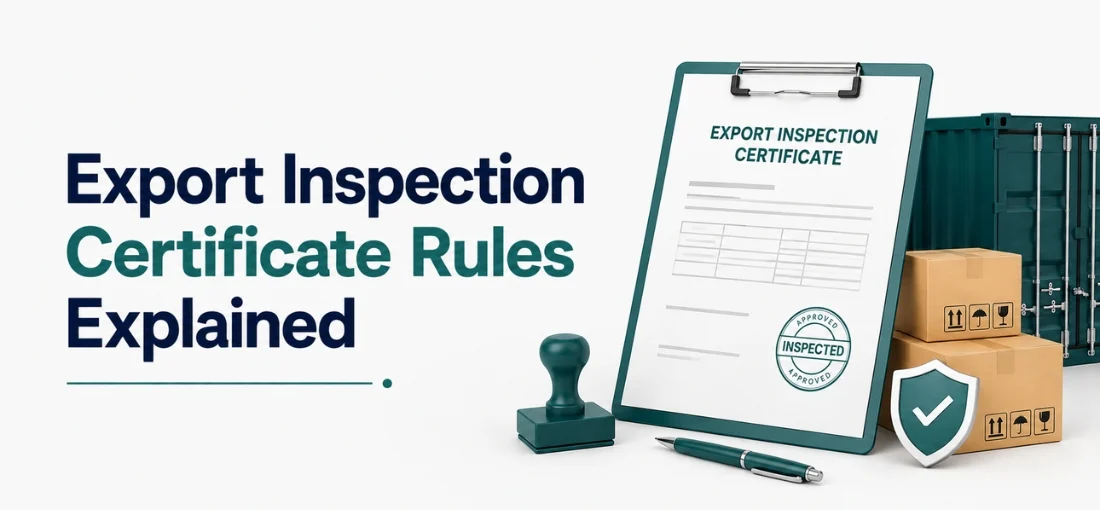
Think of an export inspection certificate as a non-negotiable health and quality passport for your cargo. You might be a spice exporter, rice exporter or a sugar exporter. The inspection certification is an official piece of paper generated either by a statutory government export council or an independent international survey firm. The document explicitly guarantees to destination border custom officers that your specific batch has been physically examined, tested, and satisfies every raw safety metric or contractual specification.
Without this paper cleared and uploaded into the custom network, ocean liners will flatly refuse to hand over your bill of lading, and destination custom officers will lock your container in a secure hold on arrival.
The Actual Steps to Clear Inspection Rules for Export
You cannot pull off a valid customs audit by trying to patch up documentation after your container doors are already padlocked. To keep your shipments moving without bleeding money at the terminal, you have to follow a strict timeline.
1. The Pre-Stuffing Application Window
Standard inspection certificate guidelines require you to register your lot with the designated inspection agency well before your scheduled packing date. If you wait until the truck is sitting in your yard, you are asking for trouble. Missing this lead time means you'll be stuck paying emergency container grounding fees at the terminal while waiting for an inspector to show up.
2. Warehouse Sampling and Lab Assays
Once your application clears the initial desk, a field inspector will physically show up at your factory floor or cold storage unit. They will pull random core samples directly from your wholesale piles. If you are shipping agricultural produce, these samples are sent straight to a lab for high-performance liquid chromatography (HPLC) testing to ensure your crop doesn't breach the destination country's chemical and pesticide caps.

3. The Sealed Loading Protocol
Assuming the lab results come back clean, the inspector will stand on your loading dock to watch the cargo go into the container. Once the last pallet is pushed in, they will clip a high-security bullet seal onto the door handle. That exact seal number is immediately typed onto your final certificate. This proves to foreign border patrols that nobody tampered with or swapped the goods while the container was crossing the ocean.
4. Digital Manifest Matching
After the physical checks are done, the formal clearance document is issued with a unique tracking code. Your custom house agents must map this code exactly to your shipping bills and international export declarations.
Distinguishing Statutory Inspections from Buyer Quality Audits
Exporters constantly cause their own logistical bottlenecks because they confuse regulatory mandates with commercial contract terms.
- Mandatory Government Audits: These are statutory requirements. Your home country forces them to protect its national brand reputation abroad, or the destination port demands them to enforce local food safety laws. Think of phytosanitary certificates for bulk grains or veterinary health clean bills for frozen meats.
- Voluntary Commercial Inspections: These are completely driven by your buyer's private business requirements. Usually written directly into a letter of credit (LC), these rules demand an independent firm (like SGS or Intertek) to verify that your grain size, color uniformity, or moisture percentages precisely match what the buyer purchased.
Cutting Out Hidden Terminal Costs and Leakages
When a shipment hits a wall during an audit, the financial damage doesn't come from the fee you paid the inspector. The real margin-killers are the secondary port penalties that compound daily when your logistics team messes up the timeline.
To protect your cash flow, make a minimum 14-day factory-to-dock container free-time window a mandatory part of your freight contract. If border control pulls your box for an unannounced random sample check, you need that two-week buffer. Without it, a routine paperwork delay will immediately push you into demurrage and detention fees that can easily eat up thousands of dollars before the container is released.
Furthermore, one must clearly understand that European labeling laws demand absolute clarity. They place a paramount emphasis on protecting the interests of the end customers and ensure they get what they order. In fact, the layout of your retail packaging must clearly feature pertinent information on various allergen matrices with distinct typography highlighting (like bold fonts, italics, or contrasting background colors) for any of the 14 regulated allergens, including gluten, mustard, sesame seeds, and nuts.
Finally, keep your digital data completely synchronized. Your commercial invoices, packing lists, and sea manifests must show identical weights, batch numbers, and product descriptions that mirror your export inspection certificate to the letter. A single typo or an extra decimal point will trigger an automatic red flag in customs computers, dragging your cargo into mandatory port holds and forced re-testing loops.
Summary
Running a successful international trade desk doesn't require a logistical miracle; it requires a strict commitment to operational discipline. By protecting your margins side-to-side through tight freight agreements, maximizing your container space, and ensuring your quality certifications are completely airtight, you stop the minor capital leaks that ruin underprepared traders. Moving into this high-volume network with an integrated, risk-shielded strategy is the most effective way to turn an ambitious trade operation into a highly predictable, maximum-profit international business.