Key Highlights
- Saudi Arabia has become a major market for Indian green cardamom.
- India's exports to Saudi Arabia reached US$114.86 million in 2024-25.
- Alleppey Green Cardamom is classified under HS Code 09083120.
- Saudi buyers focus on pod size, colour, aroma, moisture and cleanliness.
- Exporters need IEC and CRES registration for spice exports.
- Saudi food imports require compliance with SFDA regulations and registrations.
- Pesticide-residue testing and quality documentation are essential.
- Exporters can ship through Mundra or Nhava Sheva to Jeddah or Dammam.
Introduction:
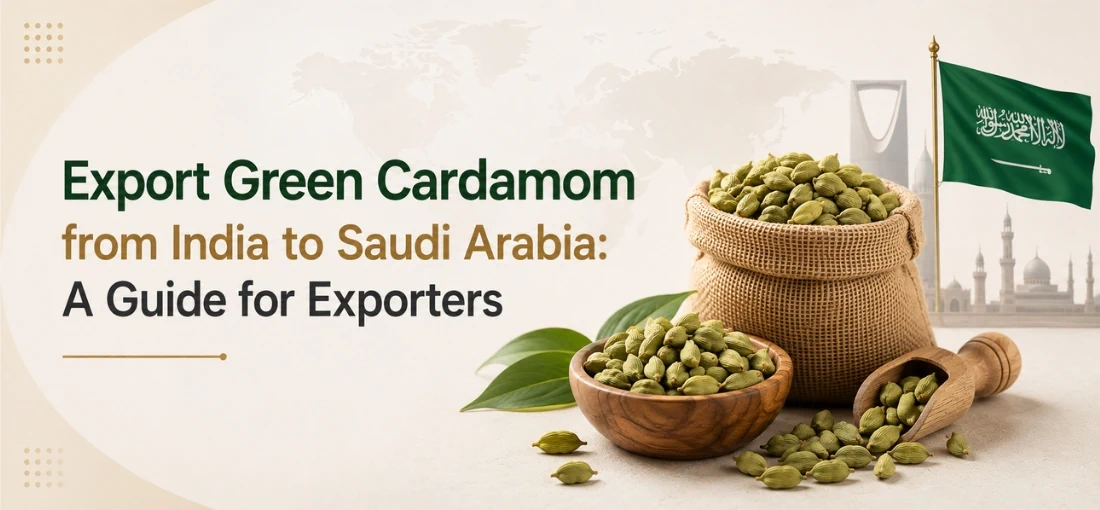
Saudi Arabia is emerging as an increasingly important destination for Indian green cardamom, creating opportunities for Indian exporters, spice traders, processors, and bulk suppliers. For Indian businesses looking to export green cardamom to Saudi Arabia , the opportunity is not limited to finding a buyer. Bulk cardamom exporters must also understand product classification, quality requirements, Saudi food regulations, documentation, shipping routes, ports, and the expectations of commercial buyers.
The trade data shows why this market deserves attention.

India's Green Cardamom Exports to Saudi Arabia
For this analysis, the product is Small (Ellettaria), Alleppey Green Cardamom , classified under HS Code 09083120.
According to the trade data provided from the Government of India's TradeStat database, India's green cardamom exports to Saudi Arabia were:
| Financial Year | Export Value |
|---|---|
| 2020-21 | US$25.43 million |
| 2021-22 | US$16.66 million |
| 2022-23 | US$25.77 million |
| 2023-24 | US$38.40 million |
| 2024-25 | US$114.86 million |
The jump in 2024-25 is particularly significant. Exports to Saudi Arabia increased by approximately 199.07% over the previous year.
At the same time, India's total exports of this commodity increased from US$129.70 million in 2020-21 to US$312.65 million in 2024-25. Saudi Arabia's share consequently increased from 19.61% to 36.74% of India's total exports of the commodity.
This means Saudi Arabia has become a much more important destination within India's green cardamom export market.
The broader India-Saudi trade picture also provides context. India's total exports to Saudi Arabia stood at approximately US$10.28 billion in 2024-25 , while green cardamom represented 1.12% of India's total exports to Saudi Arabia, compared with only 0.29% in 2020-21.
The underlying TradeStat system is maintained by India's Ministry of Commerce and Industry and provides commodity- and country-level export data.
What Is HS Code 09083120?
For exporters specifically in Small (Ellettaria), Alleppey Green Cardamom and export green cardamom to Saudi Arabia , HS Code 09083120 is the relevant Indian ITC-HS classification. Government trade documentation identifies 09083120 as “Small (Ellettaria), Alleppey Green.”
Bulk Cardamom exporters should still verify the classification against the exact product being shipped and the current customs tariff before filing a shipment, particularly where the product is crushed, ground, mixed, processed, or packaged differently.
For bulk whole Alleppey green cardamom, however, 09083120 is the classification to examine first.

What Do Saudi Buyers Look for in Green Cardamom?
A Saudi buyer purchasing commercially is unlikely to evaluate cardamom only on price. This is because spices have a very high commercial value based on their overall quality and aroma. Bulk buyers generally need consistency in:
- Pod size and grade
- Green colour and appearance
- Aroma and essential oil characteristics
- Moisture level
- Cleanliness and foreign matter
- Pesticide-residue compliance
- Microbiological quality
- Packaging and lot consistency
- Shelf life
- Traceability and batch identification
For an exporter, this means having a defined product specification is important before approaching bulk cardamom buyers in Saudi Arabia.
Instead of simply offering “Indian green cardamom,” exporters should be able to provide a specification sheet covering grade, size, origin, packing, net weight, crop/lot information, laboratory parameters and commercial terms.
Indian Exporter Requirements
The first step is to establish the export business correctly in India.
An exporter generally needs an Importer Exporter Code (IEC) and must complete the applicable GST, banking and customs formalities. Indian Customs export documentation includes the commercial invoice-cum-packing list, shipping bill and bill of lading/airway bill or other applicable transport document.
For spices, the Spices Board's Certificate of Registration as Exporter of Spices (CRES) is particularly important. The Spices Board states that CRES is mandatory for export/import of spices and spice products.
Because cardamom is a regulated spice commodity, exporters should also check whether the specific shipment falls under current mandatory sampling and testing requirements of the Spices Board. Saudi Arabia has historically been covered by destination-specific testing parameters for certain spices, including small cardamom, so exporters should verify the latest applicable notification before dispatch.
A practical export setup should therefore include:
- IEC
- FSSAI
- GST and banking/export documentation
- CRES from the Spices Board
- Appropriate customs/ICEGATE setup
- Quality-testing capability
- Export packaging compliant with the destination market
- Phytosanitary and health documentation where required
- Commercial contract and agreed Incoterms
Saudi Arabia's Food Import Requirements
This is one of the most important parts of the transaction.
Green cardamom is a food product, so Saudi Arabia's Saudi Food and Drug Authority (SFDA) requirements need to be considered alongside customs requirements.
Current SFDA guidance states that, before importing food, the Saudi importer must ensure compliance with applicable technical regulations and that the importer is registered with SFDA through the Ghad platform. The food products intended for import also need to be registered, while clearance requests are submitted through the relevant electronic systems and the Fasah trade platform.
The Saudi importer should therefore be prepared to handle the destination-side registrations and clearance process before the shipment reaches Saudi Arabia.
For exporters, this means Sell Green Cardamom to Saudi Arabia only after confirming that the Saudi buyer/importer is properly equipped to import food products.
Documents Required for the Shipment
The exact documentation can vary according to the product, shipment structure and Saudi requirements applicable at the time of import. However, exporters and bulk cardamom buyers in Saudi Arabia should typically prepare for documents such as:
- Commercial invoice
- Packing list
- Bill of lading
- Certificate of origin
- Health certificate, where applicable
- Phytosanitary certificate, where applicable
- Product/quality certificates or laboratory reports, where required
- Other certificates requested by the Saudi authorities or buyer
SFDA's current food-clearance guidance lists the origin certificate, commercial invoice, bill of lading, health certificate and phytosanitary certificate among the documents that may be submitted electronically through Fasah for food clearance.
The commercial invoice should accurately identify the products, quantities and other shipment information. Saudi customs guidance also requires importers to provide core documents including the commercial invoice, bill of lading and certificate of origin, subject to the applicable rules.
Packaging and Labelling for Saudi Arabia
Packaging is another area where exporters should avoid last-minute changes.
For consumer-facing prepackaged food, Saudi requirements include Arabic labelling. SFDA states that under SFDA.FD/GSO 9, food labels and accompanying explanatory information must be in Arabic; where another language is used, it must appear alongside Arabic and contain equivalent information.
For bulk B2B shipments, exporters should agree with the Saudi importer on the required markings before production and stuffing.
The packaging should be suitable for long-distance sea transportation and protect the cardamom from moisture, contamination, odour and physical damage. Exporters should also ensure that lot/batch information, net weight, origin and other required information are consistent across the commercial documents and packaging.
Pesticide Residues and Food Safety
For a spice exporter, laboratory compliance is not optional simply because the product is natural or agricultural.
Saudi Arabia maintains maximum residue limits for pesticides in agricultural and food products. SFDA publishes applicable pesticide-residue requirements, while its food-clearance framework also refers to microbiological criteria, contaminants and toxins, and other technical regulations.
Therefore, exporters should test representative lots through an appropriate laboratory before shipment, especially when selling to established commercial buyers.
A buyer may also request a Certificate of Analysis (COA) covering parameters such as moisture, pesticide residues, microbiological parameters and other specifications agreed in the purchase contract.
The exact testing panel should be based on the current Saudi requirements, the product specification and the buyer's purchase conditions rather than relying on an outdated generic test report.
Choosing the Right Indian Port
For exports from India to Saudi Arabia, the choice of port should depend on the supplier's location, shipping-line availability, freight rate and Saudi destination.
For western and northern Indian exporters, Mundra and Nhava Sheva/JNPA are important options.
JNPA is one of India's major container ports and connects with more than 200 ports globally.
Mundra is another major container gateway with strong multimodal connectivity to India's northern and north-western hinterland.
Shipping services from India to Saudi Arabia include routes to Jeddah and Dammam. For example, CMA CGM has operated India services connecting Nhava Sheva and Mundra with Jeddah and Dammam.
Jeddah or Dammam: Which Port Should You Choose?
The destination port should primarily be determined by where the buyer's warehouse or distribution network is located.
Jeddah Islamic Port is generally relevant for buyers in western Saudi Arabia and the Red Sea side of the country.
Dammam/King Abdulaziz Port is strategically relevant for buyers in eastern Saudi Arabia and businesses serving the Eastern Province and wider Gulf-facing markets.
Major shipping lines currently list Saudi destinations including Jeddah and Dammam on India export services.
For Indian Cardamom exporters , comparing the complete landed logistics cost is more useful than simply comparing ocean freight. Inland transportation, terminal charges, documentation, customs clearance, insurance, destination charges and delivery to the buyer's warehouse should all be considered.
Saudi Customs Clearance
Saudi importers must complete customs procedures through the relevant systems, including Fasah . ZATCA states that importers should submit the customs declaration and required documents before the shipment arrives, with its current import guidance specifying submission at least 48 hours before arrival.
The Saudi importer or appointed customs broker should therefore receive the final shipping documents promptly after shipment.
For the exporter, this means document accuracy matters. A mismatch in product description, HS classification, quantity, weight, origin, invoice value or consignee information can create avoidable clearance problems.
How to Find Green Cardamom Buyers in Saudi Arabia
For businesses looking to connect with cardamom buyers in Saudi Arabia , the target customer should be defined before starting outreach.
Potential B2B customer categories include:
- Spice importers
- Food ingredient distributors
- Wholesale spice traders
- Food-processing companies
- Tea and beverage companies
- Restaurant and hospitality suppliers
- Supermarket distributors
- Repackers and private-label companies
- Regional foodstuff trading companies
The most valuable leads are not simply companies that have searched for cardamom. Indian Cardamom exporters should identify buyers with an actual requirement for the relevant grade, packaging and quantity.
When approaching Green cardamom importers in Saudi Arabia , an exporter should be prepared with a concise commercial offer containing:
- Product: Alleppey Green Cardamom
- HS Code: 09083120
- Origin: India
- Grade/Size: Clearly specified
- Packing: Bulk or buyer-specific
- Quantity: Available monthly/contract quantity
- Price: FOB/CFR/CIF as applicable
- Payment Terms: As negotiated
- Documentation: Export and quality documents available
- Port: Mundra/Nhava Sheva or another suitable origin port
What Makes the Saudi Opportunity Attractive?
The most important signal is the scale of the recent increase.
India's green cardamom exports to Saudi Arabia increased from US$25.43 million in 2020-21 to US$114.86 million in 2024-25 based on the supplied TradeStat data.
The increase in Saudi Arabia's share of India's total exports of this commodity—from 19.61% to 36.74% —also indicates that Saudi Arabia has become a substantially more important destination for Indian green cardamom.
For bulk Cardamom suppliers , however, market opportunity should be approached alongside compliance. A competitive price alone is not enough. Successful B2B supply requires consistent quality, reliable volumes, correct documentation, regulatory compliance and dependable logistics.
Final Checklist for Exporting Green Cardamom to Saudi Arabia
Checking your final checklist is a very important thing in the trade industry. So, before shipping, an Indian exporter should confirm:
- Correct HS classification
- Valid IEC
- CRES registration
- Buyer/importer verification
- Saudi importer registration and product registration
- Applicable SFDA requirements
- Product testing and pesticide-residue compliance
- Required health/phytosanitary certificates
- Arabic labelling where applicable
- Commercial invoice and packing list
- Certificate of origin
- Bill of lading
- Shipping bill
- Appropriate export packaging
- Agreed Incoterms and payment terms
- Port of loading
- Jeddah or Dammam as the destination port
- Saudi customs/Fasah clearance readiness
For Indian Cardamom Exporters that can consistently meet these requirements, the Saudi market presents a significant B2B opportunity. The sharp rise in India's green cardamom exports to Saudi Arabia suggests that the market is becoming increasingly important—and exporters with reliable supply, compliant quality and strong buyer relationships can position themselves to participate in that growth.
Register as a seller today on tradologie.com if you want to connect with cardamom buyers in Saudi Arabia.
Disclaimer
The information provided in this article is for educational and informational purposes only. Export requirements, HS classifications, SFDA regulations, documentation, testing requirements, duties, shipping routes, and buyer requirements may change over time. Exporters should verify the latest requirements with the relevant authorities and independently confirm buyer credentials and commercial terms before entering into a transaction.