Key Highlights
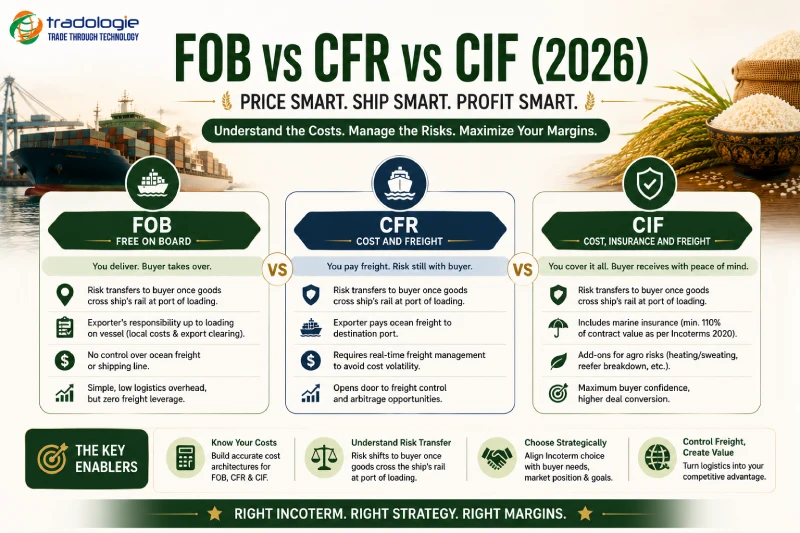
- FOB transfers freight responsibility to the buyer after vessel loading.
- CFR includes exporter paid freight but excludes marine insurance.
- CIF includes freight plus marine insurance arranged by the exporter.
- Cargo risk transfers at the origin port under all three Incoterms.
- CIF allows exporters to capture freight arbitrage opportunities.
- Marine insurance under CIF must cover at least 110% cargo value.
- Nhava Sheva and Mundra are major Indian agro export ports.
- Digital B2B systems are improving export logistics transparency globally.
Introduction:
Before we understand the difference between FOB, CIF and CFR, it is important to understand that International agricultural trade operates on razor-thin margins where financial success is entirely determined by structural precision. For an agricultural enterprise handling bulk commodities, the commercial quotation is not a simple administrative statement of price; it is a complex risk-management contract. A single uncalculated shipping variable or a misinterpreted maritime clause can instantly transform a high-volume, multi-ton deal into a catastrophic balance-sheet liability.

Navigating cross-border grain, spice, and fresh produce transactions and choosing between FOB, CFR, and CIF requires a deep, operational command of standard transport frameworks. When an overseas buying house requests a quotation, they are looking for absolute clarity regarding where an exporter's financial liability terminates and where their own operational logistics begin.
This guide uncovers the commercial mechanics, cost calculations, and risk transitions of the three primary shipping methods: FOB, CFR, and CIF.
The Legal Blueprint: Decoupling Risk from Cost
A common friction point for new exporters is the assumption that the party paying for a specific leg of transit also carries the physical risk of cargo damage during that journey. In maritime commerce, cost allocation and risk transfer travel on completely separate tracks.
This operational boundary is governed by Incoterms (International Commercial Terms), established by the International Chamber of Commerce. When you break down cif incoterms or analyze what a fob incoterm framework legally demands, you are looking at a strict, dual-stage dividing line.
For all three of these specific maritime terms—FOB, CFR, and CIF—the physical risk of loss or cargo deterioration shifts completely from the seller to the buyer the exact moment the goods safely cross the ship's rail at the port of loading. Even if your commercial contract requires you to pay the ocean freight liner all the way to a European or Middle Eastern terminal under a CFR or CIF agreement, you are not legally responsible if rough seas damage the cargo mid-voyage. Understanding this structural separation is an exporter's strongest defense against illegitimate post-delivery claims from foreign buyers.
1. What FOB Means in Shipping?
When an overseas procurement head asks for an FOB quotation, they want to isolate the raw commodity value from the volatile swings of the open ocean. To execute this properly, you must look closely at what fob means in shipping operations.
Under an FOB contract, your financial and operational liability is strictly limited to your domestic coastline. Your enterprise handles the internal logistics from the processing mill or warehouse, manages local customs clearance at the port of origin, settles the local terminal handling charges (THC), and ensures the containers are safely hoisted onto the specific vessel selected and booked by the buyer.
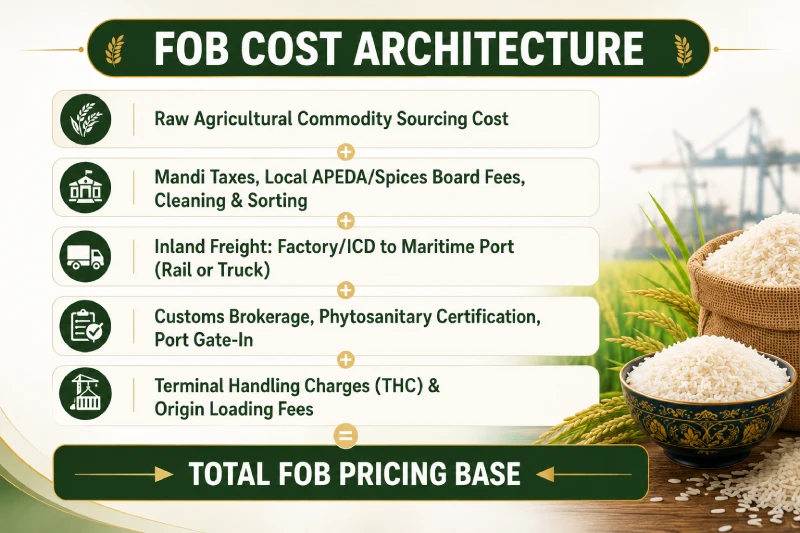
The primary advantage of choosing an FOB setup is administrative simplicity for your accounting desk. Your team does not have to watch fluctuating ocean freight markets or argue with maritime liners over container space shortages. The moment the vessel crane places your box on the deck, your operational job is done.
However, this simplicity comes with a significant commercial downside. By surrendering control of the ocean voyage, you lose the ability to negotiate volume discounts with shipping lines. This means you miss out on carving out an extra profit margin from the freight arbitrage—a leverage point that high-volume trading houses use constantly.
2. What does CFR mean in Shipping?
Quoting an FOB price is rarely enough if you want to expand your international reach. Many mid-sized foreign buyers, especially processing units in West Asia or North Africa, do not maintain direct contracts with major global container lines. They want a quote that brings the cargo straight to their destination terminal. This is where a deep grasp of cfr meaning becomes centrally important to your daily sales strategy.
When you transition from FOB to CFR, you assume the role of an ocean freight coordinator. You take your base FOB calculation and add the precise cost of ocean transit to the buyer's destination port of discharge.
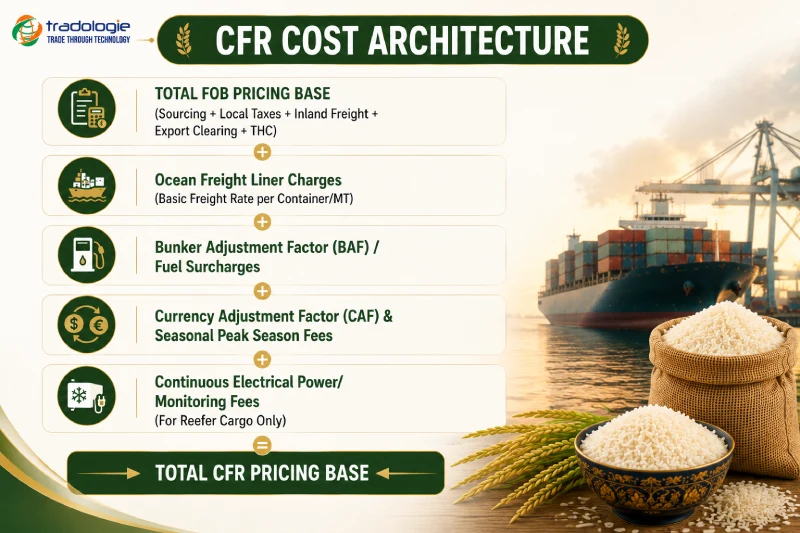
While your legal risk still ends at your local port rail, your financial obligation stays active until the ship docks at the foreign terminal. This framework requires an exporter to maintain solid, real-time lines of communication with reliable freight forwarders. If you lock in a fixed sale price with a buyer, but ocean freight rates suddenly spike before you book the container space, that freight inflation comes directly out of your pocket.
3. What is CIF Meaning in Shipping?
For institutional buyers, retail supermarket chains, and state-backed procurement agencies, the ultimate preference is almost always a CIF offer. To properly execute this, a trader must master the cif meaning in shipping circles.
The cif full form in shipping translates simply to Cost, Insurance, and Freight. Structurally, it takes your complete CFR price and adds a third layer: a marine cargo insurance policy that protects the financial value of the shipment while it floats across international waters.
When structuring a CIF deal, the seller acts as the trustee for the buyer's peace of mind. Under the revised rules governing the cif incoterms framework, the exporter is legally required to source an insurance policy that covers a minimum of 110% of the total contract value.
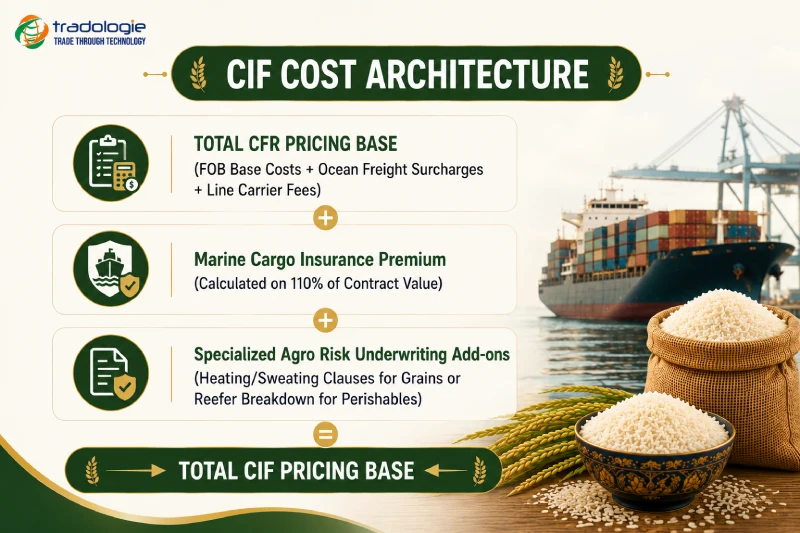
This insurance must be negotiated under reputable global standards, typically utilizing the Institute Cargo Clauses (A) or comprehensive marine underwriting rules. This safety net ensures that if the vessel encounters a structural crisis or an electrical failure destroys a reefer container full of fresh grapes or onions, the foreign buyer can recover their capital directly from the insurance provider without entering a protracted legal battle with you.
The Core Operational Clash: FOB vs CIF
When a trading house sits down to evaluate an international contract, choosing between an FOB format and a CIF structure is a major strategic decision. This choice determines your operational leverage and directly impacts your corporate cash conversion cycle.
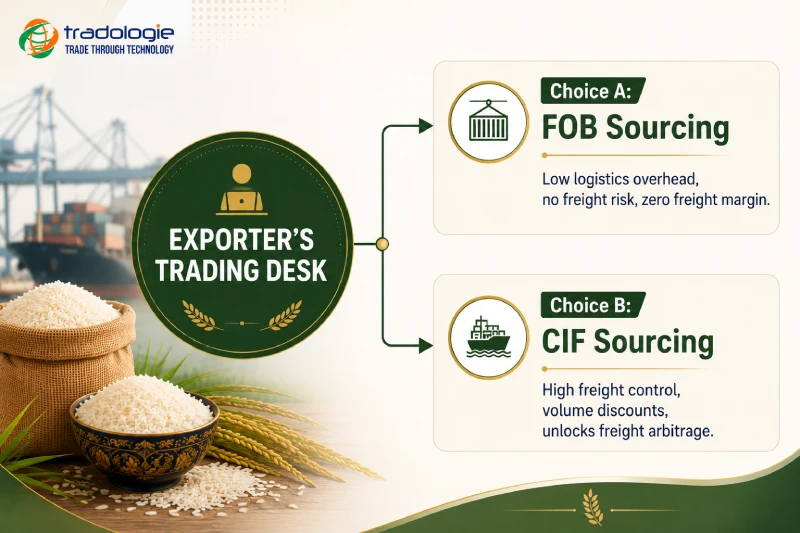
The core fob and cif difference comes down to control over the maritime supply chain. When you quote strictly on an FOB basis, you allow the foreign buyer's forwarder to dictate the shipping timeline. If their designated vessel faces a three-week delay or misses its port rotation entirely, your containers end up stuck at the dock, racking up heavy port storage fees. Your capital gets locked up because you cannot generate the clean Bill of Lading required to trigger your Letter of Credit.
Quoting on a CIF basis flips this script completely, handing the operational steering wheel back to you. Because you are the one selecting the ocean carrier, you can choose a line that aligns with your exact packing schedules.
Furthermore, if your agri-business moves hundreds of containers a year, you can leverage that bulk volume to secure deeply discounted ocean freight rates from major lines like Maersk or MSC. By charging the buyer standard market freight rates while paying a discounted volume rate behind the scenes, you turn the logistics chain into an active profit center.

Sourcing the Math: Step-by-Step Agro Export Pricing
To prevent severe financial leaks, your agriculture export desk must use a strict, layered formula when assembling an overseas quotation. Let's trace how a base raw commodity price converts into a complete CIF offer.
Step 1: Establishing the FOB Base Price
Start by calculating the net farm-gate procurement cost per metric tonne. Add internal processing costs, which include cleaning, sorting, grading, and packaging (such as multi-walled paper bags for basmati rice or specialized crates for fresh mangoes).
Next, add local mandi taxes, agricultural board fees (like APEDA or the Spices Board), and inland transport to the maritime terminal. Finally, factor in customs brokerage, export documentation verification, and the local port's Terminal Handling Charges (THC).
Step 2: Incorporating the Ocean Freight Component (CFR conversion)
Get a firm, contractually backed quote from your freight forwarder that covers the exact ocean voyage window. Ensure this rate includes all standard carrier surcharges, such as the Bunker Adjustment Factor (BAF) and the Currency Adjustment Factor (CAF).
For temperature-sensitive shipments like fresh bananas or chilled meat, make sure the quote includes the continuous electrical power fees required for reefer container units. Adding this ocean freight figure directly to your FOB base price gives you your complete CFR quotation.
Step 3: Layering the Underwriting Value (CIF Completion)
Take your calculated CFR value and scale it up to the mandatory 110% insurance baseline. Apply the premium rate provided by your marine underwriter to this expanded value.
For agricultural commodities, ensure your policy includes specialized protection clauses, such as the Cold Chain Failure Clause for perishables or the Heating and Sweating Clause for bulk grains stored in ship holds. Adding this final insurance premium to your CFR calculation completes your total CIF offer.
FOB vs CFR vs CIF Comparison Table
When evaluating shipping terms, visual simplicity helps protect contract margins. This comparison matrix outlines exactly who assumes the administrative and financial burdens across each maritime framework.
| Commercial Metric | FOB (Free on Board) | CFR (Cost and Freight) | CIF (Cost, Insurance & Freight) |
|---|---|---|---|
| Who Pays Ocean Freight? | Buyer settles directly with line | Exporter pays to destination port | Exporter pays to destination port |
| Who Pays Marine Insurance? | Buyer's voluntary option | Buyer's voluntary option | Exporter legally pays premium |
| Risk Transfer Point | Over the ship's rail at origin | Over the ship's rail at origin | Over the ship's rail at origin |
| Best Suited For | Large conglomerates with fleets | Mid-sized regional processors | Global supermarket lines & tenders |
| Exporter Control Level | Minimal (bound to coast) | Medium (controls transit line) | Maximum (controls entire journey) |
| Profit Opportunity | Flat commodity price margins | Minor freight buffer optimizations | High logistics & freight arbitrage |
| Documentation Burden | Low (domestic terminal forms) | Medium (requires direct BL tracking) | High (requires multi-layer insurance) |
| Cash-Flow Impact | Fast collection (FOB release) | Capital tied until port delivery | Capital tied until port delivery |
Real Agro Commodity Example Pricing
To understand how these theories operate on a commercial ledger, let's look at real-world mathematical structures for major Indian export items heading into global markets.
1. Basmati Rice (Mundra to Jebel Ali, Dubai)
- FOB Mundra Cost Base: $850 / MT
- Ocean Freight Surcharge: $65 / MT
- Marine Underwriting Premium (110% Value): $5 / MT
- Final Offers: FOB: $850/MT | CFR: $915/MT | CIF Dubai: $920/MT
2. Red Chilli (Chennai to Rotterdam, Netherlands)
- FOB Chennai Cost Base: $2,100 / MT
- Ocean Freight Surcharge: $180 / MT
- Marine Underwriting Premium (110% Value): $14 / MT
- Final Offers: FOB: $2,100/MT | CFR: $2,280/MT | CIF Rotterdam: $2,294/MT
3. Sesame Seeds (Nhava Sheva to Singapore Hub)
- FOB Nhava Sheva Cost Base: $1,450 / MT
- Ocean Freight Surcharge: $45 / MT
- Marine Underwriting Premium (110% Value): $9 / MT
- Final Offers: FOB: $1,450/MT | CFR: $1,495/MT | CIF Singapore: $1,504/MT
4. Fresh Yellow Onions (Kandla to Colombo, Sri Lanka)
- FOB Kandla Cost Base (Reefer Setup): $380 / MT
- Ocean Freight Surcharge: $40 / MT
- Marine Underwriting Premium (110% Value): $4 / MT
- Final Offers: FOB: $380/MT | CFR: $420/MT | CIF Colombo: $424/MT
5. Milling Wheat (Kandla to Chittagong, Bangladesh)
- FOB Kandla Bulk Base: $290 / MT
- Ocean Freight Surcharge: $25 / MT
- Marine Underwriting Premium (110% Value): $2 / MT
- Final Offers: FOB: $290/MT | CFR: $315/MT | CIF Chittagong: $317/MT
Which Incoterm is Best for Different Buyer Types?
Sourcing executives look at risk profiles differently depending on their corporate scale, logistical leverage, and capital structures.
- Large Conglomerates with Shipping Contracts: For international food brands moving thousands of tons monthly, FOB terms are the absolute default. These players maintain massive annual agreements with ocean liners and can secure freight rates far lower than anything you can access.
- SME Regional Food Processors: For mid-scale mills or processing units overseas, CFR terms represent the perfect balance. They want to avoid the headache of managing origin trucking and local Indian customs, but they prefer using their local insurance networks to protect the cargo once it floats past the ship's rail.
- Government Tender Buying Agencies: State-backed grain boards in regions like North Africa or West Asia strictly demand CIF terms. These institutions operate under dense, bureaucratic compliance laws and require full-service quotations where all logistics and insurance premiums are completely wrapped up into a single, comprehensive price.
- Supermarket Chains & New Importers: For boutique food brands or first-time buyers, CIF terms are an absolute necessity. These entities do not want any exposure to supply chain complications; they require an all-inclusive offer that ensures their local customs brokers can clear the goods without any unexpected origin liabilities.
Hidden Costs Exporters Often Ignore
The fastest way to drain your bank account in international shipping is to overlook local port and terminal fee traps.
- Container Detention Surcharges: This fee applies to the container box itself. If your buyer fails to return the empty steel container to the liner's destination depot within the agreed-upon free days, you can face crushing daily penalties.
- Port Demurrage Charges: This fee applies to the terminal space. When a container sits inside the port yard past the allowed free window because of documentation or clearance delays, terminal operators levy massive penalties that accumulate rapidly.
- Port Congestion Surcharges (PCS): When a major international hub encounters operational logjams or labor strikes, lines apply unexpected surcharges to all arriving containers. Under CFR or CIF agreements, these costs fall directly on you.
- Reefer Monitoring Charges: Perishable cargo requires continuous maintenance. Keeping a reefer container plugged into a vessel's power grid or a port terminal's electrical lines incurs an ongoing monitoring fee that can quickly erode your profits if the container misses its sailing slot.
- Marine Inspection & Amendment Fees: If a customs officer demands a physical sample check or a clerical error forces you to modify a completed Bill of Lading, processing lines apply steep administrative amendment fees that can silently chip away at your margins.
Common Mistakes First-Time Agro Exporters Make
A single documentation error can trap a high-value shipment at an international border, turning premium produce into a total loss.
- Confusing CFR with CIF Insurance Duties: Many novice traders assume that under CFR terms, the buyer is completely unprotected. Conversely, some exporters mistakenly believe they are carrying the physical transit risk during the ocean voyage under CIF agreements. As established, risk transfers at the origin rail; only the insurance payment obligation shifts.
- Forgetting Specialized Crop Insurance Clauses: Buying generic marine insurance leaves you completely exposed. For agricultural shipments, your policy must features targeted protections like the Heating and Sweating Clause for bulk grain or the Cold Chain Failure Clause for delicate reefers.
- Ignoring Grain Moisture Volatility: If your storage silos pack corn or rice with a high moisture level, natural evaporation during a long voyage will cause the cargo to shrink in weight. If your pricing structure fails to account for this shrinkage, you will face steep financial penalties for short-shipping upon arrival.
- Weak Letter of Credit Compliance Checks: If your commercial quote does not align perfectly with the specific wording of the buyer's Letter of Credit, banks will flag a discrepancy immediately. Your funds will be frozen, and your working capital will stall on the dock.
Required Export Documents Under FOB/CFR/CIF
Paperwork is the lifeblood of cross-border trade. Every single document must features flawless, matching data lines to clear customs hurdles.
- Commercial Invoice & Packing List: The fundamental ledger of your transaction. These forms must state the exact net weight, container markings, and match the specific Incoterm applied to the deal.
- Bill of Lading (MBL/HBL): The absolute title deed to your cargo. Under FOB terms, this document is often controlled by the buyer's forwarder; under CFR and CIF terms, you retain control of this key file until your bank releases it.
- Certificate of Origin & Phytosanitary Certificate: Crucial health and legal verifications issued by agencies like APEDA or plant quarantine authorities, confirming that your shipment is free from live pests and complies with destination food safety laws.
- Marine Insurance Certificate: A non-negotiable requirement for all CIF offers. This document must confirm that coverage matches at least 110% of the invoice value under globally recognized cargo underwriting terms.
- Fumigation Certificate: A critical biosecurity requirement for wood packaging or raw grains, proving the cargo has been thoroughly treated against insect infestation prior to vessel loading.
How Freight Rates Affect Agro Export Profitability
Bulk agricultural trading houses do not just track crop yields; they keep a very close eye on macroeconomic maritime shipping channels.
When structural geopolitical disruptions—such as the Red Sea corridor crisis—force container ships to bypass short transit paths and travel around the Cape of Good Hope, ocean transit times skyrocket by up to fifteen days. This extended voyage instantly drives up fuel usage, leading carriers to apply steep Bunker Adjustment Factors (BAF) across all global routes.
For high-volume, low-margin items like milling wheat or non-basmati rice, a sudden $50 per metric tonne spike in freight expenses can completely erase an exporter's profit margin under a fixed CIF contract. Furthermore, seasonal harvest spikes can cause extreme container shortages at major ports like Nhava Sheva. This imbalance forces independent traders into expensive spot-market bidding wars just to secure empty boxes, while large-scale operators utilize their bulk agreements to keep their logistics moving smoothly.
FOB vs CIF Profit Margin Analysis
Choosing your shipping framework means deciding whether you want to run a low-risk, minimal-margin logistics desk or step up into a high-reward supply chain operation.
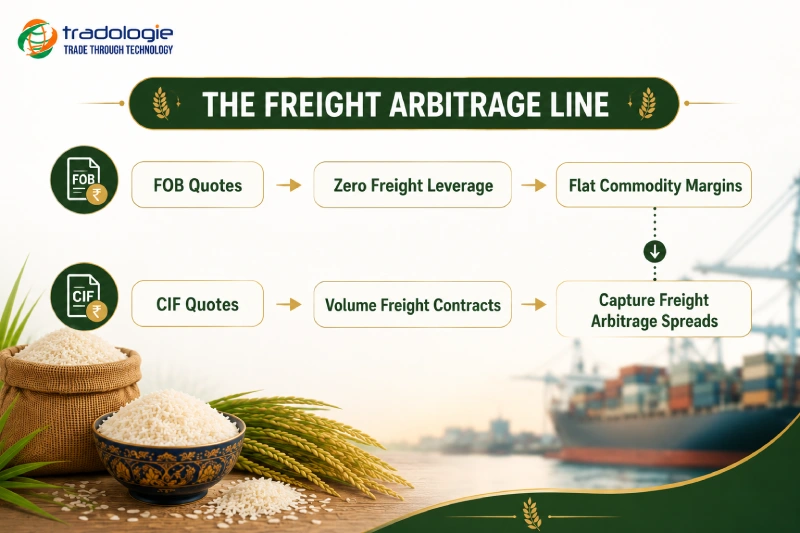
Under an FOB contract, your profit margin is entirely pinned to the local price spread of the raw commodity. If your sourcing costs rise or a domestic crop shortage hits, you have no way to optimize your earnings.
CIF sourcing alters this commercial dynamic by turning the logistics chain into an active profit center. If your enterprise moves significant volume annually, you can secure deeply discounted freight rates from major lines. By billing the foreign buyer at standard market freight rates while settling with the carrier at your discounted volume rate behind the scenes, you capture a healthy arbitrage spread. This logistics margin keeps your business highly profitable even when underlying commodity prices are completely flat.
Best Ports in India for FOB/CIF Agro Exports
Where you choose to ground your container boxes determines your inland transport costs, reefer access, and global ocean line connectivity.
- Nhava Sheva (JNPT, Maharashtra): The absolute premier gateway for containerized agricultural exports. Featuring high-capacity automated terminal systems and exceptional reefer plugging infrastructure, this hub handles massive volumes of fresh produce, spices, and premium basmati rice heading toward Europe and the Middle East.
- Mundra Port (Gujarat): A privately managed logistical powerhouse. Mundra offers deep-water berths capable of handling massive bulk grain vessels, making it the top choice for large-scale wheat, corn, and de-oiled cake shipments.
- Chennai Port (Tamil Nadu): The strategic maritime terminal for South Indian agricultural belts, dominating containerized shipments of red chillies, turmeric, and oilseeds heading into Southeast Asian markets.
- Kandla Port (Gujarat): Heavily utilized for non-containerized bulk agricultural movements, Kandla specializes in high-volume, cost-efficient break-bulk shipments of sugar, salt, and animal feed to developing markets.
Incoterms 2020 vs Older Incoterms
Failing to keep up with updating international shipping regulations can expose your export business to severe, uncovered liability gaps.
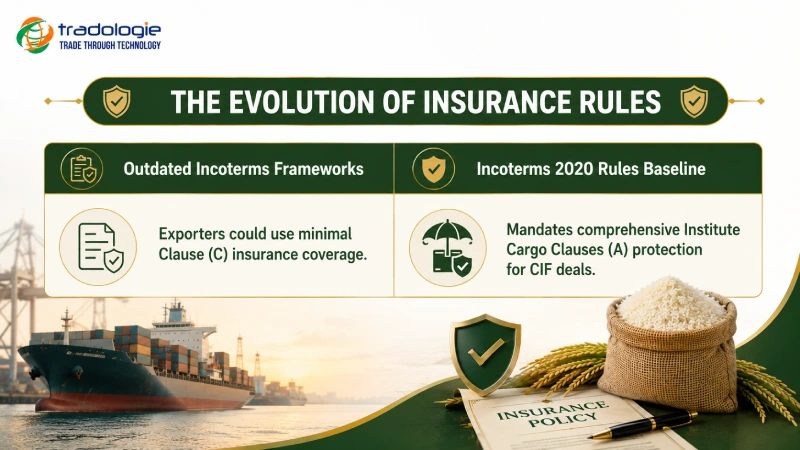
Under older versions of global shipping terms, exporters executing a CIF contract could fulfill their legal duties by purchasing basic, low-cost insurance policies—specifically utilizing Institute Cargo Clauses (C). These minimal policies only covered catastrophic events like a total vessel shipwreck, leaving traders exposed to standard transit damage.
The updated Incoterms 2020 rules completely changed this baseline for CIF transactions, mandating that the seller must secure comprehensive, top-tier insurance protection that aligns with Institute Cargo Clauses (A). This comprehensive coverage protects the cargo value from standard transit risks, including container water leakage, color damage, or localized theft, ensuring real safety for modern B2B transactions.
Risk Management Checklist Before Finalizing CIF Contracts
Before your executive desk signs off on an international container commitment, ensure your operations team runs through this critical safety checklist:
- Ocean Freight Rate Locked: Is your written freight quote from the carrier valid for the entire shipping window, or are you exposed to sudden spot-market surcharges?
- Marine Insurance Clauses Verified: Does the underwriting policy feature specialized agricultural protections, such as heating, sweating, or cold-chain breakdown clauses?
- Letter of Credit Verbiage Matched: Does every single word in your commercial invoice and draft Bill of Lading align perfectly with the specific terms laid down by the issuing bank?
- Container Free-Time Confirmed: Have you secured at least 14 days of destination detention free-time to protect your buyer from sudden customs delays?
- Weight Shrinkage Margin Allowed: Have you explicitly written a weight tolerance clause into the contract to handle natural moisture loss during long sea transits?
Country-Specific Buyer Preferences
Understanding the regional habits of international purchasing managers helps optimize your initial sales pitches.
- The Middle East Hubs (UAE, Saudi Arabia): Procurement heads in the GCC heavily favor CIF or CFR terms. These markets import immense volumes of consumer-packed rice and fresh produce, and they expect the exporter to handle the entire logistical journey straight to their main regional hubs.
- The African Corridors: Buyers across emerging African terminals lean strongly toward full-service CIF offers. Due to localized banking rules and volatile regional freight access, these importers prefer comprehensive quotations where all transport risks and insurance protections are completely wrapped into a single price.
- The European & US Retailers: Buyers in Western markets frequently demand FOB or strict CIF terms. If they are a massive retail brand, they will use their own massive container contracts under FOB lines. If they are a boutique distributor, they will demand high-spec CIF coverage backed by clean, independent lab certificates.
Digital Transformation in Agro Exports
The era of relying on messy, uncoordinated paper document chains and slow communication channels to move agricultural tonnage is coming to a close.
Modern, high-volume agri-businesses are rapidly integrating their logistics lines with advanced digital trade platforms. The widespread adoption of Electronic Bills of Lading (e-BL) is completely transforming the industry, allowing exporters to legally transfer cargo title deeds digitally within minutes instead of waiting days for expensive paper couriers to clear international borders.
Furthermore, global supply chains are leveraging automated AI enabled B2B solutions like Tradologie.com to run their cross-border trade operations. Plugging directly into these centralized channels helps you find the most genuine agriculture buyers and streamline your compliance steps. It can also help you connect with the best CHAs that provide the best custom clearance service.
Furthermore, global supply chains are leveraging automated AI enabled B2B solutions like Tradologie.com to run their cross-border trade operations. Plugging directly into these centralized channels helps you find the most genuine agriculture buyers and streamline your compliance steps. It can also help you connect with the best CHAs that provide the best custom clearance service.
Disclaimer
The shipping practices, pricing structures, freight estimates, and trade recommendations mentioned are for informational purposes only and may vary depending on freight markets, Incoterms updates, port conditions, and international trade regulations. Exporters should verify all logistics and contractual details before shipment execution.



-oil-export-from-india-process--markets.webp "Groundnut Oil Export from India: Process & Markets")