Key Highlights
- India exported $12.47 billion worth of rice (20.19 MMT) in FY 2024–25.
- Basmati contributes $5.94 billion (high-margin segment) vs Non-Basmati $6.53 billion (volume-driven).
- Top Basmati markets: Saudi Arabia, Iraq, Iran, UAE.
- Top Non-Basmati markets: Benin, Guinea, Bangladesh, Vietnam.
- Saudi Arabia alone imports $1.2B+ Basmati rice (premium market).
- Benin leads Non-Basmati imports with $1.02B (volume hub for Africa).
- India controls 30%+ of global rice trade, acting as price setter.
- Basmati offers 15–25% margins, while Non-Basmati is volume-drive.
Introduction:
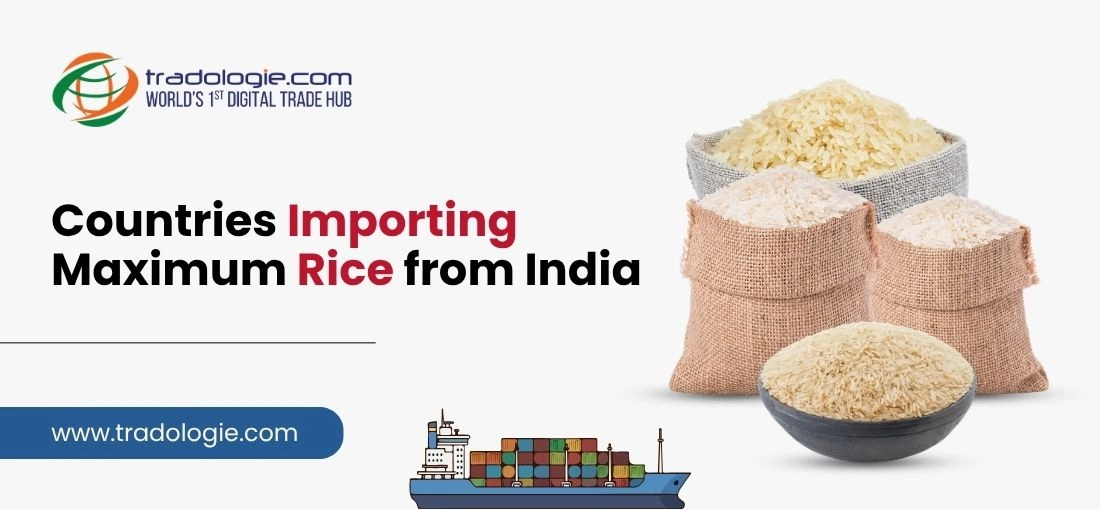
In the global trade war for food security, India isn’t just a participant; it’s the apex supplier. If you're looking for the top importers of Indian rice, you aren't just looking at a list of countries—you’re looking at the caloric backbone of 150 nations. In 2026, the global rice market doesn't move unless India says so. Whether it’s the high-margin aromatic contracts of the Middle East or the massive tonnage required to stabilize West Africa, Indian exporters are currently holding the world’s most critical commodity leverage.

The numbers for FY 2024-25 are a blunt instrument of dominance. According to APEDA data, India’s rice exports hit a record $12,472.20 million, moving over 20.19 million metric tons (MMT) across global docks. This isn't just "growth"—it's a market capture. This total is split between 6,065.50 (000' MT) of premium Basmati (valued at $5,944.50 million) and 14,129.00 (000' MT) of Non-Basmati (valued at $6,527.70 million). This blog cuts through the noise to show you exactly where the money and the tonnage are flowing in 2026.
Overview of India’s Rice Export Market
In 2026, the Indian rice export market isn’t just leading; it’s suffocating the competition. While other origins struggle with yields, India moved a staggering 20.18 million metric tons (MMT) of rice globally last year. This isn't a "steady supply"—it's a total market corner. According to APEDA, India has effectively weaponized its surplus, commanding over 30% of the global rice trade and acting as the definitive price setter for the planet.
The market is split into two ruthless battlegrounds. Basmati rice, the high-margin aromatic king, accounts for roughly 30% of total export volume (6.06 MMT), yet it pulls in nearly half the total revenue ($5.94 billion) due to its aggressive premium pricing in the GCC. On the other side, non-basmati rice is the high-velocity engine, moving 14.12 MMT (70% of volume) to satisfy the relentless tonnage requirements of bulk rice importers in West Africa and Southeast Asia.
Key Market Metrics (FY 2024-25)
| Metric | Value |
|---|---|
| Total Rice Export Value | $12,472.20 Million (₹1,05,720 Crore) |
| Basmati Export Volume | 6,065.50 (000' MT) |
| Non-Basmati Export Volume | 14,129.00 (000' MT) |
| Non-Basmati Value Share | ~52% |
| Key Regions | Middle East (GCC), West Africa, Vietnam |
The Tactical Shift: In 2026, the real money isn't just in raw grain. The India rice market, which generated $54,466.4 million in 2021, is on a collision course with a $65,431.5 million valuation by 2028. According to Grand View Research, while long-grain remains the largest revenue generator, the medium-grain segment is the fastest-growing lucrative product on the board. If you aren't already targeting this segment, you’re missing out on the most aggressive part of the market's 2.7% CAGR.
Top Countries Importing Maximum Rice from India
The geography of Indian rice trade is a map of global dependency. Whether it’s the elite dining tables of the GCC or the essential silos of West Africa, India’s export machinery is the primary driver. If you are tracking the top importers of Indian rice, you have to separate the volume-heavy markets from the high-margin, quality-obsessed corridors.
For Basmati rice importers, the game is won in the Middle East. Saudi Arabia and Iraq remain the apex predators in this segment, together devouring nearly $2.05 billion worth of premium long-grain. Conversely, Non-Basmati rice importers look toward the African continent to anchor their food security. Benin alone accounts for a staggering $1.02 billion in non-basmati value, acting as the definitive volume hub for the region.
Core Ranking: Leading Destinations for Indian Rice (FY 2024-25)
| Country | Type of Rice | Import Value (USD Million) | Market Strategy |
|---|---|---|---|
| Saudi Arabia | Basmati | $1,203.67 | Premium: High-margin, long-grain obsession. |
| Benin | Non-Basmati | $1,025.38 | Volume: High-velocity essential supply. |
| Iraq | Basmati | $850.08 | Premium: Consistent high-value demand. |
| Iran | Basmati | $753.20 | Premium: Strategic long-term buyer. |
| UAE | Basmati + Re-export | $364.55 | Trade Hub: Strategic gateway to the GCC. |
| Bangladesh | Non-Basmati | $358.82 | Price-Sensitive: Critical neighboring demand. |
The Tactical Insight: While the USA is a major player in the broader APEDA basket ($1.96 billion), it is not the primary driver for raw rice tonnage. In 2026, the real commercial gravity for rice is in the GCC, where markets like Saudi Arabia represent the main event. If you aren't positioning your brand in the GCC or scaling for West Africa, you are missing the two most aggressive profit centers in the world.

Top Countries Importing Maximum Rice from India
In the global trade for long-grain aromatic rice, Basmati Rice Importers in the Middle East aren't just buying a staple; they are buying a status symbol. The GCC remains the high-margin fortress for Indian exporters, where rice is the center of the culinary identity.
Why These Markets Pay a Heavy Premium
- Technical Perfection: Buyers in Saudi Arabia ($1,203.67M) and Iraq ($850.08M) demand "super-long" grains that remain separate and fluffy after cooking.
- Aroma and Aging: Premium importers pay for the "vintage"—Basmati that has been aged to reduce moisture and intensify the natural nut-like aroma that defines Biryani and Mandi cultures.
- Clean Audit Trails: Unlike volume-driven markets, the GCC increasingly requires high-spec laboratory clearance, prioritizing the "paper" guarantee of purity over the raw grain itself.
Consumer Preferences That Drive the Price
- Elongation Ratio: Consumers in Iran ($753.2M) and Saudi Arabia prioritize "extra-long" grains (often exceeding 8.2mm) that stretch significantly upon cooking.
- Aesthetic Synergy: In trade hubs like the UAE ($364.55M), Basmati is sold alongside high-end saffron and cardamom, creating a luxury food ecosystem.
- Purity over Price: These markets have a zero-tolerance policy for "broken" percentage; the higher the whole-grain count, the more aggressively the premium spikes.
| Country | Import Value (USD Million) | Market Share in Basmati Segment | Primary Preference |
|---|---|---|---|
| Saudi Arabia | $1,203.67 | 20.25% | Extra-long grain, premium aroma. |
| Iraq | $850.08 | 14.30% | High-grade whole grain consistency. |
| Iran | $753.20 | 12.67% | Volume-value hybrid; aged varieties. |
| UAE | $364.55 | 6.13% | Re-export quality; high-end retail. |
| Yemen | $358.34 | 6.03% | Traditional long-grain staples. |
The Trade Reality: For Basmati Rice Importers, the invoice reflects a solution for "luxury dining". In 2026, if your grain doesn't hit specific aroma and elongation specs, you're losing a contract in a segment driving $5,944.50 million of India's total export value.
Top Non-Basmati Rice Importing Countries
In the global grain market, Non-Basmati Rice Importers represent the high-velocity engine of the industry. While Basmati dominates the premium shelf, Non-Basmati is a matter of geopolitical survival. In 2026, the trade is about calorie-per-dollar efficiency and the logistical muscle required to anchor national food security for millions.
The Economics of the Non-Basmati Trade
- Aggressive Price Sensitivity: These markets operate on razor-thin margins where even a $10 shift in the Free On Board (FOB) price can redirect a 50,000-ton vessel overnight.
- G2G Dominance: A significant portion of this tonnage moves through state-controlled tenders to bypass private-sector volatility and ensure national stock stability.
- The Food Security Mandate: For nations in West Africa and Southeast Asia, Indian non-basmati is the primary caloric insurance policy against domestic inflation and climate-driven crop failures.
Market Drivers in the "Mass-Market" Segment
- Broken Rice Demand: Countries like Vietnam ($1,294.23M total APEDA basket) utilize high volumes of broken rice for industrial processing and animal feed.
- West African Logistics: Benin ($1,025.38M) acts as the definitive gateway, absorbing massive tonnage for regional trade across the African corridor.
- Policy Leverage: The removal of Indian export duties has lowered the entry barrier, allowing Non-Basmati Rice Importers to stock up on 5% and 25% broken varieties at prices competitors struggle to match.
| Country | Import Value (USD Million) | Share in Non-Basmati Segment | Primary Driver |
|---|---|---|---|
| Benin | $1,025.38 | 15.71% | Regional food security and re-export hub. |
| Guinea | $536.00 | 8.21% | High-volume domestic staple demand. |
| Cote d'Ivoire | $520.30 | 7.97% | Urbanization-led consumption growth. |
| Togo | $421.50 | 6.46% | Strategic West African volume play. |
| Bangladesh | $358.82 | 5.50% | Critical neighboring price-sensitive demand. |
The Tactical Edge: In 2026, the profit in the non-basmati segment is found in "frictionless trade". As APEDA data proves, the $6,527.70 million non-basmati market belongs to those who move massive tonnage without a single certification delay.
Basmati vs Non-Basmati Trade Dynamics
In the 2026 rice market, the choice between Basmati and Non-Basmati is about your entire commercial architecture. The Indian export machine runs on a "dual-engine" strategy: capturing elite margins in the West while anchoring global food security via massive tonnage in the East and South.
| Factor | Basmati Rice | Non-Basmati Rice |
|---|---|---|
| Market Value (FY 2024-25) | $5,944.50 Million | $6,527.70 Million |
| Primary Pricing Driver | Aroma, Aging, Grain Length | Caloric Efficiency, Logistical Speed |
| Buyer Profile | Premium Markets (GCC, USA) | Bulk Rice Importers (Africa, Asia) |
| Commercial Margin | High (Targeting 15–25% premiums) | Volume-driven (Narrower but predictable) |
| Key Regions | Saudi Arabia, Iraq, USA | Benin, Guinea, Vietnam |
The Tactical Reality: In 2026, you cannot survive on volume alone. The India rice market favors the "barbell strategy"—leveraging the 14,129.00 (000' MT) non-basmati tonnage to bankroll the high-spec certifications needed to dominate the long-grain revenue segment. Success belongs to those who treat Basmati as a brand and Non-Basmati as a utility.
Who Are the Bulk Rice Importers?
In the 2026 landscape, bulk rice importers are solving specific industrial or national problems. To dominate this $12.47 billion export corridor, you must understand the "pain point" you alleviate—whether it is national food security or factory-line consistency.
| Buyer Segment | Primary Market | Key Requirement | Value Driver |
|---|---|---|---|
| State Tenders | GCC, Iran, Iraq | Huge Tonnage | National Stock Stability |
| Industrial Food | USA, EU | Lab Repeatability | Consistency in Processing |
| Logistics Hubs | UAE (Dubai) | Re-export Velocity | Strategic Trade Positioning |
| Retail Giants | EU, USA | Clean Audit Trail | Compliance & Brand Purity |
Opportunities for Indian Rice Exporters
The 2026 landscape for the India rice market is a sophisticated play for technical dominance. With the market projected to hit a $65,431.5 million valuation by 2028, opportunities lie in moving beyond raw commodities into high-spec, value-added segments.
The Three Growth Frontiers
- Capturing Premium Basmati Strongholds: Basmati Rice Importers in Saudi Arabia ($1,203.67M) and Iraq ($850.08M) pay for the "science" of grain elongation, aroma, and lab-verified purity.
- Dominating African Volume Corridors: Non-Basmati Rice Importers in Benin ($1,025.38M) and Guinea ($536M) provide the necessary tonnage to anchor global operations.
- Scaling Value-Added Segments: * Medium-Grain Surge: Identified as the fastest-growing lucrative product for industrial food processors.
- Fortified & Parboiled Mandates: Demand is exploding within G2G tenders as global food security standards tighten.
- Direct Digital Trade: In 2026, a significant portion of India's 20.19 MMT is bypassing traditional middlemen through digital B2B corridors.
Challenges in Exporting Rice Globally
Cracking the global market in 2026 is a high-stakes battle against technical and geopolitical barriers. For anyone in the India rice market, the "price premium" is effectively a "compliance fee"
The Primary Margin-Killers
- Export Bans & Restrictions: Sudden policy shifts or Minimum Export Prices (MEP) can trap inventory overnight.
- Extreme Price Volatility: Domestic inflation often triggers government intervention, causing FOB prices to swing violently.
- Logistical Volatility: Rising container costs and bottlenecks can erode a 20% profit margin instantly.
- Currency Fluctuations: USD/INR parity flux can transform a profitable deal into a loss before the vessel clears the Suez Canal.
- Tightening MRL Standards: The "Maximum Residue Limit" is the biggest threat; a single batch failing a pesticide screen can lead to a total export blacklist.
In today’s global trade environment, exporters increasingly rely on structured platforms that enable direct interaction with verified buyers across multiple countries. These systems streamline bulk trade by ensuring transparency in pricing, quantity, and payment processes, making it easier for suppliers to scale internationally. Close Bulk Export Deals Faster
Conclusion
The 2026 rice trade has no room for the "commodity-only" mindset. With India’s export value hitting a record $12,472.20 million, profitability is now a high-stakes game of technical compliance. While high-volume corridors in Africa provide the necessary scale, the elite margins are reserved for exporters who can clear the regulatory walls of the GCC and USA. Success requires a brutal "barbell" strategy: use the massive 14.12 MMT non-basmati tonnage to bankroll the certifications needed for high-spec contracts. In this market, you aren't selling grain—you're selling a lab-verified guarantee
Disclaimer
The information provided in this article is based on industry data, APEDA reports, and global market estimates. Export values, demand patterns, and country-wise imports may vary depending on government policies, global trade conditions, and market fluctuations. Readers are advised to verify regulations, pricing, and compliance requirements before engaging in rice export activities.
Author Profile
Pravarsh Sharma – Trade Export Specialist, Tradologie.com
Pravarsh Sharma is a trade export specialist at Tradologie.com, actively involved in global B2B commodity trade and international buyer-supplier connections. With practical experience in rice exports, market analysis, and compliance processes, he provides actionable insights to help exporters identify high-demand markets and scale efficiently in global trade.