
Which Rice Variety Is Best for Export in 2026?
Key Highlights
- New markets rarely reward bulk rice exporters who try to do everything at once. The ones who grow steadily are usually the ones who stick to a couple of products they truly understand and build trust around those.
- It's often easier to sell into countries that already buy what you produce. Creating demand from scratch sounds exciting, but in reality, steady existing demand is what keeps containers moving.
- A lot of trade success comes down to boring basics — paperwork, approvals, clean documentation.
- Bulk rice buyers don't discover suppliers in just one place anymore. Some still meet you at fairs, some through references, others simply find you online while searching. Visibility matters more than most exporters think.
- In bulk food trade, reliability tends to win the long game. A shipment that arrives exactly as promised usually does more for business than shaving a few dollars off the price.
- Expansion almost never feels dramatic. It usually grows slowly — one order, then another, then a repeat contract — until suddenly you realize a new market has become regular business.
Reading the Market Through Volumes, Value, and Buyer Behaviour
In rice exports, the word best can be misleading. Trade rarely works in absolutes and top rice varieties. What succeeds in one geography may stall in another, and what looks attractive on paper can fall apart once freight, duties, and landed cost enter the equation. Bulk rice buyers don't choose varieties based on reputation alone — they choose what fits their economics.
So when bulk rice exporters ask which rice will lead in 2026, the answer isn't about trends or speculation. It's about studying what has already been moving steadily through ports and contracts over the past few seasons. Because in commodities, history is often the most reliable forecast.
Basmati: The Value Leader That Keeps Finding Buyers
If you step back from the tonnage charts and look at what actually lands in the bank account, basmati tells a different story. It may not be the heaviest mover on the docks, but it consistently punches above its weight in value. Data from India's Directorate General of Commercial Intelligence & Statistics shows shipments hovering around 5.24 million tonnes in FY 2023-24, yet bringing in close to USD 5.84 billion. In trade terms, that's quiet strength — fewer tonnes, but better money per container.
Those numbers tell an important story. Basmati doesn't dominate through sheer volume. It wins through price realization. Each tonne carries more value, and that margin cushion makes a difference when freight costs or currency rates fluctuate.
For many importers — especially across the Gulf, Europe, and North America — basmati isn't optional or seasonal. It's a staple tied to established retail shelves and foodservice menus. That built-in demand makes it easier to contract ahead and plan inventory with confidence.
- Higher per-tonne realization
- Strong diaspora-driven consumption
- Brand recognition across markets
- Better margins even at moderate volumes
If your export strategy prioritizes profitability over sheer scale, basmati usually sits at the center of the discussion.
Non-Basmati: The Volume Engine of the Trade
At the same time, it would be a mistake to overlook non-basmati. While basmati leads in value, non-basmati leads decisively in scale. In FY 2023-24, India shipped close to 11.1 million tonnes of non-basmati rice — more than double the basmati figure.
That difference isn't just statistical. It reflects how this category functions in global trade. Non-basmati is the grain of tenders, institutional procurement, and price-sensitive markets. Governments, aid agencies, and bulk distributors aren’t looking for aroma or premium packaging; they’re looking for dependable calories at the right landed cost.
Margins here are thinner, yes. But containers move faster, and contracts are often larger and more repeatable. For many bulk rice exporters, this segment keeps warehouses turning.
- Ideal for tenders and public procurement
- Competitive pricing for bulk rice buyers
- Faster stock rotation
- Larger, repeat shipments
If basmati is a value play, non-basmati is an operations play.
Policy Risk Matters as Much as Demand
Another lesson from recent seasons is that demand alone doesn't decide exports. Policy does too.
Non-basmati shipments have seen interruptions when export restrictions or duties were introduced, even though global buyers were still willing. That gap between demand and actual trade is something bulk rice suppliers can't ignore. A variety may be commercially strong and still become difficult overnight if regulatory conditions shift.
This is why experienced exporters rarely depend on one category.
- Monitor export policies alongside prices
- Spread risk across multiple SKUs
- Avoid overexposure to a single segment
- Plan inventory with flexibility
In practical terms, diversification is often the best hedge.
Destination Economics Decide the Winner
What often gets missed in “which variety is best” debates is geography. The same rice that sells quickly in Dubai may struggle in West Africa. Preferences are not universal — they're regional.
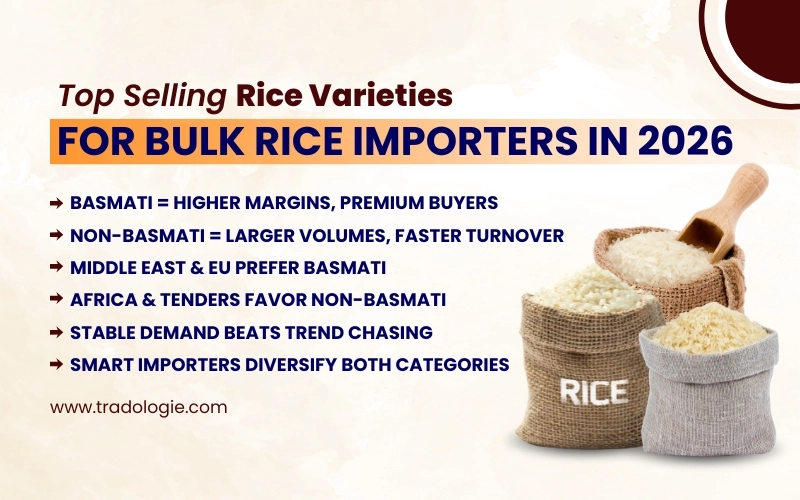
Basmati continues to flow strongly into the Middle East, the US, and the UK, where consumers are accustomed to its cooking characteristics. Non-basmati, meanwhile, dominates across Africa and other price-sensitive markets where affordability and availability matter more than branding.
So the smarter question becomes: which rice fits your target country's buying pattern?
- Middle East retail → Basmati Rice
- Premium supermarkets → Basmati Rice
- Government tenders → Non-basmati Rice
- Institutional catering → Non-basmati Rice
Trade alignment beats product superiority every time.
What 2026 Is Likely to Look Like
No exporter has next year's numbers yet. But trade patterns tend to evolve gradually rather than dramatically. Looking at recent volumes and values, it's reasonable to expect both categories to remain important — just in different ways.
Basmati should continue anchoring profitability. Non-basmati should continue driving tonnage. Together, they create balance.
That's why most seasoned bulk rice suppliers don't treat this as an either-or decision. They build portfolios that mix both. One stabilizes margins; the other stabilizes volumes. And that combination smooths out shocks.
- Basmati for earnings
- Non-basmati for scale
- Mixed strategy for resilience
- Long-term contracts over short-term bets
In commodities, consistency usually beats chasing the “next big thing.”
So, Which Variety Is Really Best?
If the question must be answered simply: basmati often wins on price, non-basmati wins on quantity. But in reality, neither works alone.
The best variety is the one your buyer already understands, already stocks, and already budgets for. Because in export trade, success isn't about novelty. It's about predictability.
And right now, the numbers suggest one clear conclusion: 2026 won't be about choosing one rice over the other. It will be about managing both wisely.
That's not exciting. But in bulk trade, steady rarely needs to be.



.webp "Jasmine Rice vs Basmati Rice – Comparison for International Importers (2026)")
.webp "Sustainable Rice Farming Practices: Benefits & Guide")