Rice Production in India: Top 10 Highest Rice Producing States (State-Wise Data)
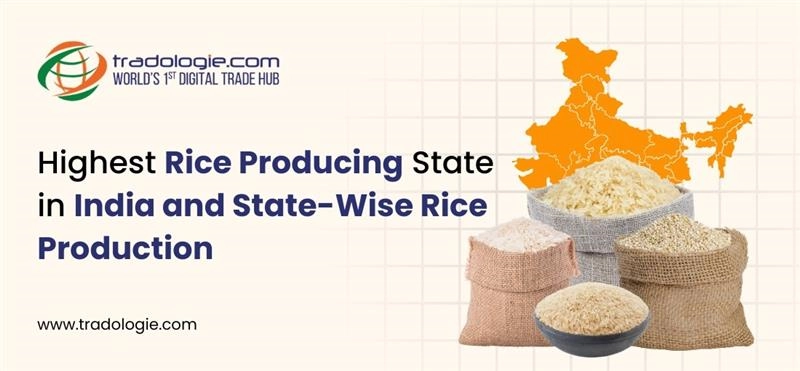
Uttar Pradesh is the number one rice-producing state in India. Telangana and West Bengal come next. Punjab and Chhattisgarh also top the list.The Economic Survey 2025-26 highlights a clear fact. These states grow a huge part of India's total rice crop. They have a few major advantages. Their soil is very rich. Their water systems are massive. Also, the weather is very good.
We need to look deeper to understand this whole picture. We must review the data state by state. We must explore the different farming methods used. Finally, we must look at how export numbers are changing.
Key Facts About Rice Production in India
India's role in the global rice market is unmatched. The scale of farming is massive, and the export volumes are equally impressive. Here are some key facts:
- Huge Output: India made a record 150.18 million tonnes of rice in the crop year 2024-25. This is a big increase from the 137.82 million tonnes made the year before. (Source: Department of Agriculture and Farmers Welfare)
- Top Exporter: India was the world's biggest rice exporter in 2024-25, sending out about 19.86 million tonnes. These shipments brought in about $12.95 billion for the country. (Source: Krishi Ujala)
- Market Share: India is responsible for about 40% of the world's rice exports. This huge share makes the country a big player in setting prices around the world.
- Total Acreage: India grows rice on about 51.27 million hectares of land. This is the biggest piece of land in the world that is used to grow rice.
- Strategic Policy: To keep the food supply safe in India, the government often uses tariffs and bans on exports. When India recently lifted restrictions on non-basmati white rice, for example, global prices fell right away, putting pressure on competitors like Thailand and Pakistan. (Source: S&P Global)
Top 10 Rice Producing States in India
State-level contributions vary greatly. Some regions focus on local consumption. Others focus heavily on export markets. Historically, West Bengal held the top spot. However, recent final estimates show a shift in leadership.
Below is the updated list for the 2024-25 crop year.
| Rank | State | Rice Production (Million Tonnes) | Cultivation Area (Million Hectares) |
| 1 | Uttar Pradesh | 20.76 | 7.35 |
| 2 | Telangana | 17.45 | 4.81 |
| 3 | West Bengal | 16.02 | 5.59 |
| 4 | Punjab | 14.36 | 3.24 |
| 5 | Chhattisgarh | 10.37 | 3.91 |
| 6 | Odisha | 9.53 | 3.83 |
| 7 | Madhya Pradesh | 9.11 | 3.89 |
| 8 | Bihar | 8.30 | 3.24 |
| 9 | Andhra Pradesh | 7.34 | - |
| 10 | Tamil Nadu | 6.80 | - |
Rice Production in India State Wise
Rice production is not spread out evenly across the country. The physical landscape and the availability of water heavily dictate how much crop is grown. Due to the fact that these variables vary by location, we observe three different regional patterns:
- The Northern Surplus: Punjab and Haryana in the north mostly use artificial canals to water their crops. This lets them grow a lot of grain every year. A large part of this extra grain goes straight into the central government's food pool. Much of it is also shipped globally, with their premium Basmati rice fetching incredibly high prices overseas.
- The Eastern Local Demand: Eastern states tell a different story. The Gangetic plains' extremely fertile soil is used by places like West Bengal and Bihar. Heavy monsoon rains also provide them with a lot of natural water, which leads to massive production. But a lot of it never leaves the area because the locals eat so much of it every day.
- The Southern River Basins: Southern states make use of the natural power of river deltas. The Krishna and Cauvery basins provide Andhra Pradesh and Tamil Nadu with water directly for their fields. Farmers here grow strong, high-yielding types of rice. This grain is often sold to other Indian states and is heavily exported to markets in Africa and the Middle East.
Rice Cultivation in India
Rice is frequently referred to as a semi-aquatic plant. This is due to the fact that it requires a very particular type of environment in order to grow. The Kharif season is when rice is primarily grown in India. The heavy summer monsoon rains have a direct effect on how well the harvest goes. The start of the farming season is when the rains are at their worst. The rainy months of June and July are typically when this occurs. During this time, farmers sowed the first seeds. The plants will reach full maturity later in the year. The end of the active farming season is marked by the harvest in November or December.
It takes a lot of hard work to grow this crop. The hard work starts with preparing the earth. Farmers must plow their land deeply and thoroughly to get the dirt ready. Once the soil is prepped, they completely flood the open fields with water. While this is happening, tiny rice seedlings are growing safely inside separate nursery beds. The workers wait until these baby plants are strong enough. Then, they carefully pull them out by hand. Finally, they manually plant each individual seedling directly into the wet, muddy fields.
Keeping a deep layer of standing water in the fields is absolutely essential for a good harvest. This standing water does two very important jobs for the plants. First, it acts as a natural shield to stop unwanted weeds from taking over. Second, it keeps the temperature of the soil perfectly steady. Therefore, a normal paddy field requires a constant supply of water. This is especially true when the plants are still vulnerable and very young. Farmers apply novel fertilizers to the soil to increase their success even more. Additionally, they select unique seeds that are intended to produce enormous crops. They can harvest as much grain as possible from each hectare by combining all of these clever farming methods.
Largest Rice Producing State in India
Uttar Pradesh currently holds the title for beingIndia's largest rice-producing state. It recently claimed this number one spot. In doing so, it finally overtook West Bengal. The harvest numbers coming from the state are truly huge. For example, we can look at the farming year 2024–2025. During this time, the state brought in an amazing 20.76 million tons of grain.
How is such a massive output possible? Several key advantages play a big role. We can break down the main reasons for this success:
- Plenty of Space: The state has a very large amount of open farmland available for planting.
- Great Soil: It is located right on the Indo-Gangetic plain. This specific area provides extremely rich and fertile earth for crops.
- Better Watering Systems: Uttar Pradesh has worked very hard to improve its water networks. Better irrigation brings water exactly where the crops need it most.
- Smarter Farming: Local farmers are constantly learning. In their fields, they have begun utilizing updated, contemporary farming techniques.
Government support is the final piece of the puzzle. The state has reliable buying policies in place. These policies make farmers feel safe about earning a living. Because they have this financial security, they are encouraged to plant even more fields with rice. All of these positive factors come together perfectly. They clearly show why Uttar Pradesh now leads the country in growing rice.
Major Rice Producing States in India
Uttar Pradesh holds the top spot. However, other important regions matter just as much. They act as the true backbone of India's farming economy. Year after year, these major states grow huge amounts of grain. Let's look at the next biggest producers.
Telangana
- Farming has grown very fast in this southern state.
- This quick growth happened fairly recently.
- A big reason for this is the government. Leaders built huge new water and irrigation projects.
- Because of this, dry lands changed completely. They turned into highly productive farms.
- Thanks to this amazing change, the harvest is now massive. Farmers here bring in 17.45 million tonnes of grain.
- This huge amount securely makes Telangana the second-largest rice producer in the country.
West Bengal
- People often call this eastern state the "Rice Bowl of India."
- The weather here stays very hot and humid. It feels like this all year long.
- This type of climate is absolutely perfect for rice. It lets local farmers plant seeds multiple times.
- In fact, they can grow two or even three crops in just one year.
- Recently, the state dropped a bit in the national rankings.
- Even so, it still adds a massive amount of food to the country's supply. It produces an impressive 16.02 million tonnes.
Punjab
- This northern state is very unique. It produces the most crops per hectare in the whole nation.
- Every year, it grows an amazing 14.36 million tonnes of rice.
- How do Punjabi farmers reach these high numbers? They rely heavily on advanced machines.
- The farmers use highly automated methods in their fields. This speeds up the farming process a great deal.
- Beyond feeding India, the state sells a lot of rice to other countries. It is a major player in the global export market.
- People all over the world know Punjab for one specific crop. It is famous globally for growing high-quality, long-grain Basmati rice.
Factors Affecting Rice Production in India
Many different things decide the success of a rice harvest. Both natural forces and human actions play a big part.
- Climate and Rainfall: Warmth is what rice plants want. Rice requires plenty of water and a hot climate (20–35°C). A poor monsoon is disastrous; rainfall should be between 100 and 200 cm. Insufficient rainfall can cause entire fields to fail.
- Soil Quality: The ground itself must be just right. Fertile clay or loamy dirt works best for this grain. These specific soil types act like a giant sponge. They hold onto water very well. The moisture does not drain away quickly. Instead, it stays right at the surface. Because of this, the rice roots stay safely underwater.
- Irrigation Infrastructure: Sometimes, the rain simply falls short. Many farming regions cannot rely on nature alone. Human engineering can assist in this situation. Large reservoirs, deep tube wells, and canals are essential to farmers. These water systems act as a lifeline. They provide the thirsty crops with fresh water directly. Appropriate irrigation saves the crop during unexpected dry spells.
- Government Policies: State rules deeply affect the agricultural market. The Minimum Support Price (MSP) acts as a strong safety net. It promises farmers a fixed base price for their grain. This financial promise builds market confidence. It pushes farmers to plant larger areas. Trade rules matter a great deal, too. Tariffs and export limits control the flow of goods. They decide how much rice stays inside the country. As a result, these decisions have an immediate impact on local market prices.
- Labor Availability: Rice farming requires a great deal of physical labor. It's a difficult task to plant the seeds. The final crop is equally difficult to harvest. Farmers, therefore, require sizable teams of manual laborers. There is occasionally a scarcity of farmhands. When workers are scarce, planting falls behind schedule. Even small delays hurt the crop cycle. In the end, these setbacks reduce the total grain output.
Importance of Rice Production in India
Growing rice is the absolute anchor of India's rural economy. Millions of farming families depend entirely on this crop to survive. It also ensures basic food security for over a billion people across the country.
From a global trade view, the importance of Indian rice is immense. India's export rules directly dictate global food inflation. If India decides to restrict its exports, prices around the world spike immediately. Many nations in Africa and the Middle East rely heavily on Indian grain to feed their people. India's ability to consistently grow 150 million tonnes helps stabilize the entire global food supply chain. Because of this, bulk traders watch India's monsoon weather very closely. A strong, successful harvest in India usually means stable food prices worldwide.
Rice Production in India Year Wise
India has shown a very steady upward trend in its total crop output. Better seed varieties have driven this impressive growth. Expanded irrigation networks have also played a huge role in boosting these numbers.
- 2021-22: Total national production stood at around 130 million tonnes.
- 2022-23: The total output climbed steadily to roughly 135 million tonnes.
- 2023-24: Overall production reached an impressive 137.82 million tonnes.
- 2024-25: The farming sector hit a massive, record-breaking 150.18 million tonnes.
This steady, year-over-year increase is incredibly important. It allows India to easily feed its rapidly growing population. At the same time, it provides a massive surplus of grain. This extra grain is then sold into the highly lucrative global export market.
Conclusion
The Scale and Scope of Production
In India, growing rice is an enormous undertaking. It requires a great deal of work each and every day. It is made possible by millions of diligent workers. Farming occurs across the entire nation. It can adjust to a wide range of weather conditions.
West Bengal, Telangana, and Uttar Pradesh are important states for this crop. Many people here at home are fed by this vital grain. It easily meets the daily food needs of the whole nation.
Global Impact and Future Growth
Beyond local borders, Indian rice also rules the world market. The country is a true giant in the global farming trade. Back on the farms, the ways workers get water to their fields are getting better all the time. New and smarter farming methods are also spreading quickly.
FAQ: Rice Production in India
Which state is the largest producer of rice in India?
Based on the latest government data from 2024-25, Uttar Pradesh holds the top spot. It is currently the largest producer in the country. It recently surpassed West Bengal to claim this title.
How much rice does India export globally?
India exported a massive amount of grain in the 2024-25 fiscal year. The total volume was approximately 19.86 million tonnes. This huge amount accounted for roughly 40% of all rice exports worldwide.
What are the main types of rice exported from India?
India exports large quantities of premium Basmati rice. The country also ships out massive volumes of standard non-basmati white rice . Additionally, parboiled rice makes up a large portion of these global exports.