Key Highlights
- Choosing the wrong setup will kill your margins before the vessel even leaves the dock.
- Bulk shipping lets you scale up volume, but it freezes your operational cash flow for weeks.
- Containers let you ship in smaller, rolling waves, which keeps your capital moving.
- If the destination port lacks automated silos, unexpected demurrage fines can ruin your deal.
- Isolated 25-ton container boxes protect your broader shipment from large-scale mold or sweat damage.
When you are trying to figure out how to ship thousands of tons of grain, sugar, or oilseeds across the ocean, picking between a massive bulk charter and a fleet of standard steel boxes isn't just a minor operational choice. It basically dictates your entire pricing structure. For decades, people drew the line strictly by volume. If you had a massive lot, it went into a ship hold. If you had a smaller, specialized batch, you packed containers.
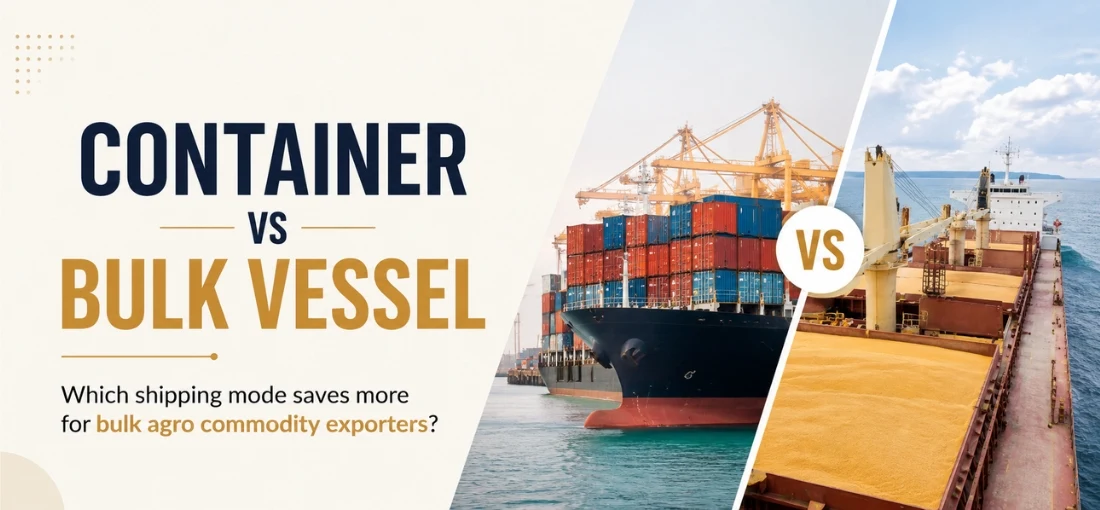
But the logistics world doesn't work that way anymore. Lately, massive swings in port congestion and container availability have completely flipped the old math of Container vs Bulk Vessel Shipping on its head.

If you are handling Bulk Agro Commodity Shipping, you have to look way past the baseline ocean freight quote a forwarder emails you. A cheap rate on paper means absolutely nothing if you ignore the ground realities—like port depth, slow unloading speeds on the other side, moisture damage during the voyage, and how much cash you are freezing at sea. This is especially true for large trading houses trying to export rice in bulk or aggressively shift seasonal varieties across global food corridors.
Capital Flow: The Reality of Aggregation vs Rolling Cash
The single biggest difference between these two modes comes down to cash. Chartering a bulk vessel means you are committing to move huge quantities—often anywhere from 10,000 to 50,000 tons at once.
Think about the physical grind of that setup. Buying 30,000 tons of corn or wheat from local mandis takes time. Your capital sits dead for weeks while you accumulate the grain, stays dead while the ship docks, and remains completely trapped during the long sea voyage. For a mid-sized trading desk, that sudden cash crunch can completely break your liquidity, wiping out whatever discount you thought you got on bulk ocean freight.
Using Container Shipping for Agricultural Exports completely changes that financial rhythm. Instead of taking one massive capital hit, you break your contract into manageable, rolling weekly waves of 500 or 1,000 tons. You can buy the grain, stuff the boxes, ship them out, and cash out your Letters of Credit continuously. This rolling setup keeps your working capital fluid and heavily protects your business if local mandi prices happen to crash while you are trying to piece a massive bulk lot together. This agility is a game-changer for businesses that export spices in bulk, where product values are incredibly high and holding massive inventory pools at origin introduces heavy financial exposure.
The Destination Port Bottleneck: Infrastructure Pitfalls
A massive trap in Bulk Agro Commodity Shipping is assuming the discharge port on the other side can handle your cargo arrangement smoothly.
Bulk vessels need heavy, highly specialized infrastructure. We are talking deep-water berths, high-speed vacuum unloaders, conveyor systems, and massive dockside silos. If your destination market—especially regional gateways across parts of Southeast Asia or East Africa—lacks these setups, your ship is going to sit at anchor for weeks. Workers will be forced to unload your grain slowly using mechanical grabs or basic ship cranes. That delay triggers brutal, daily demurrage penalties that instantly drive up your total Bulk Cargo Shipping Costs.
Containers avoid this entire mess. They can land at virtually any container terminal on the globe. The moment they hit the dock, they transfer straight onto a truck chassis or rail line for direct inland transport. If your buyer is an internal processing plant situated 300 kilometers away from the coast, receiving a steady fleet of pre-bagged containers saves them from the secondary nightmare of unloading a bulk barge, paying for on-dock bagging lines, and scrambling to hire local trucks.
Breaking Down the Logistical Expenses
To see where the money actually goes, you have to track the grain from the internal sourcing mandi down to the international destination gate. The table below traces a typical baseline cost comparison for high-density agricultural grains moving along standard commercial corridors.

Comparative Logistics Chain Expenses (Estimated USD per MT)
| Logistical Cost Component | Bulk Vessel Transport Mode | Containerized Freight Mode | Primary Operational Variable |
|---|---|---|---|
| Inland Freight to Port | $18 – $24 | $14 – $20 | Containers allow rolling rail/truck drop-offs; bulk requires heavy terminal accumulation. |
| Port Storage & Handling | $6 – $10 | $4 – $7 | Bulk cargo incurs steep warehouse ground rent while awaiting the vessel charter window. |
| Loading & Stuffing Lines | $3 – $6 | $5 – $9 | Bulk utilizes high-speed gravimetric spouts; containers require specialized grain throwers. |
| Base Ocean Freight | $28 – $38 | $35 – $50 | Bulk scales cost down with volume; containers depend heavily on liner schedules and box availability. |
| Destination Discharge & Bagging | $12 – $18 | $2 – $5 | Bulk cargo requires slow mechanical grabs and on-dock bagging lines; containers move straight to chassis. |
| Tentative Total Cost Basis | $67 – $96 | $60 – $91 | Final combined logistical spend from sourcing origin to final terminal. |
Logistical Pricing Disclaimer: The cost projections detailed in this breakdown are based on representative global freight averages and seasonal trade lane performance.
Protecting the Grain: Sweat, Rot, and Cargo Insulation
When calculating your total Bulk Cargo Shipping Costs, you have to account for the physical vulnerability of your agricultural inventory while it sits in transit. Crops are biochemically active biological entities. They breathe, they release moisture, and they react violently to temperature shifts inside a sealed environment.
The Problem with Bulk Holds
When you pack thousands of tons of grain tightly into a single massive hold, you are highly exposed to weather shifts. As the ship crosses different climate zones—like moving from the hot Indian Ocean into cooler northern waters—the temperature difference forces internal moisture to migrate through the grain mass. This creates hidden, damp pockets under the deck, fueling rapid mold growth and triggering weevil infestations. If an insect or mold problem takes root inside a massive open hold, your entire 20,000-ton shipment faces a serious quality downgrade or total quarantine rejection at the border.
How Containers Limit Your Exposure
Opting for Containerised vs Bulk Shipping acts as a natural insurance policy against these large-scale biological risks. Think of each 20-foot container as a fully self-contained, isolated ecosystem. If a moisture check fails or a localized mold issue develops because a specific batch was stuffed poorly, the damage is completely locked inside that single 25-ton box. The remaining 95% of your cargo sails through customs without a single issue, saving your commercial relationship with the buyer and preventing a catastrophic insurance claim. This protective setup is exactly why specialized operators choose box transport when they export groundnut oil in oil bladders or flexitanks, ensuring any transit leak or thermal spike remains isolated to a single unit.
The Final Outlook
Choosing between Bulk Vessel Transport for Exports and a containerized strategy ultimately comes down to a clear look at how your destination port operates.
If you are dealing in massive, lower-value commodities like feed-grade wheat or raw bulk sugar heading to heavily industrialized ports with deep-water berths and automated silo networks, Bulk Vessel Transport for Exports is still the undisputed king of raw cost efficiency. The pure scale of the voyage easily absorbs the secondary port expenses.
However, if you are exporting higher-value, quality-sensitive agri-products—like identity-preserved grains, non-GMO corn, premium rice, oilseeds, or pulse crops—where your final customer is a medium-sized processing plant without deep-water port access, the container route is consistently the more profitable choice. By eliminating expensive bagging lines at the destination dock, keeping your working capital moving in fast, predictable waves, and isolating your biosecurity risks box by box, containerized logistics lets you deliver a cleaner product while keeping your bottom line completely safe.
Disclaimer
The logistics costs, freight estimates, and operational comparisons discussed in this article are for informational purposes only. Actual shipping costs vary based on commodity type, vessel availability, container rates, port congestion, destination infrastructure, fuel prices, and market conditions. Exporters should obtain updated quotations from shipping lines, freight forwarders, and logistics partners before making commercial decisions.





-from-india-varieties--process-(1)-(1).webp "How to Export Groundnuts (Peanuts) from India: Varieties & Process")